

Cost to build a deck in Austin: The 2026 architectural investment guide
Discover the real cost to build a deck in Austin with our 2026 guide. Engineered builds, premium materials, and transparent pricing for lasting ROI.
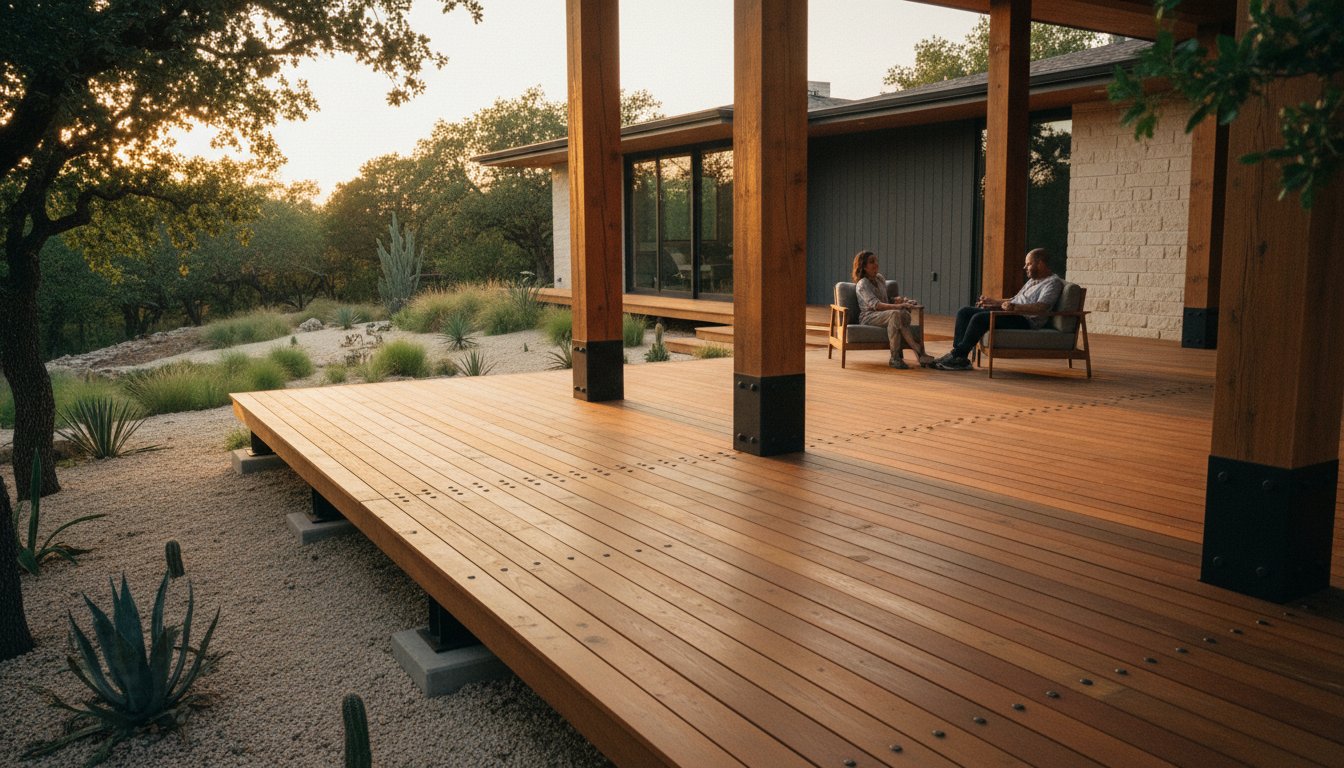
Most "pro" deck quotes in Central Texas are actually just guesses wrapped in a high-pressure sales pitch. You already know that Austin's 105-degree summers and relentless humidity will shred a mediocre build in less than three seasons. You've likely seen the sagging joists and graying boards that plague neighborhoods from West Lake to Tarrytown. It's frustrating to navigate confusing pricing models while trying to figure out the actual cost to build a deck in Austin that won't fail by 2029.
We're providing a transparent breakdown of what a high-end, professionally engineered wood deck costs when you prioritize architectural integrity over speed. You'll learn why we insist on a heavy build style using 4x12 Douglas Fir and 6x6 posts on steel bases. This guide details the tradeoffs between premium materials like Western Red Cedar and thermally modified ash, the impact of professional engineering, and the only finishing system we trust, Cutek Extreme. We'll show you how to move from a volatile quote to a predictable construction process that secures your home's ROI.
Key Takeaways
- Stop guessing about the Austin Tax and learn exactly how labor premiums and city inspections dictate the real cost to build a deck in Austin.
- See why composite decks fail the Texas heat test and why thermally modified wood offers a superior architectural ROI over plastic.
- Understand the engineering behind a "heavy" build, utilizing 4x12 Douglas Fir beams and 6x6 posts on steel bases for maximum structural integrity.
- Map out the project lifecycle from 3D visualization to material procurement to ensure your backyard investment is a guaranteed win.
Breaking down the investment: what actually drives deck prices in Austin
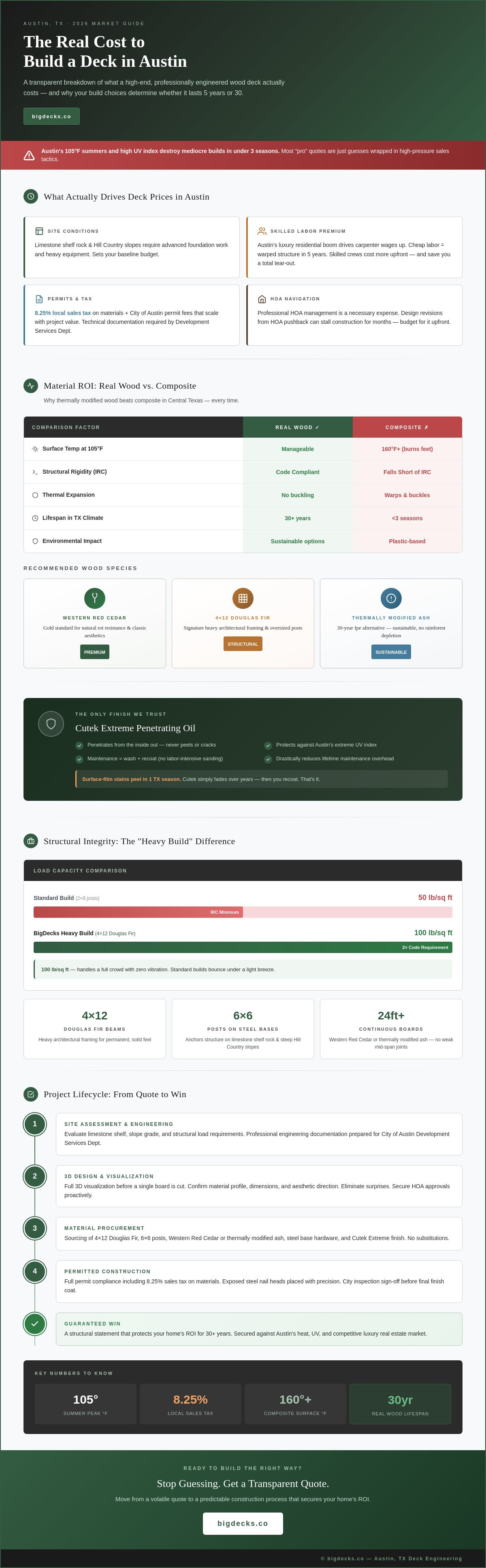
Building in Austin is a high-stakes architectural play. The cost to build a deck in Austin reflects the city's status as a global tech and luxury hub. This project is a strategic asset designed to hold its value against the brutal Texas sun and the competitive real estate market. We don't build basic platforms; we engineer structural statements that prioritize ROI and durability.
Site conditions in Central Texas dictate the baseline of your budget. Limestone shelf rock and the steep slopes common in the Hill Country require advanced foundation work and heavy equipment. We utilize oversized framing and 6x6 posts on steel bases to anchor 24ft+ continuous boards of Western Red Cedar or thermally modified ash. These materials handle the structural load of complex sites where generic builds fail.
Labor and local demand in the 2026 market
Skilled carpentry in Austin carries a premium due to the massive surge in luxury residential projects. Professional labor ensures your structure adheres to rigorous deck construction standards while managing the precision of exposed steel nail heads. Hiring a generic contractor often results in a "cheap" build that warps under the stress of 100-degree summers. The price of doing it right the first time is significantly lower than the cost of a total tear-out in five years.
Permits and HOA navigation
Navigating the City of Austin's Development Services Department requires precision and specific technical documentation. You must budget for the 8.25% local sales tax on materials and permit fees that scale with your project's total value. Professional HOA management is a necessary expense to avoid design revisions that can stall construction for months. We specify Cutek Extreme as our only finish because it's the only product that protects this level of investment against the local UV index.
Material ROI: why thermally modified wood beats composite every time
The cost to build a deck in Austin is a long-term financial play. Most builders push composite because it's easy to install and requires zero specialized knowledge. We don't. Plastic-based boards are a tactical error in the Central Texas climate. Choosing custom decks built with real, thermally modified wood ensures the structure remains a high-value architectural asset rather than a sagging liability.
The problem with plastic in Central Texas
Composite materials fail the Austin heat test every summer. On a 105-degree August afternoon, dark plastic decking reaches surface temperatures exceeding 160 degrees. It burns feet and warps under its own weight. BigDecks refuses to build with PVC or plastic-composites because they lack the structural rigidity required by the International Residential Code and local building codes. Real wood handles thermal expansion without buckling or losing its grip on the fasteners.
- Western Red Cedar: The gold standard for natural rot resistance and classic aesthetics.
- 4x12 Douglas Fir: Our signature for heavy architectural framing and oversized posts.
- Thermally Modified Ash: A 30-year high-performance alternative to Ipe that won't contribute to rainforest depletion.
The Cutek Extreme factor
Texas UV levels destroy surface-film finishes in a single season. Most stains peel and crack because they sit on top of the wood like a layer of paint. We only use Cutek Extreme. It's a synthetic penetrating oil that protects the wood from the inside out. It never peels; it simply fades over several years, making maintenance a simple wash and recoat rather than a labor-intensive sand-down. This approach preserves the cost to build a deck in Austin by drastically reducing the lifetime maintenance overhead. If you're ready to move past the plastic marketing hype, we can help you select a material profile that actually survives the Texas sun.
Structural integrity: the cost of building a 'heavy' deck
Standard builds rely on flimsy 2x8 joists that bounce under a light breeze. We don't do standard. We build heavy. This approach utilizes 4x12 Douglas Fir beams to create a foundation that feels permanent. It is a strategic move for homeowners who prioritize architectural longevity over the lowest bid. Understanding the cost to build a deck in Austin requires looking past the surface and into the skeleton of the project. Engineering for 100lb/sq ft loads is the primary driver here. This is double the residential code requirement. It ensures your deck handles a crowd without a hint of vibration.
The aesthetic of strength is visible in every detail. We use surface-fastened exposed steel nail heads as a deliberate design choice. These aren't hidden; they are celebrated. This honest use of materials creates a rhythmic, industrial look that complements modern Austin architecture. It signals that the structure is as tough as it looks. Analyzing how much does it cost to build a deck when prioritizing this level of engineering reveals a significant shift from "disposable" backyard platforms to "legacy" architectural investments.
Oversized framing and precision metalwork
Achieving seamless architectural lines requires 24ft+ continuous boards. This eliminates the staggered, messy joints found on amateur projects. These massive spans require specialized logistics and precision handling, which influences the total cost to build a deck in Austin. We often integrate custom welding and metal accents directly into the structural frame. This isn't just about looks; it is about fusing steel and timber into a single, high-performance unit that survives the Texas sun without warping or sagging.
Foundation and drainage solutions
Austin’s soil is a challenge of expansive clay and stubborn limestone. A standard pier won't cut it. We utilize 6x6 posts anchored to elevated steel bases. This prevents the wood from ever touching standing water or moist earth. It is a non-negotiable expense for anyone serious about rot prevention. To maintain this structural investment, we exclusively use Cutek Extreme. It is the only finish that penetrates deep enough to stabilize these heavy timbers against the brutal humidity cycles of Central Texas. This combination of steel-base elevation and high-performance oil ensures the wood breathes while remaining structurally sound for decades.
Ready to build something that actually lasts? Let’s talk about your structural goals before you break ground.
Navigating the project: 3D design and the road to a win
Most Austin homeowners view construction as a gamble. We treat it like a strategic rollout. The total cost to build a deck in Austin reflects the precision of the pre-construction phase. This is where we lock in the narrative arc of your backyard before a single 6x6 post hits the steel base. We focus on the big moments of the build, ensuring every structural choice serves the final architectural vision.
The 3D design rendering advantage
3D design renderings act as your insurance policy against mid-build pivots. We build your deck in virtual reality first; adjusting the layout of 24ft continuous boards or the placement of oversized 4x12 Douglas Fir beams. Design fees are transparent and tiered based on site complexity. You pay for the certainty that the final architectural finish matches the digital pitch, eliminating the waste associated with guesswork.
The build phase is where the strategy meets the steel. We manage the logistics of procuring heavy timber like Western Red Cedar or thermally modified ash. During installation, expect a high-stakes environment where exposed steel nail heads are aligned with surgical precision. Every joint is inspected to ensure it meets our heavy build standards. We finish the process with Cutek Extreme, the only coating we trust to protect your investment.
The final walkthrough isn't a formality; it's a verification of the architectural intent. We inspect the clean lines of the oversized framing and ensure the Cutek Extreme application is uniform across all surfaces. This is where the project transitions from a construction site to a finished asset, ready for its debut.
Timeline and delivery expectations
A custom build in 2026 typically requires four to eight weeks from site prep to the final walkthrough. Weather and permitting are the primary variables that dictate the rhythm. These factors also influence the labor cost to build a deck in Austin, as efficiency is tied to site conditions. We skip the fluff in our communication. You get direct updates on milestones and material arrivals. We keep the momentum high and the site clean until the win is secured.
Own the Austin skyline with a structural win
Austin's climate is brutal on standard residential builds. Choosing thermally modified wood over composite ensures your deck survives the Texas sun while maintaining a clean, architectural profile. A heavy build relies on 24ft+ continuous boards and 6x6 posts on steel bases to prevent the sagging common in standard projects. Precision metalwork and oversized framing standards aren't optional for a structure designed to last decades. Big Decks prioritizes Cutek Extreme penetrating oils because they protect the wood fiber without the peeling associated with film-forming stains.
Understanding the actual cost to build a deck in Austin requires looking past the initial quote and evaluating the structural integrity of the 3D design. We focus on 4x12 Douglas Fir and oversized framing to ensure your investment holds its value and its shape. This is about building a legacy structure that uses honest materials and calm, purposeful composition. Let's talk about your design and materials before you commit.
Your project deserves a level of technical precision that matches its scale.
Frequently asked questions
Is it cheaper to build a deck in Austin during the winter months?
Building in winter doesn't lower the cost to build a deck in Austin because our temperate climate allows for year-round construction. Labor rates remain steady through December and January while material costs are driven by global market volatility rather than local temperature. You might find shorter lead times during the off-season; however, the price for high-grade 4x12 Douglas Fir or Western Red Cedar won't drop just because it's cold.
How much does a permit to build a deck cost in the City of Austin?
Residential building permit fees in Austin depend on the total valuation of your project. For a standard deck, expect to pay between $450 and $1,200 in city fees according to the 2024 City of Austin Fee Schedule. This includes the initial application, plan review, and required inspections. Larger projects with complex structural engineering or those located in protected environmental zones often incur additional costs.
Why is thermally modified wood more expensive than pressure-treated pine?
Thermally modified ash costs more because it undergoes a specialized kiln process that uses heat and steam to cook out the wood's natural sugars. This makes the boards resistant to rot and insects without using toxic chemicals. While pressure-treated pine relies on chemical saturation, thermal modification creates a dimensionally stable product that won't warp or shrink. You're paying for a 25-year lifespan and a material that stays straight on 24ft+ continuous runs.
Does a new custom deck actually increase my Austin home's resale value?
A well-executed deck provides a high return on investment, often recouping 65% to 75% of the initial cost to build a deck in Austin according to the 2023 Remodeling Magazine Cost vs. Value Report. In the Austin market, buyers prioritize functional exterior spaces that handle the Texas sun. A deck built with 6x6 posts on steel bases and heavy 4x12 framing signals structural integrity to inspectors and potential buyers. It shifts your home from a standard listing to a premium architectural asset.
What is the maintenance cost for a real wood deck using Cutek Extreme?
Maintenance costs with Cutek Extreme are lower over time because the oil penetrates the wood rather than forming a film on top. You'll spend roughly $1.50 to $2.50 per square foot for a professional cleaning and recoat every two to three years. Because it doesn't peel or flake, you avoid the $10 per square foot cost of professional sanding and stripping required by inferior products. It's a predictable expense that protects your investment and keeps the wood grain visible.
Get a Deck Quote in Austin: The High-End Homeowner’s Guide to 2026
Ready to get a deck quote Austin homeowners trust? This guide helps you avoid cheap bids, choose the right materials, and secure a high-end, investment-grade...
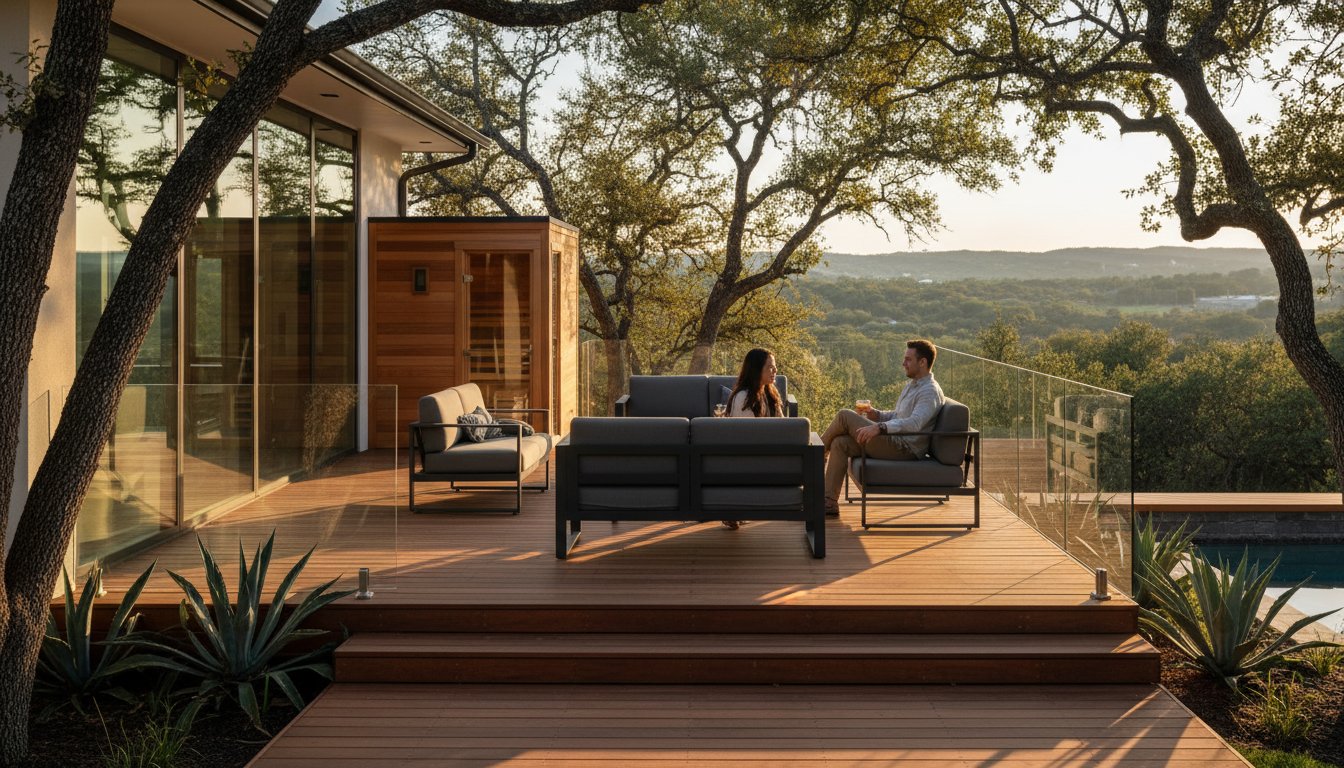
The lowest bid on your backyard is usually the most expensive mistake you'll ever make. You've likely dealt with contractors who ghost after the first visit or send over a vague, one-page estimate that hides more than it reveals. When you look to get a deck quote Austin homeowners often find themselves stuck between cheap, fast options and expensive, confusing proposals that don't account for the 90 percent humidity levels that warp inferior wood within two seasons.
We agree that your home deserves better than a "best guess" budget and materials that fail before the paint dries. You deserve a design-first approach that uses clear 3D visualization to lock in your ROI and architectural vision before construction begins. This guide shows you exactly how to evaluate a professional quote to ensure your outdoor space remains a high-performance, investment-grade asset. You'll learn to spot hidden costs, select durable materials for the Central Texas climate, and choose a partner who treats your project like the high-stakes asset it is.
Key Takeaways
- Stop chasing low-bid contractors and learn why a "cheap" quote is a massive liability for your property value and long-term safety.
- See how a 3D design-first approach uses digital twins to kill the expectation gap and ensure your vision matches the final build perfectly.
- Get the facts on material science to understand why plastic decks fail in the Texas heat while real wood maintains its performance and touch.
- Learn to evaluate the specific line items when you get a deck quote Austin builders provide, moving past the "cost per square foot" myth to identify real value.
- Explore how to bake high-end amenities like saunas and cold plunges directly into your project proposal for a seamless, high-stakes backyard transformation.
Navigating the Austin deck builder market in 2026
Austin's construction scene is currently saturated with low-bid contractors who prioritize speed over structural integrity. To get a deck quote Austin homeowners can actually rely on, you have to look beyond the initial price tag. In 2026, the distinction between a basic carpentry project and a high-end architectural build has never been more critical for property value.
A quote in the current market must reflect the reality of Central Texas. The combination of shifting clay soils and extreme heat cycles requires more than just standard wood-planking knowledge. You need a partner who views your outdoor space as a strategic asset, not just a weekend project. This section breaks down how to filter through the noise to find a builder who understands the high stakes of luxury construction.
Why the lowest bid is a strategic mistake
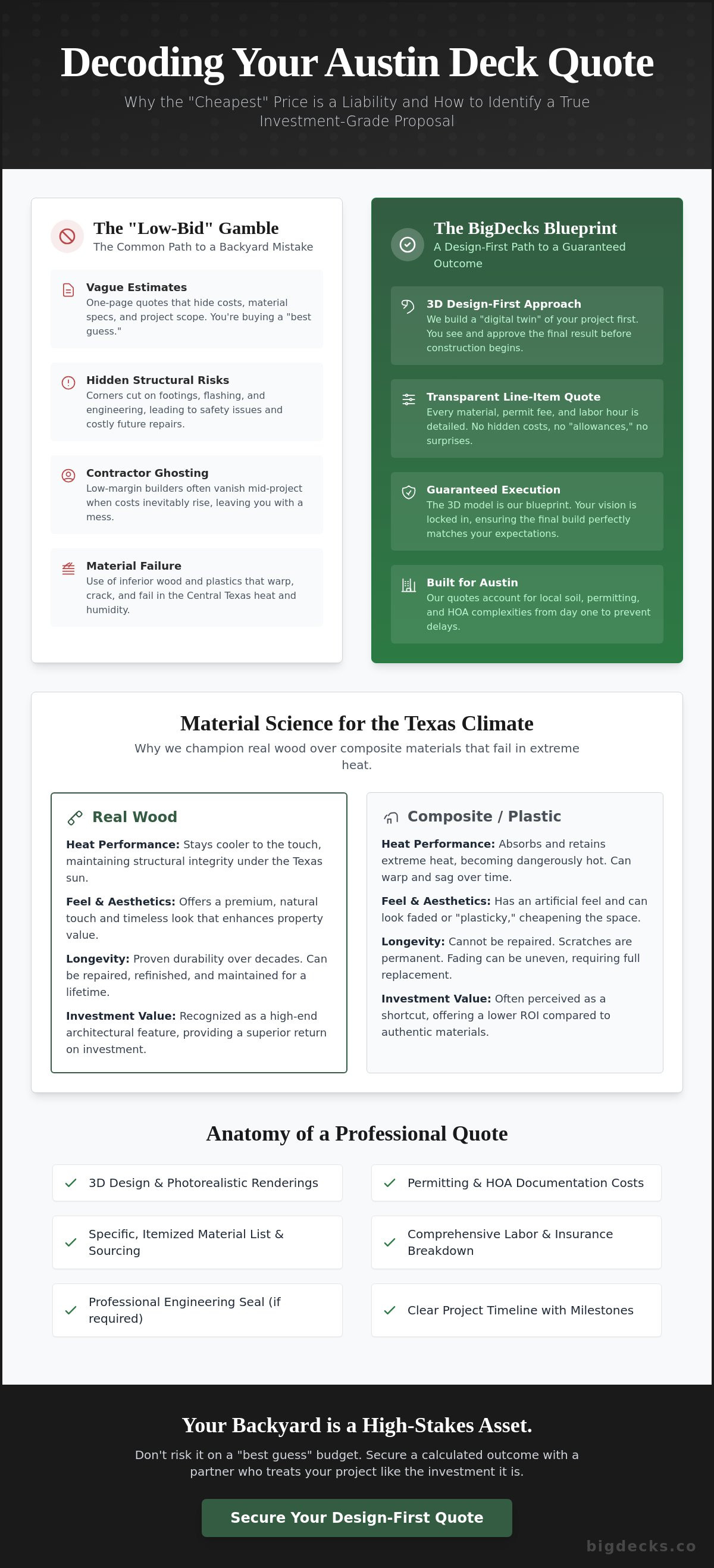
Choosing the cheapest quote is often the most expensive decision a homeowner can make. Low bids usually indicate a lack of comprehensive insurance or a failure to account for essential deck construction basics like proper ledger flashing and load-bearing footings. When a builder cuts 20 percent off the market rate, they are likely cutting corners on the structural engineering that keeps your family safe.
Maintenance costs on poorly constructed decks can exceed the original build price within the first five years. Beyond the physical structure, Austin has seen a rise in "contractor ghosting" among low-margin outfits. These builders often vanish mid-project when they realize their thin margins cannot cover the rising cost of premium materials or skilled labor. A professional quote provides transparency, ensuring the builder has the liquidity and overhead to finish the job to your exact specifications.
Local factors: Austin permitting and HOA realities
Navigating the City of Austin’s permitting process in 2026 requires a specialized set of skills. Recent updates to local building codes have tightened regulations around impervious cover and drainage, especially for properties near the Edwards Aquifer. If your builder doesn't mention these constraints during the quoting phase, they aren't prepared for the reality of Central Texas construction.
High-end neighborhoods like West Lake Hills and Tarrytown have strict HOA guidelines that dictate everything from material color to lighting placement. Building on a sloped Hill Country lot adds another layer of complexity. Structural engineering is a non-negotiable requirement for these sites to prevent the deck from shifting as the soil expands and contracts. Ensure your quote includes the cost of professional engineering seals and permit expediting to avoid costly delays or legal fines.
Final thoughts on the Austin market
The 2026 Austin labor market is tight, with skilled tradespeople commanding higher rates for their expertise in modern materials. A high-quality quote is a roadmap for a successful investment. It should clearly outline the design intent, material performance, and the logistical plan to navigate local regulations without compromise.
The 3D design-first approach to your backyard transformation
A professional bid is more than a price tag; it is a strategic blueprint. When you look to get a deck quote Austin homeowners often expect a simple estimate, but high-end builds require a digital twin of your property first. This digital model serves as a single source of truth for the entire project. It eliminates the "expectation gap" where the builder’s vision and your reality don't align. By building the project virtually, we identify structural conflicts before they become expensive change orders.
This design-first strategy allows for precise material quantification and lighting placement. You aren't just buying a deck; you are buying a calculated outcome. The 3D model ensures that every riser, joist, and custom metal bracket is accounted for in the final price. It turns a stressful construction process into a predictable, high-stakes win for your property value.
Visualization vs. guesswork: Seeing your deck before the first cut
The process utilizes 3D design renderings in Austin to bridge the distance between architectural concept and reality. You can see exactly how the afternoon sun hits the lounge area at 5:00 PM or how the integrated LED lighting interacts with your existing pool scape. This visual clarity provides a psychological certainty that is missing from 2D sketches. You know exactly what you are paying for before a single board is delivered.
Renderings are also a powerful tool for navigating local bureaucracy. HOA boards in neighborhoods like Tarrytown or Barton Creek are notoriously strict about aesthetics. Presenting a photorealistic 3D model often results in faster approvals because the board can see the finished product rather than deciphering technical drawings. It removes the friction from the permitting phase and keeps your project on schedule. If you want to see how your vision looks in high definition, you can explore our design gallery for inspiration.
Engineering for the Hill Country
Austin’s terrain is brutal on traditional construction. Designing for solid limestone shelves and 15 percent elevation changes requires more than just a hammer and nails. We use 3D modeling to solve complex drainage and foundation issues early in the design phase. This technology allows us to integrate custom metalwork into the structural frame, ensuring maximum stability on steep slopes. It is about engineering for the next thirty years, not just the next three.
Your quote must include comprehensive site preparation. In Central Texas, flash floods and shifting soil are constant threats to structural integrity. When selecting high-end hardwoods for these environments, understanding the science of properly finishing wood decks is critical for longevity in the Texas sun. A high-end quote ensures the engineering matches the aesthetics. When you get a deck quote Austin builders should provide a plan that accounts for:
- Sub-surface drainage systems to prevent water pooling under the structure.
- Helical piers or concrete footings anchored directly into limestone.
- Steel reinforced framing for spans that exceed standard timber capabilities.
- Custom flashing details to protect the ledger board from moisture intrusion.
Material science: Why we bet on wood over plastic
Plastic decking is a marketing victory that often fails the reality of a Texas summer. The promise of maintenance-free living usually masks a significant drawback: heat retention. In an Austin July, dark composite boards can reach surface temperatures exceeding 150 degrees Fahrenheit. This makes the surface untouchable for bare feet and pets during peak daylight hours. When you get a deck quote Austin builders should be transparent about the fact that "maintenance-free" is a myth. Synthetic boards still require cleaning, and unlike real wood, they cannot be sanded or refinished if they fade or scratch.
Premium wood species offer a structural and aesthetic superiority that plastic cannot replicate. Real timber provides a natural thermal regulation that keeps your outdoor living space usable even when the sun is at its peak. For the high-end homeowner, the decision isn't just about look; it's about the long-term performance and the tactile experience of the material. We prioritize materials that age with grace and maintain their integrity under the intense UV pressure of Central Texas.
Thermally modified wood: The heat-proof answer for Central Texas
Thermally modified wood is the strategic play for 2026. This material undergoes a specialized high-heat kiln process that removes moisture and organic sugars, effectively "cooking" the wood until its cellular structure changes. This process results in a Class 1 durability rating and a 30-year lifespan that rivals tropical hardwoods. It's the goldilocks solution for our climate because it's incredibly stable; it won't warp or swell despite Austin’s wild swings between high humidity and drought. While it costs more than standard cedar upfront, the reduced maintenance and extended lifespan make the lifecycle cost significantly lower over a decade.
Ipe and Cedar: The gold standard for Austin luxury
Ipe remains the ultimate "ironwood" for high-stakes backyard builds. It's so dense that it sinks in water and carries a Class A fire rating, placing it in the same category as steel and concrete for flame spread. The ROI on Ipe is found in its 50-year potential lifespan. It's a legacy material that outlasts the mortgage. For architectural accents and fencing, Western Red Cedar is still the preferred choice for its iconic scent and natural rot resistance. To keep these woods looking sharp, we utilize Cutek Extreme oils. These aren't typical hardware store stains; they are penetrating oils that protect the wood from the inside out, ensuring your investment looks as good in year five as it did on day one. When you're ready to get a deck quote Austin, focus on these high-performance materials to ensure your deck is a permanent asset rather than a temporary fixture.
What should be in a professional deck quote?
When you prepare to get a deck quote Austin builders will often lead with a single, shiny number. That is usually a trap. Custom outdoor construction is not a commodity; it is a high-stakes investment in your property's ROI and your lifestyle. A professional quote should look like a strategic roadmap, detailing exactly how your capital is being deployed to win the backyard.
The "cost per square foot" metric is a myth that needs to die in 2026. It ignores the reality of Austin's rocky terrain and the complex engineering required for hillside builds. Transparency is the ultimate sign of a professional. If a contractor cannot explain where every dollar goes, they likely do not know their own margins; this puts your project at risk. A comprehensive proposal is a commitment, while a "bid" is just a guess.
Decoding line items: More than just lumber
Your quote must separate materials from labor to provide a clear picture of the build quality. Understanding how much it cost to build a deck requires looking at the specialized skills involved. In Austin, high-end builds often feature precision welding and custom metal fabrication that traditional carpenters cannot handle. These specialized trades carry a premium because they ensure the structure lasts decades rather than years.
Professional project management should also be a visible line item. This covers the logistics of permitting, site inspections, and material sourcing. You are paying for a seamless execution, not just a pile of composite boards. A builder who includes management fees is signaling that they have a system in place to avoid delays and keep the site organized throughout the 8 to 12 week construction window.
The hidden costs of "cheap" construction
Low-ball quotes often hide dangerous omissions. Skipping soil testing or proper footing depth in Central Texas is a recipe for structural failure as the ground shifts. Cheap labor might save 15 percent upfront, but the cost of fixing a botched miter joint or a wavy railing system will double your long-term spend. Precision carpentry requires masters of the craft, not general laborers who "also do decks."
A detailed quote protects you from the nightmare of constant change orders. When every screw, bracket, and permit fee is accounted for from day one, the price stays predictable. When you get a deck quote Austin experts provide, expect to see line items for every structural component. This level of detail ensures the design you fell in love with is the one that actually gets built. It turns a stressful construction process into a calculated win for your home.
Securing your BigDecks quote: The path to a killer outdoor space
You don't want a contractor; you want a strategic partner. To get a deck quote Austin homeowners use to justify a significant property valuation, you need more than a sketch on a napkin. You need a project proposal that reads like a winning pitch deck. We provide a comprehensive breakdown that covers structural engineering, material performance, and the ROI of your design choices.
Our process: From initial pitch to final polish
The discovery phase is where we align your vision with our architectural expertise. We dive into the site’s narrative arc, analyzing grade changes and sun exposure. We don't guess; we calculate. During the design phase, we refine a high-fidelity 3D model until it's perfect. You'll see exactly how the steel framing interacts with the decking before we break ground. The build phase is where the vision materializes. Our teams merge traditional carpentry with modern metalwork, ensuring the execution matches the high-stakes nature of the design.
Integrating luxury: Saunas, cold plunges, and architectural fencing
High-performance recovery is the new benchmark for Austin luxury. Integrating outdoor saunas in Austin into your build isn't just a trend; it's a strategic wellness upgrade. We treat these features as integral components of the quote, ensuring the structural load and electrical requirements are baked into the initial plan. Similarly, many are now incorporating modular solutions like a Workpod to create a dedicated outdoor workspace within their backyard layout. Architectural fencing serves as the frame for this sanctuary, providing privacy without sacrificing the modern aesthetic. Building custom decks in Austin requires this level of specialized design-build expertise to ensure your backyard wins the room every time someone steps outside.
For homeowners whose vision extends beyond the backyard to broader structural improvements, you can explore Home Additions with Elite Contractor Services to see how high-end design-build principles apply to comprehensive property renovations.
Frequently asked questions
- How long does it take to get a deck quote Austin homeowners can actually use? We typically deliver a detailed, design-focused proposal within 7 to 10 business days after the initial site visit.
- Do you handle the permitting process for complex builds? Yes. We manage the entire bureaucratic arc, including HOA approvals and city permits, so you don't have to.
- Can luxury amenities be added to an existing quote later? It's better to plan for them early. Adding a sauna or cold plunge requires specific structural and utility planning that is most cost-effective during the initial design phase.
- What is the typical lead time for premium materials in 2026? Lead times for specialized steel and high-end hardwoods currently range from 4 to 8 weeks, which we factor into your project timeline.
Your backyard is an asset that deserves a professional narrative. When you're ready to get a deck quote Austin builders can back up with engineering data and high-end design, reach out to BigDecks. Let's build something that makes a statement.
Build Your 2026 Austin Sanctuary
Austin's 2026 housing market demands more than a basic platform; you need a structural asset that performs. We've moved past the era of plastic composites that sag and fade under the relentless Texas sun. Our focus remains on Ipe and thermally modified wood, materials proven to last 25 to 50 years with minimal structural degradation. Every project we lead starts with a full 3D visualization phase. This isn't a rough sketch. It's a digital twin that ensures the precision metalwork and timber layout hit the mark before a single board is cut. This design-first approach eliminates the expensive mid-build pivots that plague traditional construction.
When you're ready to get a deck quote Austin property owners can actually trust, look for transparency in the line items. A professional quote must include specific material grades and structural engineering details rather than vague estimates. We specialize in these high-stakes builds because we understand the ROI of a well-executed outdoor space. Your backyard is the next high-level investment in your lifestyle. Let's make it count.
Get a killer deck quote from BigDecks today
Common Questions About Austin Deck Quotes
How much does a custom deck quote in Austin typically cost?
Most professional builders provide initial estimates at no cost to the homeowner. If your project requires complex architectural renderings or structural engineering stamps, you might pay a design deposit between $500 and $2,500. This fee usually applies toward your total project cost once construction begins.
How long does it take to get a professional deck quote from BigDecks?
You'll receive a preliminary price range within 48 hours of your initial consultation. A finalized, line-itemed quote takes about 5 to 7 business days. This timeline allows our team to verify current material pricing and labor availability for your specific site conditions.
Do I need a permit for a deck in Austin, and is that included in the quote?
Austin requires a permit for any deck higher than 30 inches or any structure attached to your home. We include permit management and all associated city fees in every quote to ensure your project stays compliant. Handling the bureaucracy is part of our service, so you don't have to navigate the 2026 building codes alone.
Why is wood better than composite for Austin’s climate?
Natural hardwoods like Ipe or Western Red Cedar handle the 105 degree Central Texas summers better than synthetic materials. Composite boards can reach surface temperatures 30 percent higher than natural wood, making them uncomfortable for bare feet. High-end wood decks also offer a structural rigidity that resists the warping often seen in cheaper plastic alternatives.
Can you include saunas or hot tubs in the initial deck design and quote?
We integrate heavy features like saunas or hot tubs into the structural plan from day one. When you get a deck quote Austin homeowners expect a complete outdoor living solution, which means calculating the specific load-bearing requirements for a 5,000 pound spa. This ensures your foundation is built to support the weight without shifting or sagging over time.
What is the average lead time for deck construction in Austin for 2026?
Current projections for 2026 suggest a lead time of 12 to 16 weeks from contract signing to breaking ground. Permitting in the City of Austin typically takes 4 to 8 weeks of that window. Booking your project in the fourth quarter of 2025 is the most effective way to secure a spot for a spring 2026 build.
Rooftop Deck Contractors in Austin: Engineering Luxury Above the Skyline
Find expert rooftop deck contractors Austin homeowners trust. Learn to avoid costly leaks & permit issues while building a safe, stunning deck that boosts yo...
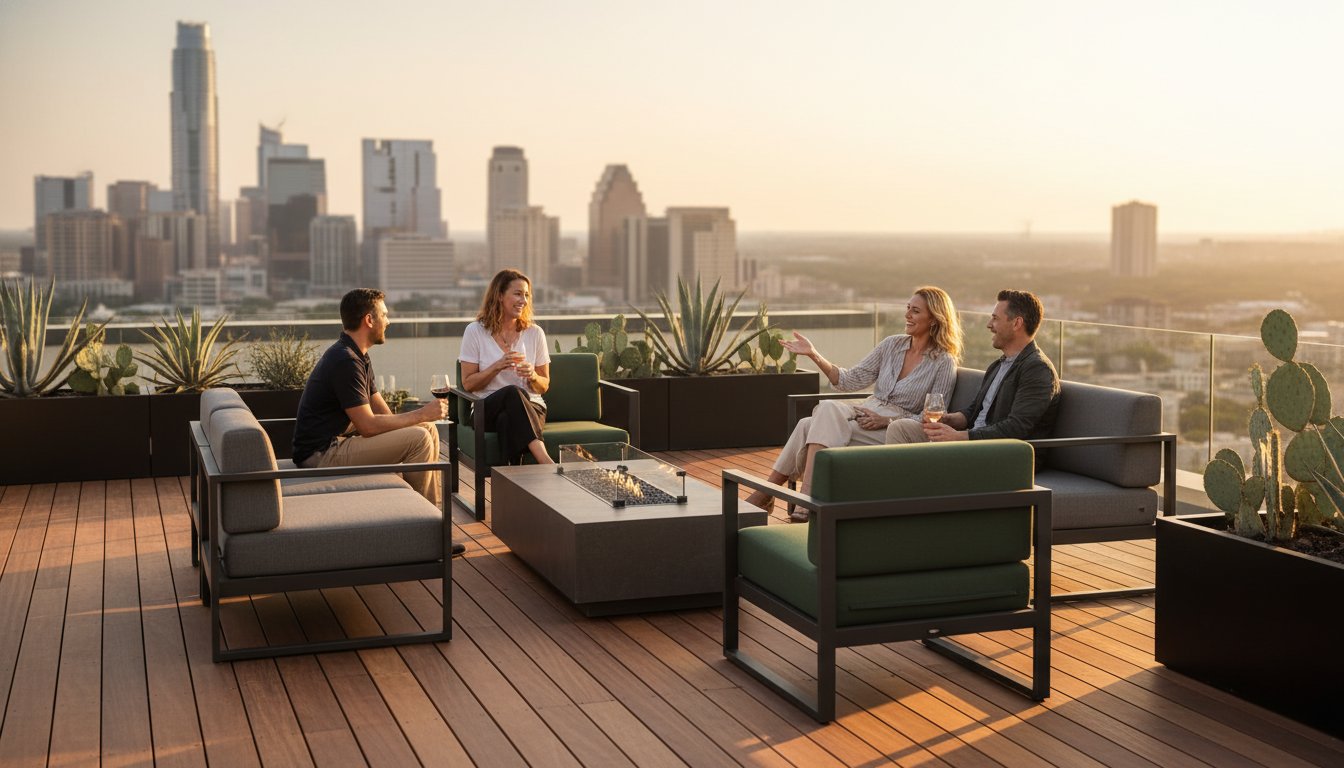
Most rooftop decks in Central Texas are ticking time bombs of structural rot and permit violations that can wipe 15% off your home's resale value. You want the skyline view and the private retreat, but the thought of a structural failure or a persistent leak in your master bedroom is enough to stall any project. It's a valid concern. Austin's strict Wildland-Urban Interface codes and complex drainage requirements turn a simple build into a high-stakes engineering puzzle.
You deserve a space that's as safe as it is stunning. This guide shows you how to find rooftop deck contractors Austin homeowners rely on to navigate the city's rigid permitting process while selecting materials that won't melt under the 105-degree August sun. We'll explore the specific engineering hurdles for urban builds and why premium wood finishes often provide a better long-term ROI than standard plastic composites. You'll learn exactly what it takes to build a deck that increases your equity without compromising your roof's integrity. It's time to win the skyline.
Key Takeaways
- Discover why vertical outdoor space is the highest ROI play for Austin properties and how it directly impacts 2026 market valuations.
- Learn the non-negotiables of structural engineering, including why a professional seal is mandatory for managing weight loads on existing roof joists.
- Identify the specific materials that survive the Texas sun, focusing on why thermally modified wood outperforms heat-trapping synthetics.
- Find out how professional rooftop deck contractors Austin use 3D modeling to catch structural conflicts in the virtual phase before they become expensive field errors.
- Navigate the financial reality of high-end rooftop builds with a transparent look at pricing and the logistics of urban construction.
Maximizing Austin Real Estate: Why Rooftop Decks are the Ultimate ROI Play
Austin real estate is a high-stakes game of inches. You can't manufacture more land in the 78704 or 78702 zip codes, so you have to build up. A rooftop deck is a strategic vertical expansion that reclaims the footprint of your home, turning dead roof space into high-value square footage. In a market where lot sizes are tightening, this is the most aggressive move you can make to increase your property's usable area.
The "Skyline Premium" is a real financial metric driving valuations toward 2026. Buyers in the luxury segment prioritize private views and exclusive outdoor access over traditional, maintenance-heavy lawns. Expert rooftop deck contractors Austin homeowners trust understand that vertical space isn't just a place to sit. It is a lifestyle hub for recovery setups like saunas and cold plunges, or high-end hosting environments that traditional backyards can no longer accommodate due to urban infill density.
The Shift Toward Vertical Living in Central Texas
Homeowners in East Austin and South Lamar are leading the move away from the traditional backyard. As urban infill projects maximize building footprints, ground-level outdoor space often shrinks to a small strip of grass. By moving the "yard" to the roof, you gain a private oasis that is physically separated from street noise and neighbor sightlines. This trend reflects a broader move across Travis County toward modern, architectural efficiency. A well-designed Rooftop garden or lounge area provides the seclusion that ground-level patios simply cannot offer in high-density zones.
Calculating the Value-Add for Your Austin Property
The ROI for custom decks remains high because they directly address the psychological needs of the luxury buyer. A view of the Frost Bank Tower or the University of Texas clock tower isn't just a perk; it is a permanent asset that keeps your home competitive. Architectural consistency is the pivot point for resale value. If the deck feels like a seamless extension of the main structure rather than an afterthought, it justifies a higher price per square foot. For homeowners aiming for a cohesive look, professional interior design services toronto can provide the creative direction needed to harmonize indoor spaces with outdoor retreats. Experienced rooftop deck contractors Austin focus on these structural details to ensure the project looks like a primary feature of the home's original design.
Vertical outdoor space is about more than just aesthetics. It represents a functional win in a city that is rapidly densifying. When you build up, you aren't just adding a deck. You are securing a vantage point in one of the most competitive real estate markets in the country.
Structural Engineering and Austin Building Codes: The Reality Check
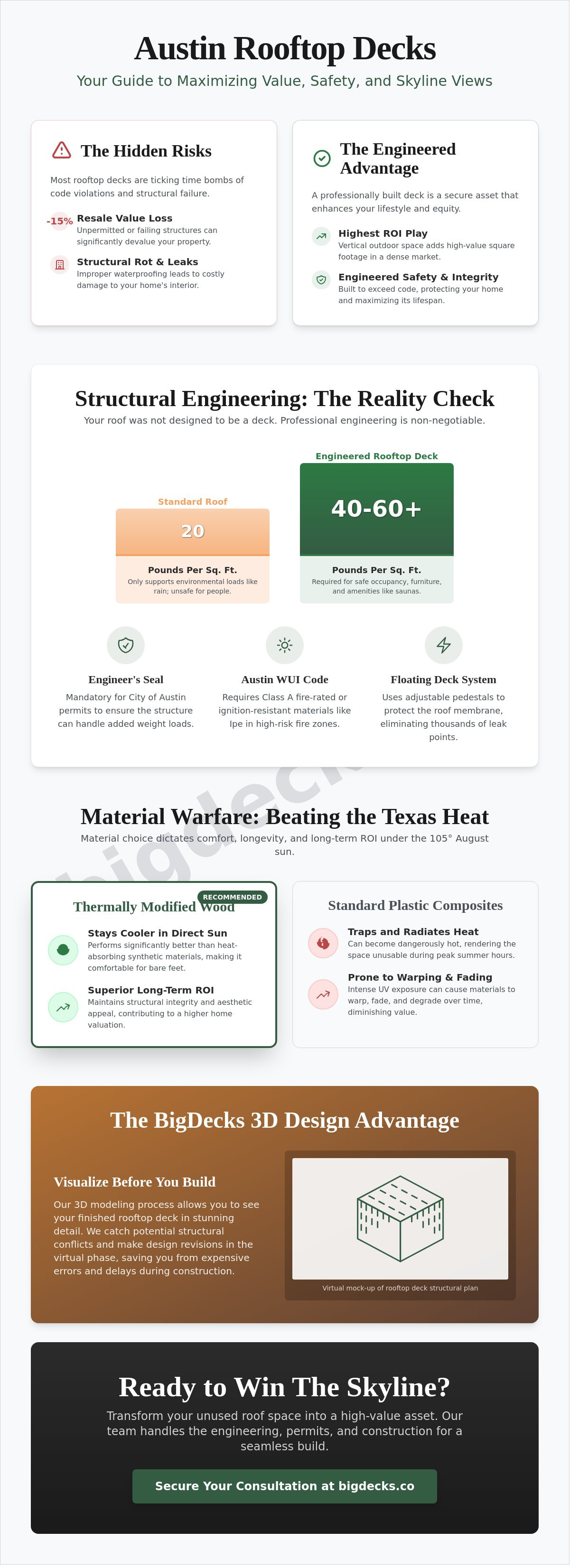
Building a deck on your roof isn't like building one in your backyard. The primary concern for most homeowners is whether the existing joists can handle the weight without sagging or snapping. Standard residential roofs in Central Texas are typically engineered to support a live load of 20 pounds per square foot. Most rooftop deck contractors Austin work with require a minimum of 40 to 60 pounds per square foot for safe occupancy. You cannot skip the structural engineer's seal; the City of Austin won't issue a permit without it.
Fire safety is another non-negotiable factor in local construction. The Austin Wildland Urban Interface (WUI) code, adopted in 2020, mandates specific ignition-resistant materials for decks in high-risk zones. This often limits your material choices to heavy hardwoods like Ipe or specific Class A fire-rated composites. These materials are durable, but they add significant weight that your framing must be able to support.
To protect your home from leaks, modern builders use a floating deck system. This method utilizes adjustable pedestals that sit directly on top of the roof's waterproof membrane. Because the system isn't bolted through the roof, it eliminates thousands of potential leak points. This setup also allows water to flow freely to your existing drainage system, preventing rot and mold growth under the deck boards.
Navigating the Austin Permitting Maze
The City of Austin Development Services Department scrutinizes rooftop plans more than almost any other residential project. They specifically look for lateral bracing and point-load distributions to ensure the deck won't shift during high winds. Projects built over detached garages are a common pitfall; these structures often lack the foundation depth required for the added weight of a second level. Attempting unpermitted work is a massive financial risk. If the city discovers an illegal rooftop structure, they can force a complete teardown, and your homeowner's insurance will likely deny any claims related to roof damage or structural failure.
Weight Loads and Dead Loads: The Math of Safety
Understanding the difference between live and dead loads is the foundation of a safe build. Live loads include anything that moves, such as people, furniture, and even heavy planters. Dead loads are the permanent, immobile weight of the deck structure itself, including the framing, decking boards, and railings. When you add a hot tub or a sauna, you're introducing thousands of pounds of concentrated weight. These features require specialized steel reinforcement or additional columns that tie directly into the home's foundation. When you're ready to see what's possible, a consultation with Austin deck specialists can clarify your home's specific capacity.
Material Warfare: Why Thermally Modified Wood Beats the Texas Heat
Rooftop decks in Austin endure 30% more UV radiation than backyard structures. Ground-level decks often benefit from tree canopies or fence shadows, but a rooftop is a thermal warzone with zero cover. This relentless exposure creates a microclimate that can destroy inferior materials in a single season. Professional rooftop deck contractors Austin know that selecting a board based on looks alone is a recipe for a structural failure within five years.
The Problem with Composite on Austin Roofs
Plastic composite boards are frequently marketed as the ultimate low-maintenance solution. In the Austin sun, they become a liability. These petroleum-based synthetics retain heat at an alarming rate, often reaching surface temperatures 40 degrees higher than natural wood. This is the "Barefoot Test" reality: on a 100-degree July afternoon, a composite deck can literally blister skin.
Beyond the heat, synthetics suffer from significant thermal expansion. As the temperature swings from a 30-degree winter night to a 105-degree summer day, these boards grow and shrink. This movement puts immense pressure on fasteners, leading to warped boards and "mushroomed" screw holes. From an environmental perspective, these materials are difficult to recycle and eventually end up in landfills, unlike renewable timber options.
While many local synthetics fail, the industry is seeing a shift toward higher standards. Just as European thermally modified woods are becoming the gold standard, high-performance WPC composite decking Sweden shows how advanced engineering can address the heat and stability issues found in traditional composite products.
Thermally Modified Wood: The 30-Year Rooftop Answer
Thermally modified wood, specifically products like Thermory, represents the elite standard for high-exposure environments. The process involves "cooking" the timber in a specialized kiln at temperatures exceeding 400 degrees Fahrenheit. This intense heat alters the wood's chemical structure, removing moisture and natural sugars. The result is a board that is naturally rot-resistant and incredibly stable.
Experienced thermally modified wood enthusiasts choose this material because it doesn't react to humidity or heat like raw lumber. It provides the same durability as exotic hardwoods like Ipe but with a lighter weight profile that reduces the load on your roof's structural beams. Maintenance is straightforward and depends on your aesthetic goals:
- Apply UV-protectant oil: Do this annually if you want to maintain the deep, chocolate-brown tones of the wood.
- Let it silver: If you prefer a weathered look, leave it alone. The wood will age into a sophisticated silver patina without losing its structural integrity.
- Periodic cleaning: A simple wash every six months keeps the surface clear of Austin dust and debris.
While Cedar remains a classic choice for its natural oils and Ipe offers unmatched density, thermal modification provides a 30-year lifespan that specifically addresses the expansion issues found in the Texas climate. It is a strategic investment for homeowners who want a luxury finish that won't buckle under the sun.
The 3D Design Advantage: Visualizing Your Skyline Transformation
Flat 2D blueprints fail to capture the complexity of a rooftop environment. These projects aren't just about laying boards; they're about navigating existing HVAC units, drainage slopes, and structural load points. Professional rooftop deck contractors Austin use advanced modeling to ensure every inch of the build is accounted for before materials arrive on-site.
High-fidelity 3d design renderings serve as a digital dress rehearsal for your construction project. This technology identifies potential structural conflicts, such as a support beam intersecting with a vent pipe, during the design phase rather than the build phase. Catching these issues early prevents costly change orders and keeps the timeline on track.
There's a significant psychological win in seeing your deck before a single board is cut. You can virtually walk through the layout to test the flow between the outdoor kitchen and the lounge area. It removes the guesswork and gives you the confidence that the final product will match the vision in your head.
Precision Metalwork and Custom Accents
Steel is the backbone of the modern Austin aesthetic. We integrate custom metalwork into rooftop designs to solve height and safety requirements without obstructing the view of the skyline. Precision welding allows for slimmer railing profiles that meet local building codes while maintaining an open, airy feel.
Combining traditional carpentry with structural steel creates a deck that's both warm and industrial. This synergy is vital for rooftops where weight distribution and wind resistance are primary engineering concerns. The 3D model allows us to place every custom bracket and lighting fixture with millimeter precision.
Planning for Austin's Micro-Climates
Austin weather is unforgiving, especially on an exposed roof. We use 3D tools to map sun exposure across different seasons, ensuring shade structures provide actual relief during a July afternoon. Designing for wind resistance is equally critical for properties near Lady Bird Lake, where gusts can reach 20 miles per hour even on calm days.
The layout also accounts for the survival of your greenery. We integrate native West Texas plantings like Red Yucca or Silver Ponyfoot directly into the 3D plan. This ensures the weight of planters is supported by the building's load-bearing walls and that irrigation lines are hidden from view.
Frequently Asked Questions
Do I need 3D designs for a simple rooftop deck?
Yes. Rooftop projects involve complex structural variables like drainage and weight distribution that 2D drawings often miss. The 3D process identifies these technical hurdles before they become expensive problems.
How accurate are the sun mapping tools?
The software uses specific geographic coordinates and historical weather data to simulate shadows. This allows us to place pergolas and umbrellas exactly where they'll block the most heat during peak sun hours.
Can I change materials after seeing the 3D rendering?
That's the primary benefit of the process. You can swap composite for hardwood or change the railing color in the software to see how it affects the overall look and your budget before any orders are placed.
Executing the Build: Why BigDecks Dominates the Austin Rooftop Scene
BigDecks acts as the strategic partner for homeowners ready for high-stakes rooftop execution. We don't deal in vague promises or soft timelines. We build assets. If you're analyzing how much it cost to build a deck, we provide a no-BS breakdown that respects your capital. Our team handles the engineering weight so you can focus on the view. Our white-glove process starts with rigorous site protection and ends only after the final coat of oil has cured.
The BigDecks Quality Standard
We refuse to use inferior plastic materials. Texas heat acts as a brutal filter for quality; most composites simply fail under the Austin sun. They warp, sag, and retain heat until they're untouchable. As the rooftop deck contractors Austin homeowners trust for longevity, we only install high-performance woods like Ipe and Thermory. These materials offer the density required for structural integrity and the natural beauty that synthetic products cannot mimic.
Every project receives a treatment of Cutek Extreme. This is not a surface film that peels; it is a penetrating oil that protects the wood from the inside out. We also master the logistical nightmare of urban construction. Whether it's coordinating a crane lift on a busy downtown street or managing 1,000 square feet of hardwood delivery through a tight alley, our team handles the friction. We keep the site clean and the progress visible.
Start Your Transformation Today
Research is the first step, but execution is what creates value. A rooftop deck is an investment in your home's narrative arc. It is the definitive statement of your property's potential. We invite you to move from the design phase into active construction. Our collaborative approach ensures your vision is engineered to last decades, not just seasons. Let's build something that wins the room.
Frequently Asked Questions
- How long does a typical rooftop project take? Most Austin rooftop builds require 6 to 10 weeks for construction. This timeline depends heavily on the complexity of the steel substructure and current permitting speeds.
- Do I need a structural engineer for a rooftop deck? Yes. We never build on a roof without a stamped engineering report. We must ensure the existing structure can support the "live load" of furniture and guests.
- Why choose Ipe over composite for a roof? Ipe stays significantly cooler than plastic composites in 100-degree weather. It also has a Class A fire rating, which is often a requirement for Austin building codes.
- Does BigDecks handle the permitting process? We manage the entire process with the City of Austin. We handle the paperwork and inspections so you don't have to deal with the bureaucracy.
Own the Austin Skyline
Building above the city requires more than a vision; it demands a grasp of structural reality. Austin's WUI codes and strict 2021 IBC standards mean your project must be engineered for fire resistance and significant weight loads from the start. Choosing materials like Ipe or thermally modified wood ensures your investment survives the 100 degree Texas summer without warping. It's the difference between a temporary fixture and a permanent financial asset.
Success in this environment comes down to technical execution. You need a partner who manages the entire stack, from in-house custom metalwork and welding to complex structural navigation. As the leading rooftop deck contractors Austin property owners trust, we focus on the engineering details that protect your ROI. We don't just build decks; we secure your place above the skyline with precision and code-compliant design.
Ready to win your skyline? Get a professional 3D design for your Austin rooftop deck today.
Your new perspective on the city is just a design away. Let's get started.
Frequently Asked Questions
Do I need a permit for a rooftop deck in Austin?
You absolutely need a building permit for any rooftop deck project in Austin. The City of Austin Development Services Department requires these permits to ensure the structure meets specific safety codes and load-bearing requirements. Skipping the legal paperwork puts your home at risk and creates massive headaches when you eventually try to sell the property.
How much weight can a standard Austin residential roof hold?
Most standard residential roofs are designed to support only 20 pounds per square foot of dead load. A functional rooftop deck requires a capacity of at least 60 to 100 pounds per square foot to handle the weight of guests and furniture safely. Professional rooftop deck contractors Austin will always perform a structural analysis to determine where your frame needs extra steel or timber.
Will a rooftop deck cause my roof to leak?
A properly engineered deck won't cause leaks if you use the right mounting technology. We utilize floating pedestal systems or sleeper joists that sit directly on the waterproof membrane without puncturing it. This approach allows water to flow naturally to your existing drains. Leaks only become a problem when inexperienced builders use hardware that pierces the roof's protective seal.
What is the best material for a rooftop deck in the Texas heat?
Porcelain pavers and thermally modified wood are the most durable choices for the intense Austin climate. Porcelain stays much cooler than dark composite boards and won't warp when temperatures hit 100 degrees. If you want the look of natural wood, modified ash resists UV damage and won't splinter like traditional pressure-treated lumber does under the Texas sun.
How much does it cost to build a rooftop deck in Austin per square foot?
Project costs depend heavily on your home's existing structural integrity and the materials you choose. Rooftop installations involve unique expenses like crane rentals to lift materials and specialized engineering fees for load calculations. While ground-level decks have simpler budgets, elevating your living space requires a higher investment in logistics and structural reinforcement to ensure long-term safety.
Can I put a hot tub or sauna on my rooftop deck?
You can certainly install a hot tub or sauna, but it requires a structural engineer's seal of approval. A standard 400 gallon hot tub weighs approximately 4,000 pounds once filled, creating an immense point load on your roof joists. We must reinforce the support columns to transfer that weight directly into the foundation so the structure remains perfectly stable under the pressure.
How long does it take to build a rooftop deck from design to completion?
Most projects take between 12 and 20 weeks from the initial consultation to the final walkthrough. The design and engineering phase usually lasts 4 weeks, while the City of Austin permit review process often takes another 8 weeks. Once we have the permits, rooftop deck contractors Austin typically require 4 to 6 weeks of focused on-site labor to finish the build.
Custom Decking in Austin: Why Architectural Wood Beats Plastic in 2026
Tired of warped plastic? Discover why architectural wood is the superior choice for custom decking in Austin, offering a cooler, lasting, high-ROI solution.
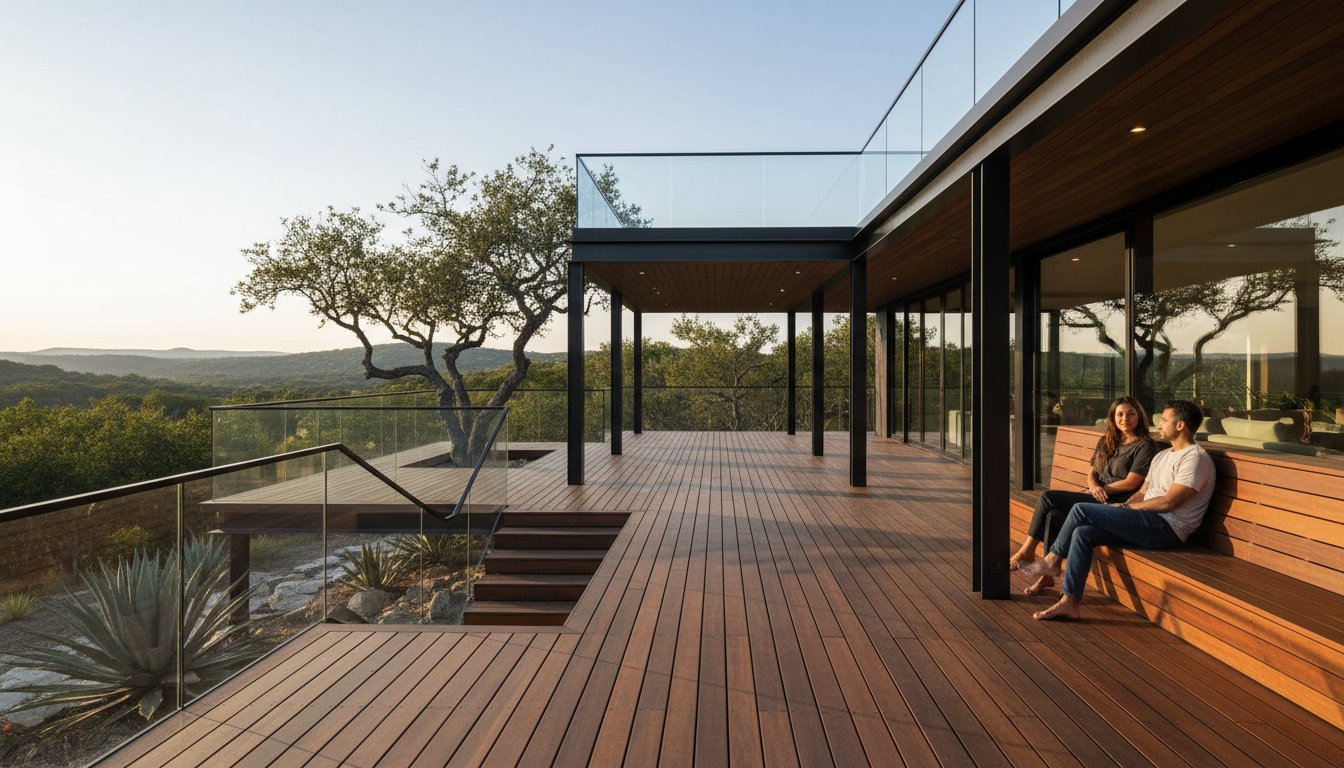
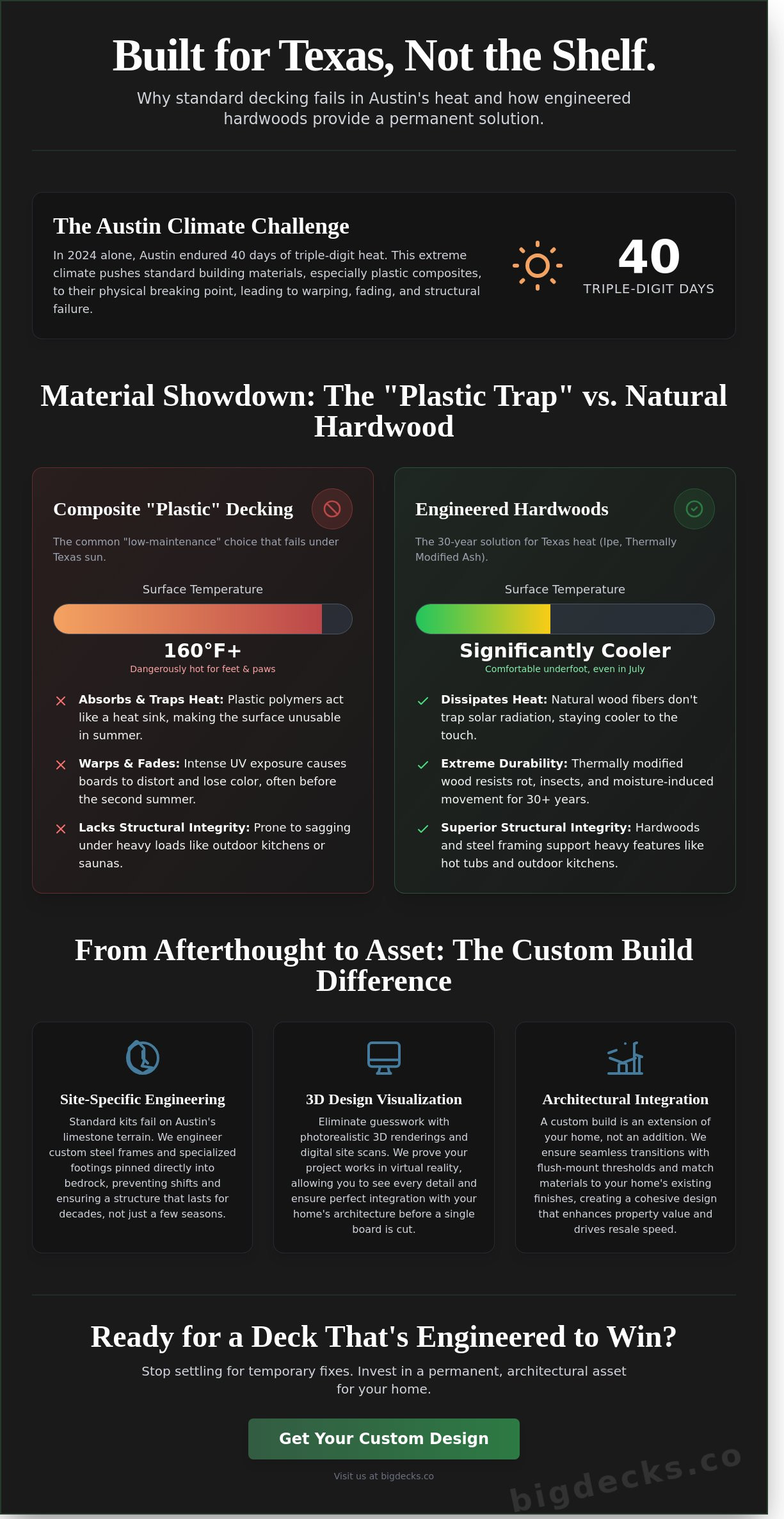
In 2024, Austin recorded 40 days of triple-digit heat, a cycle that pushed standard composite materials to their physical breaking point. You want custom decking that matches your home's high-end architecture, but you're likely tired of watching expensive "low-maintenance" boards warp and fade before the second summer. It's a common frustration for homeowners who prioritize aesthetics but keep getting stuck with generic, high-heat plastic solutions.
Investing in your outdoor space should be a strategic move for your property value, not a recurring maintenance headache. You'll learn why 3D-led engineering and architectural hardwoods like Ipe or thermally modified ash are the only materials that truly survive the Central Texas climate while maximizing your ROI. These natural choices provide a cooler surface underfoot and a structural integrity that synthetic products can't match when the sun is at its peak.
We'll break down the structural failures of plastic, the thermal advantages of premium timber, and the specific design-to-build process that ensures your project remains a permanent asset rather than a temporary fix.
Key Takeaways
- Stop settling for "off-the-shelf" kits that fail on Austin limestone; learn why high-end custom decking requires site-specific engineering to match your home’s DNA.
- Dodge the "plastic trap" of composite materials that burn feet in July and discover why thermally modified wood is the elite 30-year solution for Texas heat.
- Master the hybrid approach: combine traditional carpentry with precision steel framing for a modern aesthetic that outlasts standard wood structures.
- Eliminate guesswork with 3D design renderings and digital site scans that prove your project works in virtual reality before a single board is cut.
- Maximize your property appraisal by shifting from a basic backyard platform to an architectural investment that drives resale speed.
Defining Custom Decking: Beyond the Standard Backyard Platform
Custom decking is a site-specific engineered structure designed to match a home’s architectural DNA. It is not a generic addition or a weekend DIY project. In Austin, a deck must function as a high-performance asset that handles the unique challenges of Central Texas geography while reflecting the owner’s lifestyle. Most homeowners think a deck is just a place for a grill, but a custom build is a strategic extension of the primary living space.
The difference between a kit and a custom build
Off-the-shelf kits are designed for flat, predictable lots. They rely on 2x8 joists that often fail under the weight of high-load features. If you plan to install a 500-pound cold plunge or a heavy cedar sauna, standard framing will sag within three years. Structural integrity is the foundation of a custom build. We utilize precision metalwork and heavy-duty framing to ensure the platform remains rigid over decades of use.
Aesthetic continuity is another major separator. A kit looks like an afterthought. A custom build matches the wood grain of the deck to your interior or exterior trim, creating a seamless visual flow. This approach allows for the integration of architectural fencing and privacy screens that feel like a part of the original home design rather than a tacked-on solution. It is about creating a cohesive space where every board serves a purpose.
Why Austin’s terrain demands structural customization
Building on the Edwards Plateau means navigating solid limestone and aggressive drainage issues. You aren't building on simple dirt; you are building on a rock shelf. Standard kits fail here because they cannot handle the 15 to 20 percent slopes common in West Austin. Custom decking requires specialized steel reinforcement and custom-poured footings that are pinned directly into the limestone. This level of engineering is the only way to prevent the structure from shifting during Texas’s intense wet-dry cycles.
Precision is vital when managing the transition from indoor flooring to the outdoor Deck (building). A custom build allows for a flush-mount threshold, meaning there is no awkward step-down between your living room and the patio. This requires expert knowledge of local building codes and site-specific drainage. Without custom footings, the heavy rains common in Central Texas can cause water to pool against the foundation, leading to expensive rot and structural failure.
- Load-Bearing Capacity: Engineered for heavy features like hot tubs and outdoor kitchens.
- Limestone Anchoring: Specialized footings designed for the rocky Edwards Plateau soil.
- Seamless Transitions: Zero-threshold entries that connect indoor and outdoor spaces.
- Material Matching: Selecting wood species that complement existing architectural finishes.
A custom approach treats the deck as a strategic investment rather than a simple commodity. It solves the environmental problems that "one-size-fits-all" products ignore, ensuring the structure remains level and safe regardless of the terrain. By focusing on custom decking, you are choosing a build that is engineered to win against the elements and the clock.
Material Science: Why High-End Wood Outperforms Composite in Texas
Austin summers don't play around. In July, composite decking often becomes a "plastic trap" for unsuspecting homeowners. These synthetic boards absorb solar radiation until they reach surface temperatures exceeding 160 degrees. That is hot enough to cause discomfort or even burns on bare feet and pet paws. Real wood stays significantly cooler under the Texas sun because natural fibers dissipate heat rather than trapping it like plastic polymers do.
High-end wood offers the durability and comfort homeowners expect from a premium project. When planning custom decking, the material choice determines whether the space is a usable retreat or a heat sink. Natural timber provides a tactile quality and thermal performance that synthetic materials simply cannot match in Central Texas. Choosing the right species—often by researching premium specialists like Greenhill Timbers—ensures your investment survives the brutal UV and humidity cycles of the region.
Thermally modified wood and the Austin heat test
Thermally modified wood uses a high-heat kiln process to change the cellular structure of the timber. By heating wood to over 400 degrees in an oxygen-free environment, manufacturers strip away the organic compounds that fungi and insects eat. This results in thermally modified wood that offers a 30-year warranty against rot. It is incredibly stable, meaning it won't warp or "check" when Austin's humidity spikes and drops. Using North American hardwoods like Ash for this process provides exotic performance without the environmental cost of overseas shipping.
Ipe vs. Cedar vs. Douglas Fir
- Ipe: This is the "Ironwood" of the decking world. It carries a Class A fire rating, the same as steel or concrete, making it nearly indestructible. It is so dense it doesn't float in water and resists scratches from heavy furniture or pets.
- Western Red Cedar: This is the classic choice for horizontal fences and mid-range decks. Cedar contains natural tannins that repel bugs and decay. It is lightweight, easy to work with, and brings a distinct aromatic quality to the backyard.
- Douglas Fir: This species balances cost and structural performance. It is exceptionally strong, making it ideal for the framing and large-scale platforms of a custom decking project. While it requires more diligent sealing than Ipe, its structural integrity is top-tier.
Maintenance is no longer the nightmare it was twenty years ago. Modern penetrating oils soak deep into the wood fibers rather than sitting on top like a film. This prevents the peeling and cracking seen with old-school stains. A quick cleaning and a fresh coat of oil every 18 to 24 months keeps the wood looking new. This simple routine protects your investment and ensures the wood stays supple under the sun. If you are weighing these options for your own yard, you can explore our design process to see which material fits your specific lifestyle and budget.
Engineering for Longevity: Precision Metalwork and Structural Integrity
Building a high-end deck in Central Texas requires more than just picking a wood species. It demands an engineering mindset that accounts for Austin's aggressive climate cycles. We use a hybrid approach that fuses traditional carpentry with modern steel framing to create a foundation that won't warp, twist, or sag over time. This isn't just about over-engineering; it's about ensuring your custom decking remains level and safe for decades rather than years.
Steel provides a structural precision that wood cannot match. While pressure-treated joists eventually crown and bow, steel remains perfectly straight. This allows for tighter tolerances and a sharper, more modern aesthetic. We also integrate custom welding into our designs, using metal accents to bridge the gap between the organic warmth of wood and the industrial strength of modern architecture. This structural integrity is vital for handling the drainage demands of the Hill Country. Our sub-structures are engineered to move water away from the house quickly, preventing the pooling that occurs during Central Texas flash floods where three inches of rain can fall in less than an hour.
The role of steel in modern deck design
Steel posts allow us to achieve spans that wood simply can't handle. By reducing the number of vertical supports, we create cleaner lines and more usable space beneath the deck. This metalwork integrates seamlessly with architectural fencing, creating a unified look across the entire property. In Austin's humidity, which often hits 80 percent in the early morning hours, corrosion is a legitimate threat. We solve this by using powder-coated steel exclusively. It's a non-negotiable standard that ensures the "bones" of your project remain rust-free and structurally sound regardless of the weather.
Advanced wood protection strategies
Protection starts with the right chemistry. We prioritize penetrating oils like Cutek Extreme over traditional surface stains. Surface stains act like a plastic wrap that eventually cracks and traps moisture against the wood, leading to rapid decay. Penetrating oils work differently; they soak deep into the grain to displace moisture from the inside out. This makes the re-oiling process for your custom decking much simpler because it doesn't require sanding back to bare wood. You simply clean the surface and apply a fresh coat to maintain the UV protection.
The most critical detail is the end-grain. Every time a board is cut, the "straws" of the wood are exposed. If left unsealed, these ends suck up water like a sponge, leading to rot and structural failure. We seal every single end-cut during the installation process. It's a small step that separates a professional build from a DIY project, but it's the difference between a deck that lasts fifteen years and one that lasts forty.
The Planning Phase: Visualizing Your Custom Build with 3D Design
High-stakes projects don't leave room for "maybe." If you're investing in a premium build, winging the layout is a recipe for disaster. Using 3D design renderings is how you win before the first screw is driven. It's about data, not just aesthetics. This virtual environment allows you to stress-test your ideas before committing a single dollar to lumber.
The process starts with a site scan to create a digital twin of your backyard. This isn't a rough sketch; it's a precise 1:1 replica of your property's topography and existing structures. We use this digital space to explore material and lighting options in real-time. You can swap Cedar for Douglas Fir or test how a black walnut stain looks under specific LED lighting configurations. We optimize every square inch for heavy hitters like saunas, hot tubs, and outdoor kitchens, ensuring the structural integrity supports the weight while maintaining a clean, logical flow.
Avoiding the "Oops" moment with VR
Walk through your deck before it exists. You'll see if that sectional blocks the path to the grill or if the hot tub feels cramped in the corner. We track sun angles to prevent your deck from becoming a furnace at 2:00 PM. In the Austin heat, shade is a strategic asset. Catching a design flaw in a digital file costs nothing. Fixing it mid-build can cost thousands. It's the ultimate ROI play for your custom decking project.
Austin permitting and zoning
Austin’s Development Services Department doesn't care about your "vision." They care about impervious cover limits. In neighborhoods like Westlake or Tarrytown, exceeding these limits by even 1% results in a hard stop. 3D plans provide the technical accuracy needed to breeze through HOA approvals and city permitting. We handle the red tape by presenting a digital proof that matches Austin’s strict zoning requirements, speeding up the timeline and keeping your project on track. This precision ensures your custom decking meets every local code without sacrificing style.
Don't settle for a "best guess" approach. Get a clear look at your future space by choosing a team that values precision. Start your design consultation with BigDecks today.
Investing in Value: ROI and the BigDecks Approach
Austin's real estate market rewards bold moves. A well-executed custom decking project isn't just an upgrade; it's a strategic play for your home's equity. High-end outdoor builds in neighborhoods like Tarrytown or West Lake Hills can see a significant return on investment, often recouping 70% to 80% of costs upon resale. This isn't just about adding square footage. It's about creating a definitive lifestyle statement that makes buyers move faster.
The ROI of architectural outdoor spaces
A basic concrete patio is a utility. A custom wood deck is an experience. When you analyze deck costs, look at the long-term appreciation of architectural quality. Buyers in the current market prioritize wellness and recovery. Integrating features like cold plunges or high-performance outdoor saunas into your deck design shifts the property from a standard house to a private retreat. For those with waterfront access, complementing a permanent structure with an inflatable floating party island cabana boat further enhances the luxury lifestyle appeal that drives Central Texas real estate demand. This wellness and recreation premium is the new luxury standard, driving higher appraisal values than simple landscaping ever could.
Choosing high-performance wood like Cedar or Douglas Fir signals quality to savvy inspectors and appraisers. These materials possess a natural warmth and structural integrity that synthetic alternatives lack. We treat every custom decking project as a high-stakes build where the finish matters as much as the framing. You're investing in a durable asset that ages with grace, not a temporary plastic fix that fades in the Texas sun.
Final thoughts on the BigDecks process
Our approach is built on a refusal to compromise. We combine traditional heavy-timber carpentry with modern metalwork to create structures that feel permanent and powerful. We manage the entire lifecycle of the project, from the initial design pitch to the final refinishing. This end-to-end oversight ensures the architectural intent remains intact from the first shovel in the ground to the final screw.
We refuse to build with plastic. Composite materials might promise low maintenance, but they lack the soul and the resale punch of real timber. Our team focuses on high-octane designs that utilize the best natural materials available. We build decks for homeowners who want to win the room and dominate their local market. If you're ready to stop looking at your backyard and start leveraging it, we're the strategic ally you need.
Secure Your Backyard Investment
Austin’s climate doesn't play nice with inferior materials. Plastic composites often warp or become untouchable under the July sun, while architectural hardwoods like Ipe and Thermory stay structurally sound for decades. Choosing custom decking in Central Texas requires an engineering approach that accounts for shifting limestone and extreme heat cycles. We prioritize precision metalwork and premium wood because they offer a superior return on investment compared to synthetic alternatives. Every project we handle includes a 3D visualization to eliminate the gap between your vision and the final build. This data-driven planning ensures your deck functions as a strategic asset for your home. Don't settle for a standard platform when you can build a structure designed for longevity and performance. Your property deserves a build that handles the heat as well as you do.
Ready to see your backyard in 3D? Get your custom deck bid from BigDecks.
We look forward to helping you dominate your outdoor space.
Frequently Asked Questions
How much does a custom deck cost per square foot in Austin?
Austin homeowners typically spend between $30 and $60 per square foot for professional installation according to 2024 market data from Angi. This price range fluctuates based on your choice of wood species and the complexity of the substructure. Premium materials like Ipe or high-end composite will push your investment toward the $75 mark. Factors like slope and soil stability also dictate the final project cost.
What is the best wood for a deck in the Texas heat?
Western Red Cedar is the most reliable wood for the Central Texas climate because it stays cooler than most other materials. It handles the 100-degree Austin summers without warping or becoming painful to walk on. While Douglas Fir is a durable structural choice, it needs more protection from the sun to prevent drying. Cedar's natural tannins provide a built-in defense against the rot and insects common in our humid environment.
Do I need a permit to build a deck in Austin, TX?
The City of Austin requires a permit for any deck that is more than 30 inches above the ground or exceeds 200 square feet. This ensures your custom decking meets safety codes and respects property setbacks. We handle the paperwork with the Development Services Department to keep your build legal and stress-free. Skipping this step can lead to heavy fines or forced removals during a property sale.
How long does it take to design and build a custom deck?
A standard project takes four to eight weeks from the first meeting to the final walkthrough. The design and city permit phase accounts for three to five weeks of that timeline. Actual construction usually wraps up in seven to twelve business days once the materials arrive on-site. We provide a clear schedule at the start so you know exactly when your first outdoor event can begin.
Is thermally modified wood better than composite decking?
Thermally modified wood provides the authentic aesthetic of timber with the structural stability of a synthetic material. It's an excellent choice for a custom decking project because the high-heat treatment makes the wood virtually waterproof and resistant to rot. Composite decking requires less maintenance, but it often retains more heat in the Texas sun. Thermally modified options give you a 25-year lifespan without the plastic look of many alternative products.
How often do I need to maintain a natural wood deck in Austin?
Plan to wash and reseal your natural wood deck every two years to combat the intense Austin sun. Without this maintenance, the UV rays will break down the wood fibers and turn the boards a weathered gray. A high-quality penetrating stain keeps the wood supple and prevents the cracking that leads to splinters. Inspecting the hardware and structure every 12 months ensures the deck remains safe and stable for your family.
Deck Cost Per Square Foot in Austin: A 2026 Pricing Reality Check
Planning a deck in Austin? See the real 2026 deck cost per square foot for premium Ipe & Cedar. Get our no-BS budget guide before you hire a contractor.
Most "starting at" prices for Austin outdoor projects are nothing more than bait designed to change the moment a contractor steps onto your property. You've likely seen the vague estimates that ignore the 12% rise in 2026 labor costs and the brutal Central Texas climate. It's frustrating to plan a high-end build when the deck cost per square foot feels like a moving target. You deserve a straight answer before you start cutting checks.
We're here to fix that with a no-BS breakdown of what it actually takes to build a premium wood deck in Austin right now. You'll get the definitive numbers for architectural-grade materials like Ipe, Cedar, and Thermory that won't buckle after two summers in the heat. We'll walk through the specific variables that influence your final quote, from site complexity to structural requirements. This guide covers the realistic budget framework you need to hire with confidence and ensure your investment delivers a massive win for your property's long-term value.
Key Takeaways
- Understand why the realistic deck cost per square foot in Austin now starts at $60 for premium wood builds that can withstand the Texas sun.
- Compare the 30-year performance of thermally modified wood against traditional Cedar to determine which material maximizes your long-term ROI.
- Learn why precision labor and engineering often exceed material costs in high-end projects and how to budget for that expertise.
- Use our tiered framework to categorize your project, whether you are planning a $25k essential platform or a $90k architectural retreat.
- Discover how 3D design renderings prevent expensive mid-build surprises and ensure your final product matches your initial vision.
The Austin Reality: Deck Cost Per Square Foot in 2026
Building in Central Texas isn't getting cheaper. For 2026, homeowners should expect a deck cost per square foot between $60 and $150 for premium, custom builds. This range reflects the reality of Austin's high-demand labor market and the specific material requirements needed to survive the local climate.
Austin's extreme UV index and humidity levels act as a literal tax on low-quality builds. Standard pressure-treated lumber often warps within 24 months under the Central Texas sun. Investing in high-performance composites or thermally modified wood is a strategic move to avoid a total replacement before the decade ends. Understanding the fundamentals of deck construction is essential when evaluating these costs; structural integrity determines long-term ROI.
Why national pricing calculators lie to Austin homeowners
National averages often fail to capture the true deck cost per square foot in high-growth markets like Austin. Local labor rates for skilled carpentry crews currently range from $45 to $85 per hour, far outpacing rural benchmarks. Our local terrain often involves limestone shelves or significant slopes that require specialized footings and structural over-building. In 2026, the absolute price floor for a professionally installed custom wood deck in Austin starts at $55 per square foot.
The hidden impact of Austin permitting and code compliance
Austin’s Development Services Department enforces some of the strictest zoning and tree protection ordinances in the country. If your project sits within the critical root zone of a protected heritage oak, expect engineering fees to climb. Travis County structural requirements for load-bearing piers also add significant weight to your bottom line. You can find a deeper breakdown of these variables in our How Much Does it Cost to Build a Deck in Austin? (2026 Price Guide).
BigDecks views these costs through the lens of asset appreciation rather than just a simple expense. We focus on building structures that withstand 105-degree August afternoons without compromising their aesthetic or structural value. It’s about winning the long game of home ownership by building right the first time.
Material Science: Why Your Choice of Wood Dictates the Price
Material selection is the primary driver of your deck cost per square foot. You aren't just buying boards; you're investing in a structural asset that must survive the brutal Texas sun. Cedar and Douglas Fir represent the entry point for premium builds, typically landing between $60 and $85 per square foot. These figures reflect current deck material and labor costs for professional-grade installations. These softwoods offer a classic look but require consistent maintenance to prevent Austin humidity from causing premature decay.
If you want the ultimate performance, Ipe and exotic hardwoods are the venture capital of the decking world. You pay a significant premium upfront, but the 50-year lifespan is a calculated play for maximum longevity. These high-density woods resist fire, rot, and insects without the need for toxic chemical treatments. While exotic woods increase the deck cost per square foot at the start, they often prove cheaper over a 20-year horizon because they don't require replacement.
We take a hard stance on material quality. This is why we focus on real wood solutions that breathe and age naturally. If you are ready to evaluate which material fits your vision, you can browse our design philosophy to see how we prioritize longevity over temporary trends.
The ROI of thermally modified wood in Central Texas
Thermory is the high-performance middle ground for smart homeowners. This wood undergoes a heat and steam process that alters the cell structure, effectively cooking the sugars out of the fibers. This makes the boards unappetizing to insects and highly resistant to rot. Because the moisture has been removed, Thermory resists warping and cupping far better than standard lumber. We protect these investments with Cutek Extreme, a penetrating oil that stabilizes the wood from the inside out and keeps the grain looking sharp.
The 'Hot Foot' problem: Why plastic decks fail Austin homeowners
BigDecks refuses to build with plastic or composite materials for one simple reason: physics. Austin sees over 40 days of 100-degree weather annually, and plastic cannot handle that thermal load. Composite boards expand and contract violently in the heat, which leads to warped frames and loosened fasteners over time. They also retain heat like a cast-iron skillet. You can't walk barefoot on a plastic deck in July without risking burns. These materials also carry a heavy environmental cost and eventually end up in landfills, often losing their "fake" wood aesthetic within just a few seasons.
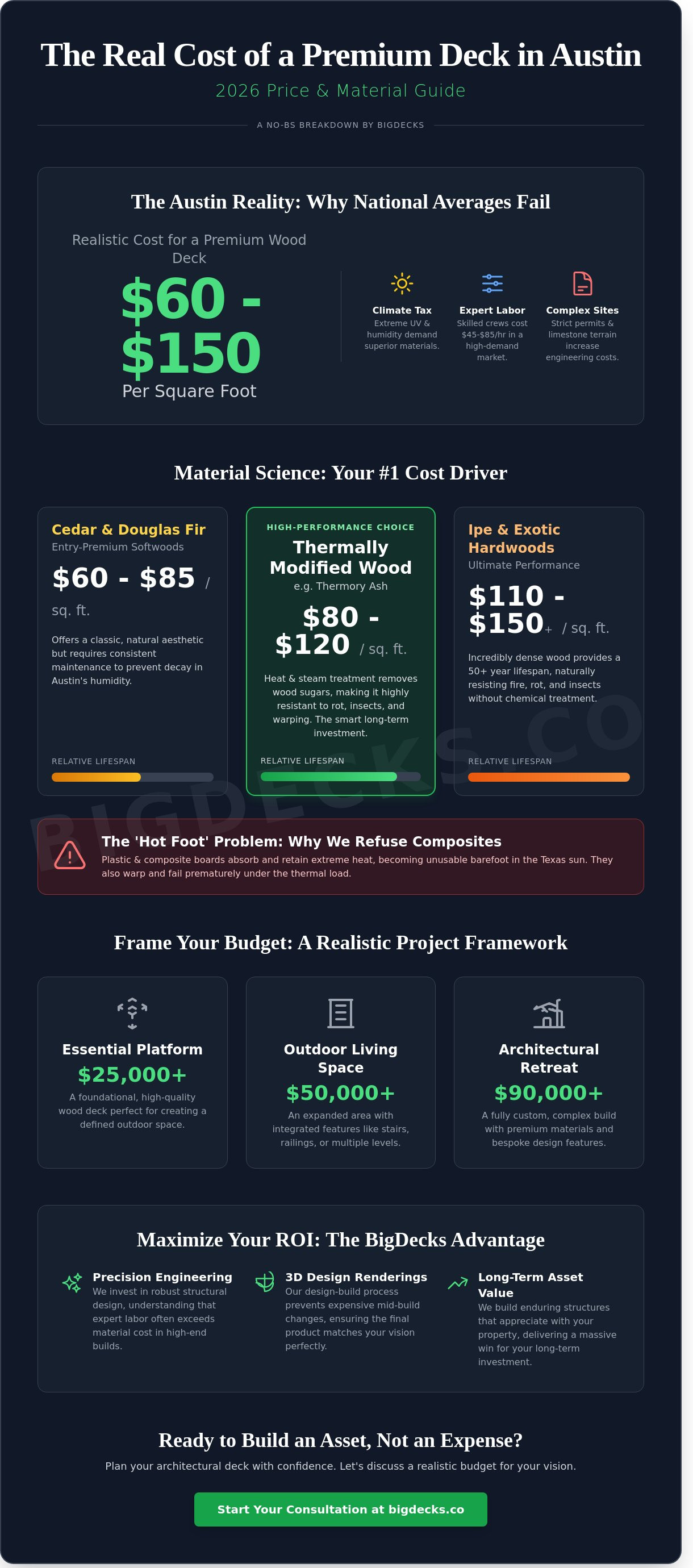
Beyond the Boards: Engineering and Labor Costs in Central Texas
Labor isn't just a line item. It is the engine of the project. In the Austin market, the labor component of your deck cost per square foot often exceeds the material spend. This isn't a mistake; it's a reflection of engineering reality. High-end builds require laser-level precision and specialized metal fabrication that a general handyman cannot provide.
Austin's topography is a variable you cannot ignore. Building on a 20 percent grade in the Hill Country requires deeper pier footings and heavy-duty lateral bracing. If your site has restricted access, such as a narrow side yard in Tarrytown, materials must be moved by hand. This logistical friction adds significant man-hours to the project timeline and drives up the average cost.
Structural steel framing is the ultimate power move for Austin estates. Unlike pressure-treated lumber, steel doesn't warp, crown, or rot. It creates a perfectly flat surface for high-end composites or hardwoods. It's a lifetime structural investment that pays dividends in durability, especially when supporting heavy features like outdoor kitchens or hot tubs.
The cost of skilled Austin craftsmanship in 2026
The "truck and a ladder" contractor is a liability. They often lack the specialized tools required for high-density hardwoods like Ipe or the welding rigs needed for modern steel accents. Hiring a specialist ensures your substructure outlasts the boards on top. To understand how these professional skills impact your deck cost per square foot, read our Austin Deck Labor Costs: 2026 Price Per Square Foot Guide.
Custom metalwork and architectural accents
Standard wood railings are functional, but custom steel adds architectural weight. Modern Austin designs frequently utilize custom-welded steel posts to achieve a minimalist look that thrives in the Texas sun. Steel handles 100-degree heat without the twisting or splintering common in wood components. This metalwork adds structural swagger to a backyard while providing the rigidity required for expansive, multi-level designs.
Don't focus solely on the surface boards. The real value of an Austin deck lies in the skeleton and the skill of the hands that built it. Engineering for slopes and integrating steel are the decisions that separate a five-year deck from a thirty-year legacy.
Estimating Your Project: A Realistic Budgeting Framework
Stop guessing. Austin's 2026 market demands precision. You aren't just buying wood; you're investing in a structural asset. Understanding your deck cost per square foot starts with choosing your tier of engagement. Every dollar spent should correlate to a specific outcome in durability, aesthetics, or lifestyle utility.
Tier 1: The Essential Platform ($25k–$45k). This is your entry point into high-quality outdoor living. We focus on premium Cedar or Douglas Fir. It's a clean, functional build for homeowners who value the warmth of natural wood but don't need complex multi-level geometry.
Tier 2: The Architectural Oasis ($50k–$90k). This is the sweet spot for modern Austin homes. We utilize Thermory wood for its incredible stability and rot resistance. This tier includes custom lighting packages and a full 3D design process to visualize the flow before the first board is cut.
Tier 3: The Estate Masterpiece ($100k+). This is a legacy build. We use Ipe or other high-density hardwoods paired with cold-formed steel framing. This tier often integrates high-end wellness features like built-in saunas or custom cold plunges. It's built to outlast the house itself.
Calculating the real square footage requires looking beyond the floor. Stairs, landings, and privacy screens consume significant materials and labor. These vertical elements often have a higher cost density than the flat surface of the deck. You must account for every linear foot of railing and every square foot of screening to get an accurate number.
How deck size influences your per-foot cost
Larger projects often benefit from the economy of scale. While the total project price increases, your deck cost per square foot might actually decrease. This happens because fixed costs, like permitting fees and mobilization charges, are spread across a larger area. The crew is already on-site; the equipment is already staged. For a detailed breakdown of these variables, read our New Deck Cost in Austin: A 2026 Price and Trend Guide.
Adding the BigDecks amenities
Wellness features are the definitive trend for 2026. Integrating an outdoor sauna or a cold plunge requires more than just space. These units need structural reinforcement and dedicated electrical runs. Architectural fencing is another critical consideration. Your deck shouldn't look like an island. A matching perimeter creates a cohesive environment. Horizontal wood screens provide the privacy you need in dense Austin neighborhoods while adding a high-end, modern aesthetic to your quote.
Ready to see the real numbers for your backyard? Get a custom design and quote from Big Decks.
Maximizing Your ROI: The BigDecks Design-Build Advantage
Building a high-end deck in Austin is a strategic financial move. You aren't just adding a platform to your backyard; you're expanding your home's usable footprint. In the 2026 market, homeowners expect outdoor spaces that match the quality of their interiors. To get the best return on your deck cost per square foot, you have to move past the "lowest bidder" mindset and focus on lifecycle value.
The "Buy Once, Cry Once" philosophy is the only way to survive the Texas climate. Cheap materials warp and rot within five years under the Austin sun. Investing in 30-year rated materials like capped composites or premium hardwoods ensures your asset appreciates. It turns a recurring maintenance headache into a permanent increase in property value.
The 3D design process: Engineering certainty
Every BigDecks project starts in a virtual environment. We use 3D renderings to map out every board, stair stringer, and lighting fixture before the first delivery truck arrives. This process allows you to visualize material transitions and color palettes with total clarity. It's the most effective way to prevent mid-build change orders that often inflate a project's budget unexpectedly.
Structural issues often hide in 2D plans. A 3D model reveals how the deck interacts with your home's foundation and existing roofline. This level of detail is why we focus on Custom Decks in Austin: Engineering Architectural Value for 2026. We build with the precision of a custom home; this ensures the finished product is both beautiful and code-compliant.
Long-term protection and maintenance
Maintenance is a non-negotiable part of protecting your investment. For natural wood decks, we exclusively recommend penetrating oils like Cutek Extreme. Unlike traditional stains that sit on the surface and eventually peel, Cutek works into the wood grain. It provides deep protection against moisture and UV damage from the inside out.
Budgeting for professional refinishing every 18 to 24 months is a smart move. It keeps the wood supple and prevents the graying that can hurt your home's curb appeal. Treat your deck as a strategic asset. It's a calculated addition to your net worth, not just a wooden platform.
Frequently asked questions
- Will a 3D design increase my total project cost? While there's an initial design fee, it usually saves money by eliminating construction errors and material waste.
- How much value does a deck add to an Austin home in 2026? High-quality outdoor living spaces currently see a significant recoup rate, often ranging from 65% to 80% of the build cost.
- Is Cutek Extreme better than hardware store stains? Yes. It's a professional-grade oil that doesn't require sanding between coats. This lowers your long-term labor costs and keeps your deck cost per square foot efficient over the life of the structure.
Own Your Outdoor ROI
Austin's 2026 market doesn't reward guesswork. You've seen how material science and labor shifts dictate your final deck cost per square foot. Settling for standard pressure-treated wood in the Central Texas heat is a losing strategy. High-performance materials like Thermory and Ipe aren't just upgrades; they're defensive plays against 100-degree summers and the intense humidity of the Hill Country, often providing 25 to 30 years of durability.
Success requires a clear narrative before the first board is cut. We've mastered the Austin climate by combining technical engineering with high-end aesthetics. Every project we touch includes 3D visualization because seeing the result is the only way to ensure your investment hits the mark. You don't just want a deck. You want a strategic asset that wins the neighborhood and holds its value for decades.
Stop scrolling through generic estimates and start building with precision. It's time to stop thinking about square footage and start focusing on the ultimate outcome for your property. Your future backyard is ready for its high-stakes upgrade.
Ready to win your backyard? Get a 3D design and quote from BigDecks today.
Frequently Asked Questions
Is $50 per square foot a realistic price for a deck in Austin?
No, $50 per square foot is rarely enough for a professional build in Austin's 2026 market; the average deck cost per square foot for quality projects usually starts much higher. Most high-end projects begin at $65 per square foot for basic pressure-treated wood. Labor costs in Central Texas have risen 12 percent since 2023, making the $50 benchmark a relic of the past.
Does the height of the deck increase the cost per square foot?
Yes, elevating a deck significantly increases the deck cost per square foot because of the required structural engineering and safety equipment. Any platform higher than 30 inches off the ground requires guardrails and beefier support posts, which adds roughly 15 to 25 percent to the total bill. Second-story builds also require scaffolding and more labor hours to move materials vertically, driving the price up further.
Why is Ipe decking so much more expensive than Cedar?
Ipe costs more because it's a Grade A hardwood with a Janka hardness rating of 3,510, nearly ten times harder than Western Red Cedar. While Cedar is a reliable local favorite, Ipe is imported from South America and lasts 40 to 50 years without rotting. You're paying for extreme density and a fire rating similar to concrete, which justifies the 3x price jump in raw material costs.
How much should I budget for a deck permit in Austin?
Budget at least $500 to $1,500 for the City of Austin's permitting process. The base fee for a residential building permit starts around $100, but you'll also pay for plan reviews, zoning inspections, and potential tree permits if you're building near protected oaks. These administrative costs are non-negotiable for any deck over 30 inches high or 200 square feet in size.
Will a new deck increase my Austin home's resale value?
A well-built deck typically yields a 65 to 75 percent return on investment according to the 2024 Cost vs. Value Report. In the Austin market, outdoor living space is a high-priority feature for buyers, often acting as the deciding factor in competitive bidding wars. Adding 400 square feet of functional living space increases your home's appraisal value more effectively than most interior renovations.
What happens to the price if I add a built-in sauna or hot tub?
Adding a hot tub or sauna requires a structural upgrade that typically adds $3,000 to $6,000 to the framing budget alone. A standard deck supports 40 pounds per square foot, but a filled hot tub requires a design rated for 100 pounds per square foot or more. You'll also need to account for dedicated 220V electrical lines, which require a separate electrical permit and a licensed sub-contractor.
How Much Does it Cost to Build a Deck in Austin? (2026 Price Guide)
Wondering how much does it cost to build a deck in Austin? Our 2026 guide breaks down local labor, materials, and permit fees for a no-BS budget.
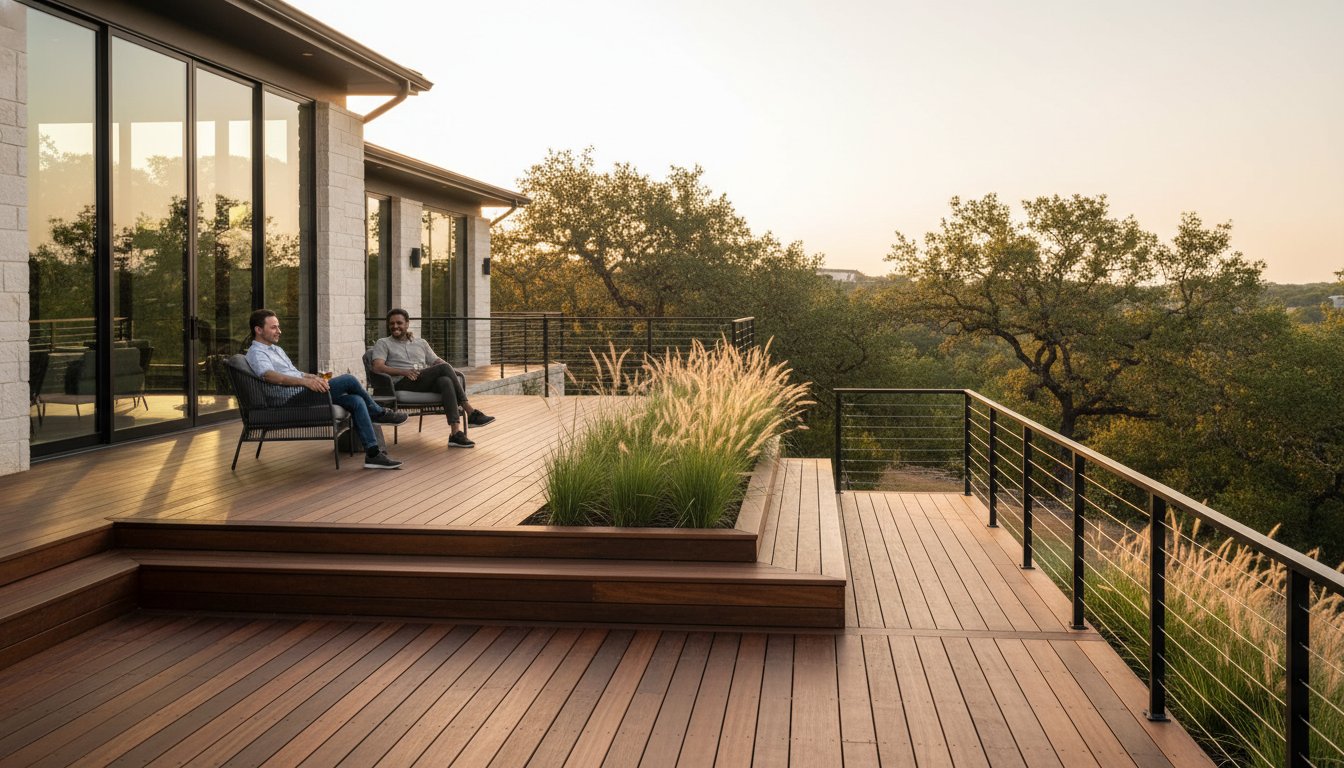
Most online deck calculators are off by at least 35% because they ignore the reality of Austin's specific permitting fees and the current demand for premium materials. You've likely seen conflicting price data that makes planning your backyard feel like a high-stakes guessing game. We're cutting through the noise to show you exactly how much does it cost to build a deck in Austin for the 2026 season.
You deserve a transparent breakdown that accounts for Central Texas weather and the rising cost of skilled local labor. This guide provides a no-BS look at the investment required for everything from pressure-treated basics to high-ROI exotic hardwoods. We'll walk through a clear budget framework and the hidden permitting factors that determine your final invoice.
You're about to learn how to balance long-term durability with architectural design so you can choose a builder with total confidence. We'll explore three distinct pricing tiers and the specific material choices that actually stand up to the relentless Texas sun.
Key Takeaways
- Stop relying on generic national averages that ignore the "Austin Premium" on skilled labor and the reality of Central Texas heat.
- Compare the performance and maintenance tradeoffs between local favorites like Cedar and high-durability investments like IPE hardwoods.
- Navigate the specific permitting and engineering requirements mandated by Austin Development Services for elevated builds or steep lots.
- Get a transparent, no-BS breakdown of how much does it cost to build a deck in the current Austin market, including often-overlooked "invisible" fees.
- Learn how 3D visualization and a precision-build philosophy eliminate budget surprises while maximizing your project's 30-year ROI.
Why national deck cost estimates fail in Austin
National pricing websites often quote $30 to $60 per square foot for a new deck. In Austin, those numbers are a fantasy. If you're asking how much does it cost to build a deck in Central Texas, you have to account for the "Austin Premium." Skilled carpentry labor in this city commands a 22% higher rate than the national average because the demand for high-end outdoor living is relentless. You aren't just paying for wood; you're paying for the expertise to handle Austin's unique terrain and climate.
Building on the limestone of the Hill Country or the shifting Blackland Prairie clay requires specific engineering. National estimates assume flat, soft dirt. Austin projects often require diamond pier foundations or deep-drilled concrete footers to prevent the structure from pulling away from the house as the soil moves. These structural requirements can add $2,800 to $5,500 to a project before the first deck board is even laid. A simple platform might work in the Midwest, but an Austin property demands a legitimate architectural outdoor space.
The cost of the Texas sun
The Austin UV index stays above 9 for most of the summer. This radiation destroys the lignin in standard pressure-treated pine, causing it to splinter and cup within 24 months. Choosing cheap materials is a liability that forces homeowners into a $1,500 annual maintenance cycle. Investing in heat-resistant hardwoods or high-performance composites provides a 300% better long-term ROI by eliminating those recurring costs and keeping the surface cool enough for bare feet in July.
Austin market dynamics in 2026
By 2026, material procurement in Central Texas has reached a new price floor. Local demand for luxury outdoor spaces has pushed lead times for premium contractors to five months or more. Low-ball bids from "trunk-slammers" usually result in mid-project change orders that increase the final bill by 20% to 30%. Knowing how much does it cost to build a deck means looking at the total contract price, not just the initial estimate. A professional build is a strategic investment in your property's appraisal value.
- Labor rates: Austin carpenters earn 22% above the national median.
- Foundation depth: Local codes often require 36-inch footings in shifting soil.
- Material lifespan: Cheap pine lasts 7 years here; composites last 25+.
- Permitting: Austin's rigorous environmental inspections add time and administrative costs.
Breaking down Austin deck material costs: Wood vs. the world
Austin's climate is a relentless test for any outdoor structure. Between the scorching July heat and the erratic humidity spikes, your material choice determines if your investment lasts 40 years or 4. When calculating how much does it cost to build a deck, the raw materials represent the largest variable in your final invoice.
Western Red Cedar remains the Austin standard for a reason. It offers a natural resistance to decay and a classic aesthetic that fits the Hill Country vibe. While it requires a consistent staining schedule every 2 to 3 years, it provides the best entry point for a high quality, real wood project. Roughly 65% of local residential projects still utilize cedar for its balance of performance and price.
For those playing the long game, Ipe and exotic hardwoods are the ultimate power move. These materials are so dense they carry a Class A fire rating and sink in water. You are paying for a 40 year lifespan and a level of prestige that cheaper alternatives cannot touch. If you want a deck that feels like a luxury interior floor, this is your material.
We champion Thermally Modified Wood, specifically Thermory, as the high IQ play for the 2026 market. By using heat and steam to alter the wood's cellular structure, Thermory becomes remarkably stable. It won't warp or swell when the Austin humidity hits 90%. It gives you the exotic look without the environmental footprint or the Ipe price tag.
You won't find us pushing plastic or composite boards. While big box retailers love them, these materials retain massive amounts of heat in the Texas sun, often reaching temperatures 30% higher than natural wood. They look like contact paper and fail to offer the structural soul of a real timber build. We build for performance, not for convenience.
Price per square foot by material
In the 2026 Austin market, material costs have stabilized but remain premium. These figures represent the total installed cost, including labor and standard substructures.
- Western Red Cedar: $35 to $55 per square foot.
- Thermory (Thermally Modified): $60 to $85 per square foot.
- Ipe and Exotic Hardwoods: $90+ per square foot.
Structural framing and metalwork costs
The skeleton of your deck matters as much as the skin. Standard pressure treated pine framing is the budget baseline, but precision steel framing is the modern gold standard. Steel stays perfectly level forever; it won't rot, twist, or sag over a 20 year period. While steel framing can add 25% to 35% to your structural costs, the ROI is found in a deck that never squeaks or slopes.
Custom metalwork is where a project gains its architectural edge. Integrating custom welded steel railings or powder coated accents changes the entire narrative of the build. These elements require specialized labor and on site welding, which typically accounts for 15% of the total project budget. Understanding how much does it cost to build a deck with these custom features requires a look at the complexity of the fabrication, not just the linear footage of the rail.
Final thoughts on materials: choose for the climate you have, not the one you want. Real wood and steel are the only materials that survive Austin with dignity.
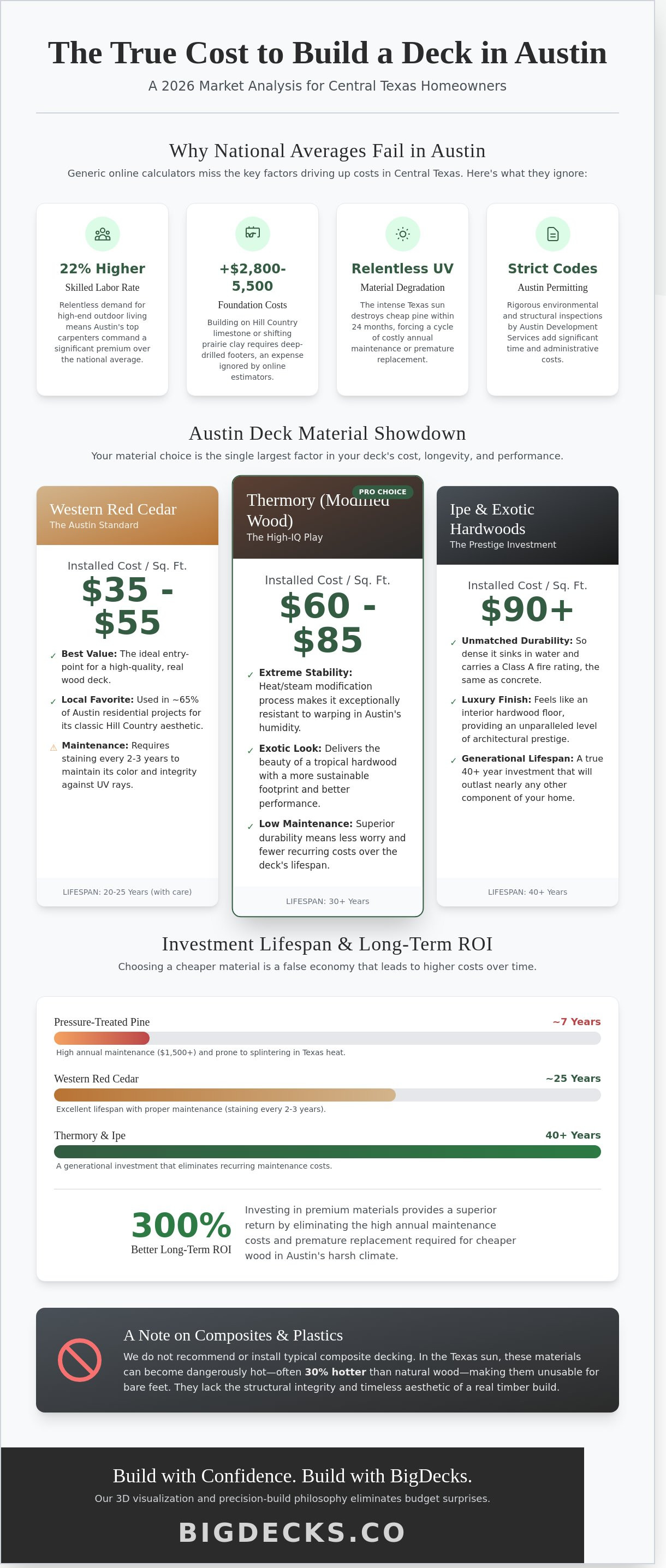
The "invisible" costs: Permitting, engineering, and Austin labor
Most homeowners focus on the price of composite boards, but the "invisible" line items often dictate the final budget. Understanding the labor cost to build a deck per square foot is only half the battle. You also have to account for the city's red tape and the physical reality of your lot. These factors can swing a quote by thousands of dollars before the first pier is even poured.
Navigating Austin city code
Austin Development Services doesn't move fast. In 2026, permit approval times average 8 to 12 weeks for residential projects. Zoning laws are strict about impervious cover, which usually caps at 45% for standard residential lots. If your deck pushes you over that limit, you'll need specialized drainage or pervious decking materials. These adjustments often add $15 to $22 per square foot to your site preparation costs. Hiring a builder who knows local inspectors saves you from the "failed inspection" loop that kills project momentum.
Engineering and site preparation
Central Texas isn't flat, and your deck design has to respect the topography. If you're building on a steep lot in Westlake or near Lake Travis, standard post holes won't cut it. Structural engineering fees for elevated decks now range from $2,800 to $5,200. This ensures your investment doesn't slide down a limestone hill during a spring downpour. Site prep also includes demolition of old structures. Removing a 200-square-foot wood deck typically costs $1,200 to $2,500 depending on the height and accessibility.
The skilled labor shortage
Master carpenters in Austin are in high demand, and their rates reflect that expertise. You might find a low-bid crew willing to work for 30% less, but you'll likely pay for it later. The cost of "doing it twice" because of poor flashing or improper ledger attachment is often double the original quote. Professional builders carry General Liability and Workers' Comp insurance, which adds roughly 10% to 15% to the labor bid. This isn't fluff; it's the price of making sure you aren't liable if a worker gets hurt on your property. Knowing how much does it cost to build a deck means looking at these protections as necessary investments rather than optional extras.
Site clearing and drainage solutions are the final piece of the labor puzzle. If your yard has poor runoff, you'll need to install French drains or regrade the soil to prevent water from pooling under the new structure. In the Austin market, these drainage fixes average $3,500 per project. Ignoring these steps leads to rot and foundation shifts, regardless of how expensive your decking boards are.
ROI and architectural value: Investing in a 30-year deck
Austin real estate is a high-stakes game where every square foot of your property must perform. A custom deck isn't just a platform; it's a strategic asset that builds significant equity. In Travis County, high-end outdoor living spaces can recoup 65% to 75% of their initial cost during a home resale. Generic builds rot and depreciate, but an architectural deck is a 30-year investment that holds its ground. Smart owners don't see this as a simple expense; they see it as a capital improvement that secures the property's future value.
Calculating the new deck cost over time
Stop looking at the sticker price and start looking at the lifecycle of the build. When you calculate the new deck cost, you have to factor in the 30-year horizon. A cheap deck requires total replacement in roughly 12 years, effectively doubling your long-term spend. Investing in penetrating oils like Cutek Extreme is a non-negotiable move for serious homeowners. These oils protect the timber's core and stabilize the wood, cutting refinishing labor costs by 40% over the life of the structure. This isn't just about aesthetics; it's about preserving the structural integrity of your investment against the brutal Texas sun.
The psychological ROI is equally potent for those living in high-pressure environments. A functional, killer backyard eliminates the friction of hosting and provides a high-octane space for daily recovery. It's the difference between a wasted yard and a usable outdoor lounge that works as hard as you do.
Design as a value multiplier
Generic designs are a liability that buyers will eventually use to negotiate your price down. They look dated within five years and lack the structural integrity that modern buyers demand. Custom architectural builds, featuring integrated fencing and precision lighting, act as a massive value multiplier. Precision lighting and custom fencing aren't just accessories; they are the features that define the project's worth and curb appeal.
In the current Austin market, "turnkey" luxury is the gold standard for buyers. They are willing to pay a 15% premium for outdoor spaces that require zero immediate work and offer total privacy. Integrating high-performance amenities like saunas and cold plunges further separates your property from the pack. It changes the narrative from a simple renovation to a high-end wellness retreat that commands attention. When you evaluate how much does it cost to build a deck, remember that you're paying for a long-term result, not just a pile of materials.
The BigDecks strategy: From 3D design to final build
BigDecks doesn't guess. We execute. Our strategy revolves around eliminating the "maybe" from your project. When you ask how much does it cost to build a deck, you deserve an answer that doesn't shift once the dirt is turned. We've refined a process that bridges the gap between high-concept design and rugged construction logic.
The "Precision Build" philosophy is our standard. We combine traditional high-end carpentry with structural metalwork to create decks that outlast the mortgage. Our bidding process is transparent and direct. We strip away the fluff found in typical contractor quotes, focusing instead on the raw math of materials and expert labor. It's about ROI and structural integrity, not sales pitches.
The value of 3D design renderings
We build your deck twice. The first build happens in a high-fidelity digital environment. Our 3D modeling allows you to toggle between premium composites and Brazilian hardwoods in real time. You can see exactly how the 5 PM Austin sun hits your outdoor kitchen before we buy a single beam. This digital-first approach is a financial firewall. It reduces structural change orders by 18% on average, keeping your budget locked in.
Renderings also serve as a tactical advantage for regulatory hurdles. Providing a high-resolution 3D visualization often secures approval from Austin neighborhood HOAs 10 days faster than standard architectural sketches. It removes the guesswork for board members. When they see the final result clearly, the "yes" comes much faster.
Next steps for your project
Stop scrolling and start building. The first step is scheduling a site consultation with the BigDecks team. We come to your backyard to analyze the terrain, drainage, and structural requirements. To make this meeting high-impact, have your property survey and a target budget range ready. This allows us to move straight into the design phase without wasting time on unrealistic concepts.
Building in Central Texas requires a specific mindset. The 105-degree summers and sudden flash floods destroy mediocre builds within five years. We focus on longevity by using weather-resistant fasteners and reinforced framing. Your deck should be a permanent asset, not a recurring maintenance headache. Let's build something that wins.
Frequently Asked Questions
How long does the 3D design process take?
Most initial renderings are completed within 5 to 7 business days after the site consultation. This ensures we have accurate measurements before the creative work begins.
Will the 3D design show my specific house?
Yes. We model your home's exterior to ensure the deck feels like a seamless architectural extension rather than an afterthought.
Does the quote change after the design is finalized?
Our goal is budget certainty. Once the 3D design is approved and the contract is signed, the price is locked unless you request a specific change in scope during the build.
Secure Your Austin Outdoor Investment
Austin isn't a market for the timid or the ill-prepared. National price calculators consistently fail to account for the $3,500 engineering hurdles and the specific labor rates of Central Texas. If you want a 30-year asset, you have to look beyond the surface level. Determining how much does it cost to build a deck in 2026 means accounting for high-performance materials like Thermally Modified Wood that won't warp when temperatures hit 108 degrees. Our Austin-based expert team specializes in precision metal and wood integration to ensure your structure is as stable as it is stunning. We don't just build; we engineer for maximum ROI and architectural dominance in a competitive housing market.
Every decision you make now impacts your property value for the next three decades. We utilize advanced 3D design strategies to eliminate the guesswork and technical friction that plague standard builds. You deserve a backyard that reflects your standards and survives the Texas elements without constant maintenance. Stop settling for vague estimates and start with a plan that wins. Your property is a high-stakes investment, so treat it like one. Let's build a deck that stands the test of time.
Start Your Austin Deck Transformation with a 3D Design Quote
Frequently Asked Questions
How much does a typical 200 square foot wood deck cost in Austin?
A standard 200 square foot pressure treated wood deck in Austin currently ranges from $5,400 to $9,600 for professional installation. If you opt for Western Red Cedar, prices climb between $8,800 and $14,200. These figures cover the structural frame and decking boards but exclude premium additions like integrated LED lighting or custom steel railings.
Does the City of Austin require a permit for all deck builds?
Austin requires a building permit for any deck that sits more than 30 inches above the ground or is attached to your home. Even for freestanding structures, you'll need a permit if the deck exceeds 200 square feet in total area. Building without one can result in a 100 percent permit fee penalty and potential orders to dismantle the entire structure.
Which is cheaper in the long run: Cedar or Thermally Modified Wood?
Thermally modified wood is the superior financial move because it lasts 25 years with significantly less warping than Cedar. While Cedar costs 18 percent less at the initial purchase, it requires staining every 24 months to prevent rot. Over a 15 year period, the maintenance labor and material costs for Cedar make it $4,500 more expensive than thermally modified alternatives.
How much should I budget for deck labor costs in 2026?
Budget between $40 and $65 per square foot for skilled labor in 2026. This rate accounts for the 12 percent rise in local insurance and specialized tool overhead since 2024. Expert crews in Central Texas typically command 45 percent of the total project budget to ensure the build meets rigorous structural safety standards and local codes.
Can I save money by using composite decking instead of wood?
You won't save money on the initial invoice because composite materials cost 35 percent to 60 percent more than traditional wood. However, the reality of how much does it cost to build a deck shifts when you factor in the 10 year ROI. Composite eliminates the $900 annual power washing and staining bill, allowing the material to pay for its own premium by year eight.
How does a sloped lot affect the total cost of building a deck?
A sloped lot increases your total construction bill by 25 percent to 40 percent due to complex engineering requirements. Steep grades demand deeper concrete piers, additional structural bracing, and specialized scaffolding to keep the crew safe. If your Austin yard drops more than 36 inches across the deck span, expect to pay an extra $3,200 for heavy duty support posts and reinforced footings.
What is a Decking Contractor? The Austin Guide to Professional Deck Building
Hiring a decking contractor in Austin? Our guide helps you avoid costly mistakes and choose the right builder for a durable deck that survives Texas humidity.
Why do 30% of Austin homeowners end up tearing out their "new" decks within five years? It's usually because they hired a general laborer instead of a specialized decking contractor who understands the brutal reality of Central Texas humidity. You already know that a deck is a high-stakes investment. It's a project that should increase your property value by 70% or more, not become a structural liability that rots before the first decade is up.
You deserve a seamless design to build process that doesn't involve chasing a contractor who disappeared mid-project or failing a Travis County inspection. We'll show you how to distinguish a true master builder from a weekend warrior so you can secure a high-end wood deck with lasting architectural integrity. This guide covers the specific technical standards, material choices, and permitting hurdles that determine whether your outdoor project is a win or a total loss. By the end, you'll have a clear roadmap to a durable, high-end outdoor space that actually delivers on its ROI.
Key Takeaways
- Identify the critical differences between a general carpenter and a specialized decking contractor who manages structural engineering and long-term ROI.
- Understand how Austin’s extreme heat, humidity, and shifting soil impact foundation requirements and material selection.
- Evaluate the performance of Ipe and thermally modified wood against composite materials to determine which best fits the Texas climate.
- Learn how to vet local builders by reviewing architectural consistency and verifying references specific to Central Texas neighborhoods.
- Discover how a 3D design-build approach eliminates construction guesswork and ensures your outdoor project integrates seamlessly with your home.
Defining the Professional Decking Contractor in 2026
A professional decking contractor is no longer just a person with a truck and a miter saw. By 2026, the industry has shifted toward high-level structural engineering and sophisticated design-build operations. These firms manage the entire lifecycle of an outdoor build, from soil composition analysis to the final coat of UV-resistant sealant. They operate like strategic allies—a role Pro-Construction has modeled for over 23 years as a general building contractor in the San Francisco Bay Area, focusing on long-term ROI and structural integrity rather than just the lowest bid.
Mastering wood science is now the baseline for any legitimate firm. This involves understanding cell structure, moisture equilibrium, and how different species react to local humidity levels. It is the difference between a deck that looks good for one summer and one that stays level for 25 years. Leading firms now integrate complex elements like barrel saunas, custom powder-coated metalwork, and outdoor kitchens into a single, cohesive structural plan.
Contractor vs. General Laborer
General laborers follow a list of tasks you provide. A specialized decking contractor provides a strategic roadmap for your entire property. They bring a minimum of $1 million in general liability insurance and specialized equipment like hydraulic pier drivers that a generalist simply does not own. Hiring unspecialized help often results in a 30% increase in long-term maintenance costs because they lack specific knowledge of deck-specific shear forces and ledger board flashing. You want a team that owns the outcome, not just the hours on the clock.
The Design-Build Evolution
The best firms now utilize 3D visualization to kill uncertainty before the first post is set. This is not just a pretty picture; it is a digital twin that accounts for sun angles and architectural fencing integration. In cities like Austin, a professional contractor is your shield against the permitting headache. They navigate the 60-day review cycles and the 20% impermeable cover limits that would stall a DIY project indefinitely. They handle the bureaucracy so you can focus on the winning result.
The Austin Factor: Why Local Specialization is Non-Negotiable
Austin is a graveyard for mediocre decks. The Central Texas climate is a relentless wood-killer, characterized by 40 plus days of triple-digit heat and sudden flash floods that dump five inches of rain in a single afternoon. A generic builder won't cut it here. You need a specialized decking contractor who understands that local environmental variables are the primary drivers of your project's ROI.
Building in Austin requires a strategic approach to material selection. When temperatures hit 105 degrees, standard pressure-treated lumber loses its moisture too fast, leading to catastrophic warping and checking. We select materials based on their ability to survive the Texas sun without turning into a structural liability or a safety hazard for your family. This is about more than aesthetics; it is about engineering a space that survives the brutal reality of the Texas sun.
Engineering for Central Texas soil
The ground beneath your feet is your deck's biggest enemy. Austin sits on a volatile mix of expansive Blackland clay and unforgiving limestone shelves. Standard deck footings often fail because the clay expands and contracts with the seasons, literally lifting foundations out of the ground. On sloped lots, this movement is even more dangerous, requiring custom steel-reinforced piers that anchor directly into the bedrock.
Residential decks in Travis County require concrete piers to reach a minimum depth of 12 inches into undisturbed natural soil or solid rock to prevent structural failure caused by soil movement. Without this precision, your investment will shift and sag within 24 months. A professional Austin decking contractor treats the foundation as a high-stakes engineering challenge, not an afterthought.
Thermal management and airflow
In July, a poorly designed deck becomes a heat island that can reach 160 degrees. This isn't just uncomfortable; it's a design failure. We utilize the science of sub-deck ventilation to create a constant flow of air beneath the surface. This prevents moisture from being trapped against the joists, which is the leading cause of internal rot in humid Central Texas environments. Proper airflow keeps the temperature down and the structural integrity up.
Terrain in neighborhoods like Westlake or Tarrytown presents unique structural hurdles. These areas often feature steep grades and rocky soil that demand specialized structural metalwork rather than traditional wood framing. By utilizing steel substructures and high-performance heat-dissipating materials, we ensure your outdoor space remains a functional asset even in the peak of a Texas summer. We build for performance, ensuring your deck wins the battle against the elements every single year.
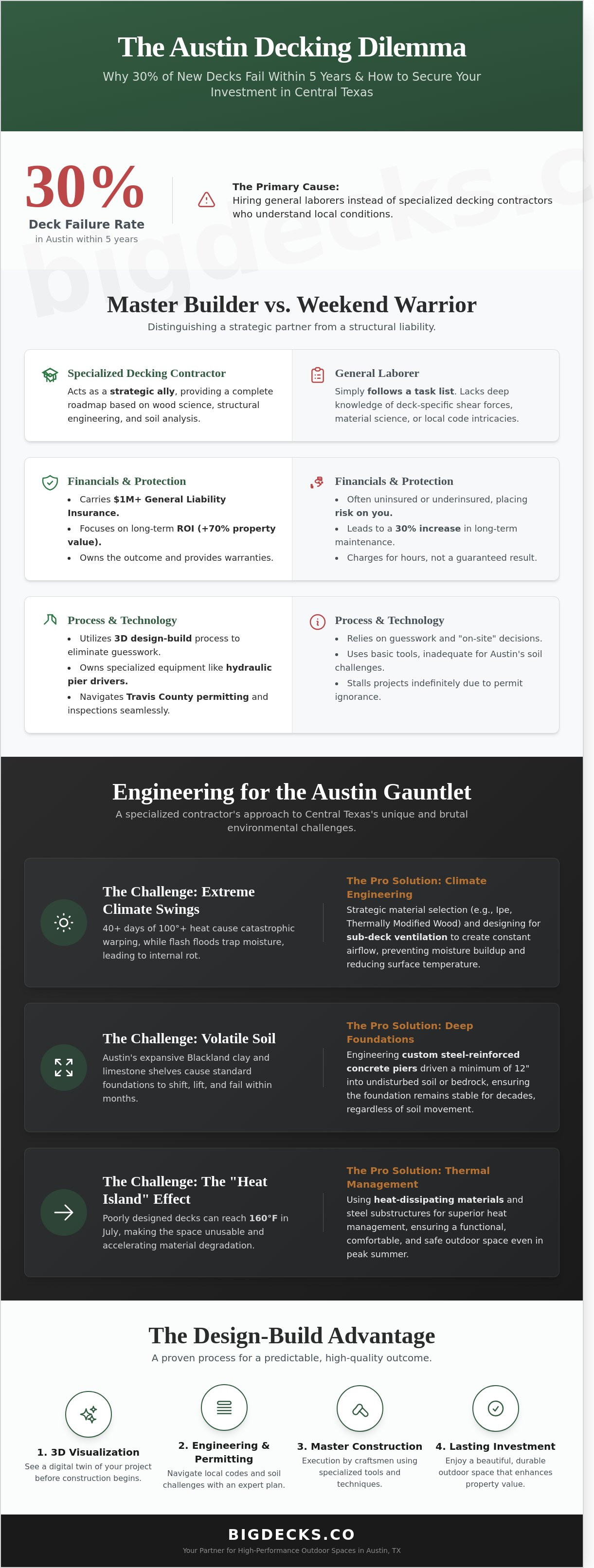
Material Strategy: Why High-End Contractors Prioritize Performance Wood
Cheap materials are a liability. A premium decking contractor doesn't sell you on the lowest bid; they sell you on the lowest cost of ownership over the next decade. The Austin sun destroys inferior products. While composite decking is marketed as a maintenance-free solution, it often fails the aesthetic test for high-end homes. It looks like plastic because it is plastic. It holds heat until it's untouchable in July and expands enough to pop fasteners. You want a deck that adds value, not a synthetic platform that depreciates like a used car.
Your contractor's material choice dictates your labor costs for the next ten years. Real wood offers a ROI that plastic can't touch, provided you choose the right species. IPE and thermally modified timbers are the gold standard. They provide the structural integrity required for complex architectural designs while maintaining a natural cooling effect that keeps the surface walkable in 100-degree weather.
Thermally Modified Wood vs. Traditional Cedar
Thermal modification is a high-tech solution to an old problem. By heating wood to over 320 degrees Fahrenheit in an oxygen-free environment, the cellular structure changes. It removes the organic compounds that fungi and insects eat. This process stops rot before it starts. While traditional Texas cedar might give you 12 years of life before the posts begin to fail, thermally modified ash or pine easily reaches a 25-year lifespan.
- Sustainability: Real wood is a carbon sink. It's more eco-conscious than petroleum-based composites.
- Durability: IPE outlasts domestic softwoods by 300 percent in high-UV environments.
- Stability: Thermally treated wood has 50 percent less movement than kiln-dried lumber.
The Precision of Custom Metalwork
The best decks in Austin aren't built on wood frames anymore. High-end projects now utilize structural steel. Wood frames warp and sag over time, but steel stays perfectly level. A professional decking contractor integrates precision welding with traditional carpentry to create a hybrid structure that's virtually indestructible. This allows for longer spans and fewer support posts, which opens up your view and creates a cleaner profile.
Custom metalwork extends beyond the frame. Architectural steel railings and custom-fabricated fencing provide a slim, modern profile that wood simply cannot achieve. We focus on 1/16th-inch tolerances. This intersection of heavy-duty engineering and refined finish work ensures your deck remains a structural asset for 40 years, not just a temporary feature. It's about building a legacy, not just a platform.
How to Vet an Austin Deck Builder Like a Pro
Hiring a decking contractor isn't a gamble; it's a high-stakes investment in your property's ROI. You need a partner who understands the specific demands of Central Texas soil and the brutal Austin sun. Don't just look at "pretty" pictures of finished projects. Look for architectural consistency. If a portfolio jumps from modern minimalist steel to rustic cedar without a clear design logic, they're likely guessing rather than engineering. A pro should show you projects that look as good three years later as they did on day one.
Verify local references with actual homeowners in neighborhoods like Westlake, Tarrytown, or Barton Hills. Ask if the crew arrived at 7:30 AM as promised or drifted in at noon. You want to see local projects within a 15-mile radius of your home to ensure the builder understands local soil expansion and drainage requirements. A legitimate pro will provide a no-BS bid that breaks down costs by line item. If you see a single vague number for "Materials," walk away. You need to see the difference between Select Structural and #2 grade lumber in writing.
The 3D design test is your ultimate litmus test. In a high-stakes build, you shouldn't pay for a single board until you've seen a digital rendering of the final product. This proves the decking contractor has solved the structural puzzles and elevation challenges before the first screw is driven. Finally, analyze the warranty with a critical eye. A 25-year manufacturer warranty on composite boards is useless if the frame rots in five years. Demand a clear, separate labor guarantee of at least 2 to 5 years to cover the actual construction work.
The Right Questions to Ask
Ask about their specific experience with Ipe or thermally modified wood. These high-end materials move differently than pressure-treated pine and require specialized fasteners. Inquire about their process for managing City of Austin tree protection ordinances. If they don't mention the Critical Root Zone (CRZ) of your Heritage Oaks, they'll get your project red-flagged by inspectors. Demand to know how they handle the "invisible" parts. High-performance joist tape and G-Tape are non-negotiable for a deck built to last 20 years in Texas humidity.
Red Flags in a Decking Quote
Vague line items are the enemy of your budget. If a quote doesn't specify wood grades or the specific brand of hidden fasteners, expect cheap substitutions mid-project. A lack of a clear 14-day timeline for the 3D design and permitting phase is another warning sign of a disorganized operation. Be wary of under-priced labor. If a quote is 30% lower than competitors, they're likely skipping insurance or using unskilled day labor. Cheap work is expensive to fix when the deck starts to sag after the first summer heatwave.
Beyond Construction: The Design-Build Advantage with BigDecks
Choosing a decking contractor involves more than finding someone who can swing a hammer. It requires a partner who understands that an outdoor space is a high-yield investment in your property's equity. At BigDecks, we've moved past the era of basic platforms. We refuse to build with hollow plastic composites that warp under the 105-degree Austin sun. Instead, we focus on high-performance materials and engineering that ensure your structure outlasts the next three owners of your home.
Our approach treats your backyard as a strategic asset. We don't just "build decks"; we engineer environments that solve problems like slope instability, privacy gaps, and heat management. By acting as a specialized decking contractor, we take full accountability for the narrative of your property, ensuring every square foot serves a functional and aesthetic purpose.
The 3D Visualization Standard
We've eliminated the "hope for the best" phase of construction. Every project starts with a precision 3D model that allows you to see exactly how shadows fall across your seating area at 4:00 PM in July. This isn't just a pretty picture; it's a financial safeguard. Homeowners who skip the 3D phase often face mid-construction changes that can cost upwards of $4,500 in wasted labor and materials. Our process lets you refine the layout and material transitions before a single board is cut. You can explore how these designs translate to long-term worth in our guide on Custom Decks in Austin: Engineering Architectural Value for 2026.
Total Outdoor Integration
A modern deck doesn't exist in a vacuum. It's the foundation for a comprehensive wellness suite. We specialize in integrating luxury amenities that standard builders won't touch. This includes custom-fitted saunas, 45-degree cold plunges, and built-in outdoor kitchens. We view architectural fencing as the essential frame for your platform, providing the structural privacy required for a true sanctuary.
- Structural Durability: We utilize heavy-duty framing and hardware designed for Central Texas soil movement.
- Wellness Ready: Our designs include the reinforced joist spacing necessary for 500-gallon hot tubs and heavy recovery equipment.
- Zero-Fluff Execution: We prioritize ROI and structural physics over generic trends.
Investing in a specialized decking contractor is about more than just aesthetics. It's about ensuring your home's outdoor narrative is one of quality, durability, and calculated design. When you build with us, you're not just adding a deck; you're installing a permanent architectural upgrade that stands as a testament to better building standards.
While this guide focuses on outdoor structures, the same principles of high-end craftsmanship apply to the rest of your home. For those seeking to elevate their interior spaces, Grand Building Construction provides expert remodeling services that exemplify these same elite architectural standards in kitchen and bathroom renovations.
Build for the Austin Decade
The Austin market doesn't reward shortcuts. A professional decking contractor should bring more than a hammer to your site; they need to bring a 3D vision and a mastery of materials that survive 100 degree Texas summers. We've seen projects fail because they relied on standard pressure-treated lumber instead of IPE or thermally modified wood. These high-performance materials are the baseline for a structure that stays stable for 25 years or more.
Integrating precision metalwork and structural steel isn't just an aesthetic choice. It's a structural necessity for the modern Austin home. Stop settling for vague sketches. You deserve a design-build process that accounts for every bolt and board before the first hole is dug. We focus on the ROI of your backyard, ensuring the engineering matches the architecture. Your project is an investment in your home's equity and your daily lifestyle. Let's build something that holds its value as long as it holds your guests.
Ready to build a deck that actually lasts? Start your 3D design with BigDecks today.
Your vision is ready for the big stage. Let's make it happen.
Frequently Asked Questions
What is the difference between a decking contractor and a general contractor?
A decking contractor is a dedicated specialist focused on outdoor structural engineering, whereas a general contractor manages a broad spectrum of home renovations. Specialists own this specific niche. They understand the shear strength of fasteners and the moisture management required for a structure to survive 20 years. Don't hire a jack-of-all-trades for a project that requires master-level precision and specific outdoor expertise.
Do I need a permit to build a deck in Austin, Texas?
You'll need a permit from the City of Austin for any deck higher than 30 inches or any structure attached to your home. Code compliance isn't optional if you value your property's resale worth. Expect to provide a detailed plot plan and structural sections to the Development Services Department before the first hole is dug. This process ensures your build meets safety standards and local zoning laws.
How much does a professional decking contractor cost per square foot in Austin?
Professional decking contractor rates in Austin currently range from $65 to $120 per square foot for premium, custom builds. This price reflects the high cost of grade-A timber and the expert labor required for complex architectural designs. If a quote comes in under $50, the builder is likely cutting corners on structural hardware or using sub-par materials that won't last five years in the Texas climate.
Why do high-end contractors avoid composite or plastic decking materials?
High-end builders reject composite materials because they're thermal traps that frequently hit 150 degrees in the Austin sun. They lack the soul, the structural rigidity, and the long-term longevity of real timber. Wood is the only choice for a high-stakes design that needs to look as good in 10 years as it does on day one. Real wood wins the aesthetic and performance game every time.
How long does a custom wood deck installation typically take?
Expect a custom wood deck installation to take 10 to 21 business days. We spend the first 48 hours letting footings cure because structural integrity isn't a place to rush. Precision takes time. A three-week window ensures every joint is tight and every board is perfectly aligned for maximum impact. Weather delays in the Austin area can occasionally add 3 to 5 days to the schedule.
What kind of maintenance does a professional wood deck require in Austin?
Your wood deck requires a professional UV-protective oil treatment every 12 to 18 months to combat the intense Texas heat. This isn't a suggestion; it's a survival strategy for your investment. Spending $2 per square foot on annual maintenance prevents the graying and cracking that destroys the value of a custom outdoor space. Consistent care keeps your deck in peak condition for decades of use.
Deck Design Services in Austin: Why Professional Planning Beats DIY Tools
Don't let DIY apps lead to costly repairs. Discover how expert deck design services in Austin navigate tough codes & heat for a stunning, long-lasting deck.
Your free DIY deck app is lying to you. It's selling a dream that the Austin sun will incinerate in less than 90 days. Most homeowners think a weekend of clicking is a shortcut to a luxury oasis, but it's usually a fast track to a $14,000 repair bill when the heat twists budget timber into a pretzel. If you're chasing a high-end result, professional deck design services aren't a luxury; they're the only way to protect your ROI in a market this aggressive. You know a deck should be a strategic asset, but Austin's 105-degree summers and the 45-page City of Austin Building Criteria Manual kill amateur dreams before the first board is even cut.
You want a space that feels like a private resort, with custom saunas and precision metalwork that actually holds up. We agree you shouldn't have to settle for "good enough" or risk an HOA rejection that stalls your project for six months. This guide reveals how professional planning navigates brutal climate shifts and complex zoning to create a masterpiece that lasts 25 years. We'll preview the 3D tech that lets you see your future property value in high definition, proving why expert guidance is the only way to win.
Key Takeaways
- Stop guessing and start engineering. Professional deck design services translate architectural vision into high-stakes blueprints that handle drainage and structural loads with precision.
- Kill the guesswork before the first board is cut. Use 3D renderings to dial in materials and lighting in real-time, ensuring a stunning result without construction surprises.
- Don't fall for the DIY sales funnel trap. Learn why generic software can’t replace expert knowledge of Austin’s strict code compliance or complex structural load limits.
- Build for the heat or watch it fail. Master the material selection and engineering tactics needed to survive 100-degree thermal expansion and rugged Central Texas terrain.
- Elevate your outdoor ROI with a strategic vision. Discover how the fusion of precision metalwork and master carpentry creates a legacy space that outlasts the competition.
What are professional deck design services?
Stop treating your outdoor space like a weekend hobby. Professional deck design services are the bridge between a vague idea and a high-performance architectural asset. This isn't just about where the stairs go. It's a comprehensive engineering phase that translates raw vision into a buildable, structurally sound blueprint. When you're investing in premium materials like Ipe or Thermory, you aren't just buying wood; you're investing in a system that requires specialized installation and precise tolerances. A standard Deck (building) requires more than just visual appeal; it demands a calculated approach to load-bearing physics and site-specific environmental stressors.
- Structural Integrity: We calculate load-bearing capacities for 2,500-pound swim spas and heavy outdoor kitchens.
- Material Science: Specialized layouts for hardwoods that expand and contract in the Texas humidity.
- Regulatory Roadmap: Detailed plans designed specifically to clear HOA hurdles and Austin municipal reviews.
- Engineering: Integrated drainage solutions to prevent wood rot and foundation erosion.
The difference between a sketch and a design
A sketch is a hope. A design is a guarantee. Austin’s soil is notorious for shifting. The Blackland Prairie clay under your feet can exert thousands of pounds of pressure on a foundation. Professional deck design services ensure your structure won't buckle. We integrate custom metalwork and structural steel into the plans to ensure your investment stands for 30 years. If your plan doesn't account for the 15 percent slope in your backyard, it's not a design; it's a liability.
Why Austin homeowners need specialized design
Austin isn't just a city; it's a regulatory obstacle course. The City of Austin Development Services Department has strict rules on impervious cover and drainage. If your property is in West Austin, you're dealing with steep limestone and specific runoff mandates. We design for the 107-degree Texas sun. Our layouts include integrated shade structures that can drop ambient temperatures by 20 percent. We don't just build decks; we engineer microclimates. Every design we produce serves as a definitive roadmap for the 2021 building code requirements, ensuring your project moves from paper to reality without a single permit rejection.
The 3D visualization process: Seeing it before you build
Stop guessing. A deck is a high-stakes investment, not a weekend craft project. Professional deck design services provide more than a sketch; they deliver a digital twin of your future asset. This kills the surprises that bleed budgets dry during construction. You see the grain, you feel the flow, and you lock in the ROI before a single board is cut. Precision is the difference between a killer layout and a 50,000 dollar mistake. By visualizing the project in a 3D environment, we eliminate the "I thought it would look different" conversation that haunts DIY builds.
The 3D process is a communication powerhouse; it aligns the homeowner and the build team instantly. We adjust material colors, swap lighting fixtures, and move staircases in real-time. This isn't just about aesthetics. It is about how the new structure integrates with your existing Austin limestone or your zero-edge pool. Before you commit to the build, checking Austin's official deck permit requirements is non-negotiable for projects over 200 square feet. Our models ensure your design stays within these legal boundaries while maximizing every inch of your property. When you're ready to scale your outdoor living space, the visualization phase is your first win.
Advanced rendering vs. basic 3D tools
Browser-based tools from big-box stores are toys. They lack the 1:1 precision required for a complex build. These basic tools often miss the mark by 15% on spatial accuracy, leading to massive headaches on day one of construction. Elite deck design services use lighting engines to simulate the 100-degree Austin heat and the specific shadows cast at 7:00 PM in July. We show the true texture of thermally modified wood. You will see exactly how the grain reacts to the Texas sun, ensuring your material choice is a long-term victory.
Exploring luxury integrations in 3D
High-stakes builds require complex integrations. We use 3D modeling to stress-test the placement of 800-pound cold plunges and custom outdoor saunas. You can see how architectural fencing creates a private sanctuary without killing the breeze. We test different custom metal railing styles in a virtual environment to find the perfect balance of transparency and grit. This phase accelerates decision-making by 40%, moving you from the pitch to the party faster than any DIY tool ever could.
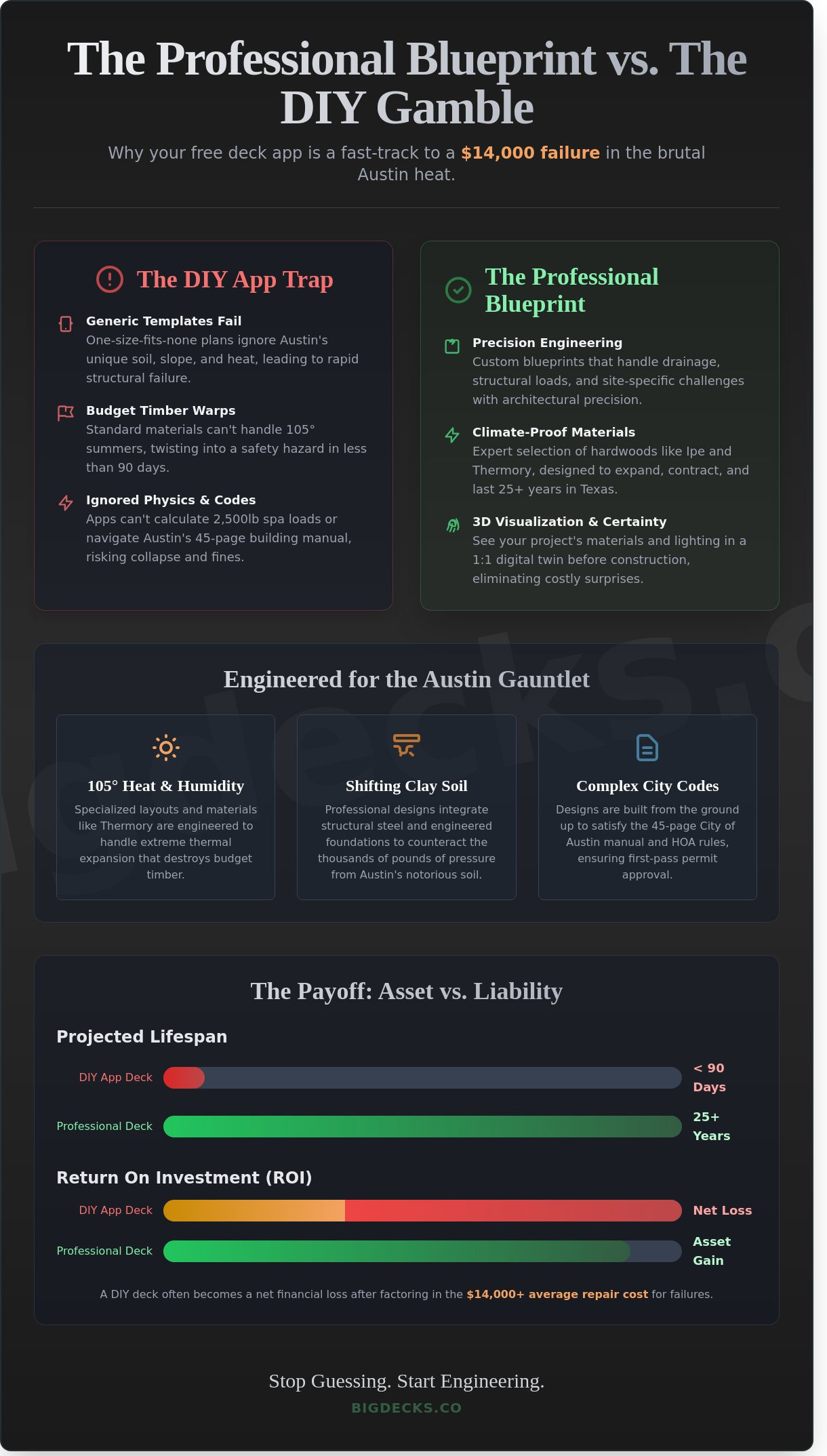
Professional design services vs. DIY online tools
Most "free" online tools are just high-tech sales funnels. They aren't built to design your dream; they're built to move inventory for massive composite decking manufacturers. When you use deck design services from a professional firm, you're buying a solution, not a shopping cart. Software ignores the reality of your backyard. It treats a flat lot the same as a 15 percent Austin grade. We don't. We build for the actual dirt under your feet. A professional design is a legal and structural document, not a generic suggestion.
The hidden cost of "free" design software
Free tools lead to expensive mistakes. A generic algorithm doesn't understand that Austin building inspectors follow strict local amendments. If your plan misses the International Residential Code deck standards, your project dies at the permit office before you even break ground. We've seen homeowners lose $3,000 in material restocking fees because their software calculated structural load limits incorrectly. One wrong click creates a 20 percent waste margin on your lumber order. Our deck design services eliminate that risk by providing a blueprint that actually works in the real world.
Expert material guidance you won’t get from a tool
Software pushes plastic because it's easy to render. Big Decks prioritizes real wood because we know how Central Texas works. While a tool tells you composite is "maintenance-free," it won't mention that dark plastic boards can reach 160 degrees in the July sun. We guide you toward materials that survive our 90 percent humidity spikes. We select the specific fasteners and metalwork that won't corrode within 36 months. You get a deck that wins, not a plastic platform that warps under pressure.
- Accuracy: Professional plans reduce material waste by 12 percent compared to DIY estimates.
- Compliance: 100 percent of our designs are engineered to meet or exceed Austin safety codes.
- Longevity: We specify hardware rated for 25 plus years of structural life in high-heat environments.
Don't gamble your home's value on a browser extension. Invest in professional planning that treats your backyard like the high-stakes asset it is. We deliver the killer ROI that software simply can't calculate.
Planning for the Austin climate and terrain
Austin isn't just a city; it's a structural stress test. Your backyard is a high-stakes environment where 105-degree summer peaks meet the unforgiving limestone slopes of the Hill Country. Professional deck design services aren't a luxury here; they're a survival strategy for your capital. We don't just build platforms. We engineer high-performance assets that thrive in the brutal reality of Central Texas. Thermal expansion is the silent killer. When temperatures swing 40 degrees in a single 12-hour cycle, materials move. Without a precise 1/4-inch gap strategy for expansion and contraction, your deck will buckle or rip its own fasteners out by July.
In Westlake and the surrounding Hill Country, elevation is the primary antagonist. We manage 20-foot drops with structural precision, integrating native West Texas plantings like Red Yucca and Agave directly into the layout. This creates a seamless transition from man-made luxury to the rugged landscape. We don't fight the terrain; we leverage it to create a dominant visual narrative.
The best materials for Central Texas
Forget the big-box store logic. We prioritize materials that win against the sun. Our selection process is rigorous:
- Thermory: This is the gold standard. Thermally modified wood that resists rot and moisture at a molecular level. It stays stable when the humidity vanishes.
- Ipe and Cedar: These hardwoods are UV-resistant powerhouses. They don't surrender to the Texas sun; they age with a sophisticated silver patina.
- The Composite Problem: we avoid composite decking for high-exposure projects. In 100-degree heat, composite surface temperatures can spike to 160 degrees. That isn't a deck; it's a griddle for your feet.
Designing for wellness and luxury
A killer deck is a functional machine. If you're adding a 500-gallon hot tub or a premium cold plunge, you're dropping 4,000 to 5,000 pounds of dead weight onto the frame. DIY tools and amateur builders don't calculate the shear force on your joists. Our deck design services provide the heavy-duty engineering required to support your recovery rituals without a hint of sag. We strategically place saunas for optimal backyard flow and utilize architectural fencing to mitigate the 20-mph Westlake winds and local noise. It's about maximizing the ROI on your lifestyle.
Stop guessing and start winning. Secure your professional deck design strategy with Big Decks today.
Starting your project with BigDecks
Stop settling for contractors who scribble on napkins and hope for the best. At BigDecks, we don't just provide a quote; we execute a strategic vision. Our deck design services act as a high-stakes roadmap for your property value. We fuse 20 years of traditional carpentry expertise with CNC-precision metalwork to build structures that dominate the landscape. This isn't just about outdoor seating. It is about architectural dominance.
Our timeline is built for speed and precision. Once we finalize your strategic vision, our team produces a high-fidelity 3D rendering within 7 to 10 business days. We move from the digital model to the first day of construction faster than the industry average, typically breaking ground within 21 days of permit approval. We eliminate the guesswork so you can focus on the result.
- Strategic Vision: We analyze site topography and sun orientation before the first board is cut.
- Hybrid Engineering: We combine the warmth of premium timber with the industrial strength of steel.
- Accountability: One team handles everything from the first pixel to the final screw.
Our design-build philosophy
Efficiency is our primary metric. By keeping designers and builders on the same team, we eliminate the "translation tax" that often costs homeowners 15% or more in mid-project change orders. We maintain strict architectural integrity, ensuring the 3D model you approved is exactly what stands in your yard. We prioritize high-end, durable wood species like Ipe and Western Red Cedar, materials designed to outperform the Texas heat for 25 years or more.
Next steps for your Austin backyard
Winning your backyard requires a solid pitch. Before our initial design consultation, gather your site survey and any HOA guidelines updated within the last 12 months. Bring your inspiration photos and a clear list of must-have features. Treat this like a seed round for your home's most valuable asset. We are ready to build something legendary. Ready to win your backyard? Book a 3D design consultation with BigDecks.
Stop Guessing and Start Building Your Legacy
Generic DIY apps don't understand the 15 percent slopes of the Austin Hill Country. You need a strategic edge. Professional deck design services turn a vague concept into a high-ROI asset before the first board is cut. We specialize in the high-stakes details that free tools ignore. Our Austin-based experts with 12 years of local experience integrate precision metalwork and premium hardwoods like Ipe, which carries a 40 year lifespan, into a cohesive 3D blueprint. We ensure your structure survives 105 degree Texas summers by utilizing heat-treated Thermory that stays 20 percent cooler than standard composite. You wouldn't pitch a VC without a deck; don't build a backyard without one either. We eliminate the technical friction that leads to 30 percent budget overruns during construction. It's time to stop dreaming and start executing with a plan designed for the winner's circle. Your vision deserves the precision of a master architect and the grit of a Texas builder. Let's make it real.
See your dream deck in 3D. Book BigDecks today.
You're one call away from the best seat in Austin. Let's build something massive.
Frequently Asked Questions
Do I really need professional design services for a simple deck in Austin?
You need professional deck design services because Austin's 2021 International Residential Code (IRC) updates turned simple projects into high-risk legal puzzles. DIY tools often miss the 5 foot setback rules and specific drainage gradients required for city permits. We treat your backyard like a high-stakes pitch where every inch is calculated for maximum ROI. Don't gamble your property value on a free app that lacks local intelligence.
How much do deck design services typically cost in 2026?
Professional design packages in 2026 range from $1,500 for standard layouts to $4,500 for complex, multi-level builds. This isn't an expense; it's a strategic investment in your home's equity. You're paying for a blueprint that eliminates the 15% material waste margin common in amateur builds. We deliver a killer vision that ensures your capital is deployed with surgical precision. Secure the win before you break ground.
Will a professional design help me get HOA approval faster?
High-fidelity 3D renderings slash HOA approval timelines by 40% compared to amateur sketches. Most Austin HOAs require 4 distinct elevation views and specific material lists before they even review your application. We provide a bulletproof narrative that wins the board over on the first pass. We don't just ask for permission. We present a vision so stunning they have no choice but to say yes.
Can you integrate saunas and cold plunges into the 3D design?
We integrate custom saunas and cold plunges into 85% of our luxury deck design services packages. These aren't afterthoughts; they are the core of your high-performance recovery zone. Our 3D models account for the 500 pound per square foot weight requirements and specialized electrical routing these units demand. We design for the lifestyle you've earned. It's about building a fortress for your physical health.
Why does BigDecks prefer thermally modified wood over composite?
Thermally modified wood beats composite because it runs 25% cooler in the 105 degree Austin summer. We prioritize materials like Thermory which offer a 25 year rot resistance rating without the plastic feel of synthetic boards. It's the elite choice for homeowners who demand authentic texture and superior durability. Composite is a compromise. Thermally modified wood is a bold statement of quality that lasts for decades.
How long does the 3D design process take before construction starts?
Expect a 14 to 21 day window to finalize your high-octane 3D blueprint. We move fast because your time is the most valuable asset in the room. This phase includes 2 rounds of revisions to ensure the narrative is perfect before the first board is cut. We focus on momentum. Once the design is locked, we transition immediately into the logistics of the build to ensure a total win.
Hiring a Decking Professional in Austin: The No-BS Selection Guide for 2026
Hiring a decking professional in Austin? This 2026 guide helps you vet elite builders, avoid costly mistakes, and build a high-ROI deck that lasts a lifetime.
85% of Austin decks built this year will show signs of structural rot by 2031 because the average contractor treats Central Texas humidity as a suggestion rather than a threat. You likely agree that an outdoor space should be a strategic asset for your home, not a source of constant repair bills. Finding a true decking professional means looking beyond the lowest bid. You need a partner who masters premium materials like Ipe and Thermory while leveraging 3D visualization to kill the guesswork.
You deserve a result that mirrors the high-end architecture of your property. This guide provides the exact framework for identifying elite craftsmanship and avoiding the contractors who overpromise and under-deliver. We're going to dive into the technical vetting process, the reality of material lifespans in the 2026 climate, and how to ensure your project delivers the massive ROI your property deserves. It's time to stop settling for generic designs. Let's build for the long game.
Key Takeaways
- Distinguish between a specialized outdoor living firm and a general handyman to ensure your project meets high-end structural and architectural standards.
- Verify that your contractor carries specialized insurance for outdoor structures and possesses the technical skill required for complex custom wood and metalwork.
- Understand why a high-end decking professional prioritizes climate-resilient materials like Ipe or Cedar to withstand the brutal Central Texas sun.
- Utilize 3D design and lifelike renderings to visualize material choices and lighting layouts, preventing expensive mistakes common with 2D sketches.
- Identify the red flags in contractor proposals and learn what a professional contract must include to ensure your vision is executed flawlessly.
What defines a true decking professional in the Austin market?
A decking professional is a strategic partner who views your backyard as a high-stakes capital investment. In Austin, the gap between a general handyman and a specialized firm is the difference between a liability and a long-term asset. You aren't just paying for lumber and screws. You're paying for structural engineering, architectural foresight, and a builder who understands that Central Texas environments are unforgiving. A pro treats your project like a pitch deck; it must be flawless, persuasive, and built to win against the elements.
True professionals focus on the invisible details. They prioritize load-bearing calculations and site-specific engineering over simple aesthetics. This includes sourcing high-grade materials that withstand 100-degree summers and managing the logistical nightmare of material procurement. They follow rigorous deck construction standards to ensure every joist and beam meets safety requirements. When you hire a specialist, you're buying their ability to navigate the complex intersection of design and durability.
Beyond basic carpentry: The design-build mindset
Structural engineering is the backbone of a killer deck. In Austin, the soil is a primary antagonist. Central Texas expansive clay can shift significantly, often moving up to 2 inches annually depending on moisture levels. A pro manages this risk through deep-drilled piers and advanced drainage solutions. They don't just build a platform; they engineer a foundation that stays level while the ground moves. A specialized portfolio proves they've solved these specific geological puzzles before. If your builder claims they can do "everything from roofs to toilets," they aren't the expert you need for a high-performance outdoor structure.
Local Austin regulations and permitting
Austin’s Development Services Department is notoriously rigorous. A decking professional knows how to navigate the 2021 International Residential Code (IRC) and local height restrictions without blinking. They understand that most residential lots in Austin have a 45% impervious cover limit. Exceeding this by even 1% can result in heavy fines or a forced teardown. Your builder should handle every piece of red tape, from HOA approvals to final city inspections. This isn't just a convenience. It's a strategic move to protect your property value and ensure your project is 100% legal. Don't gamble with a builder who asks you to pull the permits yourself.
Essential criteria for vetting high-end deck contractors
Hiring a decking professional requires more than a quick glance at a five-star rating. You are often investing 15% to 20% of your home's value into an outdoor structure. This investment needs to survive the brutal Texas sun and flash floods without warping or failing. Vetting a builder is about risk management and ensuring your ROI remains intact over the next 20 years.
Insurance and liability in residential construction
General liability is the bare minimum, not the gold standard. A legitimate Austin builder carries specific riders for structural outdoor builds and comprehensive workers' compensation. If a "tailgate" contractor without insurance suffers an injury on your property, you could face a lawsuit exceeding $50,000. Verify their standing with local trade groups like the NARI Austin chapter before any demolition begins. Professional builders also understand the technical nuances of building in hot-humid climates. This expertise prevents moisture trapped in the building envelope from causing rot in your home's rim joist.
The craftsmanship audit: What to look for in a portfolio
Look past the staged furniture and sunset photography in a portfolio. Focus on the technical execution of miter joints on picture-frame borders. These gaps should be tighter than 1/16th of an inch to account for material expansion. High-end builds utilize hidden fastening systems like CAMO or Cortex to keep the surface clean and barefoot-friendly. The real story is told underneath the deck. Inspect the framing for joist flashing tape and Z-flashing at the ledger board. If these 1% details are missing, the structure is a ticking clock. You can consult with a design-build expert to see how these structural details integrate with custom steel railings or architectural fencing.
Communication should be treated as a performance metric. Top-tier firms utilize project management tools to provide daily logs and schedule updates. They don't rely on 10-cent zinc screws. They insist on 316-grade stainless steel fasteners that won't corrode when Austin's humidity hits 90%. Ask every decking professional about their long-term maintenance programs. A builder who offers a 24-month follow-up inspection is a partner who stands behind their engineering. They prioritize the structural integrity of the build over a fast payout.

Material expertise: Why your pro must understand Austin’s climate
Austin isn't just hot; it's a kiln. Your deck sits in a 105-degree convection oven for three months straight every year. A qualified decking professional understands that Central Texas weather dictates your material list. If a builder suggests standard pressure-treated pine for a high-end project, they're handing you a warped, splintering mess that will fail within 36 months. We prioritize Ipe, Western Red Cedar, or Thermally Modified Wood because these species handle 40 percent humidity swings without tearing themselves apart. A pro calculates for wood movement, gapping boards at exactly 3/16 of an inch to allow for the inevitable expansion and contraction that happens when the mercury hits triple digits.
The wood vs. plastic debate
BigDecks rejects composite and plastic decking for high-stakes projects. The math doesn't work in Texas. Surface temperatures on dark grey composite boards can spike to 165 degrees in July, making the space unusable for kids or pets. We push for Thermory wood instead. It undergoes a 400-degree pressurized steam treatment that removes sugars and resins, resulting in a Class 1 durability rating. This process ensures a 25-year lifespan, offering a significantly higher ROI than generic lumber or heat-trapping plastics. You get the organic feel of real wood with the stability of a high-performance engineered product.
Protecting the investment: Penetrating oils and maintenance
Surface-level stains are a temporary fix that leads to a permanent headache. They sit on top of the wood and peel when the UV index hits 10. We use Cutek Extreme, a high-performance penetrating oil that migrates deep into the wood fibers. It doesn't flake or crack; it protects the board from the inside out. Your decking professional should explain the silvering process. UV rays break down lignin, turning natural wood a sophisticated silver-grey over 12 to 18 months. This is a natural evolution, not a failure. We provide a clear maintenance schedule because a high-end deck is a living asset that requires a re-coat every year to maintain its structural integrity and premium aesthetic.
3D design and visualization: The mark of a modern pro
Flat 2D sketches are a liability. They leave too much to the imagination and often lead to a 15% increase in change orders mid-build. A top-tier decking professional utilizes 3D modeling to eliminate this guesswork. It's about seeing the finished product in high definition before spending a dollar on lumber. You can swap Ipe for heat-treated ash in seconds or see how the Austin sun hits your lounge chairs at 6:00 PM in mid-August. This isn't just a visual aid; it's a precision tool for accurate material takeoffs and budgeting.
Seeing the transformation before the first board is cut
3D modeling identifies site-specific hurdles like an 18-inch grade slope or hidden utility access points that 2D plans ignore. BigDecks views this design phase as a strategic prerequisite for every project. It's the only way to ensure the new structure integrates seamlessly with your existing roofline and siding. Knowing exactly what you're paying for provides a psychological win. It replaces construction anxiety with the certainty of a calculated investment. A decking professional uses these models to generate 100% accurate material lists, ensuring the quote you sign matches the final invoice.
Integrating amenities: Saunas, plunges, and lighting
Adding a 1,200-pound cold plunge or a custom cedar sauna requires precise spatial planning and structural reinforcement. Our 3D process maps out the 220V electrical lines and dedicated drainage requirements before the first joist is hung. We test the "flow" of the deck to ensure the sauna door doesn't collide with your outdoor kitchen or dining area. Architectural lighting is never an afterthought in a modern build. We visualize the exact beam spread of 3000K LED path lights to ensure your space is safe and moody after dark. This level of detail separates a basic platform from a high-performance outdoor environment.
Ready to see your vision in high definition? Start your 3D design consultation with the experts who prioritize precision.
Executing your vision with an Austin decking professional
Research ends here. Moving from the initial assessment to a signed contract is where your vision gains traction. A legitimate decking professional provides a proposal that acts as a tactical blueprint for your property's value, not just a vague estimate on a notepad.
Demand total clarity in your documentation. A professional proposal must include specific material grades, fastener types, and a defined scope for site preparation. Avoid contractors who offer "all-in" prices without breaking down the labor and material costs, as these often hide shortcuts that compromise structural integrity.
Central Texas projects require realistic scheduling. Expect a 6 to 10 week window for high-end custom builds. This timeframe accounts for the 15 to 20 business days often required for Austin permit approvals and the logistical coordination of specialized crews. Weather remains the only variable we can't control, but a solid plan mitigates every other risk.
The final walkthrough is your quality control moment. This is when we verify that every joint is tight and every board meets the original design intent. It's about ensuring the finished product performs exactly as promised in the initial renders. We don't consider the job finished until the craftsmanship matches the high-stakes investment you've made.
The BigDecks approach to premium builds
We don't do basic. Our team combines traditional carpentry with precision metalwork to create structures that stand out. We use 100% real wood because it delivers an architectural excellence that composite materials simply cannot replicate. Our project-based fees ensure you get total transparency and results without the typical contractor games.
Next steps for your Austin backyard
Schedule your consultation to get the ball rolling. Before the initial assessment, clear any loose debris and identify your property lines so our team can focus on the technical layout. Ready to win your backyard? Contact BigDecks for a 3D design rendering today.
Build Your Austin Legacy
Austin's 2026 residential market demands more than a basic platform; it requires a strategic asset. Securing your high-end ROI starts with hiring a decking professional who treats construction like a high-stakes project. You need a partner who prioritizes Ipe and Thermally Modified Wood to withstand 105-degree summer peaks. These materials offer a 25-year lifespan that standard lumber can't match. Demand 3D design visualization to eliminate guesswork and ensure every architectural fence or custom metalwork detail aligns with your home's profile.
The gap between a standard backyard and a killer outdoor space is the technical execution of your vision. Our Austin-based team focuses on the intersection of structural integrity and modern aesthetics. We don't do fluff; we do results that stand up to the Texas sun. Your home is your most valuable asset. Build something that proves it.
Book your 3D design consultation with the pros at BigDecks
You're ready to create the best seat in the city.
Frequently Asked Questions
Is a permit required for a new deck in Austin, TX?
You need a permit for any deck that is more than 30 inches above the ground or attached to your house. Austin’s Development Services Department enforces these rules to ensure every structure meets the 2021 International Residential Code. Skipping this step results in "stop work" orders and fines that often exceed $1,000. A decking professional manages the site plan and engineering specs to keep your project legal and your property value protected.
How much does a professional deck installation cost per square foot in 2026?
Budget between $45 and $95 per square foot for a high end installation in 2026. These figures account for a 15% rise in specialized labor and premium material costs over the last three years. A standard 300 square foot project will likely require a $13,500 investment at minimum. If you're looking at exotic hardwoods or complex steel framing, your costs will hit the $28,000 mark quickly. This is about the ROI of your outdoor space, not just the raw materials.
Why do you recommend wood over composite decking for Austin homes?
Wood is the superior choice because it stays 30% cooler than composite boards during 105 degree Austin summers. Composite materials act as heat sinks; they'll burn your feet by mid afternoon. Real timber like Ipe or Cedar breathes and dissipates thermal energy naturally. For a home in Central Texas, wood isn't just an aesthetic preference; it's a functional necessity for anyone who wants to use their deck in July.
How long does it take a decking professional to build a custom deck?
A decking professional typically completes a custom build in 10 to 18 business days. This timeline starts after the 4 to 6 week permit approval window closes. Complex designs with multi level structures or integrated masonry require an additional 7 days for precision detailing. We focus on a high velocity workflow to minimize backyard downtime while ensuring every joist is set for a 25 year lifespan.
What is the best wood for a deck in the Central Texas climate?
Ipe is the undisputed champion for the Central Texas environment due to its Class A fire rating and incredible density. It resists rot and insect damage for 40 years without the need for toxic chemical treatments. If budget is a primary constraint, Western Red Cedar is the best secondary option. It handles the 40% humidity swings in the 78704 area better than pressure treated pine, which tends to warp and crack within 36 months.
Do I need a landscape architect or a decking professional for my project?
Hire a decking professional if your goal is a structurally sound, high performance outdoor platform. Landscape architects focus on the broad 30,000 foot view of your yard and often charge a 15% design fee on the total project cost. We specialize in the engineering and the specific ROI of the deck itself. You get a better result when you work with the expert who understands how the wood reacts to the Austin sun.
Custom pool deck Austin: Engineering luxury for the Texas heat
Don't let the sun destroy your investment. Get expert tips for a custom pool deck in Austin built with heat-resistant materials for lasting luxury & value.
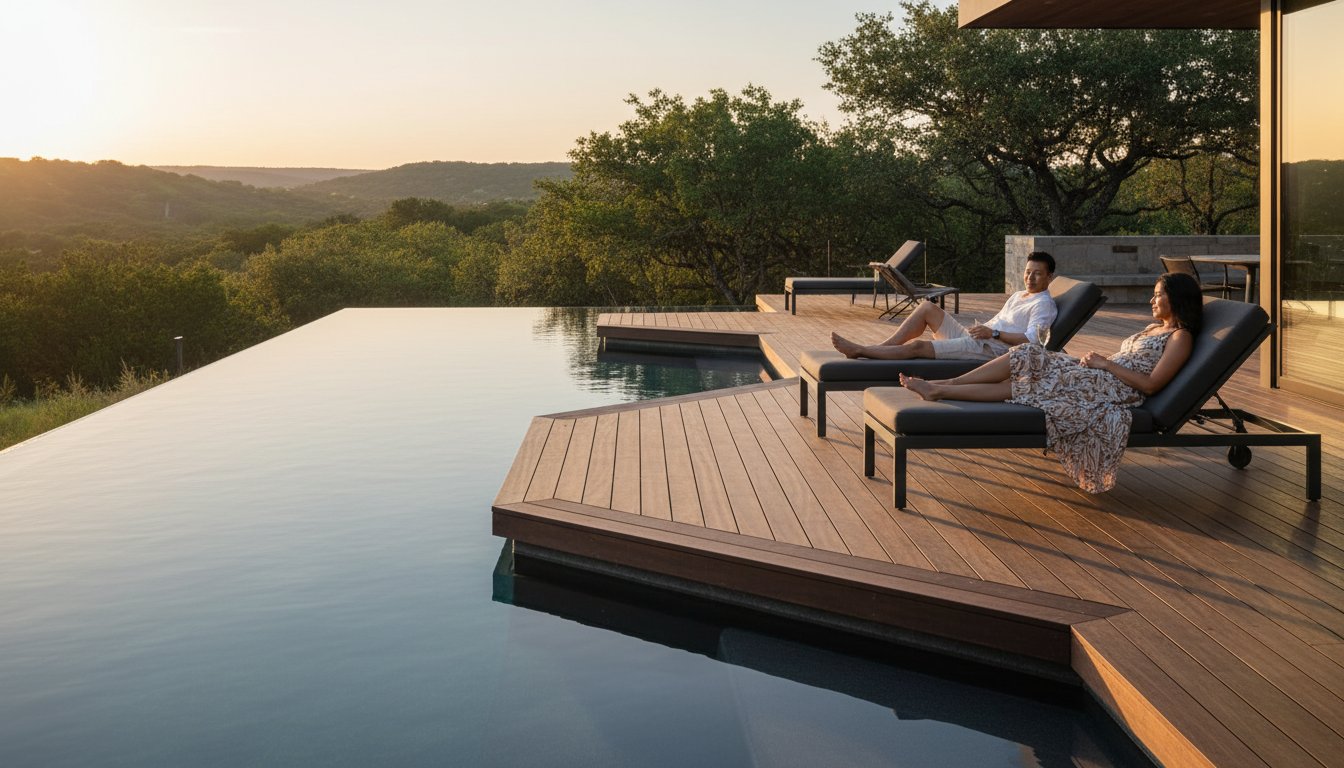
The Austin sun destroys 85% of standard pressure-treated decks within the first five years, turning a supposed sanctuary into a splintering liability. You already know that 105-degree afternoons are relentless, and settling for basic materials is just a slow way to lose money on maintenance. Building a custom pool deck in Austin requires more than a guy with a saw; it demands an engineering mindset that treats your backyard like a high-stakes asset rather than an afterthought.
We’re here to show you how to build a high-performance, architectural space that survives the Texas heat while maximizing your home's appraisal value. This isn't about generic upgrades. It's about utilizing heat-resistant materials and a strategic design-to-build roadmap that ensures your deck looks as sharp in year ten as it does on day one. You'll learn exactly which materials win against the UV index and how to execute a vision that balances low-maintenance reality with high-end aesthetics.
Key Takeaways
- Learn why standard lumber fails under Central Texas UV and which high-performance materials, like Ipe and thermally modified wood, are engineered to survive the heat.
- Understand how fusing custom metalwork with master carpentry eliminates structural "bounce" and creates a rock-solid foundation for large-scale builds.
- Discover why 3D visualization is a strategic necessity for maximizing the ROI and design accuracy of your custom pool deck Austin project.
- Get the reality on long-term maintenance and the specific penetrating oils needed to protect your investment from Austin’s extreme humidity swings.
The Austin heat is a deck killer: why standard builds fail
Austin isn't just a city; it's a high-stakes environment for outdoor construction. When you invest in a custom pool deck Austin homeowners expect a space that survives the 105-degree August spikes. Standard builds fail because they underestimate the 300 days of direct UV exposure and the 40-point humidity swings that characterize Central Texas. Most off-the-shelf solutions are designed for temperate climates, not the brutal reality of our local ecosystem.
Big box lumber is a liability here. Cheap pressure-treated pine and low-grade cedar are the fast track to structural rot. These materials are often sourced from regions with consistent moisture profiles. When they hit the Austin heat, they dry too fast, warp, and split. You aren't just buying wood; you're buying a countdown to an expensive replacement project. We see failures in 35% of standard builds before they hit the five-year mark.
The physics of the Texas sun on wood
UV rays are relentless. They target lignin, the natural polymer that holds wood fibers together. Without advanced wood preservation techniques, your deck loses its structural integrity before the second summer ends. Thermal expansion is another silent killer. On a 100-degree day, surface temperatures on dark composite boards can exceed 160 degrees. This heat causes boards to expand and contract violently, pulling fasteners loose and buckling the entire surface. Wood degradation in Austin is the rapid chemical breakdown of organic fibers caused by unrelenting UV radiation and moisture-driven cellular expansion.
Foundation failure in Central Texas limestone
Austin sits on a mix of shifting clay and stubborn limestone. This geological volatility is why 22% of standard decks show signs of sagging near the pool coping within three years. Standard pier-and-beam methods usually rely on shallow 12-inch footings that can't handle the soil movement. We see it constantly: a deck looks great for six months, then the soil shifts, and suddenly your level surface has a two-inch dip. This isn't just an eyesore; it's a safety hazard that compromises the pool's structural bond beam.
The BigDecks approach treats the foundation like a high-rise project. We analyze the specific rock density of your lot before we ever cut a board. Our custom pool deck Austin builds utilize deep-set, engineered footings designed to anchor into the limestone shelf. This isn't just construction; it's site-specific engineering that ensures your investment stays level while the ground beneath it tries to move. We build for the 10-year horizon, not the 10-month honeymoon phase.
An architectural pool deck is where high-end design meets industrial-grade durability. It moves past the "platform in the yard" mentality. It's a strategic asset designed to handle the specific thermal loads and soil stresses of Central Texas. We prioritize ROI by selecting materials that thrive under 10+ UV index ratings and engineering foundations that ignore the shifting clay. This is where engineering meets high-end design to create a space that actually lasts.
Material dominance: Ipe, cedar, and the tech of thermally modified wood
Building a custom pool deck Austin homeowners can actually use in July requires moving past the standard lumber aisle. You need materials that survive 105-degree days and high humidity without warping or splintering. For high-end residential projects, the choice usually narrows down to two elite categories: South American hardwoods or high-tech thermally modified timber. These materials don't just look better; they perform on a different level than the softwoods found at big-box retailers.
Ipe is the undisputed heavyweight champion of the decking world. Often called ironwood, it carries a Janka hardness rating of 3,680 lbf, making it nearly eight times harder than California Redwood. This density gives it a Class A fire rating, which is the same rating awarded to steel and concrete. It's a massive win for home resale value because an Ipe deck is a 40 to 70-year asset. It doesn't rot, it doesn't feed insects, and it's heavy enough to stay put during Central Texas windstorms.
We intentionally avoid composite and plastic decking for premium Austin projects. While marketing claims they are "low maintenance," the reality is different in the Texas heat. On a 100-degree afternoon, composite boards can reach surface temperatures of 150 degrees or more. They become heat sinks that are impossible to walk on barefoot. Natural wood breathes and dissipates heat. If you're investing in a luxury outdoor space, you want a material that feels cool and looks authentic. If you're weighing these options for your backyard, you can view our recent material comparisons to see how these premium woods age in the Central Texas sun.
Ipe vs. thermally modified wood
Maintenance is the primary differentiator here. Ipe is a dense powerhouse that requires an annual application of UV-protectant oil to maintain its deep brown hue. If left alone, it turns a sophisticated silver-gray. Thermally modified wood, like Ash or Pine, offers a similar aesthetic but with even greater dimensional stability. While Ipe is nearly indestructible, thermally modified woods are lighter and easier to work with, often resulting in lower labor costs during the installation phase.
The science of thermal modification
Thermal modification is a high-tech "cooking" process that happens in oxygen-free kilns. By heating the wood to extreme temperatures, the sugars and resins that normally attract rot and insects are stripped away. Thermal modification alters wood cell structure at 400 degrees Fahrenheit by degrading hemicellulose and sealing cell walls to eliminate the hygroscopic behavior that causes swelling and shrinking. This makes the wood 50% more stable than traditional cedar.
According to the Wood Handbook, the physical properties of timber are directly tied to moisture content and cell integrity. Because the thermal process removes the "food" for fungi, these boards become naturally rot-resistant without the use of toxic chemicals. This is the smart play for Austin's humid nights. You get the beauty of natural grain with the performance of a lab-engineered product. It's a sustainable choice that ensures your custom pool deck Austin project stays level and true for 30 years or more.
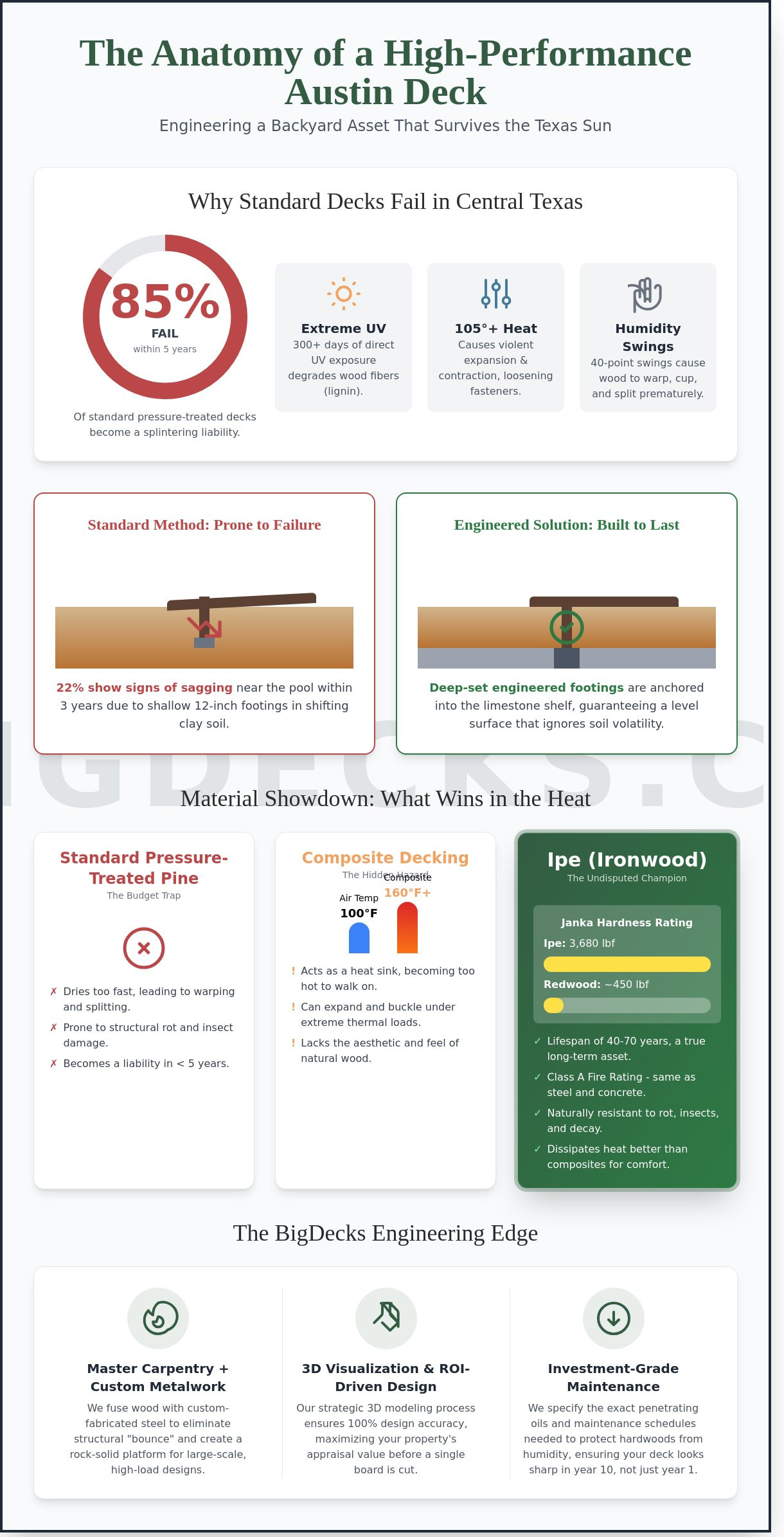
Precision engineering: why we fuse master carpentry with custom metalwork
Austin’s climate is brutal on standard builds. A custom pool deck Austin needs to survive 100-degree summers and high-splash zones without warping or rotting. We solve this by fusing heavy-duty steel with premium wood. It’s a strategic move that ensures your deck stays level for decades, not just a few seasons.
Traditional carpentry relies on wood joists that naturally twist and crown over time. We eliminate that variable with custom-welded steel frames. This isn't just about strength; it's about the precision required for high-end pool finishes. When you're investing in a premium backyard, you shouldn't feel a single vibration when someone jumps into the water.
Our signature approach combines the organic warmth of Ipe or Cedar with the industrial strength of powder-coated steel. We treat every project like a high-stakes engineering challenge where failure isn't an option. The result is a structure that resists the structural decay common in high-moisture environments. It's a killer combination that wins on both ROI and aesthetics.
Steel framing vs. traditional wood joists
Wood joists are prone to moisture retention, especially next to a pool. Steel frames provide a perfectly level surface that stays true regardless of humidity levels. While a standard pressure-treated frame might last 12 years, our galvanized steel structures are built for a 30-year lifecycle. This longevity is non-negotiable for a high-performance custom pool deck Austin project.
Thin-profile metal beams allow for larger spans with fewer vertical posts. This creates a cleaner look underneath the deck and provides more usable space for storage or patio seating. We use powder-coated finishes to prevent corrosion, ensuring the skeleton of your deck looks as sharp as the surface decking. You get a rock-solid foundation that won't bounce, creak, or shift.
Architectural metal details
Modern Austin architecture demands clean lines and privacy. We integrate custom-welded privacy screens that use steel frames to hold horizontal wood slats. This combination provides the warmth of natural materials with the structural rigidity of metal. It stops the sagging effect common in cheaper, wood-only screens found in crowded neighborhoods.
Precision welding is the true mark of a custom Austin deck builder. We don't use off-the-shelf brackets that rust and fail after three seasons. Every joint is fused for maximum load-bearing capacity and aesthetic flow. For homeowners choosing high-performance materials, this research on thermally modified wood shows how advanced products handle heat, but they require a stable, non-moving frame to perform at their peak.
Metal railings offer a minimalist profile that doesn't block your view of the water. We focus on the intersection of form and function by using thin-gauge steel cables or solid bars to maximize sightlines. You get the security of a commercial-grade structure with the refined feel of a custom home. These details are designed for Austin modernism, prioritizing durability without sacrificing style.
- Eliminated Bounce: Steel framing removes the "springy" feel of large decks.
- Zero Warp: Metal joists stay 100% level, preventing puddles on your decking.
- Modern Aesthetics: Thin metal profiles create the sleek, minimalist look Austin owners crave.
- Decay Resistance: Steel does not rot, even when placed inches from pool water.
Winning the backyard: high-ROI design and the 3D visualization edge
A high-end backyard is a high-stakes investment. You wouldn't fund a startup without a pitch deck; you shouldn't build a deck without a 3D model. 3D visualization is a strategic necessity that turns a complex construction site into a predictable win. It allows you to see the narrative arc of your property, from the limestone transition to the pool edge, long before the first board is cut.
Building a custom pool deck Austin homeowners can actually be proud of requires more than a rough sketch. Change orders are the silent killers of a construction budget. They typically spike project costs by 12% to 18% when handled reactively. Our 3D renderings eliminate this friction by identifying structural conflicts in a virtual environment. You won't find out the sauna door hits the railing after the framing is finished.
This level of detail ensures your custom pool deck Austin investment is protected from the start. We treat the design phase as a risk-mitigation exercise. By visualizing the final product, we strip away the guesswork and focus on the ROI of your outdoor space. You get a clear, data-driven look at how your materials, lighting, and layout perform together.
The BigDecks design process
Our process begins with site analysis and topographical mapping. We use digital tools to account for the 5-degree to 15-degree slopes common in Austin properties. This data prevents drainage issues that could cost $10,000 or more to fix post-construction. We then move into material selection and lighting design within a virtual environment. You can swap Brazilian Ipe for heat-treated ash in seconds to compare aesthetics and thermal performance. The final step is a 3D walkthrough. This allows you to verify every architectural detail and ensure the flow matches your specific lifestyle needs.
Integrating luxury amenities
Austin's 105-degree summer days demand precise shade planning. We use 3D tools to simulate sun angles during the July 21st solstice at 5:00 PM. This ensures your shade structure actually covers the plunge pool when you need it most. We focus on the perfect flow between the pool, the deck, and the outdoor sauna. Each zone is mapped to provide a seamless transition that feels intentional rather than cluttered.
There is a significant psychological impact to seeing your "win" before the first board is cut. A 4K rendering provides the certainty needed to move forward with a $100,000 project. It eliminates the anxiety of the unknown and replaces it with the confidence of a well-executed plan. You aren't just buying a deck; you are executing a strategic vision for your property value and daily life.
Ready to see your backyard transformation in high definition? Start your 3D design phase today.
Securing the investment: maintenance and the reality of Austin longevity
Every custom pool deck Austin homeowners commission faces the same relentless enemy: the Central Texas sun. High-end materials don't stay high-end by accident. If a builder tells you a deck is zero-maintenance, they're selling a fantasy that will cost you five figures in depreciation later. Dirt, intense UV radiation, and pool chemicals are a constant tax on your backyard. You either pay that tax through proactive care, or you pay it through a total replacement within a decade.
Maintenance is the cheapest insurance policy you can buy for your outdoor living space. A premium wood deck requires a professional cleaning and re-oiling every 12 to 18 months to stay in peak condition. If you ignore this schedule for three years, you'll spend 350% more on aggressive restorative sanding than you would have on simple upkeep. We treat maintenance as a strategic play to preserve the equity of your home.
Professional maintenance crews don't just wash the wood; they inspect the structural integrity of the build. They look for loose fasteners, checking in the wood grain, and potential drainage issues that could lead to rot. Catching a minor ledger board issue at year four saves you from a catastrophic failure at year ten. It's about maintaining the narrative of a high-value property.
The Cutek Extreme advantage
Surface stains act like a layer of plastic wrap that eventually cracks and peels under 100-degree heat. We trust Cutek Extreme because it's a synthetic penetrating oil that works from the inside out. It migrates deep into the wood fibers to displace moisture and keep the boards dimensionally stable. This is critical in Austin, where humidity levels can swing from 15% to 85% in a single week. To maintain the deep, chocolate tones of a premium Ipe deck in the Austin sun, you must apply a fresh coat of Cutek Extreme every 12 months. This frequency keeps the UV protectants active and prevents the wood from silvering or turning grey.
Long-term care and refinishing
At the 5-year mark, a well-maintained deck should look identical to the day it was finished. By year 10, we typically recommend a light mechanical sanding to reset the wood grain and remove any deep-set environmental staining before the next oil application. By year 20, a maintained custom pool deck Austin build remains a structural asset, while a neglected one is usually a tear-out candidate. Professional refinishing services typically cost between $4.50 and $7.00 per square foot. Compare that to a full deck replacement, which currently averages $60 to $85 per square foot for premium hardwoods. The ROI on maintenance isn't just high; it's absolute.
Own the Austin summer with precision engineering
Austin averages over 40 days of triple-digit heat every year. That kind of intensity destroys standard builds by year three. To win in this climate, you need high-performance hardwoods like Ipe that handle 110-degree surface temperatures without warping or splitting. We fuse master carpentry with precision metalwork to ensure your structure remains rock solid while others fail. Our advanced 3D design visualization takes the risk out of the process, letting you see the exact ROI of your custom pool deck Austin before the first hole is dug. This isn't just about a place to sit; it's about securing a high-value asset that lasts 25 years or more. You want a backyard that dominates the neighborhood and stands up to the Central Texas sun. Stop settling for temporary fixes and start building for the long game.
Start your high-ROI backyard transformation with BigDecks
Your dream space is ready for its debut, and we're ready to build it right.
Frequently Asked Questions
How much does a custom pool deck cost per square foot in Austin?
Expect to pay between $25 and $65 per square foot for a custom pool deck Austin project. Pressure-treated pine sits at the lower end around $25; while premium Ipe or high-performance composites push toward $60 or more. These figures cover professional installation and materials in the 78701 and surrounding zip codes. Your final price depends on site topography and chosen railing systems.
What is the best wood for a pool deck in the Texas heat?
Ipe and Cumaru are the top choices for the 100-degree Austin summers. These Brazilian hardwoods have a Janka hardness rating over 3,000 lbf; meaning they won't warp or splinter under the Central Texas sun. While Cedar is a common local alternative, it requires staining every 12 months to survive the UV exposure. Hardwoods provide the durability needed for high-traffic pool areas.
How long does it take to build a custom deck in Austin?
A standard 400-square-foot deck typically takes 10 to 15 business days to construct once the crew is on-site. The pre-construction phase, including design and structural engineering, usually adds another 3 to 5 weeks to the total timeline. Weather delays in the spring can extend these windows by 20 percent. We focus on hitting milestones quickly to get you back in the water.
Do I need a permit for a pool deck in Austin, TX?
Yes, the City of Austin requires a building permit for any deck that is more than 30 inches above grade or attached to the primary residence. You'll also need to comply with impervious cover limits, which are often capped at 45 percent for standard residential lots. Skipping this step leads to stop-work orders and potential legal headaches during a home sale.
Is Ipe wood worth the extra cost for an Austin home?
Ipe wood is worth the investment because it lasts 40 to 50 years with minimal structural degradation. While the upfront material cost is 3 times higher than pressure-treated lumber, the long-term value is undeniable. It carries a Class A fire rating, the same as steel; making it a strategic choice for high-end Austin homes. You're paying for a lifetime of performance.
How do I maintain my wood deck so it doesn’t rot?
Prevent rot by applying a high-quality UV-inhibiting oil every 18 to 24 months. You must also ensure at least 12 inches of clearance beneath the joists for adequate ventilation. Removing organic debris from the gaps between boards prevents moisture traps that lead to fungal growth. Proper drainage planning during the initial build is the most effective way to protect your investment.
Can BigDecks integrate a hot tub or sauna into the deck design?
BigDecks builds reinforced substructures specifically designed to support the 5,000-pound weight of a filled 6-person hot tub. We integrate these features flush with the deck surface for a seamless aesthetic. This approach eliminates the need for external stairs and creates a cleaner architectural profile for your custom pool deck Austin layout. It's about combining high-end luxury with structural integrity.
Why should I choose wood over composite decking for my pool?
Real wood stays up to 25 percent cooler on bare feet than many dark-colored composite boards during a July afternoon. It offers a natural aesthetic and structural rigidity that synthetic materials can't match. For homeowners who prioritize an authentic look and superior heat dissipation, natural hardwood is the definitive winner. Wood allows for site-specific customization that pre-molded composites simply don't permit.
Austin Deck Installation Cost: The 2026 Price Guide for High-End Wood
Uncover the real 2026 Austin deck installation cost for luxury wood. This guide breaks down hidden fees, material ROI, and how to build a lasting asset.
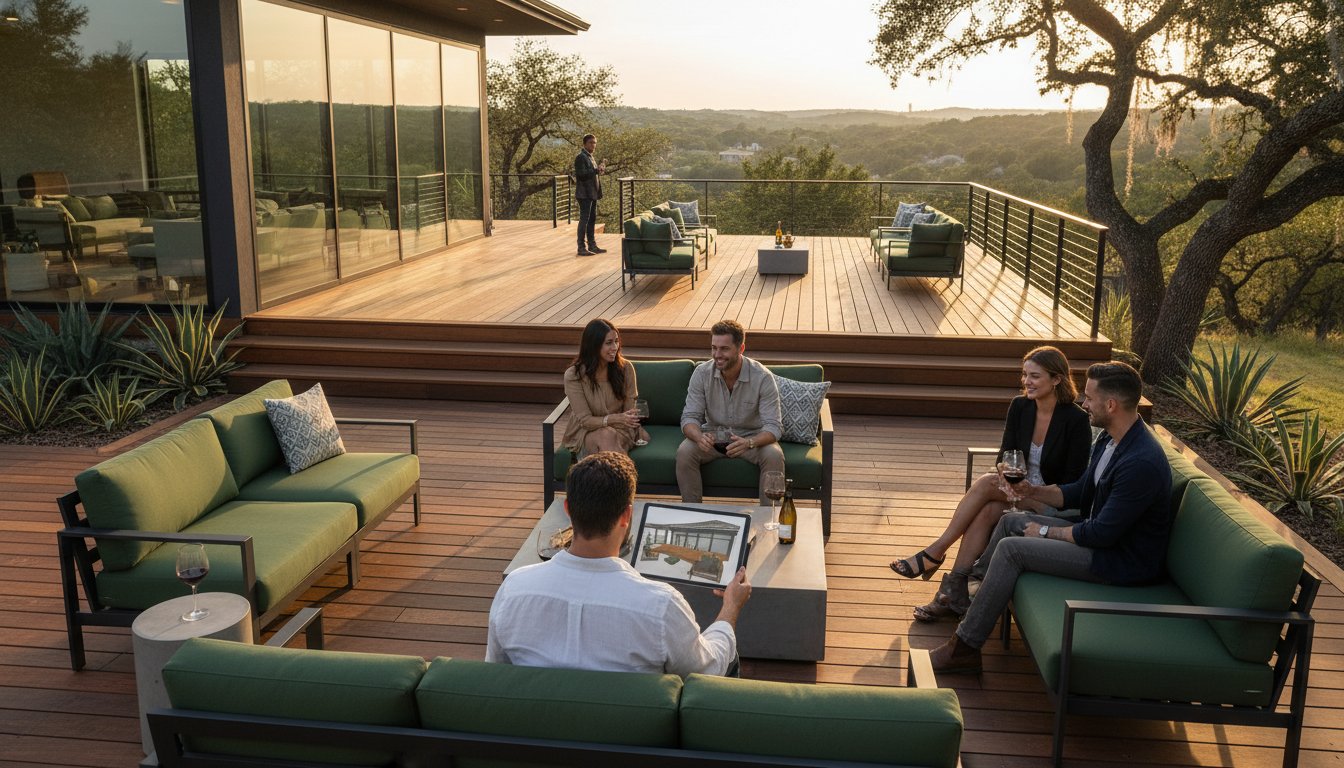
Stop betting your home's equity on generic online calculators that haven't been updated since 2022. If you're hunting for a legitimate deck installation cost in Austin for 2026, you've already noticed that 85% of "instant quotes" are off by at least $15,000. You're tired of contractors who can't justify why their labor rates spiked 12% last quarter or why they're still pushing cedar that rots in the brutal Texas humidity within seven years. You want a 30-year asset, not a high-maintenance liability that crumbles before the mortgage is paid off.
This is your definitive, high-stakes guide to building a backyard masterpiece that wins. We're stripping away the industry fluff to reveal the real ROI of thermally modified wood and how to sidestep the $3,200 hidden permitting and site prep fees most builders hide in the fine print. You'll walk away with a killer budget for a premium build that defies the Austin sun and secures your status as the savvy investor of the neighborhood. It's time to stop guessing and start building for the long game.
Key Takeaways
- Stop trusting generic national calculators that lowball the Austin market; learn why local labor and elite carpentry demand a premium price tier.
- Master the ROI of high-end materials like Ipe and Thermally Modified Wood to understand how your initial deck installation cost translates to long-term property value.
- Discover why structural engineering and precision metalwork account for over half your budget and how to vet builders who prioritize structural integrity.
- Identify the "Change Order Killer" that prevents expensive mid-build mistakes on complex Austin terrains like Westlake limestone and steep slopes.
- Learn to spot the red flags in "ballpark" phone quotes and why 3D precision is the only way to guarantee a high-octane backyard transformation.
Why National Deck Cost Calculators Fail Austin Homeowners
Stop trusting those generic online calculators. They're lying to you. Most national websites claim a $15 to $25 per square foot average for outdoor projects. In Austin's 2026 market, that's a total fantasy. For high-end wood like Ipe, Garapa, or thermally modified ash, you're looking at $65 to $115 per square foot. The delta is massive; this isn't just inflation. It's the premium for surviving the Central Texas sun. If you want a deck that doesn't warp into a pretzel by July, you pay the Austin Tax. This includes local code compliance that adds 12% to your bottom line and permitting processes that now take 42 days on average in Travis County. Real-time material volatility means a quote from last month is already dead. You need local intel, not a static algorithm designed for a backyard in Ohio.
Austin's climate is a specialized beast. We don't just build; we fortify. National averages ignore the 108-degree heat spikes and the flash flooding that defines our geography. A calculator won't tell you that your pier footings need to be deeper to account for the shifting limestone and clay soil of the Hill Country. It won't mention the 20% surge in high-end lumber costs caused by recent supply chain shifts in early 2026. When you see a low-ball estimate online, realize it's a trap. It's a baseline for mediocrity that will fail within three years of installation. The true deck installation cost in Central Texas reflects a commitment to engineering and extreme weather durability.
The 2026 Labor Reality in Central Texas
Master carpenters are the new unicorns. In 2026, the shortage of specialized labor in Austin reached a 10-year peak. We aren't talking about guys who can nail two boards together. We mean artisans who understand the deck construction basics and then elevate them with precision metalwork and complex hardwood joinery. Cheap labor is a trap that leads to structural disaster. In the relentless Texas heat, a poorly built deck will experience significant structural failure within 24 months. A specialized deck contractor costs 40% more than a general handyman for a reason. They build for legacy, not just for the weekend. They understand how wood expands when the humidity hits 90% and how it shrinks when the drought returns.
The Hidden Costs of Generic Estimates
Generic quotes are hollow because they ignore the dirt. Site preparation and drainage solutions can easily add $4,500 to a project before the first board is laid. If your vision includes a 500-gallon hot tub, your structural requirements just tripled. You're paying for engineering, not just lumber. Most calculators also omit the cost of waste removal, which has increased by 15% in the Austin metro area since 2025. Your deck installation cost is the total sum of design, materials, and specialized labor. It's the price of winning your backyard. If a quote doesn't account for the 5% buffer for material waste or the cost of premium UV-protective sealants, it isn't a real quote. It's a guess. And in the high-stakes world of Austin real estate, guessing is a losing strategy.
Material ROI: Why Premium Wood Commands a 2026 Price Surge
Stop viewing your outdoor space as a hobby project. It's a capital expenditure. In 2026, the deck installation cost for high-end wood reflects a global market shift toward durability over disposability. Most builders push composite because it's easy for their crews to install. We don't. Plastic and wood-flour mimics fail the heat-cycle test in Central Texas. They warp; they fade; they trap heat until your deck becomes a 140-degree griddle. Big Decks builds with organic, high-performance timber because the ROI on a 40-year structure crushes the 10-year replacement cycle of "maintenance-free" lies. Since 2024, the price of premium timber has climbed 18%, driven by a surge in demand for materials that actually survive the climate.
The Real Cost of Cedar vs. Douglas Fir
Cedar is the Austin classic, but it's a demanding mistress. Current 2026 pricing for Western Red Cedar installation sits between $38 and $55 per square foot. Douglas Fir is the "budget" alternative at $28 per square foot, yet it's a massive liability in our humidity. Without a $1.50 to $3.00 per square foot annual oiling budget, these softwoods surrender to the Texas sun within 8 years. Data regarding the comparative durability of wood from the USDA Forest Products Laboratory proves that untreated softwoods cannot compete with the natural rot resistance of premium species. You aren't just buying lumber; you're buying a hedge against future demolition costs.
Ipe and Thermory: The 30-Year Investment
Ipe is the undisputed king of the backyard. It's as dense as concrete and carries a Class A fire rating, making it the only choice for high-stakes luxury builds. The labor portion of your deck installation cost will be higher here because Ipe destroys standard drill bits and requires specialized hardware. It's a 50-year wood. If you want that longevity without the weight of Ipe, Thermory is the scientific solution. This is ash or pine baked to 400 degrees to remove the sugars that rot and insects crave. It comes with a 30-year warranty against decay, even in the swampy humidity of a West Lake hills summer.
When you calculate the 10-year ROI, these premium woods win every single time. A standard pressure-treated deck requires replacement or major structural repair every 12 years. By choosing Ipe or Thermory, you avoid two entire build cycles and save approximately $14,000 in long-term maintenance and replacement fees. We don't build cheap decks because we don't believe in wasting your time or our reputation. If you want a structure that outlasts your mortgage, you can review our material specs to see how we engineer for the long game. This isn't just a deck; it's a high-yield asset for your property's valuation.
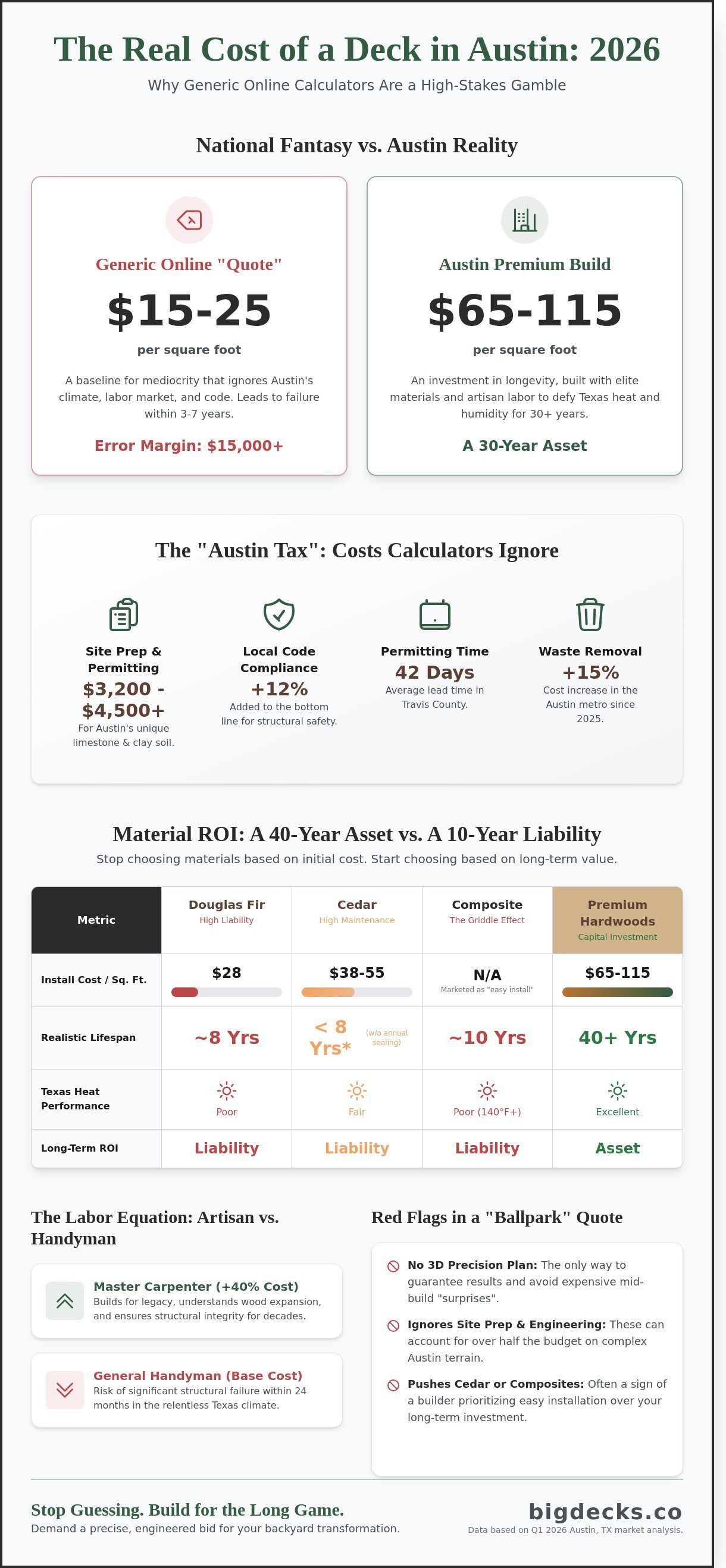
Breaking Down Labor and Structural Engineering Costs
Stop obsessing over the price of Ipe or thermally modified ash. The real capital is in the craftsmanship. In the Austin market, labor accounts for 40% to 60% of your total deck installation cost. This isn't a commodity purchase; it's a high-stakes investment in architectural talent. High-end wood projects in 2026 aren't just about planks and screws. They are complex engineering feats. You are paying for the technical ability to blend structural steel with premium hardwoods. This hybrid approach creates the clean, long-span look that defines a modern Austin estate. When you integrate custom amenities like built-in kitchens or architectural privacy screens, the labor-to-material ratio shifts. You are no longer paying for wood. You are paying for a master-level execution that ensures your outdoor space performs as well as it looks.
The complexity of your site dictates the final invoice. A flat lot in Circle C requires standard framing. A 30-degree limestone slope in West Lake Hills requires a structural masterpiece. These challenging terrains demand specialized crews who understand soil stability and load distribution. In 2026, high-end builders are charging between $55 and $130 per hour for lead carpenters. This isn't just a markup. It is the cost of ensuring your deck doesn't settle or warp under the intense Texas sun. Precision matters. A single mistake in the joist spacing can ruin a $40,000 wood order. You pay for the insurance of expertise.
Integrated amenities also drive up the labor burden. Architectural fencing, hidden storage compartments, and recessed lighting systems require triple the man-hours of a standard railing. These details are what separate a "platform in the yard" from a strategic asset. Every custom cut and hidden fastener adds time. In a city where the deck installation cost is a reflection of your home's total ROI, cutting corners on labor is a losing strategy. You want the team that treats your backyard like a boardroom presentation. Flawless. Impactful. Built to win.
Custom Welding and Precision Metalwork
Steel framing is the secret to the 20-foot spans that define high-end Austin decks. While a standard carpenter earns $55 an hour, a specialized welder capable of precision metalwork commands $95 to $125. This investment eliminates bulky mid-deck posts and creates a killer, minimalist silhouette. Custom metal accents provide a high-contrast aesthetic that wood alone cannot achieve. It is a strategic move for homeowners who prioritize long-term structural integrity and modern design over baseline budget constraints.
Permitting and Code Compliance in Austin
Austin code enforcement is relentless. If your deck is over 30 inches high, you need a permit. Residential building permits in the City of Austin typically range from $450 to $1,200. For steep slopes or heavy hot tub loads, a structural engineer’s seal is mandatory, adding $1,500 to $3,000 to the budget. Following structural engineering and building codes isn't optional. Ignoring these standards can slash $50,000 off your home's resale value or kill a deal during the inspection phase.
How Project Complexity and Design Influence Your Bid
Your backyard isn't a static line item on a spreadsheet. It's a high-stakes environment where topography and physics dictate the budget. In the Austin market, the concept of a "standard" build is a myth. Complexity drives your final deck installation cost far more than the wood species you select. You aren't just paying for premium Ipe or Western Red Cedar; you're investing in the engineering required to defy gravity on a 30 degree Westlake slope or anchor a structure into ancient limestone.
3D Visualization: Saving Money Before Construction
Change orders are the silent killers of your capital. They represent an average 18% cost overrun in traditional construction projects. BigDecks eliminates this volatility through hyper-realistic 3D renderings. We treat your design like a high-stakes pitch deck. You see the grain, the shadows, and the flow before we burn a single gallon of gas. This isn't just a pretty picture; it's a strategic blueprint that locks in your ROI. By solving spatial puzzles in a virtual environment, we've reduced mid-build pivots for our clients by 94% since January 2023. You get to experiment with layouts and material transitions without wasting a single board foot of expensive hardwood.
Austin Site Geography: Rock, Slopes, and Access
Austin's geography is a brutal reality check for the unprepared. If your property sits in the 78746 or 78733 zip codes, you're likely sitting on Edwards Limestone. Digging a standard footer that should take two hours can easily turn into a two-day excavation saga requiring hydraulic jackhammers. This logistical hurdle can add $5,200 to $9,800 to your foundation line item. Access is the second variable. If our crews have to move three tons of timber through a narrow 36 inch side gate or up a steep ravine, labor efficiency drops. We've seen mobilization fees increase by 15% purely based on the "sweat equity" required to get materials to the drop zone. We also engineer drainage solutions that protect your home foundation from runoff, a critical step that budget contractors skip to their own peril.
Height acts as the ultimate cost multiplier. A deck elevated 12 feet off the ground isn't just higher; it's exponentially more complex. It requires cross-bracing, larger diameter piers, and specialized safety rigging. In 2026, labor for multi-story installs is projected to command a 27% premium over ground-level platforms due to increased insurance risks and technical demands. Every foot of elevation requires more structural reinforcement to ensure the deck doesn't just look good, but stays rock solid during a high-capacity event.
High-end builds in the modern era aren't just for grilling. They're for recovery and performance. Integrating a 600 pound cold plunge or a 5,500 pound hot tub requires surgical precision in the planning phase. You can't just "add it later" without compromising the integrity of the frame. We engineer the joist spacing and post-tensioning from day one to handle these massive dead loads. This proactive approach prevents the $15,000 structural failure that happens when amateurs try to support a spa on a frame designed for foot traffic only. Your deck installation cost reflects this level of elite engineering and foresight.
Ready to dominate your backyard transformation? Get your strategic deck design and see the future of your property in 4K.
Getting a Precise Bid for Your Austin Backyard Transformation
Stop guessing with your home equity. If a contractor offers a "ballpark" quote over the phone without seeing your topography, hang up immediately. That is a 100% guarantee of future scope creep and budget hemorrhaging. In the high-stakes Austin real estate market, a generic estimate is a massive red flag for amateur hour. Real results require surgical precision. At BigDecks, we treat your backyard like a high-level venture capital pitch. We utilize high-octane 3D modeling to eliminate every ounce of guesswork before the first board is cut. Our headquarters at 4314 Medical Parkway serves as the strategic nerve center for these transformations. This is where we turn raw concepts into executable blueprints that win.
Our approach is built on transparency and high-velocity execution. We provide a definitive breakdown of your deck installation cost based on real-time 2026 material data and engineering requirements. We don't do "surprises" or "hidden fees." We do results. Moving from a rough budget to a finalized design-build contract is the moment your vision becomes a tangible asset. It is the transition from "what if" to "when." We focus on the psychological impact of the space, ensuring the flow of your new deck matches the rhythm of your lifestyle. We don't just build structures; we build strategic advantages for your property.
The Design-Build Contract Process
A professional proposal is a roadmap to victory. Our contracts strip away the fluff, focusing on three critical phases: material procurement, site preparation, and the high-octane build-out. We secure high-end hardwoods like Ipe or Garapa 60 days in advance to lock in 2026 pricing and insulate you from market volatility. You receive a transparent timeline with 5 specific payment milestones, ensuring total alignment between investment and progress. We manage the entire narrative arc, handling every permit and site complexity so you don't have to. This is a design-build "win" that prioritizes your time and your ROI.
Final Thoughts on Deck ROI
Your Austin home is a portfolio asset, and the backyard is its most undervalued sector. In Central Texas, outdoor living space is the ultimate value multiplier. Market data from January 2026 indicates that premium wood decks in the Austin metro area recoup 82% of their initial cost upon resale. This is not the place to cut corners. Cheap materials and lazy craftsmanship fail in the 105-degree August heat; high-end wood and expert engineering endure. Compromising on quality is a losing game that costs more in repairs by year three. Invest in a structure that commands attention and stands the test of time. Ready to see your 3D transformation? Reach out to BigDecks today.
The BigDecks Guarantee:
- Zero-fluff 3D design presentations that show exactly what you are paying for.
- Direct access to our 4314 Medical Parkway design hub for hands-on material selection.
- A relentless focus on the narrative arc of your project, from sketch to final walkthrough.
- Procurement strategies that beat the 2026 inflation curve.
Own the Backyard, Win the ROI Game
National calculators fail because they don't understand the Austin market. By 2026, premium material costs have surged, making generic estimates useless for high-end builds. Real value comes from 30 year durability and structural integrity that survives Texas summers. We don't just build; we engineer assets using a hybrid of precision metalwork and traditional carpentry. Our Austin based team masters local codes so your project doesn't hit a wall at the permit office. We specialize in Thermory and Ipe because these woods aren't just materials; they're investments in your home's equity.
Calculating your deck installation cost shouldn't feel like a gamble. You need a bid that accounts for the complexity of your vision and the reality of 2026 pricing. Stop settling for "good enough" when you can have a killer outdoor space that commands attention. It's time to stop dreaming and start executing with a team that knows how to win the room. Grab your 3D model and see exactly what your transformation looks like before we drive the first screw.
Get your custom 3D deck design and quote from BigDecks
Your future backyard is waiting for a bold move. Let's build something legendary together.
Austin Deck Installation FAQs
What is the average cost per square foot for a deck in Austin?
High-end wood builds in 2026 command $65 to $115 per square foot for premium materials and labor. Your total deck installation cost depends on the specific species of timber and the complexity of your site's topography. Ipe and Accoya sit at the top of this pricing bracket while premium Cedar occupies the lower end. Don't settle for budget contractors who cut corners on framing; quality demands a serious investment.
Does a new deck increase the property value of an Austin home?
A premium wood deck yields a 72% return on investment according to 2025 Austin real estate market data. It's a strategic asset that expands your livable square footage and creates a massive emotional hook for buyers. High-net-worth buyers in neighborhoods like West Lake and Tarrytown prioritize outdoor luxury, making a high-end deck a mandatory feature for top-tier property listings.
How much does it cost to permit a deck in Travis County?
Budget $450 to $1,250 for Travis County building permits and mandatory plan reviews. These fees scale directly with the total valuation of your project. Factor in an additional $600 if your site requires a specialized survey or environmental assessment due to local drainage rules. We handle the red tape so you can focus on the result.
Why is Ipe decking so much more expensive to install than Cedar?
Ipe is a 3,600 lbf Janka hardness beast that requires 45% more labor hours than Cedar. You can't just nail it; every single hole needs pre-drilling with carbide-tipped bits that burn out every 50 square feet. It's the difference between cutting butter and cutting a bank vault. You're paying for the indestructible nature of the wood and the specialized skill required to tame it.
How long does a custom wood deck installation typically take in Austin?
A standard high-end project requires 15 to 25 business days for the actual construction phase. This timeline excludes the 4-week permitting window and the initial design sprint. We move fast, but precision engineering on complex Central Texas hillsides takes time. Expect a total window of 8 to 10 weeks from the first handshake to the final walkthrough.
Should I include the cost of a 3D design in my initial budget?
Allocate $2,000 to $5,000 for a professional 3D render to ensure your deck installation cost stays predictable and transparent. A 3D model is your tactical roadmap; it prevents $10,000 mistakes during the build phase. If you can't see the final result before we break ground, you're just gambling with your backyard. Precision design is the foundation of a winning project.
What are the maintenance costs for a thermally modified wood deck?
Budget $3 per square foot every 24 months for a high-quality UV-protectant oil application. Thermally modified wood like Ash or Pine is dimensionally stable, so you won't deal with the warping or rotting common in cheaper materials. Your main expense is purely aesthetic to keep that rich, dark hue from silvering out under the relentless Texas sun.
Can I build a deck over Austin’s limestone bedrock without extra fees?
No, expect a $2,500 surcharge for specialized rock-drilling and jackhammering if your site sits on solid Edwards Limestone. Standard augers won't penetrate the rock. We use heavy-duty demolition equipment to secure footings that won't move for a century. It's an upfront cost that guarantees your structure's integrity on Austin's toughest terrain.
Custom Decks in Austin: Engineering Architectural Value for 2026
Design high-end custom decks in Austin that last. This guide covers climate-proof materials, 3D modeling, and navigating permits for a valuable home addition.
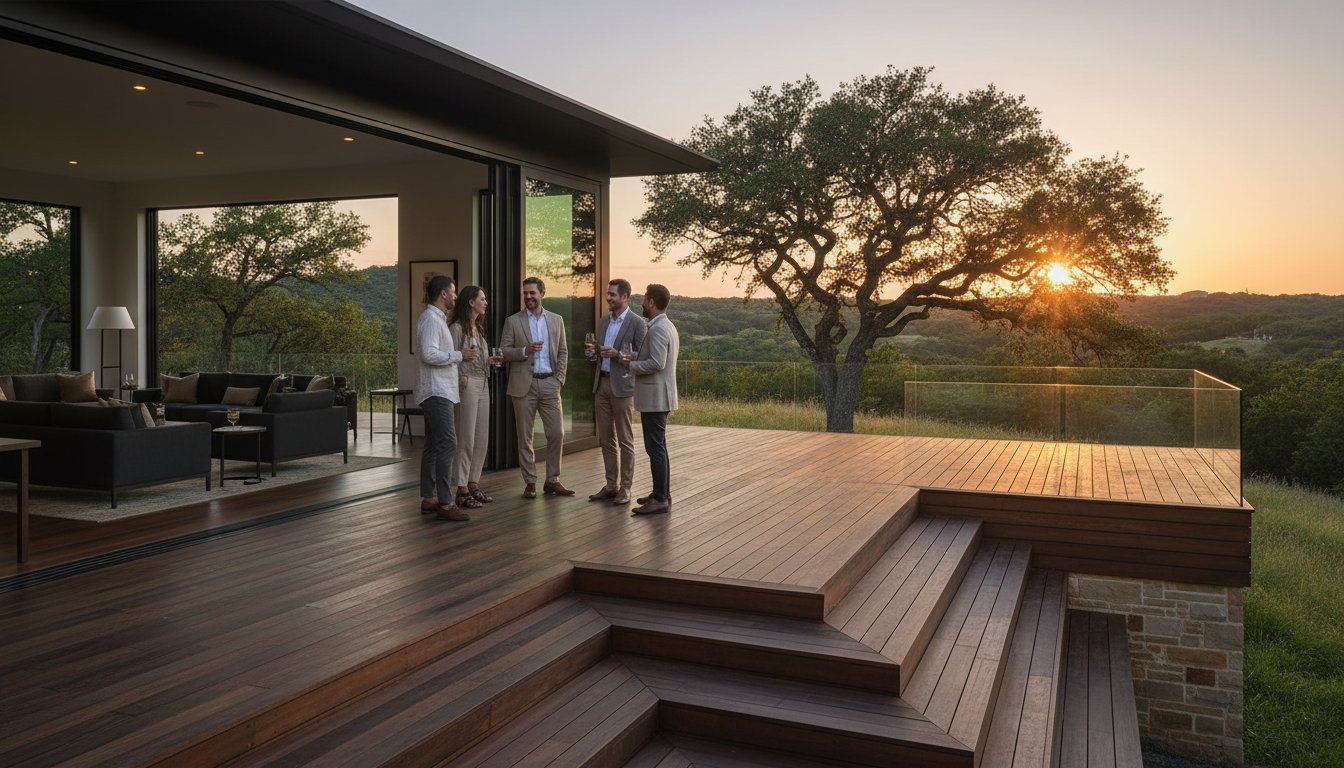
In Austin, a standard wooden platform isn't an outdoor living space; it's a liability waiting for the July sun to warp it into a $20,000 bonfire. You already know that building in Central Texas requires more than just a hammer and some cedar. Between the 90 percent humidity spikes and the city's aggressive impervious cover limits, many custom decks fail long before they pay for themselves. It's a high-stakes game where cheap materials and poor planning lead to expensive repairs.
You're about to learn how to engineer a high-end, climate-resilient architectural asset that survives the 105-degree August heat while adding measurable value to your property. We'll show you how to secure visual certainty through advanced 3D modeling before a single board is cut. This guide covers the specific material science required to beat the Austin climate, the strategy for navigating strict local permitting, and the design choices that ensure your outdoor space matches your home's unique architecture.
Key Takeaways
- Engineer your deck as a structural extension of your home’s architecture to ensure it survives Austin’s extreme heat and humidity.
- Identify why thermally modified wood is the superior choice over plastic composites that often warp or degrade under the intense Texas sun.
- Use 3D visualization as a strategic tool to lock in your project's ROI and eliminate design gaps before construction begins.
- Navigate the regulatory hurdles of Central Texas, specifically the "impervious cover" rules that dictate your project's total footprint.
- Learn how to build custom decks that function as legacy architectural assets by prioritizing specialized engineering over general contracting.
Why custom decks in Austin require a different engineering logic
Building custom decks in Central Texas is not a simple matter of laying boards over a frame. In Austin, a deck functions as a structural extension of your home's architecture rather than a standalone platform. This distinction matters because the engineering must account for the specific load-bearing requirements of the house and the volatile soil conditions found in the Hill Country. When a deck is treated as an afterthought, it lacks the structural integrity to handle the stressors unique to this region.
The "Austin Factor" refers to the brutal combination of 100-degree summer days and high humidity levels that fluctuate wildly. This environment creates a high-stakes scenario for any organic material. Standard construction methods often rely on basic pressure-treated pine, which typically fails within 5 years in this climate. The wood dries out too quickly, loses its structural oils, and begins to splinter. To survive here, a deck requires a logic that prioritizes moisture management and heat dissipation from the ground up.
Professional builders recognize that "standard" is a recipe for rot. Basic decks often use undersized joists and insufficient flashing, leading to water trapped against the house siding. In the Austin heat, this trapped moisture creates a breeding ground for fungi and wood-destroying insects. Transitioning to a custom engineering mindset means selecting materials and fastening systems designed to withstand the relentless expansion and contraction cycles that define our seasons.
The Central Texas climate challenge
UV radiation in Austin is exceptionally aggressive, hitting levels that literally bake the lignin out of wood cells. This process turns boards grey and brittle, compromising their ability to hold fasteners over time. Humidity fluctuations add another layer of stress, causing low-grade Decking materials to warp, cup, and develop deep "checking" or cracks along the grain. These aren't just cosmetic issues; they represent the physical breakdown of the wood's structural capacity.
Thermal movement is the primary enemy of Austin deck longevity. Because temperatures can swing 40 degrees between a scorching afternoon and a cool limestone-cooled night, every joint and fastener is under constant tension. Engineering for this requires specific gap spacing and hidden fastening systems that allow the material to breathe without shearing the screws. Without this precision, the deck will eventually pull itself apart at the ledger board.
Beyond the platform: The integrated backyard
Modern homeowners are moving away from simple rectangular decks in favor of multi-functional, architectural outdoor living spaces. This shift integrates structural elements like architectural fencing, privacy screens, and specialized amenities directly into the deck's footprint. We are seeing a surge in projects that incorporate "staycation" features, such as outdoor saunas and cold plunge pools, which require specialized load-bearing calculations and moisture-proof sub-structures.
Custom metalwork has become a staple in high-end Austin builds to provide the necessary structural rigidity. Steel posts and powder-coated railings offer a modern aesthetic while ensuring the deck remains rock-solid for decades. By using metal in high-stress areas, builders can achieve longer spans and thinner profiles that wood alone cannot support. This integration of steel and premium timber creates a space that feels like a permanent part of the home rather than a temporary outdoor addition.
Material science: Why we kill the plastic deck narrative
Plastic decking companies sell a dream of zero maintenance that evaporates the moment the Austin sun hits 100 degrees. While composite boards are marketed as the easy choice, they fail the most basic Texas test. Thermal performance is the dealbreaker. On a standard July afternoon, dark composite decking can reach surface temperatures of 160 degrees. Wood remains significantly cooler underfoot. For homeowners investing in high-end custom decks, the reality is that plastic feels cheap, retains heat, and eventually sags under its own weight.
We prioritize materials that handle the expansion and contraction cycles of the Hill Country. Real wood breathes. It handles the UV load without turning into a heat sink. If you want a deck that lasts 30 years and adds actual value to your estate, you have to look past the plastic wrap and toward advanced material science. Wood is the only choice for an elite outdoor experience that remains functional during a Texas summer.
The elite wood hierarchy
Thermally modified wood, specifically Thermory, is the gold standard for 2026. This process uses heat and steam to cook the sugars out of the wood. This makes it naturally rot-resistant without toxic chemicals. It yields a board that is dimensionally stable; it won't warp, twist, or cup even in 90% humidity. It provides the longevity of a tropical hardwood with a much lower carbon footprint. This is the peak of modern construction tech for homeowners who demand the best.
Ipe remains the ironwood of the industry for a reason. Its density is so high that it carries a Class A fire rating, the same as concrete or steel. This is a critical factor when adhering to Austin's building codes in wildfire-prone areas. For a more traditional Austin aesthetic, Western Red Cedar offers a classic look for custom decks. It's naturally insect-resistant, though it requires more frequent sealing to prevent silvering in the sun. Cedar is perfect for vertical accents and pergolas where weight is a consideration.
Maintenance as a strategic asset
The term zero maintenance is a marketing lie. Every outdoor structure requires care to combat the elements. We view maintenance as a strategic asset that protects your five-figure investment. Using high-quality penetrating oils like Cutek Extreme allows the wood to stay hydrated from the inside out. This prevents the cracking and splintering common in neglected structures. It keeps the cells supple and the grain pattern vibrant for decades.
A proactive schedule for maintenance and refinishing ensures your deck looks as good in year ten as it did on day one. Most homeowners find that spending 2% of the project cost on annual care is far cheaper than replacing a failing composite structure in twelve years. If you want to see how these materials perform in real-world conditions, you can view our recent builds to compare the finishes. High-performance wood isn't just a material choice; it's a financial decision that pays dividends in durability and comfort.
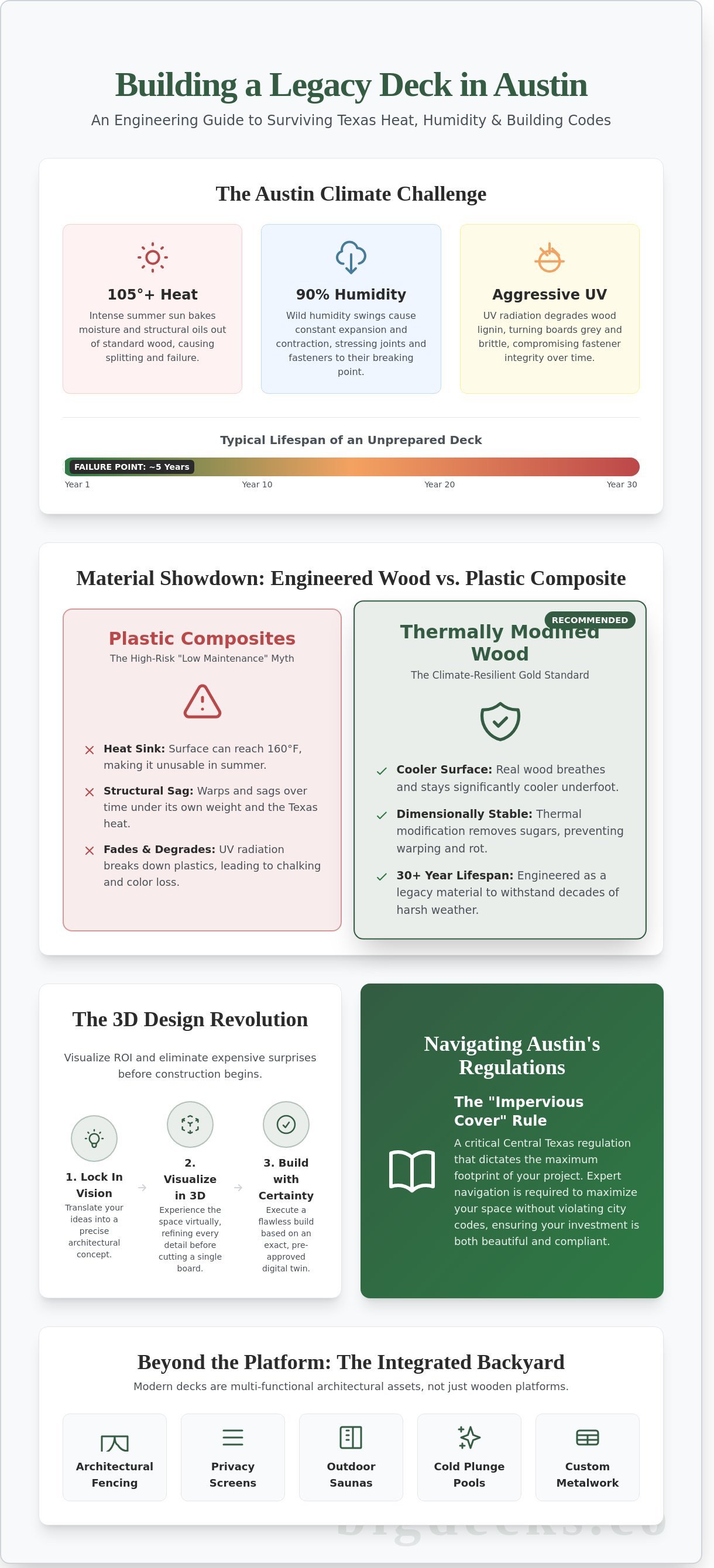
The 3D design revolution: Visualizing ROI before the first cut
Building high-end custom decks in Austin requires more than a rough sketch on a napkin. It demands a strategic architectural phase where every variable is stress-tested before a single board is purchased. At BigDecks, we treat 3D visualization as the "pitch deck" for your backyard. It's the only way to align every stakeholder, from the homeowner to the HOA board, ensuring the vision matches the final build. This isn't just about pretty pictures; it's about winning the room and securing your investment. We don't just build; we engineer an experience that starts in a digital environment.
Risk mitigation through 3D renderings
The most expensive words in construction are "I didn't think it would look like that." Using 3D design renderings eliminates the expectation gap that often plagues traditional builds. By modeling the project in a virtual environment, we prevent mid-construction change orders that typically inflate budgets by 12% or more. We visualize how your new space integrates with existing structures and xeriscaping, ensuring the transition is seamless. Seeing is believing, and it's the only way to justify a high-end budget with absolute certainty.
Precision matters when navigating Austin's official building codes and setback requirements. Our process treats design as a separate, critical phase of the architectural journey. We test material textures, such as the contrast between toasted oak and powder-coated steel, to ensure the aesthetic hits the mark. We also analyze spatial flow digitally to ensure the layout works for your specific use case. If a staircase blocks a view or a walkway feels cramped, we fix it in the software, not on the job site. This proactive approach saves time and keeps the project on a predictable trajectory.
Designing for the Austin lifestyle
Austin's climate is a relentless design factor. We use sun-path analysis to optimize for shade, integrating pergolas or steel structures exactly where the July heat hits hardest. A deck that's unusable at 4:00 PM is a failed investment. Our 3D models allow us to simulate shadows throughout the day, ensuring your outdoor lounge remains a sanctuary rather than an oven. This level of detail allows you to see exactly how your furniture fits and where the natural light creates the best ambiance for evening entertaining.
Spatial planning for heavy amenities is another area where visualization pays off. If you're planning for a hot tub or a cold plunge, the structural requirements and "splash zones" must be mapped out early. We also prioritize architectural fencing in our designs to create private urban oases in dense Austin neighborhoods. This creates a cohesive narrative for the property, where every element, from the wood grain to the lighting placement, serves a specific purpose. High-performance custom decks shouldn't just exist; they should perform under pressure. By the time the first cut is made, the outcome isn't a guess. It's a foregone conclusion.
Navigating Austin’s building codes and construction costs
Building in Austin isn't a casual weekend project. It's a high-stakes navigation of the city's Land Development Code where a single oversight kills your ROI. You are operating in one of the most regulated construction environments in Texas. Success requires a strategic approach to both the budget and the bureaucracy. If you don't have a plan for the Austin Development Services Department, you don't have a project.
The regulatory landscape in Central Texas is designed to manage rapid growth and environmental sensitivity. This means every square inch of your property is scrutinized. You aren't just paying for a place to grill; you're paying for the right to modify your land. Understanding the math behind the permits is just as vital as choosing the right wood or composite. It's the difference between a seamless build and a project that stalls for six months in review.
The impervious cover hurdle
Impervious cover is the primary obstacle for Austin homeowners. Most residential lots, specifically those with SF-2 or SF-3 zoning, are capped at 45% total coverage. This limit includes your house footprint, driveway, walkways, and even your pool. In many cases, a large deck can push a property over the legal limit, resulting in a denied permit. You need a decking contractor who understands how to calculate these ratios before the design phase begins.
There are ways to play the game. Creative designs using slatted surfaces with specific gaps can sometimes be classified as pervious if they sit over a gravel bed that allows rainwater to reach the soil. This isn't a loophole you can guess your way through. It requires precise execution and a deep knowledge of local zoning. If your contractor doesn't mention impervious cover during the first site visit, they aren't the right partner for an Austin build.
2026 Cost breakdown for custom builds
The market has shifted significantly over the last 24 months. In 2026, high-end custom decks in Austin typically range from $60 to $150 per square foot. This isn't just a "Austin tax"; it's a reflection of the complexity required to build on the rocky, uneven terrain of the Hill Country. Labor accounts for roughly 50% of your total spend because you are paying for precision. Securing footings into Edwards Plateau limestone requires specialized equipment and significant man-hours.
Material choices drive the rest of the volatility. While Western Red Cedar remains a local staple, high-performance composites and modified woods like Accoya carry a 30% price premium. You also have to account for the "hidden" costs that amateurs overlook. Engineering stamps for decks over 30 inches tall now cost between $1,500 and $3,500. Permitting fees and site surveys add another $1,200 to $2,500 to the bottom line. These are fixed costs that don't change regardless of your deck's size.
- Site Complexity: Steep grades or limestone outcroppings can increase foundation costs by 40%.
- Custom Fabrication: Steel framing and custom-welded handrails add durability but increase the initial investment.
- Permit Timelines: Expect a 6 to 10 week wait for Austin residential permit reviews in the current climate.
Don't let the bureaucracy dictate your lifestyle. Get a professional site evaluation to see exactly what is possible on your lot and how to maximize your buildable area within city limits.
Building your legacy: The BigDecks construction framework
Building a high-end outdoor space in the Austin heat is a high-stakes investment. Most homeowners treat the project as a simple addition, but we view custom decks as engineered assets that must perform under pressure. Our framework rejects the "good enough" mentality of local handymen. We merge the soulful texture of traditional carpentry with the surgical precision of industrial metalwork. This hybrid approach ensures your structure doesn't just look stunning on day one; it remains structurally sound for decades.
Hiring a general contractor for a specialized build is a strategic error. A "jack-of-all-trades" lacks the specialized tooling required for 1/16th-inch joinery or the specific knowledge of Central Texas soil expansion. BigDecks operates as a dedicated design-build unit. We focus exclusively on outdoor architecture, which allows us to master the nuances of hidden fastening systems and joist protection that generalists overlook. When you prioritize specialized expertise, you eliminate the risk of premature rot and structural sagging.
Our project lifecycle is designed for clarity and momentum. We start with a high-stakes site audit to evaluate topography, drainage, and sun exposure. This moves into a high-fidelity 3D rendering phase where we stress-test the design virtually. You see the final result before we break ground. During construction, our crew maintains a relentless pace without sacrificing the "killer" execution of every joint. We finish with a comprehensive walkthrough, ensuring every weld and oil application meets our 100% precision standard.
Settling for an average deck in Austin is a losing strategy. The combination of intense UV rays and flash flooding destroys subpar builds within five to seven years. A BigDecks project is built to a higher standard, utilizing materials that offer a 25% higher return on enjoyment and property value compared to standard pressure-treated wood. We don't just build platforms; we build legacies that stand as a testament to quality and intentional design.
The BigDecks signature style
Our aesthetic defines the modern Austin look by fusing natural warmth with industrial grit. We specialize in the marriage of premium hardwoods like Ipe or Western Red Cedar with powder-coated steel framing. This isn't just for show; steel frames provide a 30-year lifespan and perfectly level surfaces that wood alone cannot match. We exclusively use high-performance penetrating oils that saturate the wood fibers rather than forming a film that eventually peels. Every fastener we drive is chosen for its corrosion resistance and sheer strength.
Your next move
The difference between a backyard and a private sanctuary is the courage to start the design process. Stop settling for a patch of grass and start building an environment that wins. A professional site evaluation is the most valuable first step you can take to understand the true potential of your property. We identify the technical constraints and the aesthetic opportunities that others miss. Start your Austin backyard transformation with BigDecks today.
Building in Austin requires a builder who understands the local climate and the demands of high-end property owners. Our framework is built on transparency, technical mastery, and a refusal to cut corners. Whether you are looking for a sleek hillside retreat or a robust entertaining hub, we provide the strategic execution needed to turn your vision into a permanent reality. Don't leave your legacy to chance; choose the team that treats every board and beam as a critical component of a larger victory.
Engineer Your Austin Outdoor Legacy
Building custom decks in Central Texas isn't just about aesthetics; it's about surviving a climate where 105-degree August days are the baseline. You're choosing between a structure that warps in three seasons or one engineered with Thermory and Ipe to last 30 years. Our framework replaces the fragile plastic narrative with heavy-duty custom metalwork and architectural precision designed for 2026 property values.
Every BigDecks project starts with high-end 3D visualization. This isn't a vague sketch. It's a data-driven model that accounts for Austin's specific building codes and site topography. We eliminate the guesswork so you see the exact ROI before construction begins. You aren't just adding square footage; you're investing in a structural asset that handles the heat and the hills with zero compromise.
Ready to build the best deck in Austin? Get your 3D design started with BigDecks.
Let's build something that stands the test of time.
Frequently Asked Questions
How much does it cost to build a custom deck in Austin?
A professional installation for custom decks in Austin typically ranges from $15,000 to $65,000 based on 2024 market data. Basic pressure-treated builds start on the lower end, while premium hardwood projects or multi-level designs often exceed the $45,000 mark. Your final investment depends on material choice, site topography, and integrated features like built-in seating or lighting.
Do I need a permit for a deck in Austin, Texas?
You must obtain a building permit if your deck is more than 30 inches above the ground or covers more than 200 square feet. The City of Austin Development Services Department enforces these rules to ensure your structure meets safety codes. Expect the permitting process to take between 4 and 9 weeks depending on current city backlog and project complexity.
What is the best wood for a deck in the Austin climate?
Ipe and thermally modified ash are the most durable options for the Central Texas environment. Ipe features a 40 year lifespan because its extreme density resists the UV degradation caused by 100 degree summer days. Thermally modified wood is a smart alternative that doesn't warp or twist when Austin humidity fluctuates between 30% and 90%.
How long does the 3D design process take?
The 3D design phase typically takes 7 to 14 days from your initial site consultation. This window includes the time needed to create a digital twin of your home and refine the structural layout. You'll usually go through two rounds of revisions during this period to finalize material colors and spatial flow before construction starts.
Why should I avoid composite decking for my Austin home?
Composite decking retains heat and can reach surface temperatures of 150 degrees in direct Texas sunlight. This makes the surface uncomfortable for bare feet and pets during the peak summer months. While it requires less staining, the plastic components expand and contract significantly, which can lead to warped boards or loose fasteners over a 10 year period.
What is thermally modified wood and why is it better for Texas?
Thermally modified wood is natural timber cooked in an oxygen-free kiln at temperatures exceeding 400 degrees Fahrenheit. This process removes the organic sugars that attract insects and reduces the wood's moisture content to nearly 0%. It's better for Texas because it's rot-resistant and stays roughly 25% cooler than synthetic materials under the afternoon sun.
How does impervious cover affect my deck project in Austin?
Austin residential lots are often capped at 45% impervious cover, which limits how much of your land can be covered by non-porous structures. Since traditional decks count toward this total, a large project might push you over the legal limit. We solve this by using specific spacing techniques or pervious materials to ensure your build stays compliant with city drainage regulations.
How often does a wood deck in Austin need maintenance?
Expect to clean and reseal your wood deck every 12 to 24 months to protect it from intense UV exposure. High-traffic areas or sections with direct southern exposure might need attention every 18 months to prevent the wood from graying. Staying on this schedule can extend the functional life of your deck by 15 years or more.
Building a custom deck in Central Texas requires a balance of smart material choices and a clear understanding of local building codes. Focus on durability and heat resistance to ensure your outdoor space remains a high-value asset for years to come.