

Cost to build a deck in Austin: The 2026 architectural investment guide
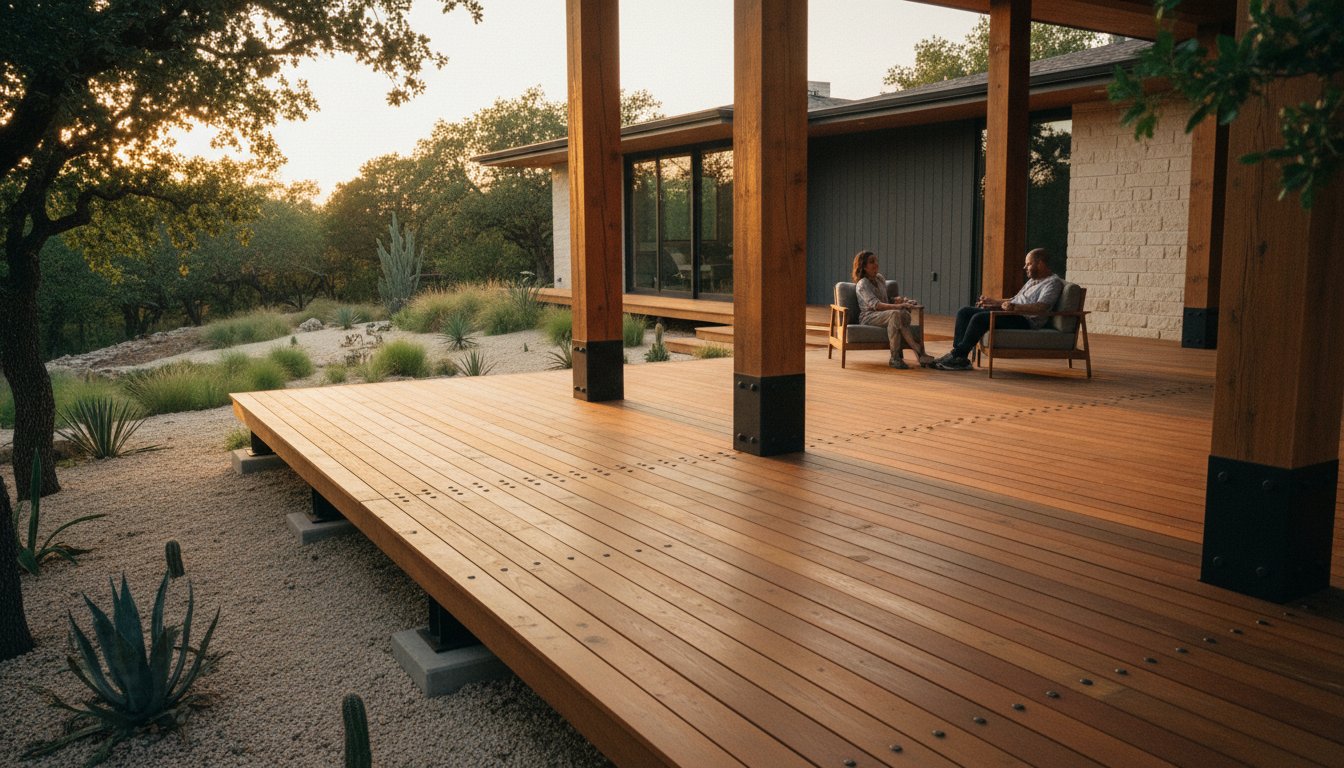
Most "pro" deck quotes in Central Texas are actually just guesses wrapped in a high-pressure sales pitch. You already know that Austin's 105-degree summers and relentless humidity will shred a mediocre build in less than three seasons. You've likely seen the sagging joists and graying boards that plague neighborhoods from West Lake to Tarrytown. It's frustrating to navigate confusing pricing models while trying to figure out the actual cost to build a deck in Austin that won't fail by 2029.
We're providing a transparent breakdown of what a high-end, professionally engineered wood deck costs when you prioritize architectural integrity over speed. You'll learn why we insist on a heavy build style using 4x12 Douglas Fir and 6x6 posts on steel bases. This guide details the tradeoffs between premium materials like Western Red Cedar and thermally modified ash, the impact of professional engineering, and the only finishing system we trust, Cutek Extreme. We'll show you how to move from a volatile quote to a predictable construction process that secures your home's ROI.
Key Takeaways
- Stop guessing about the Austin Tax and learn exactly how labor premiums and city inspections dictate the real cost to build a deck in Austin.
- See why composite decks fail the Texas heat test and why thermally modified wood offers a superior architectural ROI over plastic.
- Understand the engineering behind a "heavy" build, utilizing 4x12 Douglas Fir beams and 6x6 posts on steel bases for maximum structural integrity.
- Map out the project lifecycle from 3D visualization to material procurement to ensure your backyard investment is a guaranteed win.
Breaking down the investment: what actually drives deck prices in Austin
Building in Austin is a high-stakes architectural play. The cost to build a deck in Austin reflects the city's status as a global tech and luxury hub. This project is a strategic asset designed to hold its value against the brutal Texas sun and the competitive real estate market. We don't build basic platforms; we engineer structural statements that prioritize ROI and durability.
Site conditions in Central Texas dictate the baseline of your budget. Limestone shelf rock and the steep slopes common in the Hill Country require advanced foundation work and heavy equipment. We utilize oversized framing and 6x6 posts on steel bases to anchor 24ft+ continuous boards of Western Red Cedar or thermally modified ash. These materials handle the structural load of complex sites where generic builds fail.
Labor and local demand in the 2026 market
Skilled carpentry in Austin carries a premium due to the massive surge in luxury residential projects. Professional labor ensures your structure adheres to rigorous deck construction standards while managing the precision of exposed steel nail heads. Hiring a generic contractor often results in a "cheap" build that warps under the stress of 100-degree summers. The price of doing it right the first time is significantly lower than the cost of a total tear-out in five years.
Permits and HOA navigation
Navigating the City of Austin's Development Services Department requires precision and specific technical documentation. You must budget for the 8.25% local sales tax on materials and permit fees that scale with your project's total value. Professional HOA management is a necessary expense to avoid design revisions that can stall construction for months. We specify Cutek Extreme as our only finish because it's the only product that protects this level of investment against the local UV index.
Material ROI: why thermally modified wood beats composite every time
The cost to build a deck in Austin is a long-term financial play. Most builders push composite because it's easy to install and requires zero specialized knowledge. We don't. Plastic-based boards are a tactical error in the Central Texas climate. Choosing custom decks built with real, thermally modified wood ensures the structure remains a high-value architectural asset rather than a sagging liability.
The problem with plastic in Central Texas
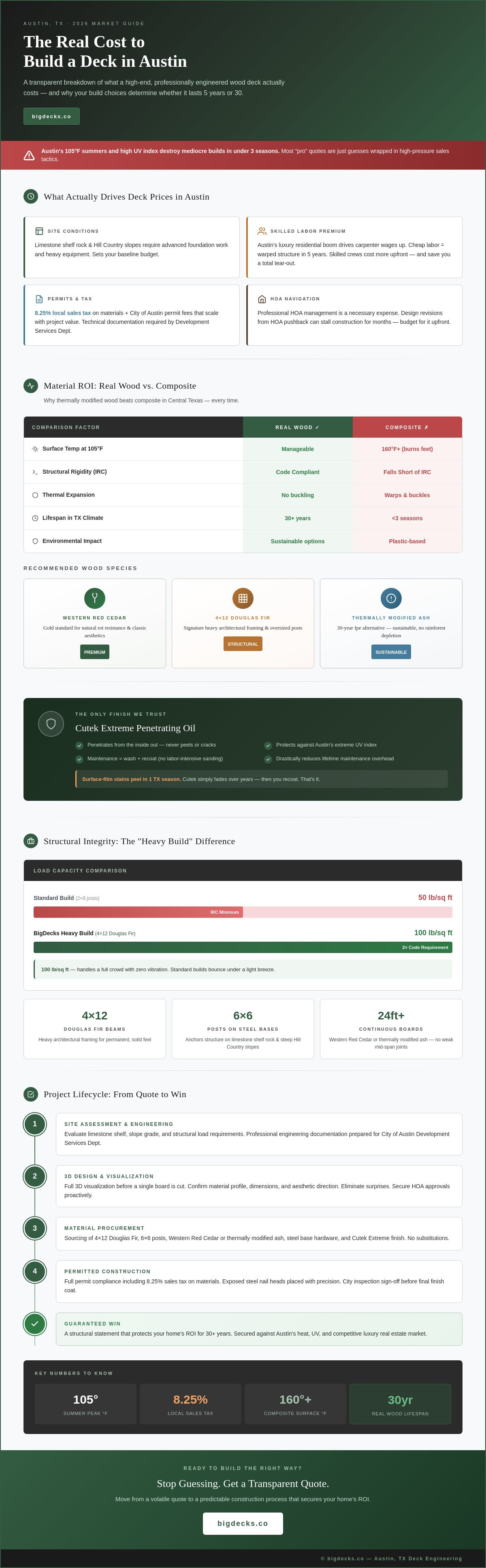
Composite materials fail the Austin heat test every summer. On a 105-degree August afternoon, dark plastic decking reaches surface temperatures exceeding 160 degrees. It burns feet and warps under its own weight. BigDecks refuses to build with PVC or plastic-composites because they lack the structural rigidity required by the International Residential Code and local building codes. Real wood handles thermal expansion without buckling or losing its grip on the fasteners.
- Western Red Cedar: The gold standard for natural rot resistance and classic aesthetics.
- 4x12 Douglas Fir: Our signature for heavy architectural framing and oversized posts.
- Thermally Modified Ash: A 30-year high-performance alternative to Ipe that won't contribute to rainforest depletion.
The Cutek Extreme factor
Texas UV levels destroy surface-film finishes in a single season. Most stains peel and crack because they sit on top of the wood like a layer of paint. We only use Cutek Extreme. It's a synthetic penetrating oil that protects the wood from the inside out. It never peels; it simply fades over several years, making maintenance a simple wash and recoat rather than a labor-intensive sand-down. This approach preserves the cost to build a deck in Austin by drastically reducing the lifetime maintenance overhead. If you're ready to move past the plastic marketing hype, we can help you select a material profile that actually survives the Texas sun.
Structural integrity: the cost of building a 'heavy' deck
Standard builds rely on flimsy 2x8 joists that bounce under a light breeze. We don't do standard. We build heavy. This approach utilizes 4x12 Douglas Fir beams to create a foundation that feels permanent. It is a strategic move for homeowners who prioritize architectural longevity over the lowest bid. Understanding the cost to build a deck in Austin requires looking past the surface and into the skeleton of the project. Engineering for 100lb/sq ft loads is the primary driver here. This is double the residential code requirement. It ensures your deck handles a crowd without a hint of vibration.
The aesthetic of strength is visible in every detail. We use surface-fastened exposed steel nail heads as a deliberate design choice. These aren't hidden; they are celebrated. This honest use of materials creates a rhythmic, industrial look that complements modern Austin architecture. It signals that the structure is as tough as it looks. Analyzing how much does it cost to build a deck when prioritizing this level of engineering reveals a significant shift from "disposable" backyard platforms to "legacy" architectural investments.
Oversized framing and precision metalwork
Achieving seamless architectural lines requires 24ft+ continuous boards. This eliminates the staggered, messy joints found on amateur projects. These massive spans require specialized logistics and precision handling, which influences the total cost to build a deck in Austin. We often integrate custom welding and metal accents directly into the structural frame. This isn't just about looks; it is about fusing steel and timber into a single, high-performance unit that survives the Texas sun without warping or sagging.
Foundation and drainage solutions
Austin’s soil is a challenge of expansive clay and stubborn limestone. A standard pier won't cut it. We utilize 6x6 posts anchored to elevated steel bases. This prevents the wood from ever touching standing water or moist earth. It is a non-negotiable expense for anyone serious about rot prevention. To maintain this structural investment, we exclusively use Cutek Extreme. It is the only finish that penetrates deep enough to stabilize these heavy timbers against the brutal humidity cycles of Central Texas. This combination of steel-base elevation and high-performance oil ensures the wood breathes while remaining structurally sound for decades.
Ready to build something that actually lasts? Let’s talk about your structural goals before you break ground.
Navigating the project: 3D design and the road to a win
Most Austin homeowners view construction as a gamble. We treat it like a strategic rollout. The total cost to build a deck in Austin reflects the precision of the pre-construction phase. This is where we lock in the narrative arc of your backyard before a single 6x6 post hits the steel base. We focus on the big moments of the build, ensuring every structural choice serves the final architectural vision.
The 3D design rendering advantage
3D design renderings act as your insurance policy against mid-build pivots. We build your deck in virtual reality first; adjusting the layout of 24ft continuous boards or the placement of oversized 4x12 Douglas Fir beams. Design fees are transparent and tiered based on site complexity. You pay for the certainty that the final architectural finish matches the digital pitch, eliminating the waste associated with guesswork.
The build phase is where the strategy meets the steel. We manage the logistics of procuring heavy timber like Western Red Cedar or thermally modified ash. During installation, expect a high-stakes environment where exposed steel nail heads are aligned with surgical precision. Every joint is inspected to ensure it meets our heavy build standards. We finish the process with Cutek Extreme, the only coating we trust to protect your investment.
The final walkthrough isn't a formality; it's a verification of the architectural intent. We inspect the clean lines of the oversized framing and ensure the Cutek Extreme application is uniform across all surfaces. This is where the project transitions from a construction site to a finished asset, ready for its debut.
Timeline and delivery expectations
A custom build in 2026 typically requires four to eight weeks from site prep to the final walkthrough. Weather and permitting are the primary variables that dictate the rhythm. These factors also influence the labor cost to build a deck in Austin, as efficiency is tied to site conditions. We skip the fluff in our communication. You get direct updates on milestones and material arrivals. We keep the momentum high and the site clean until the win is secured.
Own the Austin skyline with a structural win
Austin's climate is brutal on standard residential builds. Choosing thermally modified wood over composite ensures your deck survives the Texas sun while maintaining a clean, architectural profile. A heavy build relies on 24ft+ continuous boards and 6x6 posts on steel bases to prevent the sagging common in standard projects. Precision metalwork and oversized framing standards aren't optional for a structure designed to last decades. Big Decks prioritizes Cutek Extreme penetrating oils because they protect the wood fiber without the peeling associated with film-forming stains.
Understanding the actual cost to build a deck in Austin requires looking past the initial quote and evaluating the structural integrity of the 3D design. We focus on 4x12 Douglas Fir and oversized framing to ensure your investment holds its value and its shape. This is about building a legacy structure that uses honest materials and calm, purposeful composition. Let's talk about your design and materials before you commit.
Your project deserves a level of technical precision that matches its scale.
Frequently asked questions
Is it cheaper to build a deck in Austin during the winter months?
Building in winter doesn't lower the cost to build a deck in Austin because our temperate climate allows for year-round construction. Labor rates remain steady through December and January while material costs are driven by global market volatility rather than local temperature. You might find shorter lead times during the off-season; however, the price for high-grade 4x12 Douglas Fir or Western Red Cedar won't drop just because it's cold.
How much does a permit to build a deck cost in the City of Austin?
Residential building permit fees in Austin depend on the total valuation of your project. For a standard deck, expect to pay between $450 and $1,200 in city fees according to the 2024 City of Austin Fee Schedule. This includes the initial application, plan review, and required inspections. Larger projects with complex structural engineering or those located in protected environmental zones often incur additional costs.
Why is thermally modified wood more expensive than pressure-treated pine?
Thermally modified ash costs more because it undergoes a specialized kiln process that uses heat and steam to cook out the wood's natural sugars. This makes the boards resistant to rot and insects without using toxic chemicals. While pressure-treated pine relies on chemical saturation, thermal modification creates a dimensionally stable product that won't warp or shrink. You're paying for a 25-year lifespan and a material that stays straight on 24ft+ continuous runs.
Does a new custom deck actually increase my Austin home's resale value?
A well-executed deck provides a high return on investment, often recouping 65% to 75% of the initial cost to build a deck in Austin according to the 2023 Remodeling Magazine Cost vs. Value Report. In the Austin market, buyers prioritize functional exterior spaces that handle the Texas sun. A deck built with 6x6 posts on steel bases and heavy 4x12 framing signals structural integrity to inspectors and potential buyers. It shifts your home from a standard listing to a premium architectural asset.
What is the maintenance cost for a real wood deck using Cutek Extreme?
Maintenance costs with Cutek Extreme are lower over time because the oil penetrates the wood rather than forming a film on top. You'll spend roughly $1.50 to $2.50 per square foot for a professional cleaning and recoat every two to three years. Because it doesn't peel or flake, you avoid the $10 per square foot cost of professional sanding and stripping required by inferior products. It's a predictable expense that protects your investment and keeps the wood grain visible.