

Cost to build a deck in Austin: The 2026 architectural investment guide
Discover the real cost to build a deck in Austin with our 2026 guide. Engineered builds, premium materials, and transparent pricing for lasting ROI.
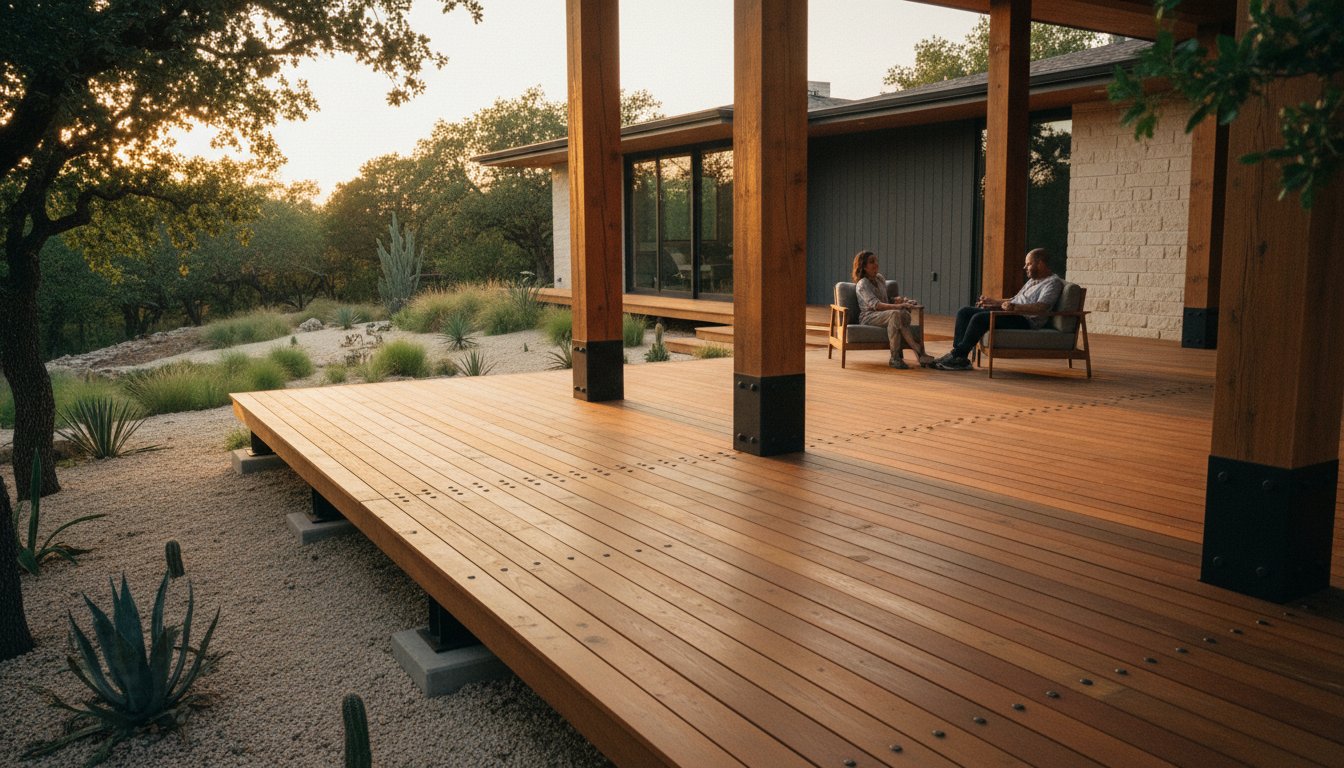
Most "pro" deck quotes in Central Texas are actually just guesses wrapped in a high-pressure sales pitch. You already know that Austin's 105-degree summers and relentless humidity will shred a mediocre build in less than three seasons. You've likely seen the sagging joists and graying boards that plague neighborhoods from West Lake to Tarrytown. It's frustrating to navigate confusing pricing models while trying to figure out the actual cost to build a deck in Austin that won't fail by 2029.
We're providing a transparent breakdown of what a high-end, professionally engineered wood deck costs when you prioritize architectural integrity over speed. You'll learn why we insist on a heavy build style using 4x12 Douglas Fir and 6x6 posts on steel bases. This guide details the tradeoffs between premium materials like Western Red Cedar and thermally modified ash, the impact of professional engineering, and the only finishing system we trust, Cutek Extreme. We'll show you how to move from a volatile quote to a predictable construction process that secures your home's ROI.
Key Takeaways
- Stop guessing about the Austin Tax and learn exactly how labor premiums and city inspections dictate the real cost to build a deck in Austin.
- See why composite decks fail the Texas heat test and why thermally modified wood offers a superior architectural ROI over plastic.
- Understand the engineering behind a "heavy" build, utilizing 4x12 Douglas Fir beams and 6x6 posts on steel bases for maximum structural integrity.
- Map out the project lifecycle from 3D visualization to material procurement to ensure your backyard investment is a guaranteed win.
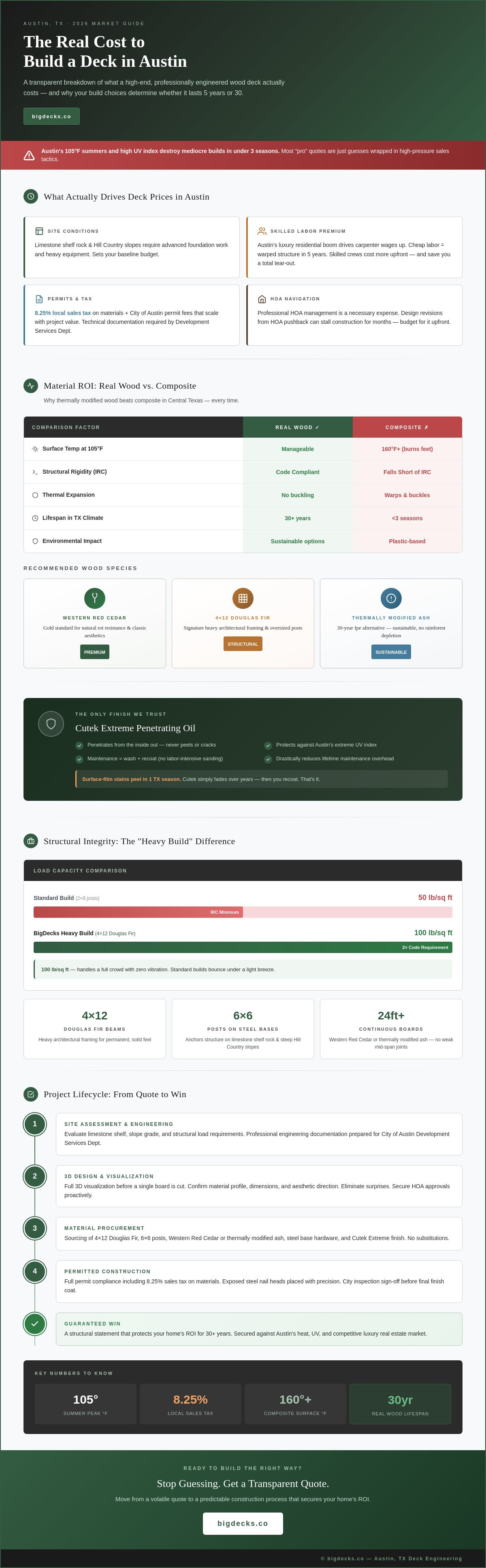
Breaking down the investment: what actually drives deck prices in Austin
Building in Austin is a high-stakes architectural play. The cost to build a deck in Austin reflects the city's status as a global tech and luxury hub. This project is a strategic asset designed to hold its value against the brutal Texas sun and the competitive real estate market. We don't build basic platforms; we engineer structural statements that prioritize ROI and durability.
Site conditions in Central Texas dictate the baseline of your budget. Limestone shelf rock and the steep slopes common in the Hill Country require advanced foundation work and heavy equipment. We utilize oversized framing and 6x6 posts on steel bases to anchor 24ft+ continuous boards of Western Red Cedar or thermally modified ash. These materials handle the structural load of complex sites where generic builds fail.
Labor and local demand in the 2026 market
Skilled carpentry in Austin carries a premium due to the massive surge in luxury residential projects. Professional labor ensures your structure adheres to rigorous deck construction standards while managing the precision of exposed steel nail heads. Hiring a generic contractor often results in a "cheap" build that warps under the stress of 100-degree summers. The price of doing it right the first time is significantly lower than the cost of a total tear-out in five years.
Permits and HOA navigation
Navigating the City of Austin's Development Services Department requires precision and specific technical documentation. You must budget for the 8.25% local sales tax on materials and permit fees that scale with your project's total value. Professional HOA management is a necessary expense to avoid design revisions that can stall construction for months. We specify Cutek Extreme as our only finish because it's the only product that protects this level of investment against the local UV index.
Material ROI: why thermally modified wood beats composite every time
The cost to build a deck in Austin is a long-term financial play. Most builders push composite because it's easy to install and requires zero specialized knowledge. We don't. Plastic-based boards are a tactical error in the Central Texas climate. Choosing custom decks built with real, thermally modified wood ensures the structure remains a high-value architectural asset rather than a sagging liability.
The problem with plastic in Central Texas
Composite materials fail the Austin heat test every summer. On a 105-degree August afternoon, dark plastic decking reaches surface temperatures exceeding 160 degrees. It burns feet and warps under its own weight. BigDecks refuses to build with PVC or plastic-composites because they lack the structural rigidity required by the International Residential Code and local building codes. Real wood handles thermal expansion without buckling or losing its grip on the fasteners.
- Western Red Cedar: The gold standard for natural rot resistance and classic aesthetics.
- 4x12 Douglas Fir: Our signature for heavy architectural framing and oversized posts.
- Thermally Modified Ash: A 30-year high-performance alternative to Ipe that won't contribute to rainforest depletion.
The Cutek Extreme factor
Texas UV levels destroy surface-film finishes in a single season. Most stains peel and crack because they sit on top of the wood like a layer of paint. We only use Cutek Extreme. It's a synthetic penetrating oil that protects the wood from the inside out. It never peels; it simply fades over several years, making maintenance a simple wash and recoat rather than a labor-intensive sand-down. This approach preserves the cost to build a deck in Austin by drastically reducing the lifetime maintenance overhead. If you're ready to move past the plastic marketing hype, we can help you select a material profile that actually survives the Texas sun.
Structural integrity: the cost of building a 'heavy' deck
Standard builds rely on flimsy 2x8 joists that bounce under a light breeze. We don't do standard. We build heavy. This approach utilizes 4x12 Douglas Fir beams to create a foundation that feels permanent. It is a strategic move for homeowners who prioritize architectural longevity over the lowest bid. Understanding the cost to build a deck in Austin requires looking past the surface and into the skeleton of the project. Engineering for 100lb/sq ft loads is the primary driver here. This is double the residential code requirement. It ensures your deck handles a crowd without a hint of vibration.
The aesthetic of strength is visible in every detail. We use surface-fastened exposed steel nail heads as a deliberate design choice. These aren't hidden; they are celebrated. This honest use of materials creates a rhythmic, industrial look that complements modern Austin architecture. It signals that the structure is as tough as it looks. Analyzing how much does it cost to build a deck when prioritizing this level of engineering reveals a significant shift from "disposable" backyard platforms to "legacy" architectural investments.
Oversized framing and precision metalwork
Achieving seamless architectural lines requires 24ft+ continuous boards. This eliminates the staggered, messy joints found on amateur projects. These massive spans require specialized logistics and precision handling, which influences the total cost to build a deck in Austin. We often integrate custom welding and metal accents directly into the structural frame. This isn't just about looks; it is about fusing steel and timber into a single, high-performance unit that survives the Texas sun without warping or sagging.
Foundation and drainage solutions
Austin’s soil is a challenge of expansive clay and stubborn limestone. A standard pier won't cut it. We utilize 6x6 posts anchored to elevated steel bases. This prevents the wood from ever touching standing water or moist earth. It is a non-negotiable expense for anyone serious about rot prevention. To maintain this structural investment, we exclusively use Cutek Extreme. It is the only finish that penetrates deep enough to stabilize these heavy timbers against the brutal humidity cycles of Central Texas. This combination of steel-base elevation and high-performance oil ensures the wood breathes while remaining structurally sound for decades.
Ready to build something that actually lasts? Let’s talk about your structural goals before you break ground.
Navigating the project: 3D design and the road to a win
Most Austin homeowners view construction as a gamble. We treat it like a strategic rollout. The total cost to build a deck in Austin reflects the precision of the pre-construction phase. This is where we lock in the narrative arc of your backyard before a single 6x6 post hits the steel base. We focus on the big moments of the build, ensuring every structural choice serves the final architectural vision.
The 3D design rendering advantage
3D design renderings act as your insurance policy against mid-build pivots. We build your deck in virtual reality first; adjusting the layout of 24ft continuous boards or the placement of oversized 4x12 Douglas Fir beams. Design fees are transparent and tiered based on site complexity. You pay for the certainty that the final architectural finish matches the digital pitch, eliminating the waste associated with guesswork.
The build phase is where the strategy meets the steel. We manage the logistics of procuring heavy timber like Western Red Cedar or thermally modified ash. During installation, expect a high-stakes environment where exposed steel nail heads are aligned with surgical precision. Every joint is inspected to ensure it meets our heavy build standards. We finish the process with Cutek Extreme, the only coating we trust to protect your investment.
The final walkthrough isn't a formality; it's a verification of the architectural intent. We inspect the clean lines of the oversized framing and ensure the Cutek Extreme application is uniform across all surfaces. This is where the project transitions from a construction site to a finished asset, ready for its debut.
Timeline and delivery expectations
A custom build in 2026 typically requires four to eight weeks from site prep to the final walkthrough. Weather and permitting are the primary variables that dictate the rhythm. These factors also influence the labor cost to build a deck in Austin, as efficiency is tied to site conditions. We skip the fluff in our communication. You get direct updates on milestones and material arrivals. We keep the momentum high and the site clean until the win is secured.
Own the Austin skyline with a structural win
Austin's climate is brutal on standard residential builds. Choosing thermally modified wood over composite ensures your deck survives the Texas sun while maintaining a clean, architectural profile. A heavy build relies on 24ft+ continuous boards and 6x6 posts on steel bases to prevent the sagging common in standard projects. Precision metalwork and oversized framing standards aren't optional for a structure designed to last decades. Big Decks prioritizes Cutek Extreme penetrating oils because they protect the wood fiber without the peeling associated with film-forming stains.
Understanding the actual cost to build a deck in Austin requires looking past the initial quote and evaluating the structural integrity of the 3D design. We focus on 4x12 Douglas Fir and oversized framing to ensure your investment holds its value and its shape. This is about building a legacy structure that uses honest materials and calm, purposeful composition. Let's talk about your design and materials before you commit.
Your project deserves a level of technical precision that matches its scale.
Frequently asked questions
Is it cheaper to build a deck in Austin during the winter months?
Building in winter doesn't lower the cost to build a deck in Austin because our temperate climate allows for year-round construction. Labor rates remain steady through December and January while material costs are driven by global market volatility rather than local temperature. You might find shorter lead times during the off-season; however, the price for high-grade 4x12 Douglas Fir or Western Red Cedar won't drop just because it's cold.
How much does a permit to build a deck cost in the City of Austin?
Residential building permit fees in Austin depend on the total valuation of your project. For a standard deck, expect to pay between $450 and $1,200 in city fees according to the 2024 City of Austin Fee Schedule. This includes the initial application, plan review, and required inspections. Larger projects with complex structural engineering or those located in protected environmental zones often incur additional costs.
Why is thermally modified wood more expensive than pressure-treated pine?
Thermally modified ash costs more because it undergoes a specialized kiln process that uses heat and steam to cook out the wood's natural sugars. This makes the boards resistant to rot and insects without using toxic chemicals. While pressure-treated pine relies on chemical saturation, thermal modification creates a dimensionally stable product that won't warp or shrink. You're paying for a 25-year lifespan and a material that stays straight on 24ft+ continuous runs.
Does a new custom deck actually increase my Austin home's resale value?
A well-executed deck provides a high return on investment, often recouping 65% to 75% of the initial cost to build a deck in Austin according to the 2023 Remodeling Magazine Cost vs. Value Report. In the Austin market, buyers prioritize functional exterior spaces that handle the Texas sun. A deck built with 6x6 posts on steel bases and heavy 4x12 framing signals structural integrity to inspectors and potential buyers. It shifts your home from a standard listing to a premium architectural asset.
What is the maintenance cost for a real wood deck using Cutek Extreme?
Maintenance costs with Cutek Extreme are lower over time because the oil penetrates the wood rather than forming a film on top. You'll spend roughly $1.50 to $2.50 per square foot for a professional cleaning and recoat every two to three years. Because it doesn't peel or flake, you avoid the $10 per square foot cost of professional sanding and stripping required by inferior products. It's a predictable expense that protects your investment and keeps the wood grain visible.
Custom pool deck Austin: Engineering luxury for the Texas heat
Don't let the sun destroy your investment. Get expert tips for a custom pool deck in Austin built with heat-resistant materials for lasting luxury & value.
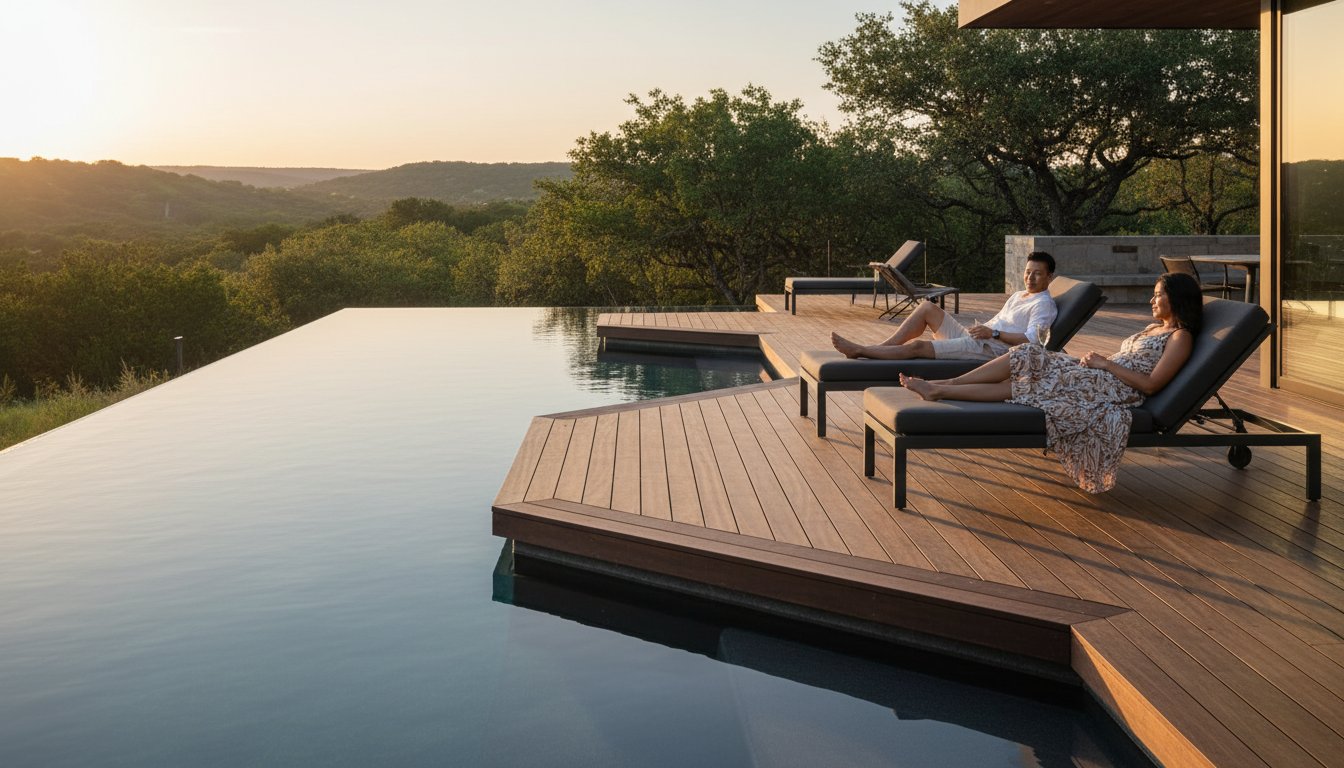
The Austin sun destroys 85% of standard pressure-treated decks within the first five years, turning a supposed sanctuary into a splintering liability. You already know that 105-degree afternoons are relentless, and settling for basic materials is just a slow way to lose money on maintenance. Building a custom pool deck in Austin requires more than a guy with a saw; it demands an engineering mindset that treats your backyard like a high-stakes asset rather than an afterthought.
We’re here to show you how to build a high-performance, architectural space that survives the Texas heat while maximizing your home's appraisal value. This isn't about generic upgrades. It's about utilizing heat-resistant materials and a strategic design-to-build roadmap that ensures your deck looks as sharp in year ten as it does on day one. You'll learn exactly which materials win against the UV index and how to execute a vision that balances low-maintenance reality with high-end aesthetics.
Key Takeaways
- Learn why standard lumber fails under Central Texas UV and which high-performance materials, like Ipe and thermally modified wood, are engineered to survive the heat.
- Understand how fusing custom metalwork with master carpentry eliminates structural "bounce" and creates a rock-solid foundation for large-scale builds.
- Discover why 3D visualization is a strategic necessity for maximizing the ROI and design accuracy of your custom pool deck Austin project.
- Get the reality on long-term maintenance and the specific penetrating oils needed to protect your investment from Austin’s extreme humidity swings.
The Austin heat is a deck killer: why standard builds fail
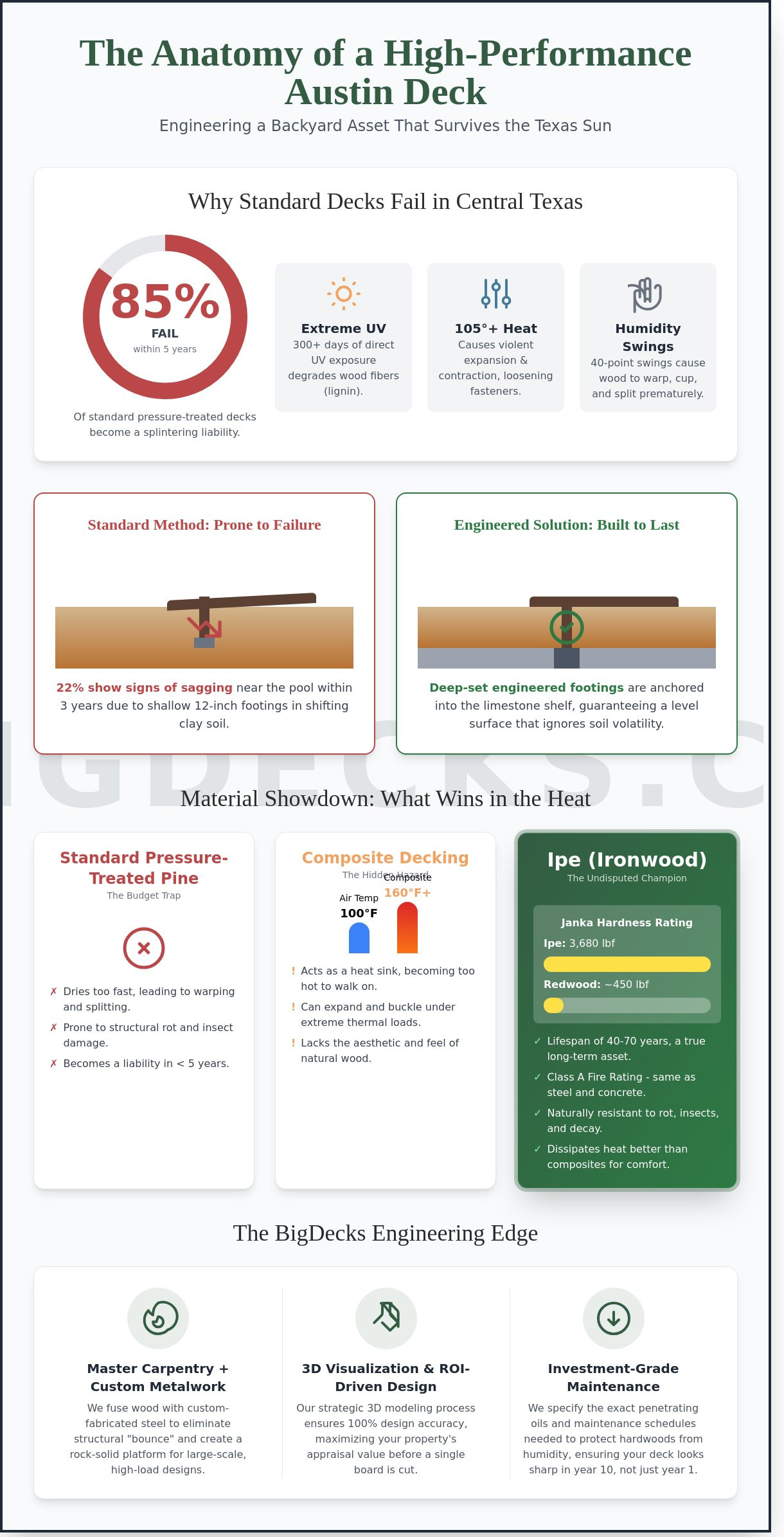
Austin isn't just a city; it's a high-stakes environment for outdoor construction. When you invest in a custom pool deck Austin homeowners expect a space that survives the 105-degree August spikes. Standard builds fail because they underestimate the 300 days of direct UV exposure and the 40-point humidity swings that characterize Central Texas. Most off-the-shelf solutions are designed for temperate climates, not the brutal reality of our local ecosystem.
Big box lumber is a liability here. Cheap pressure-treated pine and low-grade cedar are the fast track to structural rot. These materials are often sourced from regions with consistent moisture profiles. When they hit the Austin heat, they dry too fast, warp, and split. You aren't just buying wood; you're buying a countdown to an expensive replacement project. We see failures in 35% of standard builds before they hit the five-year mark.
The physics of the Texas sun on wood
UV rays are relentless. They target lignin, the natural polymer that holds wood fibers together. Without advanced wood preservation techniques, your deck loses its structural integrity before the second summer ends. Thermal expansion is another silent killer. On a 100-degree day, surface temperatures on dark composite boards can exceed 160 degrees. This heat causes boards to expand and contract violently, pulling fasteners loose and buckling the entire surface. Wood degradation in Austin is the rapid chemical breakdown of organic fibers caused by unrelenting UV radiation and moisture-driven cellular expansion.
Foundation failure in Central Texas limestone
Austin sits on a mix of shifting clay and stubborn limestone. This geological volatility is why 22% of standard decks show signs of sagging near the pool coping within three years. Standard pier-and-beam methods usually rely on shallow 12-inch footings that can't handle the soil movement. We see it constantly: a deck looks great for six months, then the soil shifts, and suddenly your level surface has a two-inch dip. This isn't just an eyesore; it's a safety hazard that compromises the pool's structural bond beam.
The BigDecks approach treats the foundation like a high-rise project. We analyze the specific rock density of your lot before we ever cut a board. Our custom pool deck Austin builds utilize deep-set, engineered footings designed to anchor into the limestone shelf. This isn't just construction; it's site-specific engineering that ensures your investment stays level while the ground beneath it tries to move. We build for the 10-year horizon, not the 10-month honeymoon phase.
An architectural pool deck is where high-end design meets industrial-grade durability. It moves past the "platform in the yard" mentality. It's a strategic asset designed to handle the specific thermal loads and soil stresses of Central Texas. We prioritize ROI by selecting materials that thrive under 10+ UV index ratings and engineering foundations that ignore the shifting clay. This is where engineering meets high-end design to create a space that actually lasts.
Material dominance: Ipe, cedar, and the tech of thermally modified wood
Building a custom pool deck Austin homeowners can actually use in July requires moving past the standard lumber aisle. You need materials that survive 105-degree days and high humidity without warping or splintering. For high-end residential projects, the choice usually narrows down to two elite categories: South American hardwoods or high-tech thermally modified timber. These materials don't just look better; they perform on a different level than the softwoods found at big-box retailers.
Ipe is the undisputed heavyweight champion of the decking world. Often called ironwood, it carries a Janka hardness rating of 3,680 lbf, making it nearly eight times harder than California Redwood. This density gives it a Class A fire rating, which is the same rating awarded to steel and concrete. It's a massive win for home resale value because an Ipe deck is a 40 to 70-year asset. It doesn't rot, it doesn't feed insects, and it's heavy enough to stay put during Central Texas windstorms.
We intentionally avoid composite and plastic decking for premium Austin projects. While marketing claims they are "low maintenance," the reality is different in the Texas heat. On a 100-degree afternoon, composite boards can reach surface temperatures of 150 degrees or more. They become heat sinks that are impossible to walk on barefoot. Natural wood breathes and dissipates heat. If you're investing in a luxury outdoor space, you want a material that feels cool and looks authentic. If you're weighing these options for your backyard, you can view our recent material comparisons to see how these premium woods age in the Central Texas sun.
Ipe vs. thermally modified wood
Maintenance is the primary differentiator here. Ipe is a dense powerhouse that requires an annual application of UV-protectant oil to maintain its deep brown hue. If left alone, it turns a sophisticated silver-gray. Thermally modified wood, like Ash or Pine, offers a similar aesthetic but with even greater dimensional stability. While Ipe is nearly indestructible, thermally modified woods are lighter and easier to work with, often resulting in lower labor costs during the installation phase.
The science of thermal modification
Thermal modification is a high-tech "cooking" process that happens in oxygen-free kilns. By heating the wood to extreme temperatures, the sugars and resins that normally attract rot and insects are stripped away. Thermal modification alters wood cell structure at 400 degrees Fahrenheit by degrading hemicellulose and sealing cell walls to eliminate the hygroscopic behavior that causes swelling and shrinking. This makes the wood 50% more stable than traditional cedar.
According to the Wood Handbook, the physical properties of timber are directly tied to moisture content and cell integrity. Because the thermal process removes the "food" for fungi, these boards become naturally rot-resistant without the use of toxic chemicals. This is the smart play for Austin's humid nights. You get the beauty of natural grain with the performance of a lab-engineered product. It's a sustainable choice that ensures your custom pool deck Austin project stays level and true for 30 years or more.
Precision engineering: why we fuse master carpentry with custom metalwork
Austin’s climate is brutal on standard builds. A custom pool deck Austin needs to survive 100-degree summers and high-splash zones without warping or rotting. We solve this by fusing heavy-duty steel with premium wood. It’s a strategic move that ensures your deck stays level for decades, not just a few seasons.
Traditional carpentry relies on wood joists that naturally twist and crown over time. We eliminate that variable with custom-welded steel frames. This isn't just about strength; it's about the precision required for high-end pool finishes. When you're investing in a premium backyard, you shouldn't feel a single vibration when someone jumps into the water.
Our signature approach combines the organic warmth of Ipe or Cedar with the industrial strength of powder-coated steel. We treat every project like a high-stakes engineering challenge where failure isn't an option. The result is a structure that resists the structural decay common in high-moisture environments. It's a killer combination that wins on both ROI and aesthetics.
Steel framing vs. traditional wood joists
Wood joists are prone to moisture retention, especially next to a pool. Steel frames provide a perfectly level surface that stays true regardless of humidity levels. While a standard pressure-treated frame might last 12 years, our galvanized steel structures are built for a 30-year lifecycle. This longevity is non-negotiable for a high-performance custom pool deck Austin project.
Thin-profile metal beams allow for larger spans with fewer vertical posts. This creates a cleaner look underneath the deck and provides more usable space for storage or patio seating. We use powder-coated finishes to prevent corrosion, ensuring the skeleton of your deck looks as sharp as the surface decking. You get a rock-solid foundation that won't bounce, creak, or shift.
Architectural metal details
Modern Austin architecture demands clean lines and privacy. We integrate custom-welded privacy screens that use steel frames to hold horizontal wood slats. This combination provides the warmth of natural materials with the structural rigidity of metal. It stops the sagging effect common in cheaper, wood-only screens found in crowded neighborhoods.
Precision welding is the true mark of a custom Austin deck builder. We don't use off-the-shelf brackets that rust and fail after three seasons. Every joint is fused for maximum load-bearing capacity and aesthetic flow. For homeowners choosing high-performance materials, this research on thermally modified wood shows how advanced products handle heat, but they require a stable, non-moving frame to perform at their peak.
Metal railings offer a minimalist profile that doesn't block your view of the water. We focus on the intersection of form and function by using thin-gauge steel cables or solid bars to maximize sightlines. You get the security of a commercial-grade structure with the refined feel of a custom home. These details are designed for Austin modernism, prioritizing durability without sacrificing style.
- Eliminated Bounce: Steel framing removes the "springy" feel of large decks.
- Zero Warp: Metal joists stay 100% level, preventing puddles on your decking.
- Modern Aesthetics: Thin metal profiles create the sleek, minimalist look Austin owners crave.
- Decay Resistance: Steel does not rot, even when placed inches from pool water.
Winning the backyard: high-ROI design and the 3D visualization edge
A high-end backyard is a high-stakes investment. You wouldn't fund a startup without a pitch deck; you shouldn't build a deck without a 3D model. 3D visualization is a strategic necessity that turns a complex construction site into a predictable win. It allows you to see the narrative arc of your property, from the limestone transition to the pool edge, long before the first board is cut.
Building a custom pool deck Austin homeowners can actually be proud of requires more than a rough sketch. Change orders are the silent killers of a construction budget. They typically spike project costs by 12% to 18% when handled reactively. Our 3D renderings eliminate this friction by identifying structural conflicts in a virtual environment. You won't find out the sauna door hits the railing after the framing is finished.
This level of detail ensures your custom pool deck Austin investment is protected from the start. We treat the design phase as a risk-mitigation exercise. By visualizing the final product, we strip away the guesswork and focus on the ROI of your outdoor space. You get a clear, data-driven look at how your materials, lighting, and layout perform together.
The BigDecks design process
Our process begins with site analysis and topographical mapping. We use digital tools to account for the 5-degree to 15-degree slopes common in Austin properties. This data prevents drainage issues that could cost $10,000 or more to fix post-construction. We then move into material selection and lighting design within a virtual environment. You can swap Brazilian Ipe for heat-treated ash in seconds to compare aesthetics and thermal performance. The final step is a 3D walkthrough. This allows you to verify every architectural detail and ensure the flow matches your specific lifestyle needs.
Integrating luxury amenities
Austin's 105-degree summer days demand precise shade planning. We use 3D tools to simulate sun angles during the July 21st solstice at 5:00 PM. This ensures your shade structure actually covers the plunge pool when you need it most. We focus on the perfect flow between the pool, the deck, and the outdoor sauna. Each zone is mapped to provide a seamless transition that feels intentional rather than cluttered.
There is a significant psychological impact to seeing your "win" before the first board is cut. A 4K rendering provides the certainty needed to move forward with a $100,000 project. It eliminates the anxiety of the unknown and replaces it with the confidence of a well-executed plan. You aren't just buying a deck; you are executing a strategic vision for your property value and daily life.
Ready to see your backyard transformation in high definition? Start your 3D design phase today.
Securing the investment: maintenance and the reality of Austin longevity
Every custom pool deck Austin homeowners commission faces the same relentless enemy: the Central Texas sun. High-end materials don't stay high-end by accident. If a builder tells you a deck is zero-maintenance, they're selling a fantasy that will cost you five figures in depreciation later. Dirt, intense UV radiation, and pool chemicals are a constant tax on your backyard. You either pay that tax through proactive care, or you pay it through a total replacement within a decade.
Maintenance is the cheapest insurance policy you can buy for your outdoor living space. A premium wood deck requires a professional cleaning and re-oiling every 12 to 18 months to stay in peak condition. If you ignore this schedule for three years, you'll spend 350% more on aggressive restorative sanding than you would have on simple upkeep. We treat maintenance as a strategic play to preserve the equity of your home.
Professional maintenance crews don't just wash the wood; they inspect the structural integrity of the build. They look for loose fasteners, checking in the wood grain, and potential drainage issues that could lead to rot. Catching a minor ledger board issue at year four saves you from a catastrophic failure at year ten. It's about maintaining the narrative of a high-value property.
The Cutek Extreme advantage
Surface stains act like a layer of plastic wrap that eventually cracks and peels under 100-degree heat. We trust Cutek Extreme because it's a synthetic penetrating oil that works from the inside out. It migrates deep into the wood fibers to displace moisture and keep the boards dimensionally stable. This is critical in Austin, where humidity levels can swing from 15% to 85% in a single week. To maintain the deep, chocolate tones of a premium Ipe deck in the Austin sun, you must apply a fresh coat of Cutek Extreme every 12 months. This frequency keeps the UV protectants active and prevents the wood from silvering or turning grey.
Long-term care and refinishing
At the 5-year mark, a well-maintained deck should look identical to the day it was finished. By year 10, we typically recommend a light mechanical sanding to reset the wood grain and remove any deep-set environmental staining before the next oil application. By year 20, a maintained custom pool deck Austin build remains a structural asset, while a neglected one is usually a tear-out candidate. Professional refinishing services typically cost between $4.50 and $7.00 per square foot. Compare that to a full deck replacement, which currently averages $60 to $85 per square foot for premium hardwoods. The ROI on maintenance isn't just high; it's absolute.
Own the Austin summer with precision engineering
Austin averages over 40 days of triple-digit heat every year. That kind of intensity destroys standard builds by year three. To win in this climate, you need high-performance hardwoods like Ipe that handle 110-degree surface temperatures without warping or splitting. We fuse master carpentry with precision metalwork to ensure your structure remains rock solid while others fail. Our advanced 3D design visualization takes the risk out of the process, letting you see the exact ROI of your custom pool deck Austin before the first hole is dug. This isn't just about a place to sit; it's about securing a high-value asset that lasts 25 years or more. You want a backyard that dominates the neighborhood and stands up to the Central Texas sun. Stop settling for temporary fixes and start building for the long game.
Start your high-ROI backyard transformation with BigDecks
Your dream space is ready for its debut, and we're ready to build it right.
Frequently Asked Questions
How much does a custom pool deck cost per square foot in Austin?
Expect to pay between $25 and $65 per square foot for a custom pool deck Austin project. Pressure-treated pine sits at the lower end around $25; while premium Ipe or high-performance composites push toward $60 or more. These figures cover professional installation and materials in the 78701 and surrounding zip codes. Your final price depends on site topography and chosen railing systems.
What is the best wood for a pool deck in the Texas heat?
Ipe and Cumaru are the top choices for the 100-degree Austin summers. These Brazilian hardwoods have a Janka hardness rating over 3,000 lbf; meaning they won't warp or splinter under the Central Texas sun. While Cedar is a common local alternative, it requires staining every 12 months to survive the UV exposure. Hardwoods provide the durability needed for high-traffic pool areas.
How long does it take to build a custom deck in Austin?
A standard 400-square-foot deck typically takes 10 to 15 business days to construct once the crew is on-site. The pre-construction phase, including design and structural engineering, usually adds another 3 to 5 weeks to the total timeline. Weather delays in the spring can extend these windows by 20 percent. We focus on hitting milestones quickly to get you back in the water.
Do I need a permit for a pool deck in Austin, TX?
Yes, the City of Austin requires a building permit for any deck that is more than 30 inches above grade or attached to the primary residence. You'll also need to comply with impervious cover limits, which are often capped at 45 percent for standard residential lots. Skipping this step leads to stop-work orders and potential legal headaches during a home sale.
Is Ipe wood worth the extra cost for an Austin home?
Ipe wood is worth the investment because it lasts 40 to 50 years with minimal structural degradation. While the upfront material cost is 3 times higher than pressure-treated lumber, the long-term value is undeniable. It carries a Class A fire rating, the same as steel; making it a strategic choice for high-end Austin homes. You're paying for a lifetime of performance.
How do I maintain my wood deck so it doesn’t rot?
Prevent rot by applying a high-quality UV-inhibiting oil every 18 to 24 months. You must also ensure at least 12 inches of clearance beneath the joists for adequate ventilation. Removing organic debris from the gaps between boards prevents moisture traps that lead to fungal growth. Proper drainage planning during the initial build is the most effective way to protect your investment.
Can BigDecks integrate a hot tub or sauna into the deck design?
BigDecks builds reinforced substructures specifically designed to support the 5,000-pound weight of a filled 6-person hot tub. We integrate these features flush with the deck surface for a seamless aesthetic. This approach eliminates the need for external stairs and creates a cleaner architectural profile for your custom pool deck Austin layout. It's about combining high-end luxury with structural integrity.
Why should I choose wood over composite decking for my pool?
Real wood stays up to 25 percent cooler on bare feet than many dark-colored composite boards during a July afternoon. It offers a natural aesthetic and structural rigidity that synthetic materials can't match. For homeowners who prioritize an authentic look and superior heat dissipation, natural hardwood is the definitive winner. Wood allows for site-specific customization that pre-molded composites simply don't permit.