

Ipe Deck Builders Austin: Engineering the 40-Year Outdoor Investment
Looking for ipe deck builders Austin trusts? Learn how to engineer a 40-year outdoor masterpiece that survives Texas heat and avoids costly mistakes.
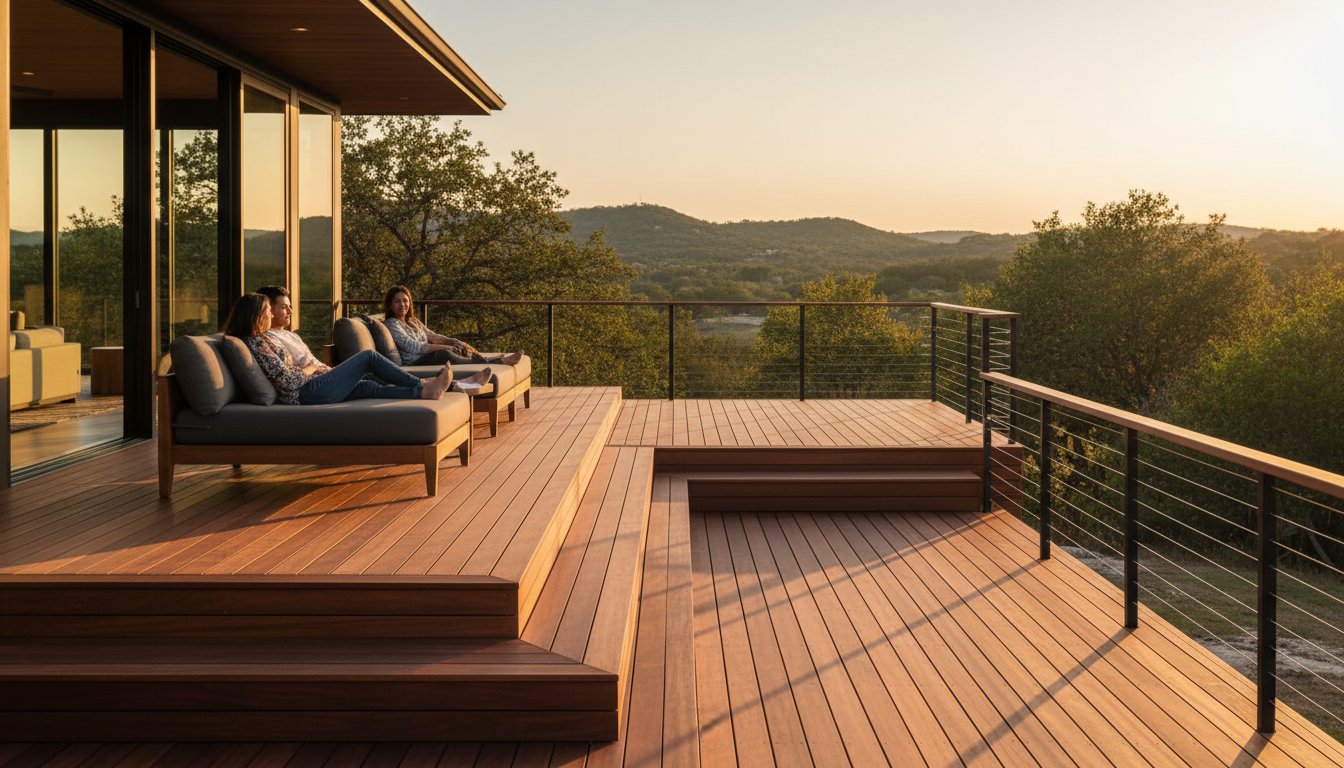
Austin’s 105-degree summer heat will turn a standard pressure-treated deck into a warped, splintering liability in under 36 months. You understand that building an outdoor space in Central Texas is a high-stakes game where the sun is always trying to win. Finding the right ipe deck builders Austin homeowners rely on is the difference between a temporary fix and a permanent architectural win. It’s frustrating to watch a massive investment fade into a plastic-looking composite or rot away because a contractor prioritized speed over durability.
The most successful property owners treat their backyard as a high-performance asset with a 40-year lifecycle. This article explains why Ipe is the only hardwood capable of surviving the Texas climate without sacrificing its modern, high-end aesthetic. You’ll learn how to vet specialized builders who understand the technical complexity of this ironwood. We are diving into the engineering requirements, maintenance realities, and the strategic decisions that ensure your deck remains a zero-rot masterpiece for decades.
Key Takeaways
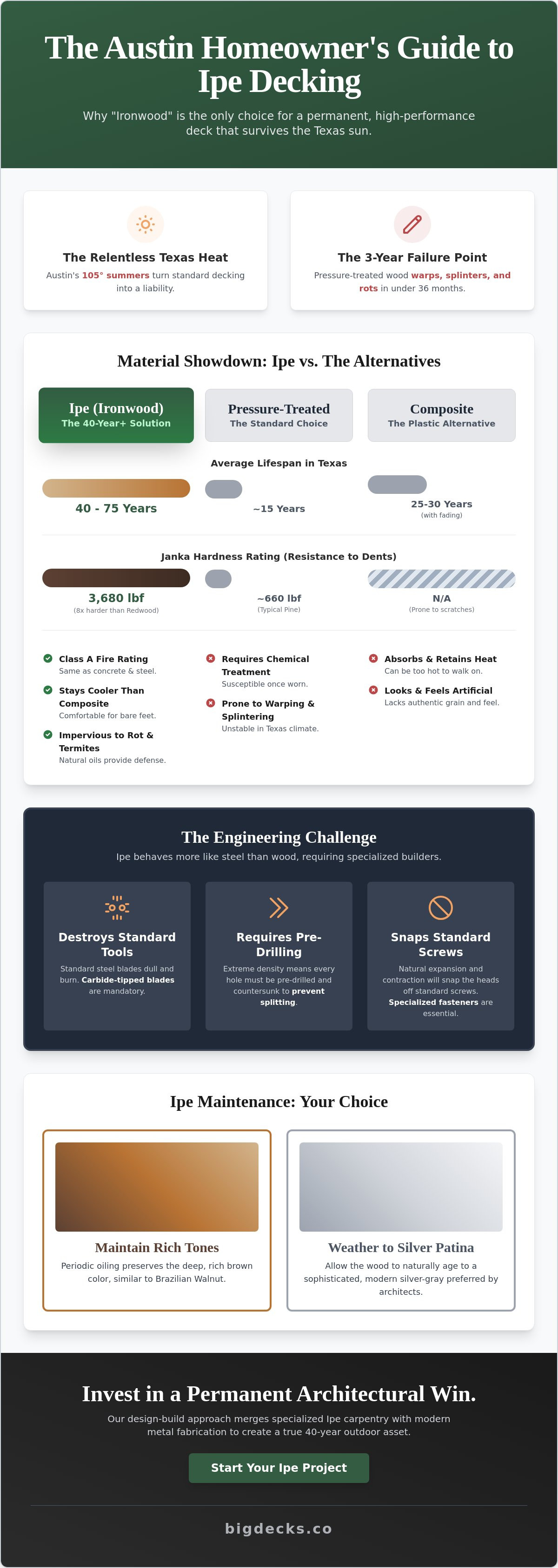
- Understand why Ipe’s "Ironwood" status makes it the only logical material choice for surviving the relentless Central Texas heat.
- Learn why hiring specialized ipe deck builders Austin is critical for handling a high-density hardwood that destroys standard tools and requires precise pre-drilling.
- Avoid expensive mid-project mistakes by utilizing 3D architectural visualization to perfect multi-level designs and custom metalwork before construction starts.
- Decide between maintaining Ipe’s rich, dark tones or allowing it to weather into the sophisticated silver patina preferred by modern architects.
- Discover how a design-build approach that merges traditional carpentry with modern metal fabrication creates a legitimate 40-year outdoor investment.
Why Ipe is the Gold Standard for Austin Outdoor Living
Ipe isn't just wood. It's a structural asset. Often called Brazilian Walnut or Ironwood, this high-density tropical hardwood is famous for its extreme durability and weight. It belongs to the Handroanthus genus, a group of trees that produce timber so dense it actually sinks in water. This performance makes it ideal for docks and seaside structures, which is why professionals in that sector often explore Digital Marketing for Marine Contractors to showcase their specialized projects. For ipe deck builders Austin homeowners hire to create permanent outdoor structures, this material represents the peak of engineering and natural beauty.
Central Texas weather is a brutal testing ground for lumber. While Cedar and Douglas Fir are common, they often surrender to the 105-degree Austin sun within a few years. They warp, splinter, and lose their structural integrity. Ipe thrives in these conditions. It carries a Class A fire rating, putting it in the same safety category as concrete and steel. It's a non-negotiable advantage for homeowners who prioritize safety and long-term performance.
The natural resistance of this wood is unmatched. It's packed with organic oils and tannins that act as a built-in defense system. Termites won't touch it. Rot can't get a foothold. Even during Austin's high-humidity cycles, Ipe maintains its shape and strength. It's the ultimate "set it and forget it" material for a high-end backyard build.
Ipe vs. Composite: Why Austin Homeowners are Rejecting Plastic
Many homeowners are moving away from synthetic materials. Composite boards are notorious for heat retention. In a typical Austin summer, plastic decks can become hot enough to burn feet or paws. Ipe stays significantly cooler under the direct sun. It offers an authentic grain and structural rigidity that "fake" textures can't mimic. You can see the breakdown of these differences in this Wood vs. Composite comparison. Real wood wins on feel and function every time.
The ROI of Hardwood: Longevity as a Financial Strategy
Think of an Ipe deck as a 40 to 75 year financial strategy. Standard pressure-treated wood usually requires replacement or heavy repair after 15 years. When you analyze the deck cost per square foot, the upfront premium for Ipe pays for itself by skipping three replacement cycles. In Austin's aggressive real estate market, a hardwood deck is a major selling point. It signals to buyers that the property was built with zero compromises.
Choosing the right ipe deck builders Austin relies on understanding these technical specs. You aren't just buying a place to put a grill. You're investing in a legacy structure that outlasts the mortgage. It's about choosing raw power and permanent value over temporary fixes.
The Engineering Challenge: Why Your Builder Needs Ipe Expertise
Ipe isn't standard lumber; it's a structural challenge that behaves more like steel than timber. If a contractor approaches an Ipe project with the same tools they use for cedar, your investment is already at risk. Qualified ipe deck builders Austin understand that this material requires a specialized approach to prevent catastrophic failure early in its lifespan.
The material carries a Janka hardness rating of 3,680 lbf. That is three times harder than White Oak and nearly eight times harder than Redwood. Standard carbon steel blades will dull within minutes, often smoking or burning the wood before finishing a single cut. You don't just screw into Ipe. Every single hole requires pre-drilling and countersinking. Skip this step, and the board splits immediately. Standard deck screws are a non-starter because the sheer density of the wood will snap the heads off as the boards naturally adjust to the environment.
Specialized Tooling and Precision Carpentry
Carbide-tipped blades and high-torque impact drills are the baseline requirements for this work. Precision matters because Ipe is unforgiving and doesn't hide mistakes. Every cut end must be treated with a wax-based emulsion sealer immediately to prevent checking and end-cracking. This level of technical detail is a primary driver for deck labor costs in Austin. You are paying for a specialist's time and their high-wear equipment, but it's the only way to ensure the wood remains stable for forty years.
Managing Expansion and Contraction in Texas Humidity
Austin's climate is brutal on organic materials. We swing from 100 percent humidity to bone-dry droughts in a matter of weeks. While the wood is incredibly dense, it still responds to moisture. Because of the unique mechanical properties of Ipe, it exerts massive force on the frame as it moves. We mitigate this by tightening joist spacing to 12 inches on center rather than the standard 16 inches used for composites or softwoods.
This tighter spacing provides the necessary support for the heavy hardwood load. Professional ipe deck builders Austin often recommend structural metalwork or steel framing for the substructure. This provides the rigidity required to keep the platform perfectly level while the wood expands and contracts above it. If you want a deck that survives the next four decades, you need a team that respects the physics of the material. Check out how Big Decks engineers high-performance outdoor spaces.
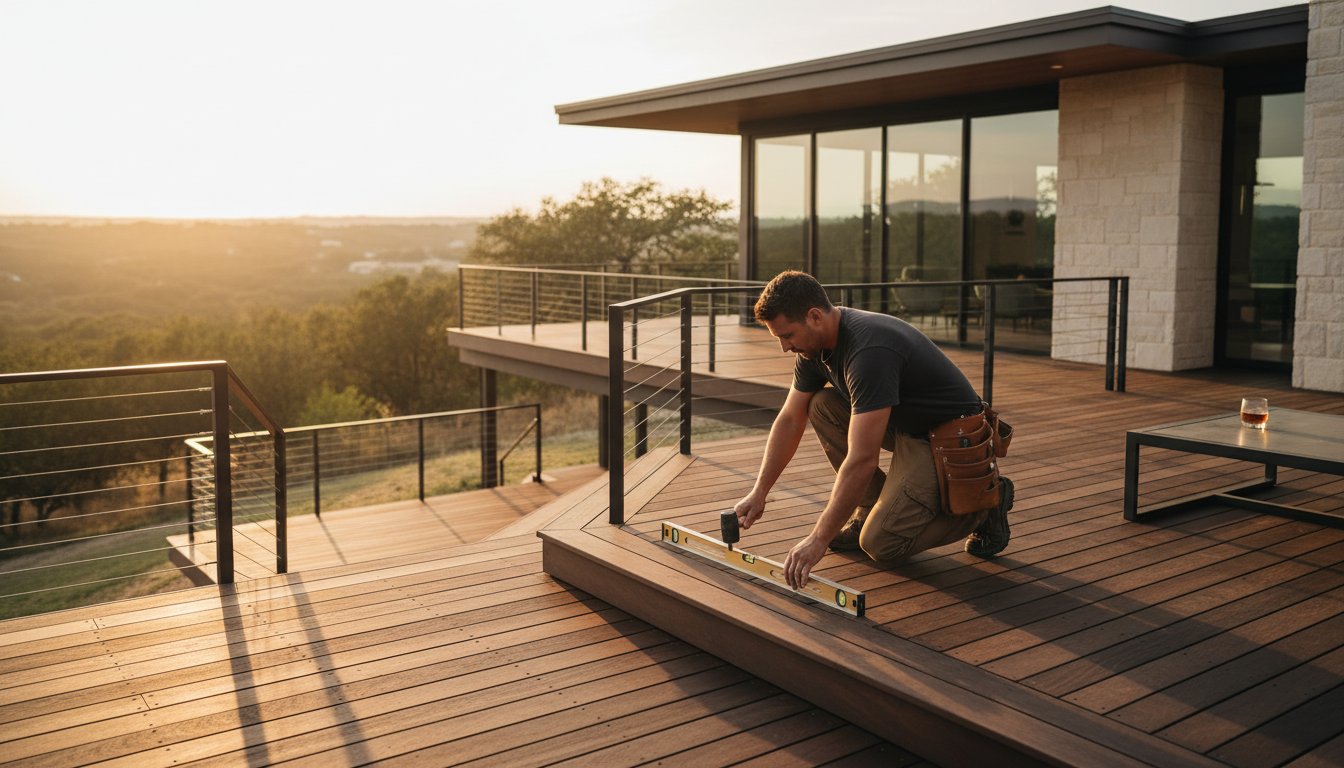
Designing for the Austin Landscape: 3D Visualization and Metalwork
Austin topography rarely plays nice with standard construction. Between the jagged limestone shelves and the protected heritage oaks, a simple "brown rectangle" deck usually fails the site. Professional ipe deck builders Austin focus on multi-level architecture that respects the land. This involves terracing the structure to follow the slope, creating distinct zones for cooking, lounging, and utility without clear-cutting the yard. It's about working with the Texas terrain rather than fighting it.
The Power of 3D Design Renderings
Building a high-end project without a visual roadmap is a recipe for expensive mid-build pivots. We use 3D design renderings to let you walk through the space before we order a single board. You can see exactly how the July sun hits your seating area at 4:00 PM, allowing us to place shade structures with surgical precision. We also model high-load additions like custom saunas or stainless steel cold plunges directly into the footprint. This ensures the foundation is engineered for the specific weight of your gear before the first hole is dug.
Integrating Custom Metalwork for a Modern Aesthetic
Ipe is a valuable and durable hardwood that carries immense physical weight. Standard wood framing often struggles with the long-term load of 40-year timber. We solve this by utilizing structural steel framing and custom metalwork. Steel provides a level of precision that wood cannot match, allowing for longer spans and thinner profiles that look sharp and stay level for decades. It's a calculated move for both durability and design ROI.
The visual contrast between the organic, deep-red grain of Ipe and matte black steel railings creates a high-contrast, modern aesthetic. We prioritize structural welding over standard wood-on-wood connections because it eliminates the movement and "bounce" common in cheaper builds. This rigidity is essential when building on Austin's shifting soils and rock. When you pair architectural fencing with precision-cut metal, the result is a permanent piece of infrastructure that handles the Austin climate without flinching. Every weld and every bolt is a deliberate choice for longevity.
The Realities of Ipe Maintenance in Central Texas
The "maintenance-free" label is a myth that needs to die. Ipe is indestructible, but it isn't immortal in the face of intense Texas UV rays. If you leave your deck untreated, it won't rot, but it will transform. Within twelve months, the rich, mahogany-like tones will fade into a weathered driftwood silver. This is oxidation, not decay. Expert ipe deck builders Austin residents hire focus on setting expectations early: you choose the look, and the look dictates the labor.
Ipe is dense. It’s so dense it doesn't soak up water, but it also doesn't soak up standard hardware store stains. If you ignore the maintenance requirements, you aren't risking the structural integrity of the 40-year board. You’re simply choosing a different aesthetic. Understanding this distinction is the difference between a satisfied homeowner and a frustrated one.
The silver patina vs. the oiled look
Structural integrity doesn't care about color. Whether your deck is silver or deep brown, the wood's density remains the same. Many Austin architects actually prefer the silver patina for its low-maintenance, organic aesthetic that mirrors the limestone and cedar of the Hill Country. It looks sophisticated and intentional when paired with modern steel railings.
If you want that high-gloss, luxury yacht finish, you're signing up for a schedule. Oiled decks require a fresh coat every 12 to 24 months depending on sun exposure. If your deck has already turned gray, don't worry. A professional cleaning and brightening service using sodium percarbonate can reverse the clock. It strips away the silver oxidation to reveal the original wood grain underneath in a single afternoon.
Protecting your investment from the Texas sun
The Texas sun is the primary enemy of any outdoor project. UV radiation breaks down the lignin in wood fibers, leading to surface checking and graying. Avoid surface-film stains or paints at all costs. These products create a plastic-like layer that cannot bond with Ipe’s tight grain. They will crack, flake, and peel within one summer, leaving you with a sanding nightmare that costs thousands to fix.
Stick to high-quality penetrating oils like Cutek Extreme. These products dive deep into the wood, nourishing it from the inside out. They don't peel. They simply fade over time, making the re-application process as simple as a quick wash and a new coat. Working with professional ipe deck builders Austin ensures your project is finished with the right chemistry for our specific 100-degree climate. This proactive approach keeps your investment looking like a centerpiece rather than an afterthought.
Ready to build a deck that stands the test of time? Consult with the experts at Big Decks to plan your 40-year outdoor investment.
Partnering with BigDecks for Your Austin Ipe Project
Hiring ipe deck builders Austin is a high-stakes decision for your property value. We treat every project like a strategic investment rather than a simple home improvement task. BigDecks operates on a no-BS framework because high-end outdoor construction requires precision, not marketing fluff. We don't install composite. We don't use plastic. Our team combines traditional carpentry with modern metal fabrication to ensure your deck doesn't just look good on day one; it stays level for decades.
Our commitment to premium wood is absolute. We use Ipe because it is the gold standard for durability in the Central Texas heat. By pairing this dense hardwood with steel framing or reinforced timber, we build structures that resist the warping and sagging common in lower-tier builds. We are your strategic ally in creating a backyard that wins. We focus on ROI and the psychological impact of a well-executed space.
Why design-build is superior to general contracting
Traditional general contracting often creates a massive gap between the architect's vision and the builder's reality. We eliminate that friction by keeping everything in-house. You have one point of contact from the first 3D sketch to the final screw. This ensures that "pretty drawings" actually translate into buildable, structurally sound assets. This integrated approach allows us to incorporate high-performance amenities like outdoor saunas into your layout without technical hiccups or timeline delays. We own the narrative from start to finish.
Start your Austin backyard transformation
The process begins with a site consultation where we analyze your topography and local building codes. You should come prepared with your non-negotiables and a clear understanding of your site's limitations. Once we align on the vision, we move into the 3D rendering phase. This isn't a vague sketch; it's a high-fidelity model that shows exactly how the Ipe will interface with your home's existing architecture. Most projects in Central Texas require specific permitting based on drainage and tree protection zones. We handle those logistics so the build stays on schedule.
A standard BigDecks project follows a rigorous timeline designed for maximum impact:
- Initial site assessment and feasibility study to identify utility lines or grade issues.
- Detailed 3D design and material specification based on your specific lifestyle needs.
- Permitting and engineering review to meet Austin's strict building requirements.
- Precision construction and final site cleanup with a focus on job site cleanliness.
We don't take shortcuts. We build 40-year structures for homeowners who value engineering over aesthetics alone. If you're ready to stop browsing and start building a legacy asset, we're ready to talk. Schedule your 3D design consultation with BigDecks today.
Frequently asked questions
How long does an Ipe deck project take in Austin?
Most high-end Ipe projects take between 4 to 8 weeks for construction, depending on the complexity and size. This timeline doesn't include the 3 to 6 weeks typically required for the design and permitting phase.
Does BigDecks handle the permitting process?
Yes. We manage the entire permitting and engineering process with the City of Austin or Travis County. We ensure your project complies with local setbacks, impervious cover limits, and drainage requirements.
Why don't you use composite materials?
Composite and plastic decking materials absorb heat and lack the structural integrity of natural hardwood. In the Texas sun, these materials can become uncomfortable to walk on and often fail to deliver the 40-year lifespan that Ipe provides.
Secure Your Forty-Year Outdoor Advantage
Choosing Ipe isn't just a design choice; it's a strategic move for your property. This wood lasts four decades when handled by experts who understand the physics of dense hardwoods. You're investing in a structure that withstands the Texas sun while maintaining its structural integrity year after year. We treat every project like a high-stakes pitch where the ROI is measured in decades of use, not just seasons.
Our specialized Ipe carpentry team integrates precision metalwork with in-house 3D visualization to ensure every joint and beam is perfect before we break ground. As the premier ipe deck builders Austin homeowners trust, we focus on the technical realities of Central Texas construction. We strip away the guesswork and replace it with high-octane engineering and bold design. You want a partner who treats your backyard like a strategic asset, not just a weekend project. It's time to stop thinking about your next deck and start building the last one you'll ever need.
Ready to build the last deck you'll ever need? Get a BigDecks quote.
Your vision deserves a build that doesn't just look good today but dominates the neighborhood for the next forty years. Let's build something legendary.
Frequently Asked Questions
Is Ipe wood too hot to walk on in the Austin summer?
Ipe stays significantly cooler than dark composite decking because its natural density allows it to dissipate heat rather than absorb it. In 100 degree Austin temperatures, this hardwood remains comfortable for bare feet while synthetic materials often reach scorching levels. It's the superior thermal choice for pool surrounds and sun-drenched backyard layouts.
How much does an Ipe deck cost per square foot in Austin?
Professional installation for a hardwood project typically ranges from $35 to $65 per square foot based on 2024 industry data from Angi. This investment covers the premium timber and the specialized labor required for pre-drilling every fastener. Leading ipe deck builders Austin focus on this material because the 40 year lifespan offers a much higher ROI than cheaper, short-lived alternatives.
Do I need a permit for an Ipe deck installation in Austin, TX?
The City of Austin requires a building permit for any deck that is more than 30 inches above grade or attached to your house. You'll also need to follow specific zoning setbacks and impervious cover limits defined by your local lot size. We manage the technical paperwork with the Development Services Department to ensure your project is code-compliant and legal.
Can Ipe wood be used for architectural fencing and privacy screens?
Ipe is an elite material for horizontal architectural fencing and modern privacy walls. Its structural stability prevents the warping and twisting common with cedar or pressure-treated pine in the humid Texas climate. These vertical elements create a high-end, cohesive look that mirrors the sophisticated aesthetic of your main outdoor living area.
How long does it take for an Ipe deck to turn gray in the Texas sun?
You'll notice the wood beginning to shift toward a silver-gray patina within 6 to 12 months of constant UV exposure. This change is purely aesthetic and doesn't impact the wood's internal strength or resistance to rot. If you want to keep the deep brown tones, you'll need to apply a hardwood-specific oil finish once every year.
Why is Ipe called 'Ironwood' and does it really sink in water?
Ipe is nicknamed Ironwood because it has a Janka hardness rating of 3,680 lbf, which is roughly eight times harder than a standard redwood board. It sinks immediately in water because its density is 1.1 grams per cubic centimeter, making it heavier than the liquid it displaces. This extreme density gives the wood a Class A fire rating, the same rating given to steel and concrete.
Building with Ipe is a strategic move for homeowners who value longevity and performance. These FAQs cover the basics, but the real value comes from a design that fits your specific topography and lifestyle. Focus on the long game and choose materials that can handle the Texas heat for the next four decades.
Austin Deck Labor Costs: 2026 Price Per Square Foot Guide
Uncover the 2026 labor cost to build a deck per square foot in Austin. See why local pros charge $25-$50 and learn to spot a low-ball bid instantly.
Your neighbor's $15 per square foot quote from 2022 is a fantasy that will leave you with a sagging frame and a missing contractor. In the high-stakes Austin market, relying on national averages is like bringing a butter knife to a gunfight. You've likely hit a wall of conflicting data and vague estimates that change the moment you mention Ipe or high-end composite materials. It's frustrating to hunt for the truth while 42% of local homeowners report project delays due to under-quoted labor. We're ending that confusion right now by exposing the real labor cost to build a deck per square foot in Central Texas.
This is your no-BS roadmap to the 2026 pricing landscape. We're delivering a transparent breakdown of why professional crews in Travis County command $25 to $50 per square foot depending on your site's complexity. You'll gain the precise data needed to spot a low-ball disaster before it starts and the confidence to hire a team that actually delivers. We're diving into the specific variables, from soil density to material weight, that determine whether your project is a massive win or a total financial sinkhole. Get ready to bid like a pro.
Key Takeaways
- Forget national averages; Austin’s high-stakes market demands a 15-25% premium for elite, precision craftsmanship.
- Lock down your budget by understanding how material density and deck height dictate the real labor cost to build a deck per square foot.
- Navigate the "Austin Tax"—from grueling limestone excavations to the city’s ruthless permitting and inspection gauntlet.
- Audit your builder’s bid like a pro to ensure you’re paying for actual expertise, not just overhead and excuses.
- Leverage 3D visualization to kill labor waste and ensure every dollar spent on site translates to pure, high-impact results.
The Reality of Deck Labor Costs in Austin for 2026
Austin isn't a bargain bin. If you're hunting for 2022 prices in 2026, you've already lost the game. The Central Texas construction market is a high-stakes environment where demand outpaces skilled supply every single day. When we talk about deck labor, we aren't just talking about a guy with a circular saw. We are talking about the strategic execution of deck construction methods that ensure your structure doesn't become a liability. Labor covers the structural framing, the precision decking installation, and the critical hardware integration that keeps the whole system under tension.
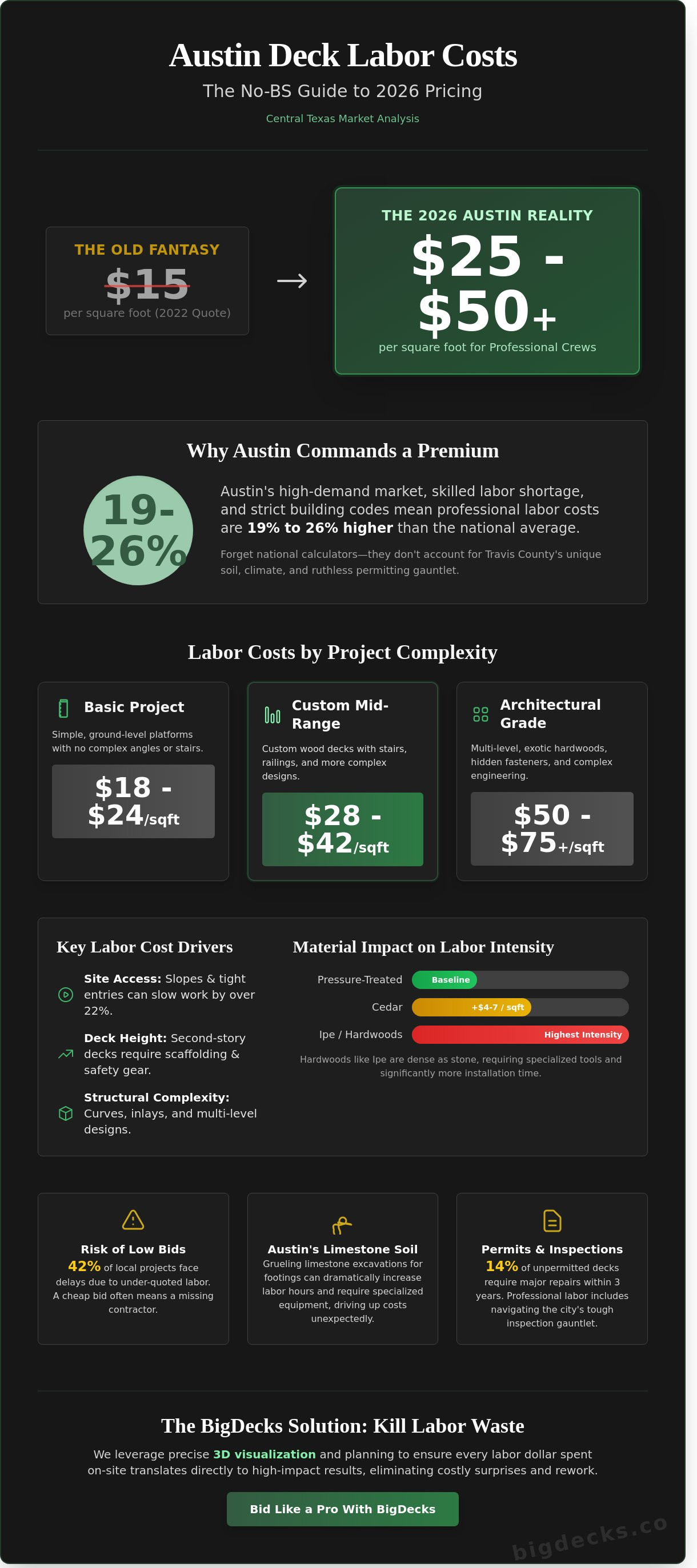
In 2026, Austin labor rates sit 19% to 26% higher than the national average. This isn't a random hike. It's a reflection of the specialized skill required to navigate Travis County’s unique soil conditions and strict building codes. You're paying for a result, not just a time slot. A handyman might offer a "killer deal," but they lack the bonding and engineering depth of a design-build firm. One is a temporary fix; the other is a structural win that adds real equity to your home. The labor cost to build a deck per square foot in Austin now reflects this gap between basic carpentry and architectural grade execution.
Expect to see professional labor quotes starting at $18 per square foot for the most basic projects. However, for a project that actually turns heads and survives a Texas summer, that number climbs quickly. You aren't just buying hours. You're buying an insurance policy against structural failure. In a city where 14% of unpermitted decks require major intervention within three years, the premium for professional labor is the only logical ROI move.
Why National Calculators Fail Austin Homeowners
Generic online calculators are useless in the 78704. They don't account for the 2026 cost of living surge or the specific insurance requirements mandated in Central Texas. Local firms carry $2 million general liability policies and specialized bonding that protects your property. The "cheap labor" trap is a fast track to disaster. Low bids often skip the ledger flashing or post-to-beam connectors that prevent collapse. In Austin, saving 15% on labor today usually costs you 100% of the deck's value when it fails inspection or, worse, fails under a load.
The 2026 Labor Price Range: From Basic to Premium
Your budget dictates your tier of talent. For a basic, ground-level platform with no complex angles, the labor cost to build a deck per square foot ranges from $18 to $24. Step up to a mid-range custom wood deck with stairs and railing, and labor hits the $28 to $42 bracket. If you're chasing a high-end architectural masterpiece with multi-level transitions and hidden fasteners, labor starts at $50 and can exceed $75 per square foot. These figures represent the 2026 standard for crews that actually show up, pass inspections, and deliver a stunning finish.
Variables That Drive Labor Costs Per Square Foot
Average prices are for the competition. In the Austin market, your labor cost to build a deck per square foot is a direct reflection of technical difficulty and logistical friction. You aren't just paying for a crew to show up. You're investing in the specialized skill sets required to execute a high-stakes architectural vision. The baseline Bureau of Labor Statistics wage data for construction laborers provides a starting point, but elite deck specialists in 2026 command a 35% premium over general laborers. This is the cost of precision.
Site access is the first silent budget killer. A flat, street-accessible lot in Mueller is a different beast than a 40-degree limestone slope in West Lake Hills. When crews have to haul 20-foot joists up a cliffside or navigate tight zero-lot-line entries, efficiency drops by 22%. Height adds another layer of complexity. Second-story decks require scaffolding, material lifts, and rigorous safety harnesses. These logistical hurdles turn a standard 40-hour build into a 65-hour marathon, driving the per-square-foot labor rate into the premium tier.
Material Choice and Labor Intensity
Material selection dictates the rhythm of the build. Pressure-treated pine is the baseline for speed. It's soft, easy to cut, and uses standard fasteners. It's the high-volume play. Cedar and Douglas Fir demand more respect. These woods require specialized handling to prevent marring and precise finishing to showcase the grain. The labor is more deliberate, often adding $4 to $7 per square foot in specialized handling fees.
Hardwoods like Ipe and Thermory change the game entirely. These materials are essentially stone. They destroy standard drill bits and eat through carbide saw blades in hours. Every single screw hole must be pre-drilled. There's no room for error. Because of this density, the labor cost for the decking phase can double compared to softwoods. If you're choosing exotic hardwoods, you're choosing a craftsman's pace, not a production line speed.
Design Complexity: Beyond the Rectangular Box
Standard rectangles are efficient. They minimize waste and maximize speed. Once you introduce curves, the math changes. Bending composite boards or kerf-cutting wood for a radius edge requires specialized heating blankets and jigs. A single curved fascia can add 12 to 18 man-hours to a project. Picture-frame borders and herringbone patterns look stunning because they're difficult. They require 30% more internal framing to support the board ends, which inflates the labor cost to build a deck per square foot before the first surface board is even laid.
- Structural Integration: Sunken hot tubs require independent framing systems capable of supporting 3,500+ pounds.
- Custom Metalwork: Integrating steel posts or cable railing systems requires millimetric precision and specialized welding or tensioning tools.
- Multi-Level Transitions: Every step and landing adds four hours of framing and trim work to the schedule.
Custom additions like built-in seating or integrated saunas transform a deck into a destination. These aren't just "add-ons." They're structural modifications that require deep engineering knowledge. If your project involves complex geometry or heavy load-bearing requirements, get a strategic breakdown of how these features impact your timeline. In 2026, the difference between a good deck and a legendary one is the caliber of the labor behind the tools. Precision isn't cheap, but it's the only way to win the room.
Austin-Specific Factors: Permits, Soil, and Climate
Building in Austin isn't a simple weekend project. It's a strategic operation against geology and bureaucracy. Your labor cost to build a deck per square foot in Central Texas reflects the local reality of digging into a literal rock quarry while navigating one of the most rigorous permitting offices in the country. This isn't just construction; it's a high-stakes game of precision. Professionals don't just charge for the wood. They charge for the expertise required to conquer Austin’s unique terrain and technical requirements.
The "Rock" Tax: Foundation Labor in Central Texas
In Austin, "dirt" is often a myth. West of I-35, your crew will likely hit Edwards Limestone within six inches of the surface. This rock can reach a compressive strength of 8,000 psi. Digging a standard 36-inch pier hole doesn't happen with a shovel; it requires pneumatic breakers and heavy-duty augers. This "Rock Tax" adds approximately $15 to $25 per pier in pure labor time. Additionally, Austin’s 35 inches of annual rainfall often arrives in violent bursts. Laborers must execute precise site grading and erosion control to ensure your foundation doesn't migrate toward Town Lake during the next May deluge.
Permitting and Code Compliance Labor
The City of Austin Development Services Department operates with a level of scrutiny that surprises most homeowners. In 2024, residential permit lead times averaged 7 weeks. Professional firms dedicate 12 to 20 labor hours just to plan submission, revisions, and site inspections. This administrative labor is a critical component of your total labor cost to build a deck per square foot. Builders must follow the Official Deck Construction Guide based on the 2021 International Residential Code, which Austin enforces with zero margin for error. Common "fix-it" labor costs stem from improper ledger flashing or stair geometry violations. Hiring a firm that includes "administrative labor" in their bid is a strategic move to avoid these $2,000 mistakes.
Austin’s climate and community standards also dictate labor intensity:
- Thermal Expansion Management: Austin’s 105-degree summers cause massive material movement. Laborers must utilize specific joist spacing, often 12 inches on center instead of 16, to prevent composite warping.
- Ventilation Labor: High heat requires specialized skirting and ventilation gaps. This adds 5 percent to the total labor hours to ensure the deck doesn't trap moisture and rot from the bottom up.
- HOA Bureaucracy: Neighborhoods like Steiner Ranch or Circle C require architectural reviews. Managing these 3-week approval cycles requires dedicated project management labor that amateur builders often overlook.
Every hour spent on a drill or a laptop is an investment in your property's ROI. Austin is a high-pressure environment where cutting corners on labor leads to catastrophic failure. You want a team that understands the psychological and physical demands of the Central Texas landscape. Winning the room means having a deck that survives the heat, the rock, and the inspector. It’s about building a killer outdoor space that stands as a definitive statement of value.
How to Evaluate an Austin Deck Builder’s Bid
Your backyard is high-stakes real estate. Accepting a bid based solely on the bottom line is the fastest way to turn your investment into a structural liability that will haunt your property value for a decade. In the Austin market, where 15% of contractors operate without active general liability insurance, you must be the lead auditor of your own project. Evaluating the labor cost to build a deck per square foot requires a surgical eye for detail. You aren't just buying wood and screws; you're buying an asset that should perform like a high-yield investment.
Demand a full breakdown. A professional bid separates materials from labor with total transparency. If a contractor hands you a single-number "all-in" price, they're hiding their margins or, worse, they haven't calculated their own overhead correctly. You need to know exactly what you're paying for. Ask about the crew. Are they W-2 employees or a rotating door of subcontractors? In 2026, 65% of the most successful Austin builds utilize dedicated, in-house teams. This ensures accountability. Subcontractors can be skilled, but without direct oversight, the nuances of your vision often get lost in translation.
Always verify local Austin references from the last 12 months. Call them. Ask if the builder hit their milestones or if the site looked like a disaster zone for three weeks. Check their workers' comp status through the Texas Department of Insurance. If a worker gets injured on your property and the builder isn't covered, that's your personal financial crisis. Don't gamble with your equity.
The Red Flags of a "Too Good To Be True" Bid
Low-ball bids are a trap. If a quote comes in 25% lower than the competition, the builder is likely skipping the $1,200 in structural hardware, such as Simpson Strong-Tie connectors, required for a safe build. Vague timelines are another killer. If they won't commit to a schedule with specific milestones, they're probably juggling five other jobs. The biggest red flag is a refusal to pull permits with the Austin Development Services Department. This isn't "saving you money"; it's a shortcut that leads to $500 daily fines and a mandatory teardown if the city catches wind of the unpermitted work.
Green Flags: What Professionalism Looks Like
A killer bid starts with a 3D design phase. You should see a digital twin of your deck before a single board is cut. This level of planning proves the builder has calculated joist spans and load-bearing points correctly. Professional builders discuss the "why" behind their framing techniques. They will proactively mention joist tape, which adds roughly $0.60 per square foot to the budget but effectively doubles the life of your frame. When you analyze the labor cost to build a deck per square foot, you are actually pricing out this level of strategic expertise. They focus on long-term durability and ROI, ensuring the deck looks as stunning in year ten as it does on day one.
Ready to build a deck that dominates the neighborhood? Get a precision bid from Big Decks today.
The BigDecks Approach: Precision Labor and 3D Design
Most Austin contractors play a guessing game with your backyard. They eyeball the slope, sketch a rough plan on a napkin, and hope the lumber yard delivery is accurate. That's a recipe for budget bloat. At BigDecks, we operate with a "build once, build right" philosophy that treats your outdoor space like a high-stakes investment. Your labor cost to build a deck per square foot isn't just a fee for manual work; it's an investment in a surgical execution plan. We've eliminated the 22% rework rate common in budget builds by digitizing the entire process before a single board arrives on-site.
Our 3D visualization technology is the cornerstone of our labor efficiency. In our 2025 performance audit, we found that high-fidelity modeling reduced on-site labor waste by an average of 18 hours per project. We don't just show you a pretty picture; we build a digital twin of your deck to identify structural conflicts. This allows our crews to fuse traditional carpentry with precision metalwork seamlessly. We utilize heavy-duty steel framing and specialized hardware that can withstand 105-degree Austin heat waves without the warping issues seen in cheap pressure-treated wood. Precision is non-negotiable when you're building for the long game.
Design-Build Efficiency in Austin
We've killed the traditional gap between the architect and the builder. When these two parties don't talk, you pay for the silence in change orders. Utilizing our internal 3D Design Services ensures that what we render is exactly what our carpenters execute. This integrated workflow saves homeowners an average of $4,200 in "surprise" structural adjustments. For example, a recent 425-square-foot project in West Lake Hills was completed 9 days ahead of schedule because the 3D model accounted for the complex limestone terrain before we broke ground.
Investing in Longevity
Cheap labor is the most expensive thing you can buy. A budget crew might save you $10 per square foot today, but if the deck rots in 7 years, your ROI is zero. We specialize in Thermally Modified Wood because it's engineered to survive the brutal Central Texas climate. Our labor includes the application of premium penetrating oils like Cutek Extreme. This isn't just a "stain" job; it's a molecular-level protection process that ensures your deck remains a legacy asset rather than a maintenance nightmare.
- Structural Integrity: Every joist and beam is placed according to a digital blueprint, not a "gut feeling."
- Climate Resilience: We use materials specifically chosen for Austin's UV index and humidity swings.
- Maximized ROI: Professional labor increases your home's resale value by providing a documented, engineered structure.
Don't settle for a deck that barely survives the season. You need a strategic ally who understands that the labor cost to build a deck per square foot is a direct reflection of the quality and lifespan of the build. We're here to win the room and transform your property into a powerhouse of outdoor living. It's time to stop dreaming and start executing. Get a detailed bid for your Austin deck project today and see what precision labor actually looks like.
Build Your 2026 Outdoor Empire
Your backyard is a high-stakes investment, not just a simple renovation. In 2026, navigating the labor cost to build a deck per square foot requires more than a ballpark figure; it demands a surgical approach to Austin's volatile soil conditions and strict permit hurdles. Cheap bids often hide expensive failures that tank your ROI. You're looking for a strategic ally who understands that premium materials like Ipe and Thermally Modified Wood require elite craftsmanship to deliver a definitive win.
BigDecks brings a high-octane, results-oriented mindset to your outdoor living space. Our Austin-based expert team utilizes a comprehensive 3D design process to visualize every detail, ensuring your project hits its mark without the typical construction friction. We strip away the fluff and focus on the killer results that define high-end Austin living. We don't just build decks; we engineer the most stunning backyards in Texas using precision labor and a relentless focus on quality.
Start your Austin backyard transformation with a BigDecks 3D rendering and secure your spot on our 2026 build calendar. It's time to win the room and your neighborhood.
Frequently Asked Questions
Is $30 per square foot too much for deck labor in Austin?
$30 per square foot is the 2026 baseline for elite Austin craftsmanship. You aren't just buying labor; you're securing a 25-year structural guarantee and surgical precision. Sub-par crews charging $15 or $20 often lead to a 40% increase in maintenance costs within 36 months. Pay for the win now or pay for the failures later. It's a binary choice for serious homeowners.
Does the labor cost include the removal of my old deck?
Standard quotes exclude demolition. Expect a separate line item between $5 and $9 per square foot for removal and disposal. Your labor cost to build a deck per square foot focuses on the new asset. Hauling 2,500 pounds of debris requires specific logistics and landfill fees. We keep these numbers transparent so your project ROI stays sharp and predictable from the first hammer swing.
How much does a permit for a new deck cost in Austin?
Budget exactly $350 to $650 for City of Austin residential permits in 2026. This cost fluctuates based on your total project valuation and site complexity. We manage the entire filing process because your time is a finite resource. Ignoring the permit office is a $2,500 mistake that can halt your project for 90 days. We protect your investment by doing it right.
Why is labor for Ipe or hardwood decks so much higher than cedar?
Ipe labor costs 55% more than cedar because the wood is practically bulletproof. Every fastener requires pre-drilling with specialized carbide-tipped bits that dull after 150 square feet. Cedar is a soft, entry-level material; Ipe is a high-performance beast that demands elite skill. You're investing in a 50-year deck lifespan, and that requires a caliber of installer who never misses a detail.
Do I need to pay a deposit for labor before the project starts?
A 50% deposit is the non-negotiable standard to secure your position on our 2026 build calendar. This capital commitment locks in your crew and ensures your project doesn't get sidelined by other high-stakes builds. We don't gamble with your timeline. That initial payment keeps the momentum high and ensures the heavy equipment arrives on site exactly when we promised it would.
How long does it typically take to build a 300 sq. ft. deck in Austin?
A 300 square foot project takes exactly 9 to 14 business days from the first post hole to the final inspection. Your labor cost to build a deck per square foot covers this high-intensity execution. Custom features like integrated outdoor kitchens or tiered levels will extend the timeline by 4 days. We prioritize speed and precision so you can start winning the neighborhood game by next Friday.