

Ipe Deck Builders Austin: Engineering the 40-Year Outdoor Investment
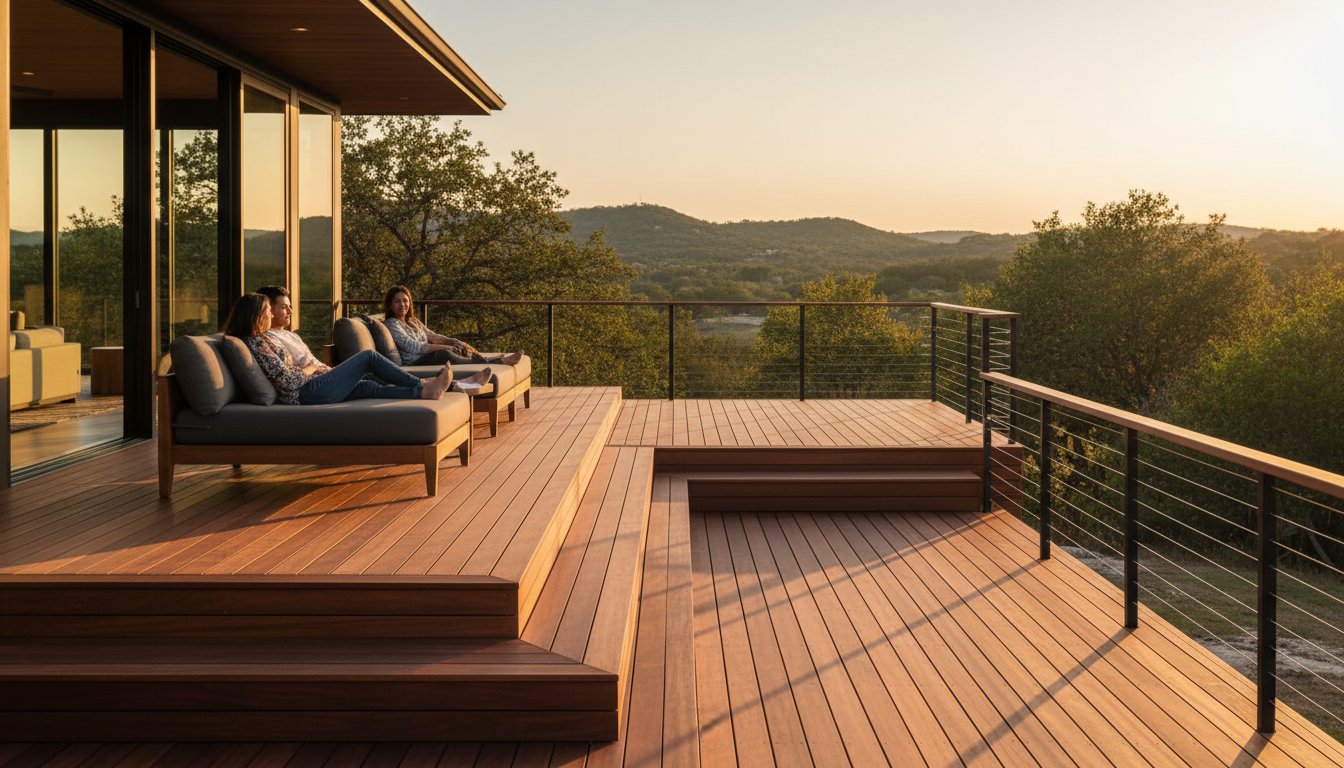
Austin’s 105-degree summer heat will turn a standard pressure-treated deck into a warped, splintering liability in under 36 months. You understand that building an outdoor space in Central Texas is a high-stakes game where the sun is always trying to win. Finding the right ipe deck builders Austin homeowners rely on is the difference between a temporary fix and a permanent architectural win. It’s frustrating to watch a massive investment fade into a plastic-looking composite or rot away because a contractor prioritized speed over durability.
The most successful property owners treat their backyard as a high-performance asset with a 40-year lifecycle. This article explains why Ipe is the only hardwood capable of surviving the Texas climate without sacrificing its modern, high-end aesthetic. You’ll learn how to vet specialized builders who understand the technical complexity of this ironwood. We are diving into the engineering requirements, maintenance realities, and the strategic decisions that ensure your deck remains a zero-rot masterpiece for decades.
Key Takeaways
- Understand why Ipe’s "Ironwood" status makes it the only logical material choice for surviving the relentless Central Texas heat.
- Learn why hiring specialized ipe deck builders Austin is critical for handling a high-density hardwood that destroys standard tools and requires precise pre-drilling.
- Avoid expensive mid-project mistakes by utilizing 3D architectural visualization to perfect multi-level designs and custom metalwork before construction starts.
- Decide between maintaining Ipe’s rich, dark tones or allowing it to weather into the sophisticated silver patina preferred by modern architects.
- Discover how a design-build approach that merges traditional carpentry with modern metal fabrication creates a legitimate 40-year outdoor investment.
Why Ipe is the Gold Standard for Austin Outdoor Living
Ipe isn't just wood. It's a structural asset. Often called Brazilian Walnut or Ironwood, this high-density tropical hardwood is famous for its extreme durability and weight. It belongs to the Handroanthus genus, a group of trees that produce timber so dense it actually sinks in water. This performance makes it ideal for docks and seaside structures, which is why professionals in that sector often explore Digital Marketing for Marine Contractors to showcase their specialized projects. For ipe deck builders Austin homeowners hire to create permanent outdoor structures, this material represents the peak of engineering and natural beauty.
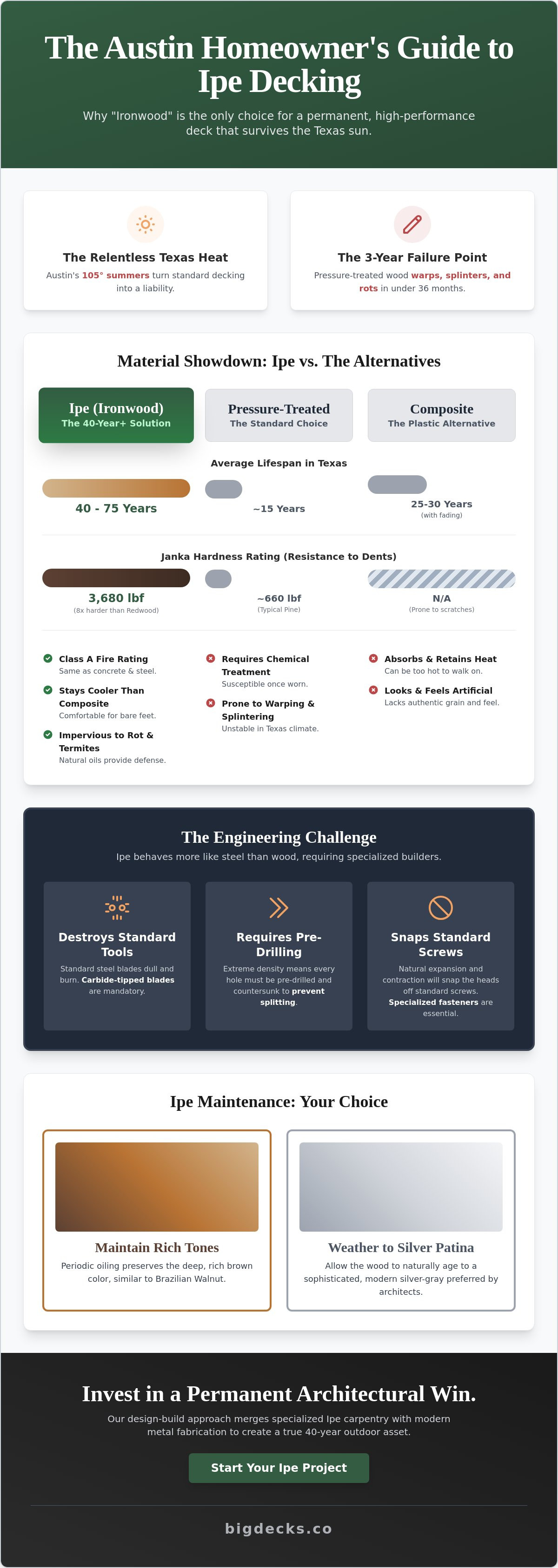
Central Texas weather is a brutal testing ground for lumber. While Cedar and Douglas Fir are common, they often surrender to the 105-degree Austin sun within a few years. They warp, splinter, and lose their structural integrity. Ipe thrives in these conditions. It carries a Class A fire rating, putting it in the same safety category as concrete and steel. It's a non-negotiable advantage for homeowners who prioritize safety and long-term performance.
The natural resistance of this wood is unmatched. It's packed with organic oils and tannins that act as a built-in defense system. Termites won't touch it. Rot can't get a foothold. Even during Austin's high-humidity cycles, Ipe maintains its shape and strength. It's the ultimate "set it and forget it" material for a high-end backyard build.
Ipe vs. Composite: Why Austin Homeowners are Rejecting Plastic
Many homeowners are moving away from synthetic materials. Composite boards are notorious for heat retention. In a typical Austin summer, plastic decks can become hot enough to burn feet or paws. Ipe stays significantly cooler under the direct sun. It offers an authentic grain and structural rigidity that "fake" textures can't mimic. You can see the breakdown of these differences in this Wood vs. Composite comparison. Real wood wins on feel and function every time.
The ROI of Hardwood: Longevity as a Financial Strategy
Think of an Ipe deck as a 40 to 75 year financial strategy. Standard pressure-treated wood usually requires replacement or heavy repair after 15 years. When you analyze the deck cost per square foot, the upfront premium for Ipe pays for itself by skipping three replacement cycles. In Austin's aggressive real estate market, a hardwood deck is a major selling point. It signals to buyers that the property was built with zero compromises.
Choosing the right ipe deck builders Austin relies on understanding these technical specs. You aren't just buying a place to put a grill. You're investing in a legacy structure that outlasts the mortgage. It's about choosing raw power and permanent value over temporary fixes.
The Engineering Challenge: Why Your Builder Needs Ipe Expertise
Ipe isn't standard lumber; it's a structural challenge that behaves more like steel than timber. If a contractor approaches an Ipe project with the same tools they use for cedar, your investment is already at risk. Qualified ipe deck builders Austin understand that this material requires a specialized approach to prevent catastrophic failure early in its lifespan.
The material carries a Janka hardness rating of 3,680 lbf. That is three times harder than White Oak and nearly eight times harder than Redwood. Standard carbon steel blades will dull within minutes, often smoking or burning the wood before finishing a single cut. You don't just screw into Ipe. Every single hole requires pre-drilling and countersinking. Skip this step, and the board splits immediately. Standard deck screws are a non-starter because the sheer density of the wood will snap the heads off as the boards naturally adjust to the environment.
Specialized Tooling and Precision Carpentry
Carbide-tipped blades and high-torque impact drills are the baseline requirements for this work. Precision matters because Ipe is unforgiving and doesn't hide mistakes. Every cut end must be treated with a wax-based emulsion sealer immediately to prevent checking and end-cracking. This level of technical detail is a primary driver for deck labor costs in Austin. You are paying for a specialist's time and their high-wear equipment, but it's the only way to ensure the wood remains stable for forty years.
Managing Expansion and Contraction in Texas Humidity
Austin's climate is brutal on organic materials. We swing from 100 percent humidity to bone-dry droughts in a matter of weeks. While the wood is incredibly dense, it still responds to moisture. Because of the unique mechanical properties of Ipe, it exerts massive force on the frame as it moves. We mitigate this by tightening joist spacing to 12 inches on center rather than the standard 16 inches used for composites or softwoods.
This tighter spacing provides the necessary support for the heavy hardwood load. Professional ipe deck builders Austin often recommend structural metalwork or steel framing for the substructure. This provides the rigidity required to keep the platform perfectly level while the wood expands and contracts above it. If you want a deck that survives the next four decades, you need a team that respects the physics of the material. Check out how Big Decks engineers high-performance outdoor spaces.
Designing for the Austin Landscape: 3D Visualization and Metalwork
Austin topography rarely plays nice with standard construction. Between the jagged limestone shelves and the protected heritage oaks, a simple "brown rectangle" deck usually fails the site. Professional ipe deck builders Austin focus on multi-level architecture that respects the land. This involves terracing the structure to follow the slope, creating distinct zones for cooking, lounging, and utility without clear-cutting the yard. It's about working with the Texas terrain rather than fighting it.
The Power of 3D Design Renderings
Building a high-end project without a visual roadmap is a recipe for expensive mid-build pivots. We use 3D design renderings to let you walk through the space before we order a single board. You can see exactly how the July sun hits your seating area at 4:00 PM, allowing us to place shade structures with surgical precision. We also model high-load additions like custom saunas or stainless steel cold plunges directly into the footprint. This ensures the foundation is engineered for the specific weight of your gear before the first hole is dug.
Integrating Custom Metalwork for a Modern Aesthetic
Ipe is a valuable and durable hardwood that carries immense physical weight. Standard wood framing often struggles with the long-term load of 40-year timber. We solve this by utilizing structural steel framing and custom metalwork. Steel provides a level of precision that wood cannot match, allowing for longer spans and thinner profiles that look sharp and stay level for decades. It's a calculated move for both durability and design ROI.
The visual contrast between the organic, deep-red grain of Ipe and matte black steel railings creates a high-contrast, modern aesthetic. We prioritize structural welding over standard wood-on-wood connections because it eliminates the movement and "bounce" common in cheaper builds. This rigidity is essential when building on Austin's shifting soils and rock. When you pair architectural fencing with precision-cut metal, the result is a permanent piece of infrastructure that handles the Austin climate without flinching. Every weld and every bolt is a deliberate choice for longevity.
The Realities of Ipe Maintenance in Central Texas
The "maintenance-free" label is a myth that needs to die. Ipe is indestructible, but it isn't immortal in the face of intense Texas UV rays. If you leave your deck untreated, it won't rot, but it will transform. Within twelve months, the rich, mahogany-like tones will fade into a weathered driftwood silver. This is oxidation, not decay. Expert ipe deck builders Austin residents hire focus on setting expectations early: you choose the look, and the look dictates the labor.
Ipe is dense. It’s so dense it doesn't soak up water, but it also doesn't soak up standard hardware store stains. If you ignore the maintenance requirements, you aren't risking the structural integrity of the 40-year board. You’re simply choosing a different aesthetic. Understanding this distinction is the difference between a satisfied homeowner and a frustrated one.
The silver patina vs. the oiled look
Structural integrity doesn't care about color. Whether your deck is silver or deep brown, the wood's density remains the same. Many Austin architects actually prefer the silver patina for its low-maintenance, organic aesthetic that mirrors the limestone and cedar of the Hill Country. It looks sophisticated and intentional when paired with modern steel railings.
If you want that high-gloss, luxury yacht finish, you're signing up for a schedule. Oiled decks require a fresh coat every 12 to 24 months depending on sun exposure. If your deck has already turned gray, don't worry. A professional cleaning and brightening service using sodium percarbonate can reverse the clock. It strips away the silver oxidation to reveal the original wood grain underneath in a single afternoon.
Protecting your investment from the Texas sun
The Texas sun is the primary enemy of any outdoor project. UV radiation breaks down the lignin in wood fibers, leading to surface checking and graying. Avoid surface-film stains or paints at all costs. These products create a plastic-like layer that cannot bond with Ipe’s tight grain. They will crack, flake, and peel within one summer, leaving you with a sanding nightmare that costs thousands to fix.
Stick to high-quality penetrating oils like Cutek Extreme. These products dive deep into the wood, nourishing it from the inside out. They don't peel. They simply fade over time, making the re-application process as simple as a quick wash and a new coat. Working with professional ipe deck builders Austin ensures your project is finished with the right chemistry for our specific 100-degree climate. This proactive approach keeps your investment looking like a centerpiece rather than an afterthought.
Ready to build a deck that stands the test of time? Consult with the experts at Big Decks to plan your 40-year outdoor investment.
Partnering with BigDecks for Your Austin Ipe Project
Hiring ipe deck builders Austin is a high-stakes decision for your property value. We treat every project like a strategic investment rather than a simple home improvement task. BigDecks operates on a no-BS framework because high-end outdoor construction requires precision, not marketing fluff. We don't install composite. We don't use plastic. Our team combines traditional carpentry with modern metal fabrication to ensure your deck doesn't just look good on day one; it stays level for decades.
Our commitment to premium wood is absolute. We use Ipe because it is the gold standard for durability in the Central Texas heat. By pairing this dense hardwood with steel framing or reinforced timber, we build structures that resist the warping and sagging common in lower-tier builds. We are your strategic ally in creating a backyard that wins. We focus on ROI and the psychological impact of a well-executed space.
Why design-build is superior to general contracting
Traditional general contracting often creates a massive gap between the architect's vision and the builder's reality. We eliminate that friction by keeping everything in-house. You have one point of contact from the first 3D sketch to the final screw. This ensures that "pretty drawings" actually translate into buildable, structurally sound assets. This integrated approach allows us to incorporate high-performance amenities like outdoor saunas into your layout without technical hiccups or timeline delays. We own the narrative from start to finish.
Start your Austin backyard transformation
The process begins with a site consultation where we analyze your topography and local building codes. You should come prepared with your non-negotiables and a clear understanding of your site's limitations. Once we align on the vision, we move into the 3D rendering phase. This isn't a vague sketch; it's a high-fidelity model that shows exactly how the Ipe will interface with your home's existing architecture. Most projects in Central Texas require specific permitting based on drainage and tree protection zones. We handle those logistics so the build stays on schedule.
A standard BigDecks project follows a rigorous timeline designed for maximum impact:
- Initial site assessment and feasibility study to identify utility lines or grade issues.
- Detailed 3D design and material specification based on your specific lifestyle needs.
- Permitting and engineering review to meet Austin's strict building requirements.
- Precision construction and final site cleanup with a focus on job site cleanliness.
We don't take shortcuts. We build 40-year structures for homeowners who value engineering over aesthetics alone. If you're ready to stop browsing and start building a legacy asset, we're ready to talk. Schedule your 3D design consultation with BigDecks today.
Frequently asked questions
How long does an Ipe deck project take in Austin?
Most high-end Ipe projects take between 4 to 8 weeks for construction, depending on the complexity and size. This timeline doesn't include the 3 to 6 weeks typically required for the design and permitting phase.
Does BigDecks handle the permitting process?
Yes. We manage the entire permitting and engineering process with the City of Austin or Travis County. We ensure your project complies with local setbacks, impervious cover limits, and drainage requirements.
Why don't you use composite materials?
Composite and plastic decking materials absorb heat and lack the structural integrity of natural hardwood. In the Texas sun, these materials can become uncomfortable to walk on and often fail to deliver the 40-year lifespan that Ipe provides.
Secure Your Forty-Year Outdoor Advantage
Choosing Ipe isn't just a design choice; it's a strategic move for your property. This wood lasts four decades when handled by experts who understand the physics of dense hardwoods. You're investing in a structure that withstands the Texas sun while maintaining its structural integrity year after year. We treat every project like a high-stakes pitch where the ROI is measured in decades of use, not just seasons.
Our specialized Ipe carpentry team integrates precision metalwork with in-house 3D visualization to ensure every joint and beam is perfect before we break ground. As the premier ipe deck builders Austin homeowners trust, we focus on the technical realities of Central Texas construction. We strip away the guesswork and replace it with high-octane engineering and bold design. You want a partner who treats your backyard like a strategic asset, not just a weekend project. It's time to stop thinking about your next deck and start building the last one you'll ever need.
Ready to build the last deck you'll ever need? Get a BigDecks quote.
Your vision deserves a build that doesn't just look good today but dominates the neighborhood for the next forty years. Let's build something legendary.
Frequently Asked Questions
Is Ipe wood too hot to walk on in the Austin summer?
Ipe stays significantly cooler than dark composite decking because its natural density allows it to dissipate heat rather than absorb it. In 100 degree Austin temperatures, this hardwood remains comfortable for bare feet while synthetic materials often reach scorching levels. It's the superior thermal choice for pool surrounds and sun-drenched backyard layouts.
How much does an Ipe deck cost per square foot in Austin?
Professional installation for a hardwood project typically ranges from $35 to $65 per square foot based on 2024 industry data from Angi. This investment covers the premium timber and the specialized labor required for pre-drilling every fastener. Leading ipe deck builders Austin focus on this material because the 40 year lifespan offers a much higher ROI than cheaper, short-lived alternatives.
Do I need a permit for an Ipe deck installation in Austin, TX?
The City of Austin requires a building permit for any deck that is more than 30 inches above grade or attached to your house. You'll also need to follow specific zoning setbacks and impervious cover limits defined by your local lot size. We manage the technical paperwork with the Development Services Department to ensure your project is code-compliant and legal.
Can Ipe wood be used for architectural fencing and privacy screens?
Ipe is an elite material for horizontal architectural fencing and modern privacy walls. Its structural stability prevents the warping and twisting common with cedar or pressure-treated pine in the humid Texas climate. These vertical elements create a high-end, cohesive look that mirrors the sophisticated aesthetic of your main outdoor living area.
How long does it take for an Ipe deck to turn gray in the Texas sun?
You'll notice the wood beginning to shift toward a silver-gray patina within 6 to 12 months of constant UV exposure. This change is purely aesthetic and doesn't impact the wood's internal strength or resistance to rot. If you want to keep the deep brown tones, you'll need to apply a hardwood-specific oil finish once every year.
Why is Ipe called 'Ironwood' and does it really sink in water?
Ipe is nicknamed Ironwood because it has a Janka hardness rating of 3,680 lbf, which is roughly eight times harder than a standard redwood board. It sinks immediately in water because its density is 1.1 grams per cubic centimeter, making it heavier than the liquid it displaces. This extreme density gives the wood a Class A fire rating, the same rating given to steel and concrete.
Building with Ipe is a strategic move for homeowners who value longevity and performance. These FAQs cover the basics, but the real value comes from a design that fits your specific topography and lifestyle. Focus on the long game and choose materials that can handle the Texas heat for the next four decades.