

Austin Deck Labor Costs: 2026 Price Per Square Foot Guide
Your neighbor's $15 per square foot quote from 2022 is a fantasy that will leave you with a sagging frame and a missing contractor. In the high-stakes Austin market, relying on national averages is like bringing a butter knife to a gunfight. You've likely hit a wall of conflicting data and vague estimates that change the moment you mention Ipe or high-end composite materials. It's frustrating to hunt for the truth while 42% of local homeowners report project delays due to under-quoted labor. We're ending that confusion right now by exposing the real labor cost to build a deck per square foot in Central Texas.
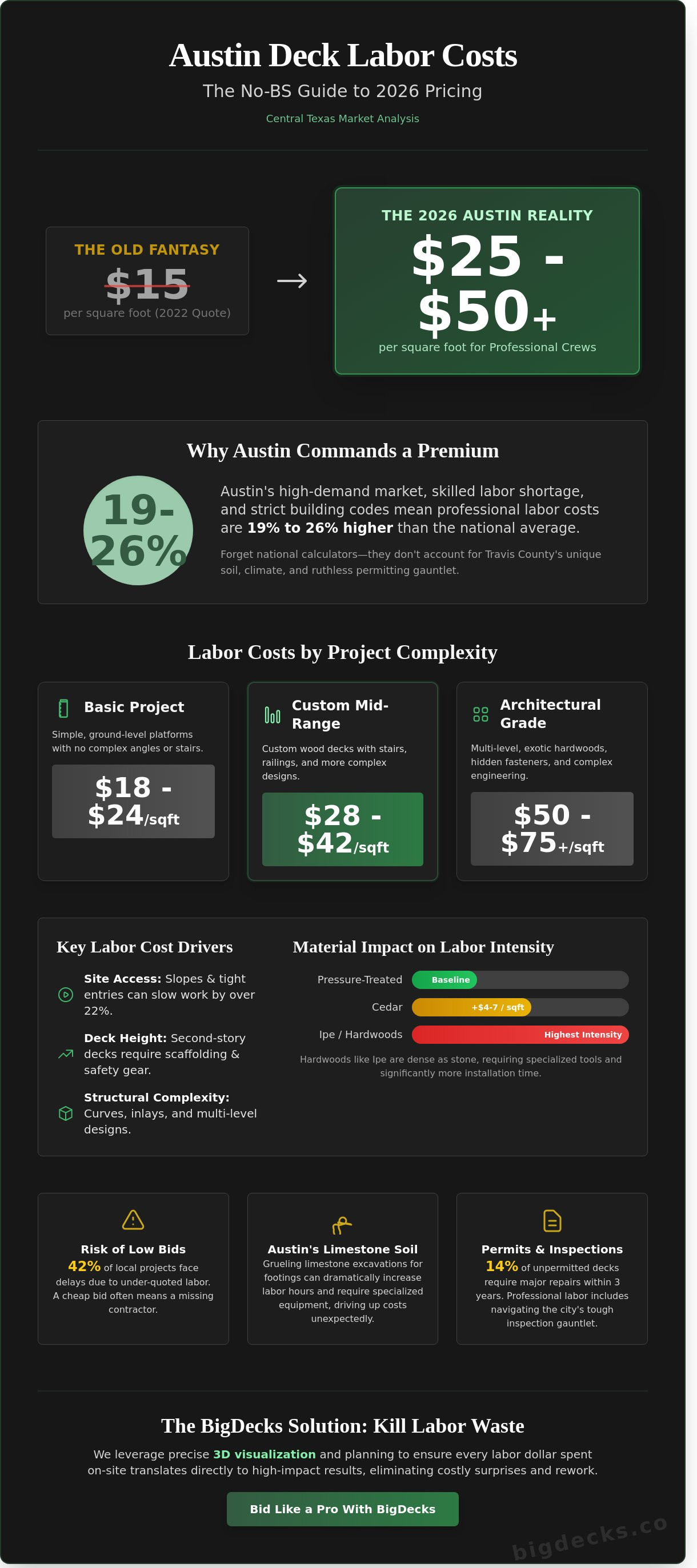
This is your no-BS roadmap to the 2026 pricing landscape. We're delivering a transparent breakdown of why professional crews in Travis County command $25 to $50 per square foot depending on your site's complexity. You'll gain the precise data needed to spot a low-ball disaster before it starts and the confidence to hire a team that actually delivers. We're diving into the specific variables, from soil density to material weight, that determine whether your project is a massive win or a total financial sinkhole. Get ready to bid like a pro.
Key Takeaways
- Forget national averages; Austin’s high-stakes market demands a 15-25% premium for elite, precision craftsmanship.
- Lock down your budget by understanding how material density and deck height dictate the real labor cost to build a deck per square foot.
- Navigate the "Austin Tax"—from grueling limestone excavations to the city’s ruthless permitting and inspection gauntlet.
- Audit your builder’s bid like a pro to ensure you’re paying for actual expertise, not just overhead and excuses.
- Leverage 3D visualization to kill labor waste and ensure every dollar spent on site translates to pure, high-impact results.
The Reality of Deck Labor Costs in Austin for 2026
Austin isn't a bargain bin. If you're hunting for 2022 prices in 2026, you've already lost the game. The Central Texas construction market is a high-stakes environment where demand outpaces skilled supply every single day. When we talk about deck labor, we aren't just talking about a guy with a circular saw. We are talking about the strategic execution of deck construction methods that ensure your structure doesn't become a liability. Labor covers the structural framing, the precision decking installation, and the critical hardware integration that keeps the whole system under tension.
In 2026, Austin labor rates sit 19% to 26% higher than the national average. This isn't a random hike. It's a reflection of the specialized skill required to navigate Travis County’s unique soil conditions and strict building codes. You're paying for a result, not just a time slot. A handyman might offer a "killer deal," but they lack the bonding and engineering depth of a design-build firm. One is a temporary fix; the other is a structural win that adds real equity to your home. The labor cost to build a deck per square foot in Austin now reflects this gap between basic carpentry and architectural grade execution.
Expect to see professional labor quotes starting at $18 per square foot for the most basic projects. However, for a project that actually turns heads and survives a Texas summer, that number climbs quickly. You aren't just buying hours. You're buying an insurance policy against structural failure. In a city where 14% of unpermitted decks require major intervention within three years, the premium for professional labor is the only logical ROI move.
Why National Calculators Fail Austin Homeowners
Generic online calculators are useless in the 78704. They don't account for the 2026 cost of living surge or the specific insurance requirements mandated in Central Texas. Local firms carry $2 million general liability policies and specialized bonding that protects your property. The "cheap labor" trap is a fast track to disaster. Low bids often skip the ledger flashing or post-to-beam connectors that prevent collapse. In Austin, saving 15% on labor today usually costs you 100% of the deck's value when it fails inspection or, worse, fails under a load.
The 2026 Labor Price Range: From Basic to Premium
Your budget dictates your tier of talent. For a basic, ground-level platform with no complex angles, the labor cost to build a deck per square foot ranges from $18 to $24. Step up to a mid-range custom wood deck with stairs and railing, and labor hits the $28 to $42 bracket. If you're chasing a high-end architectural masterpiece with multi-level transitions and hidden fasteners, labor starts at $50 and can exceed $75 per square foot. These figures represent the 2026 standard for crews that actually show up, pass inspections, and deliver a stunning finish.
Variables That Drive Labor Costs Per Square Foot
Average prices are for the competition. In the Austin market, your labor cost to build a deck per square foot is a direct reflection of technical difficulty and logistical friction. You aren't just paying for a crew to show up. You're investing in the specialized skill sets required to execute a high-stakes architectural vision. The baseline Bureau of Labor Statistics wage data for construction laborers provides a starting point, but elite deck specialists in 2026 command a 35% premium over general laborers. This is the cost of precision.
Site access is the first silent budget killer. A flat, street-accessible lot in Mueller is a different beast than a 40-degree limestone slope in West Lake Hills. When crews have to haul 20-foot joists up a cliffside or navigate tight zero-lot-line entries, efficiency drops by 22%. Height adds another layer of complexity. Second-story decks require scaffolding, material lifts, and rigorous safety harnesses. These logistical hurdles turn a standard 40-hour build into a 65-hour marathon, driving the per-square-foot labor rate into the premium tier.
Material Choice and Labor Intensity
Material selection dictates the rhythm of the build. Pressure-treated pine is the baseline for speed. It's soft, easy to cut, and uses standard fasteners. It's the high-volume play. Cedar and Douglas Fir demand more respect. These woods require specialized handling to prevent marring and precise finishing to showcase the grain. The labor is more deliberate, often adding $4 to $7 per square foot in specialized handling fees.
Hardwoods like Ipe and Thermory change the game entirely. These materials are essentially stone. They destroy standard drill bits and eat through carbide saw blades in hours. Every single screw hole must be pre-drilled. There's no room for error. Because of this density, the labor cost for the decking phase can double compared to softwoods. If you're choosing exotic hardwoods, you're choosing a craftsman's pace, not a production line speed.
Design Complexity: Beyond the Rectangular Box
Standard rectangles are efficient. They minimize waste and maximize speed. Once you introduce curves, the math changes. Bending composite boards or kerf-cutting wood for a radius edge requires specialized heating blankets and jigs. A single curved fascia can add 12 to 18 man-hours to a project. Picture-frame borders and herringbone patterns look stunning because they're difficult. They require 30% more internal framing to support the board ends, which inflates the labor cost to build a deck per square foot before the first surface board is even laid.
- Structural Integration: Sunken hot tubs require independent framing systems capable of supporting 3,500+ pounds.
- Custom Metalwork: Integrating steel posts or cable railing systems requires millimetric precision and specialized welding or tensioning tools.
- Multi-Level Transitions: Every step and landing adds four hours of framing and trim work to the schedule.
Custom additions like built-in seating or integrated saunas transform a deck into a destination. These aren't just "add-ons." They're structural modifications that require deep engineering knowledge. If your project involves complex geometry or heavy load-bearing requirements, get a strategic breakdown of how these features impact your timeline. In 2026, the difference between a good deck and a legendary one is the caliber of the labor behind the tools. Precision isn't cheap, but it's the only way to win the room.
Austin-Specific Factors: Permits, Soil, and Climate
Building in Austin isn't a simple weekend project. It's a strategic operation against geology and bureaucracy. Your labor cost to build a deck per square foot in Central Texas reflects the local reality of digging into a literal rock quarry while navigating one of the most rigorous permitting offices in the country. This isn't just construction; it's a high-stakes game of precision. Professionals don't just charge for the wood. They charge for the expertise required to conquer Austin’s unique terrain and technical requirements.
The "Rock" Tax: Foundation Labor in Central Texas
In Austin, "dirt" is often a myth. West of I-35, your crew will likely hit Edwards Limestone within six inches of the surface. This rock can reach a compressive strength of 8,000 psi. Digging a standard 36-inch pier hole doesn't happen with a shovel; it requires pneumatic breakers and heavy-duty augers. This "Rock Tax" adds approximately $15 to $25 per pier in pure labor time. Additionally, Austin’s 35 inches of annual rainfall often arrives in violent bursts. Laborers must execute precise site grading and erosion control to ensure your foundation doesn't migrate toward Town Lake during the next May deluge.
Permitting and Code Compliance Labor
The City of Austin Development Services Department operates with a level of scrutiny that surprises most homeowners. In 2024, residential permit lead times averaged 7 weeks. Professional firms dedicate 12 to 20 labor hours just to plan submission, revisions, and site inspections. This administrative labor is a critical component of your total labor cost to build a deck per square foot. Builders must follow the Official Deck Construction Guide based on the 2021 International Residential Code, which Austin enforces with zero margin for error. Common "fix-it" labor costs stem from improper ledger flashing or stair geometry violations. Hiring a firm that includes "administrative labor" in their bid is a strategic move to avoid these $2,000 mistakes.
Austin’s climate and community standards also dictate labor intensity:
- Thermal Expansion Management: Austin’s 105-degree summers cause massive material movement. Laborers must utilize specific joist spacing, often 12 inches on center instead of 16, to prevent composite warping.
- Ventilation Labor: High heat requires specialized skirting and ventilation gaps. This adds 5 percent to the total labor hours to ensure the deck doesn't trap moisture and rot from the bottom up.
- HOA Bureaucracy: Neighborhoods like Steiner Ranch or Circle C require architectural reviews. Managing these 3-week approval cycles requires dedicated project management labor that amateur builders often overlook.
Every hour spent on a drill or a laptop is an investment in your property's ROI. Austin is a high-pressure environment where cutting corners on labor leads to catastrophic failure. You want a team that understands the psychological and physical demands of the Central Texas landscape. Winning the room means having a deck that survives the heat, the rock, and the inspector. It’s about building a killer outdoor space that stands as a definitive statement of value.
How to Evaluate an Austin Deck Builder’s Bid
Your backyard is high-stakes real estate. Accepting a bid based solely on the bottom line is the fastest way to turn your investment into a structural liability that will haunt your property value for a decade. In the Austin market, where 15% of contractors operate without active general liability insurance, you must be the lead auditor of your own project. Evaluating the labor cost to build a deck per square foot requires a surgical eye for detail. You aren't just buying wood and screws; you're buying an asset that should perform like a high-yield investment.
Demand a full breakdown. A professional bid separates materials from labor with total transparency. If a contractor hands you a single-number "all-in" price, they're hiding their margins or, worse, they haven't calculated their own overhead correctly. You need to know exactly what you're paying for. Ask about the crew. Are they W-2 employees or a rotating door of subcontractors? In 2026, 65% of the most successful Austin builds utilize dedicated, in-house teams. This ensures accountability. Subcontractors can be skilled, but without direct oversight, the nuances of your vision often get lost in translation.
Always verify local Austin references from the last 12 months. Call them. Ask if the builder hit their milestones or if the site looked like a disaster zone for three weeks. Check their workers' comp status through the Texas Department of Insurance. If a worker gets injured on your property and the builder isn't covered, that's your personal financial crisis. Don't gamble with your equity.
The Red Flags of a "Too Good To Be True" Bid
Low-ball bids are a trap. If a quote comes in 25% lower than the competition, the builder is likely skipping the $1,200 in structural hardware, such as Simpson Strong-Tie connectors, required for a safe build. Vague timelines are another killer. If they won't commit to a schedule with specific milestones, they're probably juggling five other jobs. The biggest red flag is a refusal to pull permits with the Austin Development Services Department. This isn't "saving you money"; it's a shortcut that leads to $500 daily fines and a mandatory teardown if the city catches wind of the unpermitted work.
Green Flags: What Professionalism Looks Like
A killer bid starts with a 3D design phase. You should see a digital twin of your deck before a single board is cut. This level of planning proves the builder has calculated joist spans and load-bearing points correctly. Professional builders discuss the "why" behind their framing techniques. They will proactively mention joist tape, which adds roughly $0.60 per square foot to the budget but effectively doubles the life of your frame. When you analyze the labor cost to build a deck per square foot, you are actually pricing out this level of strategic expertise. They focus on long-term durability and ROI, ensuring the deck looks as stunning in year ten as it does on day one.
Ready to build a deck that dominates the neighborhood? Get a precision bid from Big Decks today.
The BigDecks Approach: Precision Labor and 3D Design
Most Austin contractors play a guessing game with your backyard. They eyeball the slope, sketch a rough plan on a napkin, and hope the lumber yard delivery is accurate. That's a recipe for budget bloat. At BigDecks, we operate with a "build once, build right" philosophy that treats your outdoor space like a high-stakes investment. Your labor cost to build a deck per square foot isn't just a fee for manual work; it's an investment in a surgical execution plan. We've eliminated the 22% rework rate common in budget builds by digitizing the entire process before a single board arrives on-site.
Our 3D visualization technology is the cornerstone of our labor efficiency. In our 2025 performance audit, we found that high-fidelity modeling reduced on-site labor waste by an average of 18 hours per project. We don't just show you a pretty picture; we build a digital twin of your deck to identify structural conflicts. This allows our crews to fuse traditional carpentry with precision metalwork seamlessly. We utilize heavy-duty steel framing and specialized hardware that can withstand 105-degree Austin heat waves without the warping issues seen in cheap pressure-treated wood. Precision is non-negotiable when you're building for the long game.
Design-Build Efficiency in Austin
We've killed the traditional gap between the architect and the builder. When these two parties don't talk, you pay for the silence in change orders. Utilizing our internal 3D Design Services ensures that what we render is exactly what our carpenters execute. This integrated workflow saves homeowners an average of $4,200 in "surprise" structural adjustments. For example, a recent 425-square-foot project in West Lake Hills was completed 9 days ahead of schedule because the 3D model accounted for the complex limestone terrain before we broke ground.
Investing in Longevity
Cheap labor is the most expensive thing you can buy. A budget crew might save you $10 per square foot today, but if the deck rots in 7 years, your ROI is zero. We specialize in Thermally Modified Wood because it's engineered to survive the brutal Central Texas climate. Our labor includes the application of premium penetrating oils like Cutek Extreme. This isn't just a "stain" job; it's a molecular-level protection process that ensures your deck remains a legacy asset rather than a maintenance nightmare.
- Structural Integrity: Every joist and beam is placed according to a digital blueprint, not a "gut feeling."
- Climate Resilience: We use materials specifically chosen for Austin's UV index and humidity swings.
- Maximized ROI: Professional labor increases your home's resale value by providing a documented, engineered structure.
Don't settle for a deck that barely survives the season. You need a strategic ally who understands that the labor cost to build a deck per square foot is a direct reflection of the quality and lifespan of the build. We're here to win the room and transform your property into a powerhouse of outdoor living. It's time to stop dreaming and start executing. Get a detailed bid for your Austin deck project today and see what precision labor actually looks like.
Build Your 2026 Outdoor Empire
Your backyard is a high-stakes investment, not just a simple renovation. In 2026, navigating the labor cost to build a deck per square foot requires more than a ballpark figure; it demands a surgical approach to Austin's volatile soil conditions and strict permit hurdles. Cheap bids often hide expensive failures that tank your ROI. You're looking for a strategic ally who understands that premium materials like Ipe and Thermally Modified Wood require elite craftsmanship to deliver a definitive win.
BigDecks brings a high-octane, results-oriented mindset to your outdoor living space. Our Austin-based expert team utilizes a comprehensive 3D design process to visualize every detail, ensuring your project hits its mark without the typical construction friction. We strip away the fluff and focus on the killer results that define high-end Austin living. We don't just build decks; we engineer the most stunning backyards in Texas using precision labor and a relentless focus on quality.
Start your Austin backyard transformation with a BigDecks 3D rendering and secure your spot on our 2026 build calendar. It's time to win the room and your neighborhood.
Frequently Asked Questions
Is $30 per square foot too much for deck labor in Austin?
$30 per square foot is the 2026 baseline for elite Austin craftsmanship. You aren't just buying labor; you're securing a 25-year structural guarantee and surgical precision. Sub-par crews charging $15 or $20 often lead to a 40% increase in maintenance costs within 36 months. Pay for the win now or pay for the failures later. It's a binary choice for serious homeowners.
Does the labor cost include the removal of my old deck?
Standard quotes exclude demolition. Expect a separate line item between $5 and $9 per square foot for removal and disposal. Your labor cost to build a deck per square foot focuses on the new asset. Hauling 2,500 pounds of debris requires specific logistics and landfill fees. We keep these numbers transparent so your project ROI stays sharp and predictable from the first hammer swing.
How much does a permit for a new deck cost in Austin?
Budget exactly $350 to $650 for City of Austin residential permits in 2026. This cost fluctuates based on your total project valuation and site complexity. We manage the entire filing process because your time is a finite resource. Ignoring the permit office is a $2,500 mistake that can halt your project for 90 days. We protect your investment by doing it right.
Why is labor for Ipe or hardwood decks so much higher than cedar?
Ipe labor costs 55% more than cedar because the wood is practically bulletproof. Every fastener requires pre-drilling with specialized carbide-tipped bits that dull after 150 square feet. Cedar is a soft, entry-level material; Ipe is a high-performance beast that demands elite skill. You're investing in a 50-year deck lifespan, and that requires a caliber of installer who never misses a detail.
Do I need to pay a deposit for labor before the project starts?
A 50% deposit is the non-negotiable standard to secure your position on our 2026 build calendar. This capital commitment locks in your crew and ensures your project doesn't get sidelined by other high-stakes builds. We don't gamble with your timeline. That initial payment keeps the momentum high and ensures the heavy equipment arrives on site exactly when we promised it would.
How long does it typically take to build a 300 sq. ft. deck in Austin?
A 300 square foot project takes exactly 9 to 14 business days from the first post hole to the final inspection. Your labor cost to build a deck per square foot covers this high-intensity execution. Custom features like integrated outdoor kitchens or tiered levels will extend the timeline by 4 days. We prioritize speed and precision so you can start winning the neighborhood game by next Friday.