

Horizontal Cedar Fence Austin: Modern Design Meets Texas Durability
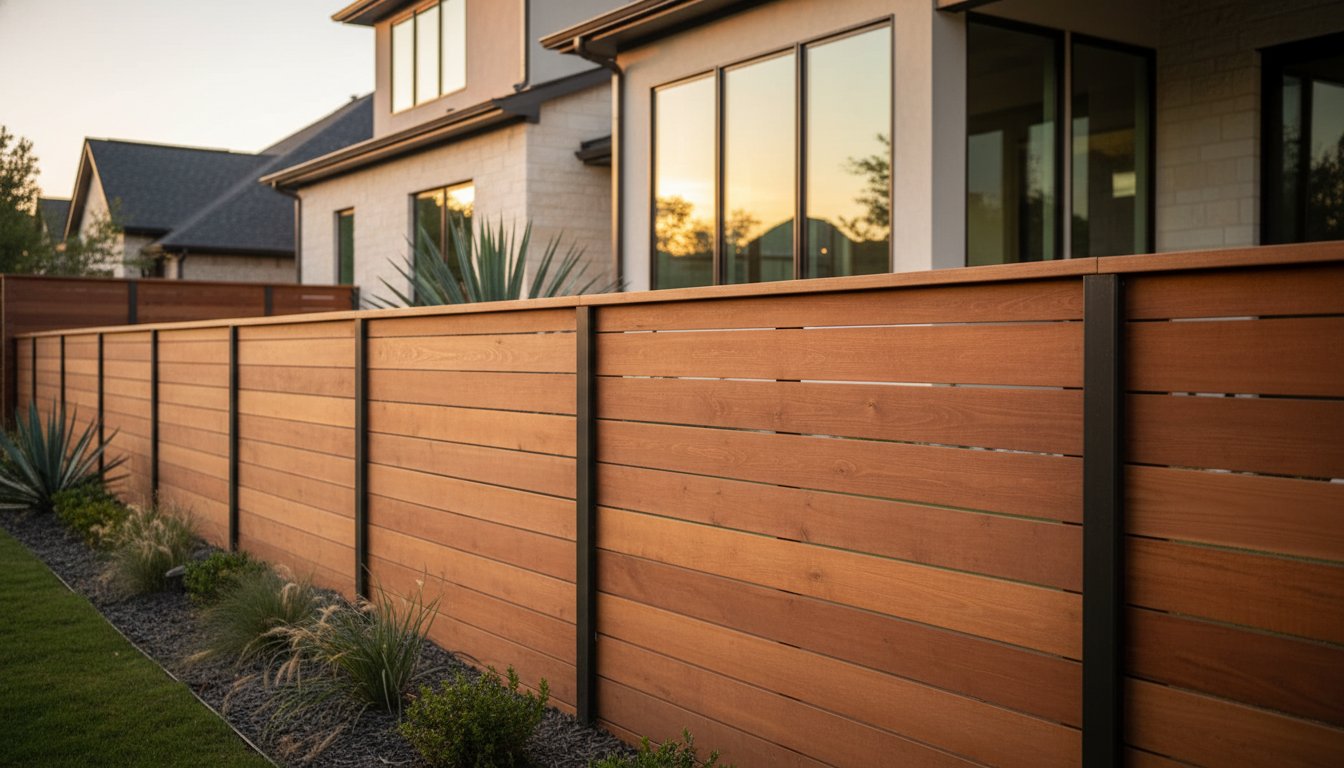
Your neighbor’s vertical picket fence is a liability, not an asset. In a city where 105°F summer stretches are the standard, a basic barrier is just expensive kindling waiting to warp. If you want to win the neighborhood arms race, a horizontal cedar fence is the only move that delivers a high-octane architectural statement while surviving the brutal Central Texas climate. You’ve likely seen those sleek, modern lines in Westlake and wondered if that aesthetic can actually withstand the relentless UV assault and the shifting clay-heavy soil that plagues Austin backyards every single season.
We agree that settling for a mediocre backyard is a losing game. You want a killer outdoor space that holds its form for 15+ years without looking like a twisted mess by next August. This guide reveals the high-level strategy for selecting the right lumber grades and the engineering secrets required to keep your boards straight in the Texas heat. We are diving into the soil-specific anchoring techniques and moisture-management tactics that separate a professional, high-ROI build from a total structural failure.
Key Takeaways
- Ditch dated vertical pickets for a sleek, high-end profile that commands attention and defines your property lines. Discover why a horizontal cedar fence is the ultimate architectural power move for Austin backyards.
- Stop settling for subpar materials that crumble in the humidity. Learn why Western Red Cedar’s natural tannins are the secret weapon for surviving the brutal 2026 Texas climate.
- Avoid the #1 failure point in Austin’s clay-heavy soil by mastering the science of metal posts. We break down the non-negotiable engineering required to keep your investment standing straight for decades.
- Clear coats are a rookie mistake that will cost you thousands in maintenance. Get the hard truth about which finishes actually fight UV degradation and which ones are a total waste of your capital.
- Eliminate the guesswork of a high-end build with advanced 3D visualization. See exactly how your architectural statement integrates into your backyard narrative before a single board is cut.
The Rise of the Horizontal Cedar Fence in Austin Architecture
Forget the status quo. The standard vertical picket fence is a suburban cliché that is dying a quiet death in Central Texas. Enter the horizontal cedar fence. It is a sleek, elongated visual profile where every board runs parallel to the ground. This is a design statement that signals modern authority. Austin homeowners are ditching vertical lines because they want their property to feel like an intentional architectural choice, not a developer afterthought. It is about precision. It is about craft. It is about winning the curb appeal game before you even step inside.
Small backyards in East Austin have a persistent problem. They feel cramped. Horizontal lines solve this through a psychological hack. They draw the eye outward, creating a wider field of vision. It is the same reason you wear horizontal stripes to look broader. In a 2,500-square-foot lot, every inch of perceived space is a win for your property value. When you install a horizontal cedar fence, you are not just building a barrier; you are expanding your footprint without buying more land.
Modern Aesthetics for Central Texas Neighborhoods
Drive through Tarrytown or West Lake Hills and the trend is undeniable. This style dominates because it mirrors the clean line philosophy of contemporary builds. It is the perfect partner for xeriscaping. When you pair native Texas limestone and agave with the natural decay resistance of Western red cedar, you get a landscape that looks expensive and stays durable. We don't do standard here. We mix board widths, like 1x4 pickets combined with 1x6 boards. This creates a rhythmic, custom texture that transforms a basic boundary into a high-end architectural feature that stops traffic.
Why Horizontal Lines Work Better for Austin Slopes
Austin isn't flat. If you are building on a hill, a vertical fence often looks like a jagged, uncoordinated mess. Horizontal boards allow us to manage the grade with surgical precision. We can choose between a "stair-step" approach or a "racked" design to mask uneven terrain. It is about visual continuity. You want your fence to flow seamlessly into your custom decks, creating a unified outdoor living space that screams luxury. This isn't just a fence. It is the framework for your outdoor empire. Don't settle for the vertical relics of the past when you can own the horizon.
Selecting Cedar Grades That Survive the 2026 Texas Climate
Western Red Cedar isn't just a design choice. It's a strategic asset for your property. In the high-stakes Austin environment, where temperatures hit 105 degrees for thirty days straight, average materials fold. Cedar thrives. The secret lies in its cellular chemistry. Cedar is packed with natural tannins. These organic compounds act as a built-in defense system against rot, decay, and the relentless Texas termite population. When you invest in a horizontal cedar fence, you're playing a long game. These tannins align with established scientific wood finishing and preservation guidelines to ensure the wood remains structurally sound even as UV radiation attempts to break down the fibers. For the 2026 outlook, we're seeing a massive shift toward thermally modified wood for high-end builds. This process uses heat to cook out the sugars that pests love, creating a board that is virtually immune to the elements. Your budget dictates your grade. Clear Grade is the pinnacle of the market. It's knot-free, sleek, and delivers that high-end architectural finish. If you want a killer aesthetic with a bit more character, STB (Standard and Better) is your move. It offers the same durability at a more aggressive price point.Western Red Cedar vs. Local Alternatives
Pressure-treated pine is a liability in Central Texas. It's cheap because it's unstable. Under the Austin sun, pine loses moisture too fast, leading to warping, bowing, and "the twist" within 18 months. Cedar offers superior dimensional stability. It stays flat. It stays straight. From a sustainability perspective, cedar is a win. It requires fewer chemical treatments than softwoods, leaving a smaller footprint on your land.The Problem with Big Box Store Lumber in Austin
Retail chains sell "wet" lumber. It's heavy, saturated, and destined for failure. When that moisture evaporates during its first Texas summer, your fence boards will shrink. Those tight gaps you paid for will turn into massive, ugly voids. We don't play that game. Big Decks sources premium, kiln-dried architectural-grade lumber. We ensure every board is seasoned to handle the specific humidity swings of the Hill Country. This precision prevents the structural failures common in DIY or low-bid projects. If you're ready to build a structure that actually wins against the elements, you can view our premium material specs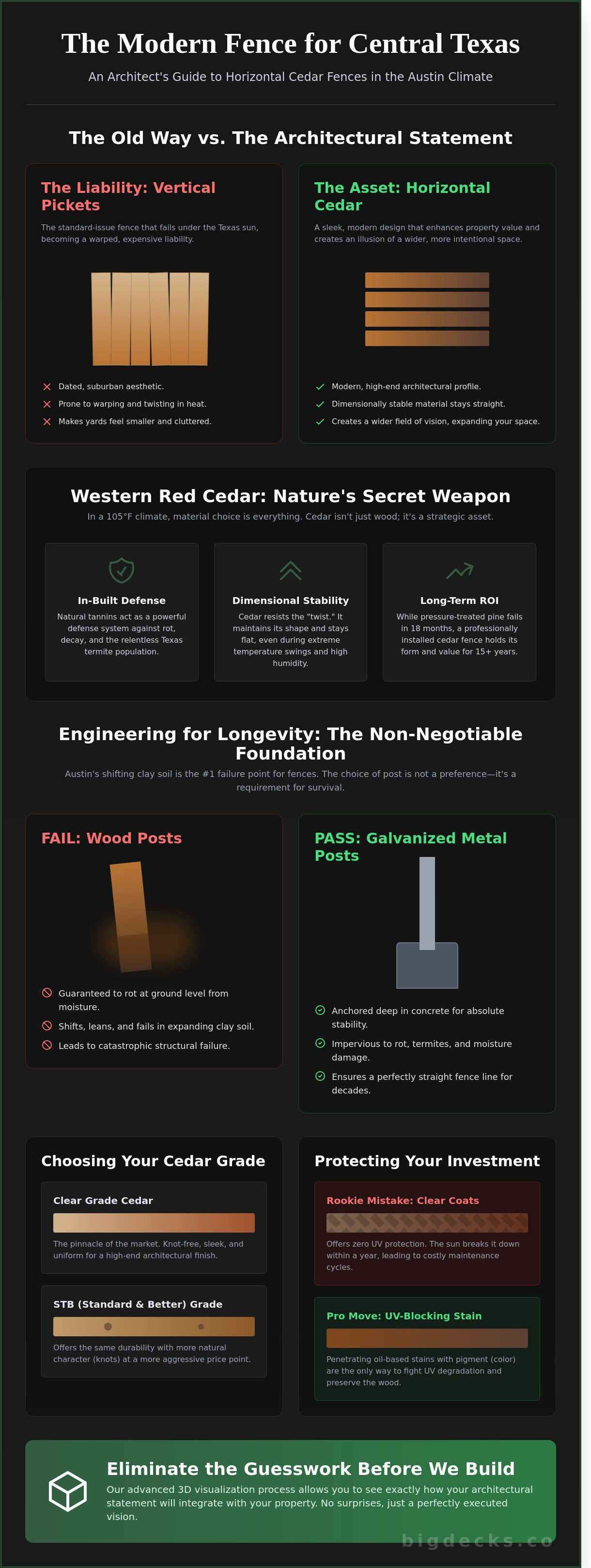
Engineering for Longevity: Why Metal Posts are Non-Negotiable
A horizontal cedar fence is a high-performance asset, not a weekend DIY project. If you're still using wood posts in Austin, you're building on a foundation of planned obsolescence. It's that simple. The structural physics of horizontal spans demand a level of rigidity that 4x4 pressure-treated lumber cannot provide over the long haul. We build for the 30-year horizon, not the 5-year patch job.
Horizontal boards act like massive sails. A solid-privacy design catches every gust of Texas wind, putting immense lateral pressure on your supports. While vertical pickets allow air to bleed through gaps, horizontal configurations create a massive surface area that tests the shear strength of every fastener. Sagging isn't a material flaw of cedar. It's a builder error. Amateurs space posts too far apart or use inferior fasteners. We eliminate the sag by shortening the span and locking every board into a rigid steel skeleton that refuses to budge.
Fighting Post Rot in Austin Blackland Prairie Soil
Austin’s Blackland Prairie soil is a structural nightmare. This clay-heavy earth expands and contracts with a force that can crush wooden footings or heave them right out of the ground. When wood posts sit in this moisture-trapping clay, they rot at the ground line within 7 to 10 years. That's a losing investment. We don't play that game. The 2026 industry standard for a premium horizontal cedar fence is galvanized steel. Specifically, we utilize PostMaster posts to ensure 30-year structural integrity. These posts don't warp, twist, or snap under pressure.
To handle high-tension horizontal spans, we specify a minimum 3,000 PSI concrete mix for every footing. We follow strict cedar fence grading standards to ensure the wood quality matches the strength of the steel foundation. This isn't just a fence; it's an engineered barrier designed to dominate the elements. We treat every installation like a high-stakes build where failure isn't an option.
Concealed Metal Posts vs. Exposed Steel Accents
Design is where we win the room. You have two distinct paths for your project. You can go for the "floating" wood look where we hide the steel supports entirely behind the cedar cladding. It's clean, minimalist, and perfectly sleek. It gives the illusion of pure wood while maintaining a hidden, unbreakable spine.
Alternatively, you can lean into the industrial-modern Austin aesthetic. We use black powder-coated steel posts to create high-contrast frames that pop against the warm, natural cedar tones. By integrating custom metalwork into the fence frame, we achieve maximum rigidity without sacrificing an ounce of style. This is how you build a legacy property. You combine the best natural materials with the unyielding strength of modern engineering. Don't settle for a fence that leans after the first spring storm. Build for the win.
Protecting Your Investment: Maintenance and Finishing in 2026
Austin's sun is a relentless asset-stripper. By 2026, Central Texas heat cycles have only become more aggressive, turning a premium horizontal cedar fence into a brittle, gray liability within 18 months if you play it safe with cheap products. Clear coats are a total waste of capital. They offer zero UV filtration. It's like wearing a transparent shirt to a desert gunfight. If you want that high-end look to last, you need a strategy, not a bucket of hardware store sealer. You’re protecting a major asset, so act like it.
Year 1 is your foundation. You apply the first round of protection within 30 days of installation to lock in the wood's natural resins. By Year 5, you aren't stripping or sanding. You're simply re-applying a maintenance coat to replenish lost oils. Untreated cedar can lose up to 12% of its internal moisture in a single Austin July. That leads to warping, checking, and a total loss of structural integrity. If you want to avoid the "weathered gray" effect, you have to stay ahead of the oxidation curve.
Penetrating Oils vs. Surface Stains
Surface films like paint or heavy stains are a death sentence for your wood. Austin's 105-degree afternoons cause cedar to expand and contract violently. A surface film can't move with the wood, so it cracks and peels. This creates a maintenance nightmare that requires sanding every single board. We use penetrating oils like Cutek Extreme. It doesn't sit on top. It dives deep into the fibers to hydrate the wood from the inside out. When applying to horizontal boards, work one full length at a time. This prevents the lap marks and drips that ruin a modern aesthetic. It’s about precision execution and long-term performance.
The UV Battle: Choosing the Right Pigment
Pigment is your SPF. The more color you have, the more UV radiation you block. If you want to keep the natural vibe without the "old barn" gray look, select a "Cedar" or "Teak" tint. These pigments enhance the grain while scattering the rays that cause silvering. UV-rated penetrating oil is the primary defense against cedar brittleness. Don't settle for a finish that fades by October. Protect your ROI with a finish that actually fights back against the Texas elements. This is how you ensure your horizontal cedar fence remains a neighborhood benchmark for a decade or more. Partner with the experts at Big Decks to build a structure that wins every time.
Building Your Vision with BigDecks 3D Visualization
Sketching a design on a cocktail napkin is for amateurs. When you are investing in a high-end architectural horizontal cedar fence, "good enough" is a liability. You need a strategic partner who understands that a fence isn't just a boundary; it's a critical chapter in your backyard narrative. At BigDecks, we treat every project like a high-stakes pitch. We don't just show you a line on a map. We integrate your fencing into a total environment, ensuring a seamless transition from your perimeter to a privacy screen for the deck. This level of planning eliminates the friction of mid-project changes and ensures your ROI is locked in from day one.
Seeing Your Fence in 3D Before Breaking Ground
The biggest risk in any construction project is the gap between expectation and reality. Our 3D design renderings close that gap permanently. We build your entire backyard in a virtual environment, allowing you to visualize exactly how the 6:00 PM Austin sun casts shadows across your lawn. You can experiment with board widths and metal accents before a single nail is driven. We model your fence alongside your existing assets, ensuring the lines of your horizontal cedar fence perfectly complement your sauna, pool, or pergola. You get to test-drive your privacy levels in a 360-degree space, preventing the buyer's remorse that comes from guessing at board spacing.
The BigDecks Build: Precision Carpentry Meets Metalwork
Design is the hook, but execution is the win. Our build teams operate with a level of discipline that borders on obsession. We maintain 1/8-inch tolerances across every horizontal alignment. If a line isn't laser-straight over a 100-foot span, it doesn't pass our internal audit. We have a strict policy against using plastic or composite materials for our structural fencing. Those materials lack the soul and the 25-year durability of premium Texas-ready cedar. Our process includes:
- Steel Post Integration: We use heavy-duty steel posts to ensure your horizontal lines never sag or warp under the Texas heat.
- Zero-Fluff Communication: You get direct updates and clear milestones. No corporate jargon. No excuses.
- The Final Walkthrough: We don't leave until every board is perfect and your Austin oasis is ready to dominate the neighborhood.
We build for clients who demand the best and refuse to settle for the standard. Your backyard is a high-value asset; we provide the precision carpentry and metalwork required to protect it. When the project is finished, you aren't just looking at a fence. You are looking at a masterclass in modern design and structural integrity.
Own the Austin Skyline
Austin's 2026 climate is a brutal testing ground for residential architecture. You've seen the data; standard timber posts fail while structural steel remains the only non-negotiable standard for longevity in Texas soil. We've mastered the fusion of high-grade Western Red Cedar and elite metalwork to ensure your horizontal cedar fence survives 100-degree summers and flash floods alike. Our team eliminates the guesswork that ruins 90% of local residential projects. We don't just guess where the sun hits; we prove the final look with lifelike 3D renderings included in every single build. This is about more than privacy. It's about a strategic investment in your property's ROI and aesthetic dominance. As Austin-based design-build specialists, we bring a killer edge to every perimeter we secure. You deserve a result that mirrors your ambition. Stop settling for mediocre contractors who use outdated methods. It's time to build a legacy that stays straight, stays stunning, and stays standing.
Get a Bid for Your Modern Austin Fence Project
Your vision is ready for the big stage, and we're here to make sure it wins.
Frequently Asked Questions
Does a horizontal cedar fence cost more than a vertical one?
Yes, a horizontal cedar fence requires a higher investment than vertical alternatives. Precision is the primary driver. Installers spend 20 percent more time on leveling and board alignment to ensure the lines are flawless. You aren't just buying wood; you're buying the technical expertise required to execute a high-end architectural feature. It's a statement piece that demands a specialized skill set.
How do you prevent a horizontal cedar fence from sagging over time?
You prevent sagging by reducing post spacing to 6 feet and adding vertical mid-span blocking. Standard 8-foot spans can't handle the weight of horizontal boards over time. Gravity is a constant threat. By installing a 2x4 stiffener every 4 feet on the back of the panels, you lock the boards in place. This engineering ensures your lines stay straight for a decade, not just a season.
Is Western Red Cedar the best wood for the Austin climate?
Western Red Cedar is the undisputed performance leader for the Austin environment. It contains natural oils called thujaplicins that act as built-in preservatives against rot and insects. While pressure-treated pine often warps under the 105-degree Texas sun, cedar remains dimensionally stable. It's the strategic choice for anyone looking to maximize the lifespan of their outdoor assets without constant repairs.
Do I need a permit for a 6-foot horizontal fence in Austin?
You don't need a permit for a 6-foot fence in Austin if it stays outside of floodplains. According to the City of Austin Building Criteria Manual Section 1.2.0, permits are only mandatory for fences exceeding 7 feet in height. Always verify your property lines and utility easements before you dig. If you're in an HOA, check their specific architectural guidelines, as they often override city minimums.
How often should I restain my horizontal cedar fence in Texas?
You should restain your horizontal cedar fence every 2 to 3 years to protect your investment. The Texas UV index hits 10 or higher for months at a time, which aggressively breaks down wood lignin. Using a high-quality oil-based stain prevents the boards from turning grey and keeps the wood supple. If water doesn't bead on the surface, your fence is vulnerable to the next heatwave.
Can I use metal posts with a horizontal wood design?
Integrating steel posts into a horizontal design is the ultimate power move for durability. Galvanized steel posts last 25 years and eliminate the risk of ground-line rot that plagues wood. We use hidden bracket systems to ensure the metal stays invisible from the street. You get the sleek, modern aesthetic of wood with the structural integrity of an industrial skyscraper. It's a win for your property's long-term value.