

Architectural Fence Design in Austin: 5 High-Impact Styles for 2026
Tired of warped fences? Discover 5 high-impact styles for architectural fence design in Austin. Learn how steel & modified wood create lasting, modern privacy.
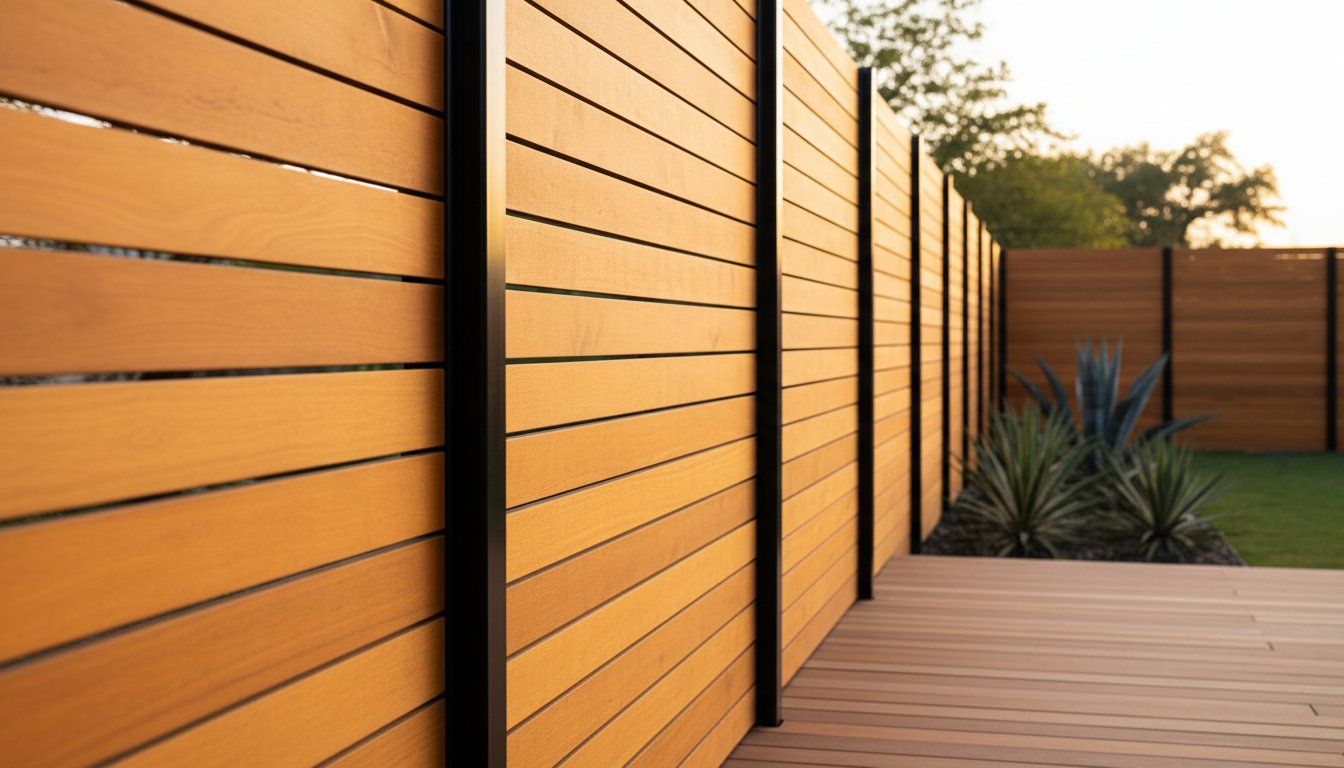
Most Austin fences are essentially ticking time bombs of warped cedar and rotting posts that devalue the very homes they're meant to protect. It's a frustrating reality for homeowners who watch their "privacy" screen bow and grey after just two Texas summers. You've likely seen those bulky, cheap posts that ruin a modern aesthetic and turn a backyard into a cluttered mess. We're here to kill that trend.
Investing in architectural fence design Austin homeowners can trust means moving beyond basic property lines and embracing precision engineering. You'll learn how to combine thermally modified wood with high-grade metalwork to achieve a 20-year lifespan with minimal maintenance. This article previews five high-impact styles for 2026 that provide 100% privacy while perfectly aligning with your home's architectural DNA. It's time to stop building barricades and start designing statements that actually win the room.
Key Takeaways
- Learn why standard contractor-grade pickets are a liability and how architectural fencing serves as a strategic asset for Austin property valuation.
- Discover why we reject plastic composites in favor of thermally modified wood and steel to survive the Central Texas UV and humidity.
- Explore five high-impact styles for architectural fence design Austin homeowners are using to create modern, industrial, and hybrid perimeters.
- Understand the engineering required to anchor deep-set steel into limestone terrain to ensure your structure survives heavy wind loads.
- See how 3D visualization eliminates the risk of 2D sketches by modeling how fence shadows and light interact with your deck’s mood.
Beyond the Property Line: Why Architectural Fencing Defines Austin Real Estate
You aren't just building a barrier. You're framing an asset. In Austin's aggressive real estate market, a standard cedar picket fence is the equivalent of a blank pitch deck. It functions, but it doesn't win the room. High-end architectural fence design Austin property owners invest in acts as a strategic move to increase valuation before a visitor even reaches the front door. It shifts the perception of a home from a standard residential lot to a curated estate.
Moving past the contractor-grade mindset means rejecting the basic 6-foot dog-ear picket. These standard installs often fail within 10 years and offer zero design ROI. A well-framed perimeter creates a psychological transition. It dictates the flow of the entire backyard, turning a patch of grass into a private oasis. This design bridge connects the public street view to your private life, ensuring the transition feels intentional rather than accidental.
The ROI of High-End Perimeter Design
Curb appeal in neighborhoods like Westlake and Tarrytown starts at the sidewalk. While the history of fencing centers on simple property division, modern Austin design focuses on long-term capital appreciation. Choosing architectural steel over traditional wood posts isn't just an aesthetic choice. It's a durability play. Powder-coated steel components often carry a 20-year lifespan, more than doubling the 7 to 9-year cycle of standard cedar supports.
A custom fence acts as the narrative arc for your landscape. It sets the tone for the materials used in your deck, pool surround, and hardscaping. When you invest in premium materials, you're telling a story of quality and permanence. This level of detail is what separates a quick flip from a legacy property. Investors and homeowners who prioritize this early in the build process see a direct correlation in appraisal values and buyer interest.
Austin’s Architectural Diversity and Fence Synergy
Austin is a playground for Mid-Century Modern, Texas Modern, and sleek Contemporary builds. A "one size fits all" fencing approach fails the Austin aesthetic test every time. A Texas Modern home requires the warmth of horizontal clear-grade cedar paired with the industrial edge of raw steel. Geometric alignment is the secret to a cohesive outdoor footprint. If the lines of your fence don't mirror the roofline or the window casings of the main structure, the entire property feels disjointed.
Successful architectural fence design Austin projects rely on precision. We look at the site's topography and the home's silhouette to determine the right height and transparency. A fence should provide privacy without feeling like a fortress. By utilizing varying slat widths or integrated lighting—informed by the design standards of LED Artistry—we create a perimeter that feels integrated into the architecture. This synergy ensures the fence doesn't just sit on the property line; it defines the property's character.
Your perimeter is the first and last thing people see. Don't settle for a basic divider when you can install a design-forward asset that secures your investment and elevates your lifestyle. The right choice here sets the stage for everything else you build inside the line.
The Material Hierarchy: Why We Kill the Plastic and Build with Steel and Thermory
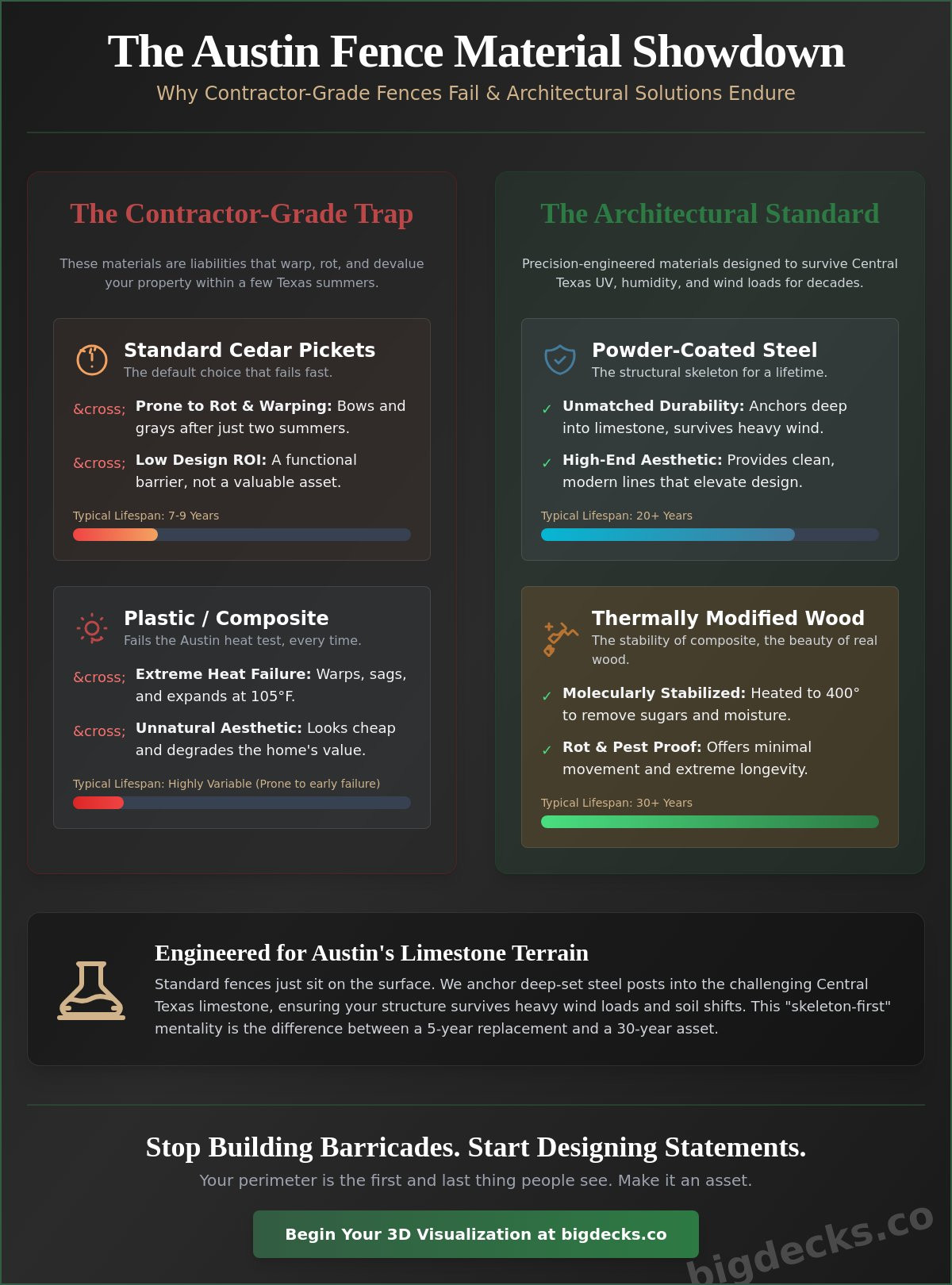
Plastic belongs in a recycling bin, not on your property line. Most builders push composite fencing because it is easy to install, but it fails the Austin heat test every single time. When the thermometer hits 105 degrees, plastic expands, warps, and sags. High-performance architectural fence design Austin requires a different breed of materials. We focus on a hierarchy of steel and thermally modified wood to ensure your investment actually lasts thirty years.
The BigDecks manifesto is simple. We never touch plastic or low-grade pressure-treated lumber for structural components. These materials are liabilities that lead to leaning panels and rot within five years. We build with a "skeleton first" mentality. This means using precision metalwork and stabilized timber that can handle the radical humidity swings of Central Texas without flinching.
Thermory and Ipe: The Heavyweights of Wood Fencing
Thermal modification is a game changer for wood stability. Thermory undergoes a process where the wood is heated to 400 degrees in a vacuum. This removes all moisture and sugars, essentially changing the wood at a molecular level. The result is a board that does not rot and barely moves. It provides a 30-year lifespan that rivals any synthetic product without the cheap, artificial look.
For those who want maximum density, Ipe is the "ironwood" solution. It is so heavy it sinks in water and carries a class-A fire rating. Maintenance is the only variable here. We use penetrating oils like Cutek Extreme to lock in the color. This oil works from the inside out to prevent UV damage. If you skip the oil, the wood turns a sophisticated silver gray, but it remains structurally sound for decades.
Steel and Custom Metalwork Integration
Wood posts buried in Texas limestone are a recipe for failure. We use custom-welded, powder-coated steel posts for every high-end architectural fence design Austin project. This creates a permanent skeleton that will never lean or snap. The steel provides a rigid frame that allows us to play with the "shadow line" aesthetic. This is a deliberate gap between the wood and the metal that creates depth and architectural interest.
Metal framing also solves the problem of gate sag, which is the number one complaint with traditional fences. Our steel gates are engineered for high-traffic use and heavy wind loads. While following official fence design guidelines for height and setbacks, we focus on corrosion resistance. Powder coating ensures the steel remains impervious to the elements. If you are ready to stop replacing your fence every seven years, explore our architectural design options to see how we build for the long term.
5 Architectural Fence Designs Dominating Austin Backyards
Choosing an architectural fence design in Austin requires balancing heat resilience with high-end aesthetics. The following five styles represent the current peak of Central Texas outdoor design; each solves specific privacy and airflow challenges while maximizing property value. These aren't just barriers. They're structural statements that define the character of a modern landscape.
The Modern Horizontal Mastery
Horizontal cedar fencing remains the gold standard for Tarrytown and West Lake Hills contemporary homes. To avoid a generic look, we suggest a custom rhythm by mixing board widths. Alternating 1x2, 1x4, and 1x6 planks breaks up the visual weight and creates a bespoke texture that standard fences can't match.
Precision spacing is critical for both longevity and security. We recommend a gap of 1/8 to 1/4 inch between boards to allow for natural wood expansion without creating a "ladder" effect that makes the fence easy to climb. For a deeper dive into these technical specs, check out The Austin Guide to Horizontal Fences.
Bull Panel and Steel Precision
The "Texas Modern" look often centers on high-end bull panel fencing. We pair heavy-gauge 4-inch welded wire with steel frames and thermally modified wood accents like ash or pine. It's a favorite for front yards because it defines the boundary without obscuring the architecture of the home. It keeps the view open while keeping the dogs in.
These designs perform best when integrated with local limestone pavers and xeriscaping. Achieving this look requires professional metalwork, specifically ground-down, flush-finished welds and hidden fasteners. This level of steel precision ensures the fence looks like a structural extension of the house rather than a perimeter afterthought.
Vertical Slat Screens offer a different architectural rhythm. By placing slats closer together on the vertical axis, you create deep shadow lines that change throughout the day. This style provides excellent privacy from a side angle while still feeling open when viewed head-on. It's a strategic way to add depth to a flat yard.
Louvered Privacy Fencing is an engineering solution for the Austin climate. By angling the slats, we block the neighbor's second-story view while allowing significantly more airflow than a solid wall. This prevents the "dead air" pockets that make Texas summers unbearable in tight backyard spaces.
Floating Panel Designs represent the high-stakes end of custom metalwork. These fences use negative space between the panels and the support posts to create the illusion that the fence is suspended in mid-air. It's a bold move that requires heavy-duty steel engineering to maintain structural integrity without visible bracing.
Engineering Privacy: The Technical Side of Precision Metalwork and Wood Hybrids
Building a high-end fence in Central Texas requires more than a nail gun and a level. The local environment is notoriously difficult, featuring solid limestone shelves and 100-degree temperature swings that can warp inferior materials in a single season. Achieving a lasting architectural fence design in Austin means treating the project like a structural engineering task rather than a simple boundary marker.
Step 1: Site analysis and grading. Austin terrain is rarely flat. We use laser levels to map the grade, ensuring the fence line follows the slope without creating "stair-step" gaps that compromise privacy or allow pets to escape. In areas with Edwards Limestone, we deploy rock saws or carbide-tipped augers to ensure posts are anchored into the substrate rather than just sitting on top of it.
Step 2: Foundation engineering. Wind loads are the primary killer of privacy fences. An 8-foot solid screen acts like a massive sail during a spring thunderstorm. We set steel posts in 36-inch deep concrete piers to ensure the structure remains plumb when 70mph gusts hit the vertical surface area.
Step 3: Material expansion math. Wood is a living material that breathes. In the Texas heat, Western Red Cedar can shrink or expand by 3% depending on moisture content. We calculate specific 1/8-inch gaps between horizontal slats to allow for this movement, preventing the boards from buckling or popping fasteners during a July heatwave.
Step 4: Custom fabrication. True architectural styles rely on a dedicated weld shop. We fabricate steel frames and channels off-site to ensure 90-degree precision. This allows us to "sandwich" wood pickets within a metal track, hiding the end grains and protecting them from water intrusion.
Step 5: Finish and protection. We use UV-rated powder coating for all steel components and oil-based penetrating stains for wood. This combination prevents the "silvering" of the wood and keeps the metal from rusting in the high humidity of an Austin summer.
Structural Integrity vs. Aesthetic Minimalism
Modern design often demands a clean, two-sided finish where the structural "guts" are invisible. We achieve this by using internal steel skeletons that support the weight without bulky 2x4 rails. This method prevents horizontal board sag over 10-foot spans and ensures the fence looks identical from both the street and the backyard. For 8-foot privacy screens, we increase the gauge of the steel to manage the increased leverage exerted by the height.
The Hardware of High-End Fencing
Standard galvanized nails often react with the natural tannins in cedar, leaving ugly black streaks down the wood. We exclusively use 304 or 316-grade stainless steel fasteners to eliminate this risk. For gates, we engineer custom frames that can weigh over 200 lbs, utilizing industrial ball-bearing hinges that allow a heavy steel-and-wood gate to swing with the push of a single finger. We also integrate smart tech like RFID readers and remote-access hardware directly into the gate posts for seamless security. You can explore our custom gate options to see how we blend security with high-end aesthetics.
Designing a fence that lasts 20 years requires a deep understanding of physics and local geology. By focusing on the hidden engineering, we ensure the visual impact of your architectural fence design in Austin remains as sharp in a decade as it does on move-in day.
Designing Your Perimeter: How BigDecks Uses 3D Visualization to Guarantee the Win
2D sketches are a liability in high-stakes outdoor design. They fail to capture scale, depth, or the way a structure interacts with the unique topography of an Austin lot. When you're investing in premium architectural fence design Austin, a flat drawing is a gamble you don't need to take. BigDecks eliminates the guesswork by moving the design process into a high-fidelity virtual environment. We treat your backyard like a high-value pitch deck, where every detail must be vetted before the first post is set in concrete.
Visualizing shadows and light is critical for setting the right mood. A six-foot privacy fence looks different at 10:00 AM than it does during the harsh glare of a 5:00 PM Texas sunset. Our 3D models show you exactly how your fence will cast shadows across your pool or deck area. This "See It Before We Build It" philosophy removes the anxiety of the "I thought it would look different" moment. We ensure the spatial flow is perfect, giving you the confidence to move forward with a design that actually works for your lifestyle.
The 3D Rendering Advantage
We don't just model a fence; we build a digital twin of your home’s actual architecture. This ensures the fence lines up perfectly with your roofline, windows, and existing structures. In this virtual space, we explore material variations with zero risk. You can compare the natural, warm grain of Western Red Cedar against the sleek, dark, and ultra-durable profile of Thermory ash. This level of detail allows us to optimize the ROI of your project by selecting materials that look stunning and perform under pressure. Discover why 3D design renderings in Austin are the only way to start a serious outdoor project.
The Path to a BigDecks Build
Our process moves from a strategic initial pitch to a relentless focus on execution. We don't settle for "good enough" during the final walk-through. Every joint, fastener, and slat is inspected to ensure it meets our high standards for architectural fence design Austin. We specialize in transitioning from a simple perimeter project to a full backyard transformation. By integrating your fencing with custom decks in Austin, we create a cohesive architectural narrative that increases your property's value and utility. To see how high-end hardscaping can further elevate this vision, you can explore Interlocking Driveways for design inspiration. We handle the complexity of the build so you can focus on the result.
Final Thoughts: Your perimeter is the most important "deck" you'll ever build. It defines the boundaries of your private world and sets the tone for every hour you spend outside. By utilizing advanced 3D visualization and a disciplined construction approach, we ensure your fence is a strategic asset rather than just a boundary. It’s time to stop guessing and start building with total clarity.
Secure Your Perimeter for the Long Game
Austin's high-end real estate market moves fast, and your property line shouldn't be an afterthought. Choosing Thermory wood and precision steel ensures your perimeter survives the Central Texas climate while maintaining a sharp, modern aesthetic. We've moved past the era of flimsy plastic and standard privacy pickets. Success in 2026 requires a technical approach to architectural fence design Austin homeowners can rely on for decades of durability.
BigDecks eliminates the guesswork by providing custom 3D renderings for every project. This visualization ensures that precision metalwork and wood hybrids align perfectly with your home's existing architecture before the first post is set. You aren't just buying a fence; you're investing in a strategic asset designed by local experts who understand high-stakes design-build.
Ready to win your backyard? Get your architectural fence bid from BigDecks today.
Building a superior perimeter is about making the right technical choices today so you don't have to rebuild them tomorrow. It's time to stop settling for average and start building for the win.
Frequently Asked Questions
How much does an architectural fence cost per foot in Austin?
High end architectural fence design in Austin typically starts at 60 dollars per linear foot for premium materials and can exceed 150 dollars for custom steel or exotic hardwoods. These figures reflect 2024 market averages for professional installations involving masonry or precision metalwork. Your final investment depends on site topography and the complexity of the structural engineering required for the project.
Is thermally modified wood better than Western Red Cedar for Austin's climate?
Thermally modified wood offers superior dimensional stability in Austin's 100 plus degree summers. It resists rot and moisture better than cedar because the heat treatment process removes the sugars that fungi feed on. While cedar is a classic Texas staple, it's prone to movement and checking. Thermally modified ash or pine holds its shape, making it the smarter play for long term ROI.
Do I need a permit for an 8-foot privacy fence in Austin, TX?
Yes, you must obtain a permit for any fence over 6 feet tall according to the City of Austin Land Development Code. Building an 8-foot privacy wall without city approval invites code violations and potential removal orders. We handle the bureaucracy because architectural fence design in Austin requires precise adherence to setback rules and neighbor notification protocols to ensure your project stays legal.
How long does it take to design and install a custom architectural fence?
Expect a 6 to 10 week window from the initial pitch to the final walkthrough. The design phase takes 2 weeks to lock in the vision and material specs. Fabrication and site prep consume another 3 weeks. Actual installation usually wraps in 7 to 14 days, though custom steelwork or complex masonry can extend that timeline based on crew availability and weather.
Will a horizontal fence warp faster than a vertical fence?
Horizontal fences warp more frequently if you skip the structural essentials like mid-span blocking or steel posts. Gravity is the enemy. Planks have a natural tendency to sag over time without proper support every 4 feet. Vertical fences hide movement better, but a well-engineered horizontal design uses high-grade clips and seasoned lumber to kill the warp before it starts.
Can you integrate a fence with an existing deck or stone patio?
Integration is mandatory for a cohesive estate look. We anchor fence posts directly into existing stone patios using core drilling or bolt them to deck framing for a seamless transition. This creates a unified architectural narrative rather than a disjointed collection of backyard features. It's about building a fortress that looks intentional, not like an afterthought.
Horizontal Cedar Fence Austin: Modern Design Meets Texas Durability
Discover how a horizontal cedar fence can survive Austin's heat. Learn the secrets to lumber, posts, and finishes for a modern design that lasts 15+ years.
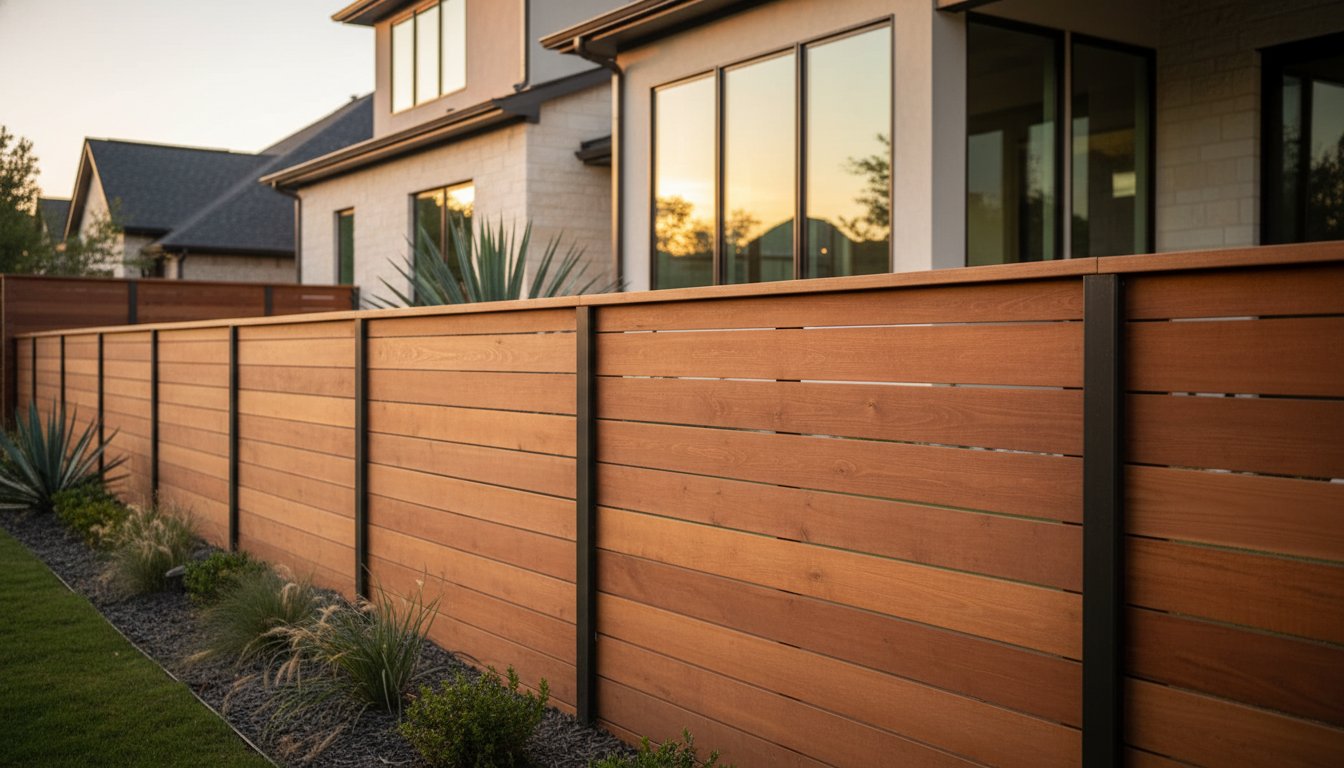
Your neighbor’s vertical picket fence is a liability, not an asset. In a city where 105°F summer stretches are the standard, a basic barrier is just expensive kindling waiting to warp. If you want to win the neighborhood arms race, a horizontal cedar fence is the only move that delivers a high-octane architectural statement while surviving the brutal Central Texas climate. You’ve likely seen those sleek, modern lines in Westlake and wondered if that aesthetic can actually withstand the relentless UV assault and the shifting clay-heavy soil that plagues Austin backyards every single season.
We agree that settling for a mediocre backyard is a losing game. You want a killer outdoor space that holds its form for 15+ years without looking like a twisted mess by next August. This guide reveals the high-level strategy for selecting the right lumber grades and the engineering secrets required to keep your boards straight in the Texas heat. We are diving into the soil-specific anchoring techniques and moisture-management tactics that separate a professional, high-ROI build from a total structural failure.
Key Takeaways
- Ditch dated vertical pickets for a sleek, high-end profile that commands attention and defines your property lines. Discover why a horizontal cedar fence is the ultimate architectural power move for Austin backyards.
- Stop settling for subpar materials that crumble in the humidity. Learn why Western Red Cedar’s natural tannins are the secret weapon for surviving the brutal 2026 Texas climate.
- Avoid the #1 failure point in Austin’s clay-heavy soil by mastering the science of metal posts. We break down the non-negotiable engineering required to keep your investment standing straight for decades.
- Clear coats are a rookie mistake that will cost you thousands in maintenance. Get the hard truth about which finishes actually fight UV degradation and which ones are a total waste of your capital.
- Eliminate the guesswork of a high-end build with advanced 3D visualization. See exactly how your architectural statement integrates into your backyard narrative before a single board is cut.
The Rise of the Horizontal Cedar Fence in Austin Architecture
Forget the status quo. The standard vertical picket fence is a suburban cliché that is dying a quiet death in Central Texas. Enter the horizontal cedar fence. It is a sleek, elongated visual profile where every board runs parallel to the ground. This is a design statement that signals modern authority. Austin homeowners are ditching vertical lines because they want their property to feel like an intentional architectural choice, not a developer afterthought. It is about precision. It is about craft. It is about winning the curb appeal game before you even step inside.
Small backyards in East Austin have a persistent problem. They feel cramped. Horizontal lines solve this through a psychological hack. They draw the eye outward, creating a wider field of vision. It is the same reason you wear horizontal stripes to look broader. In a 2,500-square-foot lot, every inch of perceived space is a win for your property value. When you install a horizontal cedar fence, you are not just building a barrier; you are expanding your footprint without buying more land.
Modern Aesthetics for Central Texas Neighborhoods
Drive through Tarrytown or West Lake Hills and the trend is undeniable. This style dominates because it mirrors the clean line philosophy of contemporary builds. It is the perfect partner for xeriscaping. When you pair native Texas limestone and agave with the natural decay resistance of Western red cedar, you get a landscape that looks expensive and stays durable. We don't do standard here. We mix board widths, like 1x4 pickets combined with 1x6 boards. This creates a rhythmic, custom texture that transforms a basic boundary into a high-end architectural feature that stops traffic.
Why Horizontal Lines Work Better for Austin Slopes
Austin isn't flat. If you are building on a hill, a vertical fence often looks like a jagged, uncoordinated mess. Horizontal boards allow us to manage the grade with surgical precision. We can choose between a "stair-step" approach or a "racked" design to mask uneven terrain. It is about visual continuity. You want your fence to flow seamlessly into your custom decks, creating a unified outdoor living space that screams luxury. This isn't just a fence. It is the framework for your outdoor empire. Don't settle for the vertical relics of the past when you can own the horizon.
Selecting Cedar Grades That Survive the 2026 Texas Climate
Western Red Cedar isn't just a design choice. It's a strategic asset for your property. In the high-stakes Austin environment, where temperatures hit 105 degrees for thirty days straight, average materials fold. Cedar thrives. The secret lies in its cellular chemistry. Cedar is packed with natural tannins. These organic compounds act as a built-in defense system against rot, decay, and the relentless Texas termite population. When you invest in a horizontal cedar fence, you're playing a long game. These tannins align with established scientific wood finishing and preservation guidelines to ensure the wood remains structurally sound even as UV radiation attempts to break down the fibers. For the 2026 outlook, we're seeing a massive shift toward thermally modified wood for high-end builds. This process uses heat to cook out the sugars that pests love, creating a board that is virtually immune to the elements. Your budget dictates your grade. Clear Grade is the pinnacle of the market. It's knot-free, sleek, and delivers that high-end architectural finish. If you want a killer aesthetic with a bit more character, STB (Standard and Better) is your move. It offers the same durability at a more aggressive price point.Western Red Cedar vs. Local Alternatives
Pressure-treated pine is a liability in Central Texas. It's cheap because it's unstable. Under the Austin sun, pine loses moisture too fast, leading to warping, bowing, and "the twist" within 18 months. Cedar offers superior dimensional stability. It stays flat. It stays straight. From a sustainability perspective, cedar is a win. It requires fewer chemical treatments than softwoods, leaving a smaller footprint on your land.The Problem with Big Box Store Lumber in Austin
Retail chains sell "wet" lumber. It's heavy, saturated, and destined for failure. When that moisture evaporates during its first Texas summer, your fence boards will shrink. Those tight gaps you paid for will turn into massive, ugly voids. We don't play that game. Big Decks sources premium, kiln-dried architectural-grade lumber. We ensure every board is seasoned to handle the specific humidity swings of the Hill Country. This precision prevents the structural failures common in DIY or low-bid projects. If you're ready to build a structure that actually wins against the elements, you can view our premium material specs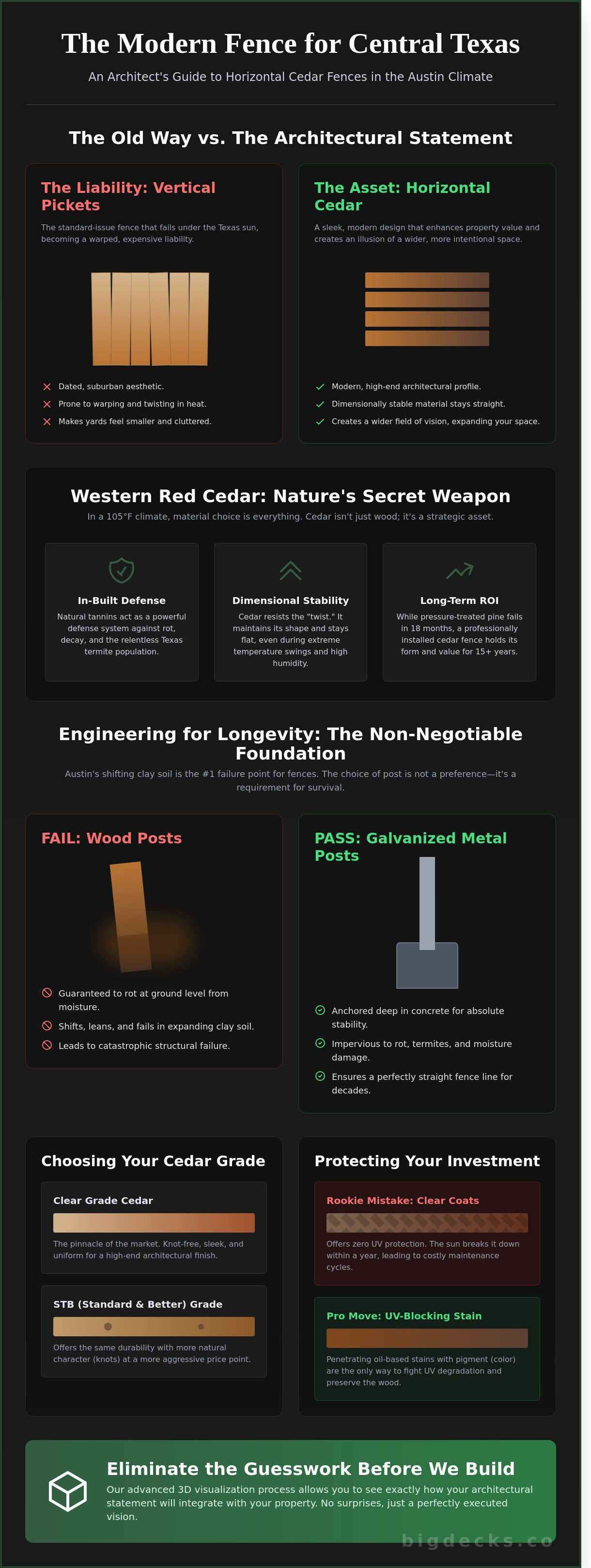
Engineering for Longevity: Why Metal Posts are Non-Negotiable
A horizontal cedar fence is a high-performance asset, not a weekend DIY project. If you're still using wood posts in Austin, you're building on a foundation of planned obsolescence. It's that simple. The structural physics of horizontal spans demand a level of rigidity that 4x4 pressure-treated lumber cannot provide over the long haul. We build for the 30-year horizon, not the 5-year patch job.
Horizontal boards act like massive sails. A solid-privacy design catches every gust of Texas wind, putting immense lateral pressure on your supports. While vertical pickets allow air to bleed through gaps, horizontal configurations create a massive surface area that tests the shear strength of every fastener. Sagging isn't a material flaw of cedar. It's a builder error. Amateurs space posts too far apart or use inferior fasteners. We eliminate the sag by shortening the span and locking every board into a rigid steel skeleton that refuses to budge.
Fighting Post Rot in Austin Blackland Prairie Soil
Austin’s Blackland Prairie soil is a structural nightmare. This clay-heavy earth expands and contracts with a force that can crush wooden footings or heave them right out of the ground. When wood posts sit in this moisture-trapping clay, they rot at the ground line within 7 to 10 years. That's a losing investment. We don't play that game. The 2026 industry standard for a premium horizontal cedar fence is galvanized steel. Specifically, we utilize PostMaster posts to ensure 30-year structural integrity. These posts don't warp, twist, or snap under pressure.
To handle high-tension horizontal spans, we specify a minimum 3,000 PSI concrete mix for every footing. We follow strict cedar fence grading standards to ensure the wood quality matches the strength of the steel foundation. This isn't just a fence; it's an engineered barrier designed to dominate the elements. We treat every installation like a high-stakes build where failure isn't an option.
Concealed Metal Posts vs. Exposed Steel Accents
Design is where we win the room. You have two distinct paths for your project. You can go for the "floating" wood look where we hide the steel supports entirely behind the cedar cladding. It's clean, minimalist, and perfectly sleek. It gives the illusion of pure wood while maintaining a hidden, unbreakable spine.
Alternatively, you can lean into the industrial-modern Austin aesthetic. We use black powder-coated steel posts to create high-contrast frames that pop against the warm, natural cedar tones. By integrating custom metalwork into the fence frame, we achieve maximum rigidity without sacrificing an ounce of style. This is how you build a legacy property. You combine the best natural materials with the unyielding strength of modern engineering. Don't settle for a fence that leans after the first spring storm. Build for the win.
Protecting Your Investment: Maintenance and Finishing in 2026
Austin's sun is a relentless asset-stripper. By 2026, Central Texas heat cycles have only become more aggressive, turning a premium horizontal cedar fence into a brittle, gray liability within 18 months if you play it safe with cheap products. Clear coats are a total waste of capital. They offer zero UV filtration. It's like wearing a transparent shirt to a desert gunfight. If you want that high-end look to last, you need a strategy, not a bucket of hardware store sealer. You’re protecting a major asset, so act like it.
Year 1 is your foundation. You apply the first round of protection within 30 days of installation to lock in the wood's natural resins. By Year 5, you aren't stripping or sanding. You're simply re-applying a maintenance coat to replenish lost oils. Untreated cedar can lose up to 12% of its internal moisture in a single Austin July. That leads to warping, checking, and a total loss of structural integrity. If you want to avoid the "weathered gray" effect, you have to stay ahead of the oxidation curve.
Penetrating Oils vs. Surface Stains
Surface films like paint or heavy stains are a death sentence for your wood. Austin's 105-degree afternoons cause cedar to expand and contract violently. A surface film can't move with the wood, so it cracks and peels. This creates a maintenance nightmare that requires sanding every single board. We use penetrating oils like Cutek Extreme. It doesn't sit on top. It dives deep into the fibers to hydrate the wood from the inside out. When applying to horizontal boards, work one full length at a time. This prevents the lap marks and drips that ruin a modern aesthetic. It’s about precision execution and long-term performance.
The UV Battle: Choosing the Right Pigment
Pigment is your SPF. The more color you have, the more UV radiation you block. If you want to keep the natural vibe without the "old barn" gray look, select a "Cedar" or "Teak" tint. These pigments enhance the grain while scattering the rays that cause silvering. UV-rated penetrating oil is the primary defense against cedar brittleness. Don't settle for a finish that fades by October. Protect your ROI with a finish that actually fights back against the Texas elements. This is how you ensure your horizontal cedar fence remains a neighborhood benchmark for a decade or more. Partner with the experts at Big Decks to build a structure that wins every time.
Building Your Vision with BigDecks 3D Visualization
Sketching a design on a cocktail napkin is for amateurs. When you are investing in a high-end architectural horizontal cedar fence, "good enough" is a liability. You need a strategic partner who understands that a fence isn't just a boundary; it's a critical chapter in your backyard narrative. At BigDecks, we treat every project like a high-stakes pitch. We don't just show you a line on a map. We integrate your fencing into a total environment, ensuring a seamless transition from your perimeter to a privacy screen for the deck. This level of planning eliminates the friction of mid-project changes and ensures your ROI is locked in from day one.
Seeing Your Fence in 3D Before Breaking Ground
The biggest risk in any construction project is the gap between expectation and reality. Our 3D design renderings close that gap permanently. We build your entire backyard in a virtual environment, allowing you to visualize exactly how the 6:00 PM Austin sun casts shadows across your lawn. You can experiment with board widths and metal accents before a single nail is driven. We model your fence alongside your existing assets, ensuring the lines of your horizontal cedar fence perfectly complement your sauna, pool, or pergola. You get to test-drive your privacy levels in a 360-degree space, preventing the buyer's remorse that comes from guessing at board spacing.
The BigDecks Build: Precision Carpentry Meets Metalwork
Design is the hook, but execution is the win. Our build teams operate with a level of discipline that borders on obsession. We maintain 1/8-inch tolerances across every horizontal alignment. If a line isn't laser-straight over a 100-foot span, it doesn't pass our internal audit. We have a strict policy against using plastic or composite materials for our structural fencing. Those materials lack the soul and the 25-year durability of premium Texas-ready cedar. Our process includes:
- Steel Post Integration: We use heavy-duty steel posts to ensure your horizontal lines never sag or warp under the Texas heat.
- Zero-Fluff Communication: You get direct updates and clear milestones. No corporate jargon. No excuses.
- The Final Walkthrough: We don't leave until every board is perfect and your Austin oasis is ready to dominate the neighborhood.
We build for clients who demand the best and refuse to settle for the standard. Your backyard is a high-value asset; we provide the precision carpentry and metalwork required to protect it. When the project is finished, you aren't just looking at a fence. You are looking at a masterclass in modern design and structural integrity.
Own the Austin Skyline
Austin's 2026 climate is a brutal testing ground for residential architecture. You've seen the data; standard timber posts fail while structural steel remains the only non-negotiable standard for longevity in Texas soil. We've mastered the fusion of high-grade Western Red Cedar and elite metalwork to ensure your horizontal cedar fence survives 100-degree summers and flash floods alike. Our team eliminates the guesswork that ruins 90% of local residential projects. We don't just guess where the sun hits; we prove the final look with lifelike 3D renderings included in every single build. This is about more than privacy. It's about a strategic investment in your property's ROI and aesthetic dominance. As Austin-based design-build specialists, we bring a killer edge to every perimeter we secure. You deserve a result that mirrors your ambition. Stop settling for mediocre contractors who use outdated methods. It's time to build a legacy that stays straight, stays stunning, and stays standing.
Get a Bid for Your Modern Austin Fence Project
Your vision is ready for the big stage, and we're here to make sure it wins.
Frequently Asked Questions
Does a horizontal cedar fence cost more than a vertical one?
Yes, a horizontal cedar fence requires a higher investment than vertical alternatives. Precision is the primary driver. Installers spend 20 percent more time on leveling and board alignment to ensure the lines are flawless. You aren't just buying wood; you're buying the technical expertise required to execute a high-end architectural feature. It's a statement piece that demands a specialized skill set.
How do you prevent a horizontal cedar fence from sagging over time?
You prevent sagging by reducing post spacing to 6 feet and adding vertical mid-span blocking. Standard 8-foot spans can't handle the weight of horizontal boards over time. Gravity is a constant threat. By installing a 2x4 stiffener every 4 feet on the back of the panels, you lock the boards in place. This engineering ensures your lines stay straight for a decade, not just a season.
Is Western Red Cedar the best wood for the Austin climate?
Western Red Cedar is the undisputed performance leader for the Austin environment. It contains natural oils called thujaplicins that act as built-in preservatives against rot and insects. While pressure-treated pine often warps under the 105-degree Texas sun, cedar remains dimensionally stable. It's the strategic choice for anyone looking to maximize the lifespan of their outdoor assets without constant repairs.
Do I need a permit for a 6-foot horizontal fence in Austin?
You don't need a permit for a 6-foot fence in Austin if it stays outside of floodplains. According to the City of Austin Building Criteria Manual Section 1.2.0, permits are only mandatory for fences exceeding 7 feet in height. Always verify your property lines and utility easements before you dig. If you're in an HOA, check their specific architectural guidelines, as they often override city minimums.
How often should I restain my horizontal cedar fence in Texas?
You should restain your horizontal cedar fence every 2 to 3 years to protect your investment. The Texas UV index hits 10 or higher for months at a time, which aggressively breaks down wood lignin. Using a high-quality oil-based stain prevents the boards from turning grey and keeps the wood supple. If water doesn't bead on the surface, your fence is vulnerable to the next heatwave.
Can I use metal posts with a horizontal wood design?
Integrating steel posts into a horizontal design is the ultimate power move for durability. Galvanized steel posts last 25 years and eliminate the risk of ground-line rot that plagues wood. We use hidden bracket systems to ensure the metal stays invisible from the street. You get the sleek, modern aesthetic of wood with the structural integrity of an industrial skyscraper. It's a win for your property's long-term value.
The Austin Guide to Horizontal Fences: Modern Privacy for Central Texas
Build a modern horizontal fence in Austin that boosts property value. Learn the best materials & techniques to prevent warping and sagging in the Texas climate.
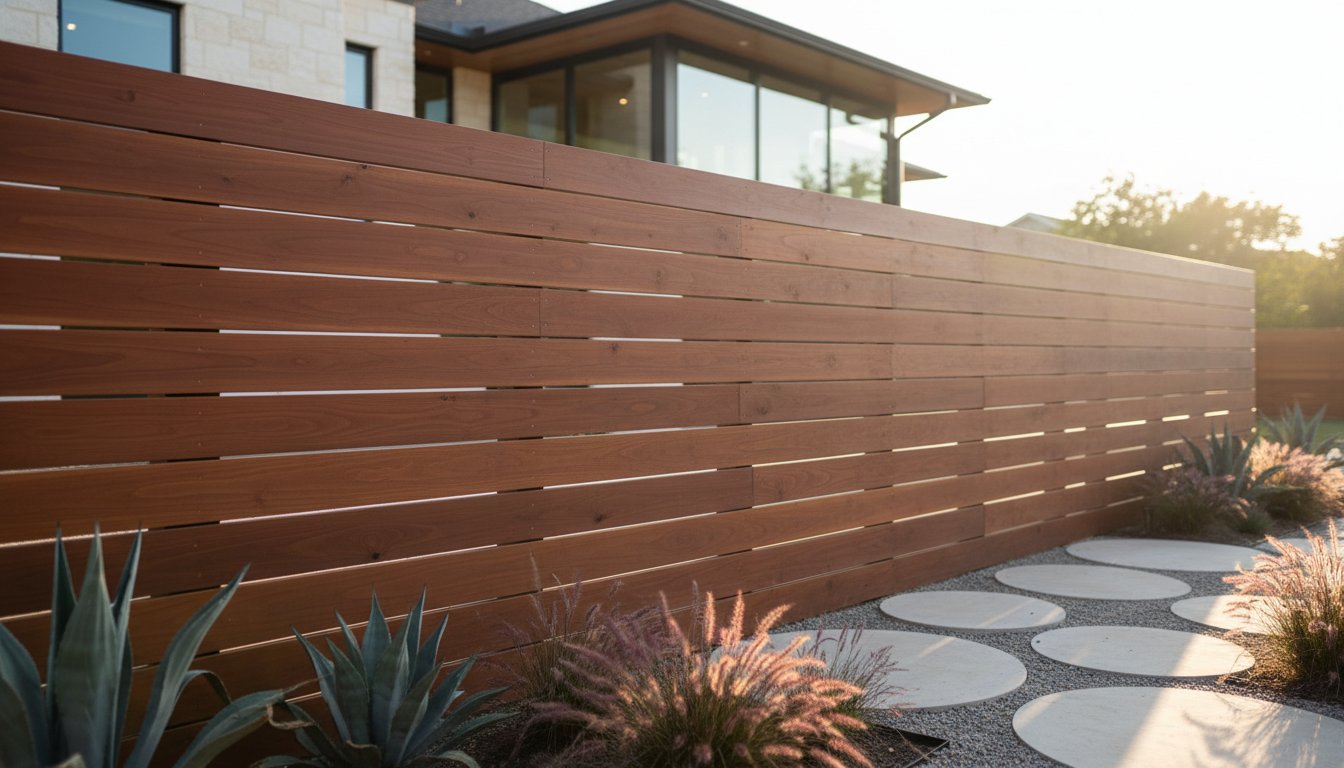
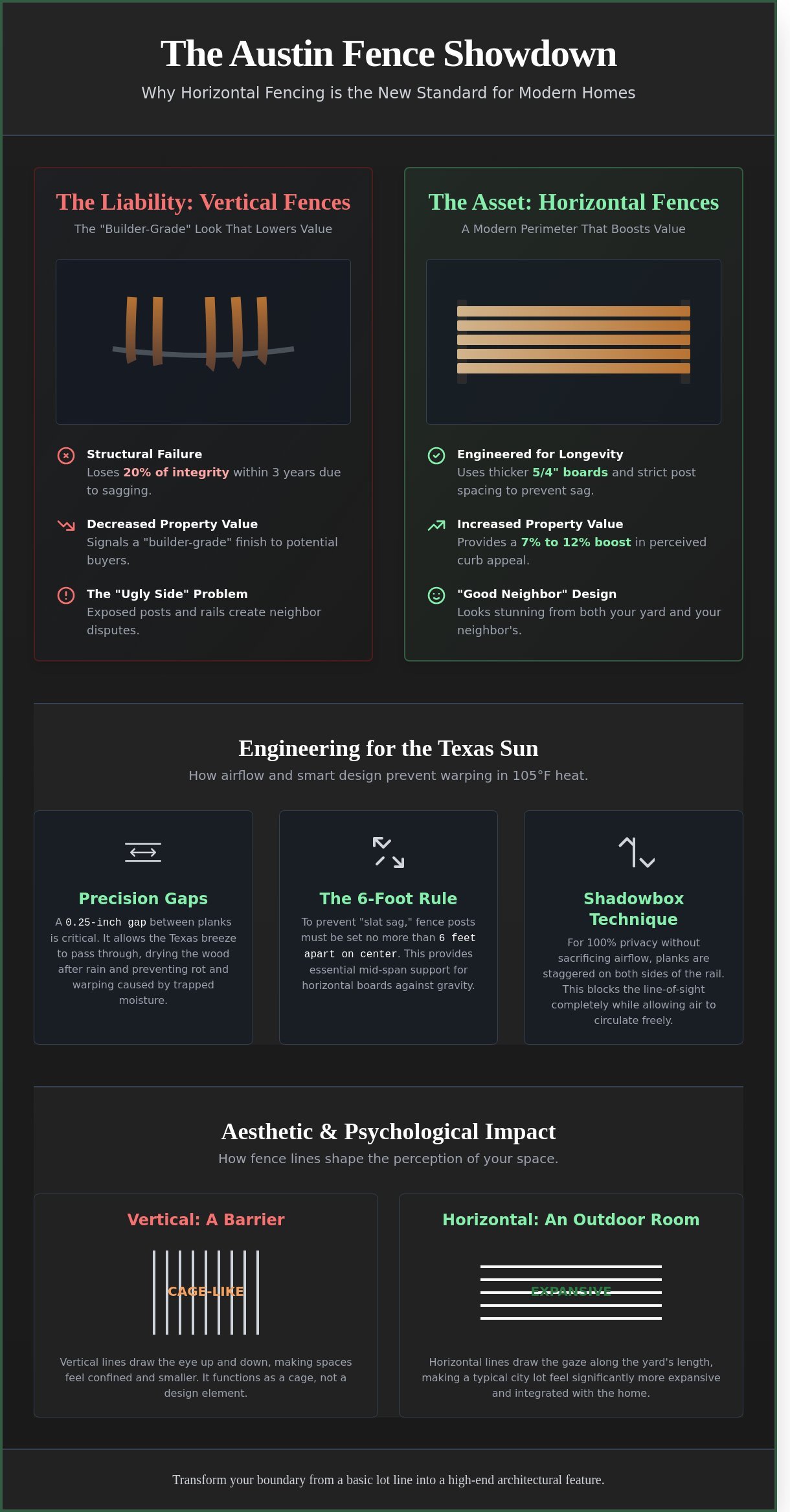
Your neighbor’s vertical dog-ear fence is a liability, not an asset. It often loses 20% of its structural integrity within the first three years, sagging under its own weight and screaming "builder-grade" in a city that demands high-end design. You likely already realize that the standard suburban look won't cut it if you want to maximize your property value. Choosing a horizontal fence is the fastest way to pivot from a generic lot to a modern sanctuary that actually stands out in the competitive Austin market.
It is a strategic move that balances bold aesthetics with the harsh realities of Central Texas. We'll show you how to build a perimeter that survives 105-degree August afternoons without the wood warping into a twisted mess. This guide covers the engineering required for our rocky soil, the specific 0.25-inch gap spacing needed to maintain airflow, and the material choices that ensure your privacy doesn't turn into a maintenance nightmare. We are stripping away the fluff to give you the technical specs and design logic used by leading designers across the 272 square miles of Austin.
Key Takeaways
- Learn how modern parallel planks redefine your backyard from a basic boundary into a high-end architectural room.
- Select materials like Western Red Cedar that actually survive the brutal Central Texas UV and humidity levels.
- Prevent the "slat sag" disaster by mastering the 6-foot center rule for a horizontal fence that stays straight.
- Navigate the reality of Austin’s 6ft vs. 8ft height restrictions and the specialized machinery required for local limestone.
- Use 3D visualization to lock in your design and material choices before spending a dollar on construction.
Why Horizontal Fences are the Modern Standard for Austin Homes
Austin’s residential landscape is shifting. The standard vertical dog-ear fence is a relic of 1990s suburban planning; today, the horizontal fence has taken its place as the modern standard for high-end builds. This design uses parallel planks stacked horizontally to create a sleek, architectural look that redefines property lines.
The psychological impact of this change is profound. A vertical fence acts as a barrier or a cage, but a horizontal layout creates the feeling of an "outdoor room." It turns a basic boundary into an intentional design feature that complements the interior flow of a home. In neighborhoods like Allandale and Travis Heights, this shift is driven by a desire for clean lines and a departure from the cluttered, traditional aesthetics of the past.
Real estate performance backs up this trend. Data from local appraisals suggests that a custom horizontal installation can provide a 7% to 12% boost in curb appeal compared to standard vertical fencing. It signals to buyers that the property is updated, maintained, and designed with a modern eye. For a $600,000 home in South Austin, that visual upgrade translates to thousands of dollars in perceived value the moment a visitor pulls into the driveway.
The Aesthetic Advantage: Clean Lines and Visual Space
Horizontal lines trick the human eye through a principle of visual perception. By drawing the gaze along the length of the yard rather than up and down, these fences make a typical 50-foot wide city lot feel significantly more expansive. This linear symmetry aligns perfectly with Austin’s mid-century modern homes and the sharp geometry of new contemporary builds.
This style also solves the "ugly side" problem common in residential construction. Traditional fences have a finished side and a structural side with exposed posts and rails. A well-engineered horizontal fence is a "Good Neighbor" design. The planks wrap around the posts or are inset between them, ensuring the fence looks stunning from both the homeowner’s patio and the neighbor’s yard. It eliminates the awkward negotiations over who gets the "good" side of the fence.
Privacy vs. Airflow: Finding the Sweet Spot
Austin’s climate is a brutal test for any outdoor structure. High heat and 65% humidity levels in the summer can trap moisture against wood, leading to rapid decay. Smart builders use slat spacing to solve this. Leaving a 1/8-inch or 1/4-inch gap between planks allows the Texas breeze to pass through the structure, which cools the yard and dries the wood after a heavy thunderstorm.
Maintaining this airflow is essential for the longevity of the materials. Using established methods for wood preservation helps the cedar or redwood planks resist the warping that occurs when one side of a board stays damp while the other bakes in 100-degree sun. For those who demand total seclusion, the shadowbox technique is the superior choice. This involves staggering planks on both sides of the rail to create a 3D effect that blocks 100% of the line-of-sight while still allowing massive amounts of air to circulate through the fence body.
- Increased Durability: Horizontal orientations often use thicker 5/4-inch boards to prevent sagging.
- Modern Integration: Easily pairs with steel posts or stone gabion walls for a mixed-material look.
- Maintenance Ease: Replacing a single horizontal board is often simpler than repairing a section of vertical pickets.
Engineering for the Texas Sun: Materials That Do Not Warp
Austin's climate doesn't just age wood; it actively tries to destroy it. Between the 105-degree August peaks and the erratic humidity spikes, standard pressure-treated pine is a recipe for failure. When you build a horizontal fence, the boards are fighting gravity across a wider span than traditional vertical styles. Without the right engineering, those boards will cup, bow, and pull away from the fasteners within 24 months. You aren't just building a barrier; you're managing a structural battle against UV radiation.
Western Red Cedar serves as the baseline for Austin builds because its natural tannins resist rot and insects. It's a reliable entry-level choice, but it still requires a consistent staining schedule every 2 to 3 years to prevent silvering and moisture intrusion. For homeowners looking for a high-stakes architectural look, Ipe and other exotic hardwoods represent the gold standard. These materials carry a Class A fire rating and a 40-year lifespan. They're so dense they don't float in water, which makes them incredibly resistant to the "movement" that plagues cheaper lumber.
Thermally Modified Wood: The Austin Heat Shield
Thermally modified wood, such as Thermory, is the result of a specialized "cooking" process known as pyrolysis. The timber is heated to temperatures exceeding 400 degrees Fahrenheit in an oxygen-free kiln. This high-heat treatment alters the wood at a cellular level, permanently removing the organic sugars that fungi and bacteria feed on. It's a clean, non-toxic alternative to the chemical treatments detailed in this EPA overview of wood preservatives.
This process makes the planks dimensionally stable. While cedar might expand 1/8th of an inch during a tropical storm, thermally modified wood stays put. It doesn't shrink when the temperature hits triple digits. Over a 10-year horizon, the maintenance ROI is significant. You'll spend less on restaining and zero dollars on replacing warped boards. It's the ultimate durability solution for a modern horizontal fence that needs to look as sharp in year ten as it did on day one.
The Steel Post Requirement: Fighting Gravity and Wind
Austin sits on a mix of shifting "Blackland Prairie" clay and stubborn limestone. This soil moves constantly. Wood posts in this environment are a liability; they rot at the ground line and snap during 50 mph spring wind gusts. We use galvanized steel posts because they're impervious to soil movement. They provide the rigid skeleton required to keep long horizontal runs perfectly straight over a 30-year lifecycle.
Homeowners generally choose between two primary aesthetics for their steel support system:
- The Hidden Post: Wood cladding wraps the steel entirely. This creates a seamless, "floating" wood wall effect that prioritizes organic textures.
- The Industrial Accent: Powder-coated black steel posts remain exposed. This provides a sharp, high-contrast frame that complements modern black window trims and steel roofing.
If you want a structure that survives the Texas sun, you need to stop thinking about "fencing" and start thinking about high-performance engineering. You can explore our design gallery to see how these materials hold up in real-world Austin environments. Choosing the right material isn't just about the first 90 days; it's about the next 900.
Precision Carpentry: Solving the Slat Sagging Problem
Gravity works against every horizontal fence. While vertical pickets transfer their weight directly down to the rails, horizontal slats are constantly fighting a battle against their own mass. This creates a leverage problem. If the span is too wide, the wood inevitably bows toward the ground, creating a "belly" that ruins the clean lines of a modern design.
Engineering data shows that 6-foot centers are the maximum allowable distance for a horizontal fence built with 1x6 cedar or hardwood planks. Pushing this to 8-foot centers is a common mistake that leads to visible sagging within the first 18 months. To combat this, we install vertical stiffeners or "anti-sag" battens every 3 feet on the back side. These internal braces tie the slats together, forcing them to act as a single rigid unit rather than individual boards.
Precision is the difference between a high-end architectural feature and a DIY project gone wrong. A 1/8th inch leveling error on the first board compounds with every foot of progress. On a 40-foot run, that tiny mistake results in a 5-inch discrepancy that makes the entire structure look lopsided. We use laser levels for every single course to ensure the lines remain perfectly parallel to the horizon.
Fastening Systems: Beyond the Standard Nail
Cedar contains natural tannins that react poorly with standard galvanized fasteners. Using anything other than 304 or 316-grade stainless steel screws will result in permanent black streaks bleeding down your wood. For homeowners who want a completely seamless look, hidden fastening systems eliminate visible screw heads entirely. These systems also allow the wood to expand and contract during Austin's humid summers without cracking or pulling the screws out of the posts.
The Joinery of Gates: Where Most Fences Fail
Most gates fail because they're built entirely of wood. A 6-foot wide gate is heavy; wood joinery alone cannot support that weight over time. We solve this by using internal steel frames that provide a rigid skeleton. This ensures the gate stays square while high-torque hinges and integrated modern latches provide a smooth, high-end feel. These components are designed to handle the weight of premium hardwoods like Ipe or Mangaris without dragging or sticking.
- 6-foot maximum: Never exceed this distance between posts to prevent structural bowing.
- Stainless steel only: Use 304-grade or higher to avoid chemical reactions and wood staining.
- Steel frames: Mandatory for any horizontal gate over 4 feet wide to ensure long-term functionality.
- Vertical stiffeners: These hidden supports are the secret to maintaining a perfectly straight line for decades.
Planning Your Build: Austin Permits, Soil, and HOA Rules
A fence is a major investment that requires more than just picking a wood grade. Getting the paperwork or the ground prep wrong can cost thousands in fines or structural failure. In Austin, the line between a quick project and a legal headache is exactly 6 feet. The City of Austin Municipal Code states that residential fences 6 feet or shorter don't require a building permit. If you want 8 feet of privacy, you must submit plans to the Development Services Department for a formal building permit.
Don't trust old property markers or a neighbor's word. A fresh land survey typically costs around $500, but it's much cheaper than a "tear-it-down" order from the city. Building even 3 inches onto a neighbor's lot or into a utility easement is a recipe for disaster. Austin Energy and Austin Water have the legal right to remove any structure obstructing their access. They won't pay you for the damage, so verify your boundaries before the first post hole is dug.
Austin Permitting and Property Lines
Navigating local code is about knowing the setbacks. In most Austin residential zones, fences in the front yard are limited to 4 feet in height to maintain visibility for drivers. If your lot sits on a corner, "sight triangles" at the intersection may restrict your build even further. Always call 811 to have underground lines marked. Striking a buried line in a high-density neighborhood like Mueller or Tarrytown can result in massive service interruptions and heavy repair bills.
Soil Dynamics: From Blackland Prairie to Hill Country Rock
Your foundation strategy depends on which side of I-35 you call home. East Austin sits on Blackland Prairie soil, a heavy clay that expands and contracts significantly during Texas rain cycles. We set posts at least 36 inches deep in these areas to prevent the "lean" that ruins many DIY projects. This depth ensures the post remains stable even when the top layers of soil shift. We use reinforced footings to handle the high wind loads that a horizontal fence naturally catches during spring storms.
West of Mopac, you'll likely hit solid Edwards Limestone within 6 inches of the surface. Digging here requires a skid steer equipped with a 12-inch hydraulic rock drill. This specialized machinery typically adds $25 to $40 per hole to your project estimate. While the cost is higher, the stability is unmatched. A horizontal fence anchored into solid rock is essentially a permanent structure that won't sag or shift over time. Our engineering approach treats the ground as a structural element, not just a place to hide a post.
HOA boards often view modern designs with suspicion. When presenting your plan for approval, provide a material sample and a 3D rendering to show how the design complements the neighborhood. Focus on "neighbor-friendly" construction where the structural posts are hidden or finished on both sides. This transparency usually speeds up the approval process in restrictive communities like Circle C or Steiner Ranch.
Drainage is the final technical hurdle. A fence shouldn't act as a dam for rainwater. We leave a 2-inch gap between the bottom rail and the grade to allow runoff to move freely across the property. This prevents backyard pooling and stops your bottom boards from rotting in standing water. If your yard has a steep slope, we step the panels to follow the grade while maintaining consistent height for privacy.
Ready to start your project? You can consult with our Austin design-build team to handle the permits and engineering for you.
Designing Your Backyard Legacy: The BigDecks 3D Process
A 2D sketch is the fastest route to a fence project that misses the mark. Flat drawings cannot account for the 15 degree slope in your yard or the way a horizontal fence interacts with your neighbor's second story window. We use 3D modeling to eliminate the guesswork, allowing you to walk through a digital twin of your property before a single post is set in concrete.
Your backyard narrative lasts for two decades. This isn't a temporary fix; it's a structural investment that defines how you use your outdoor space every day. By integrating the fence design with existing features like Ipe decks, custom saunas, or stone masonry, we ensure the perimeter feels like an intentional architectural choice. We treat every linear foot as a piece of a larger puzzle, focusing on how the materials will age and perform in the Austin climate over the next 20 years.
Most homeowners realize too late that their fence height doesn't provide the privacy they expected. A standard 6 foot fence might leave your dining area exposed if the adjacent lot sits higher than yours. Our models use topographical data to show if you need a 7 or 8 foot height to achieve true seclusion. This precision prevents the "surprises" that usually lead to expensive change orders mid-construction.
The psychological value of seeing your project before it starts cannot be overstated. When you are spending thousands of dollars on a custom build, you shouldn't have to rely on your imagination. Our 3D walk-throughs provide the confidence that every detail, from the gate hardware to the corner transitions, aligns with your vision. It transforms a stressful construction process into a collaborative design experience where the outcome is guaranteed.
Planning for landscaping and drainage is another critical step often ignored in 2D planning. A heavy rain in Austin can move significant amounts of soil, and a poorly placed fence line can act as a dam. Our 3D process allows us to map out the interaction between your fence and your garden beds or drainage swales. This ensures your investment doesn't just look good on day one, but remains functional and stable for its entire 20 year lifespan.
The 3D Advantage: See the Shadow Play
Light behaves differently when it passes through horizontal slats. Our 3D process simulates the sun's path on a 100 degree July afternoon, showing you exactly how shadows will fall across your patio. You can test different slat spacings, perhaps a 1/2 inch gap for privacy or a 1 inch gap for airflow. We also apply virtual renders of Cutek Extreme stain colors to real wood models so you know exactly how the Western Red Cedar will look.
The Strategic Build: Precision Metal Meets Traditional Carpentry
We build for 2026 durability standards by combining custom steel fabrication with premium lumber. While standard contractors use wood 4x4 posts that warp within three seasons, we utilize heavy gauge metal posts and custom welding to create a "bulletproof" skeleton. This hybrid approach ensures your horizontal fence remains perfectly level even as the ground shifts in Central Texas soil. Ready to win your backyard? Get a 3D design bid from BigDecks.
Secure Your Modern Backyard Legacy
Central Texas summers regularly hit 105 degrees; that heat destroys standard wood builds. A modern horizontal fence demands specialized engineering to prevent the common sagging and warping seen in amateur installs. We solve this by using a precision hybrid of metal structural supports and expert carpentry. This approach ensures your perimeter remains straight and secure for 20 years or more, regardless of shifting limestone soil or intense UV exposure. You don't have to wonder if the final result will pass your HOA's 6-foot height requirements or match your home’s aesthetic. We provide 3D visualization for 100% of our projects, allowing you to walk through the design before construction starts. It's about building a structural asset that increases property value while providing total privacy. Stop settling for basic cedar pickets that fail in three seasons. Your property deserves a build that handles the Texas climate with zero compromises.
Start your Austin backyard transformation with a custom 3D design bid
We're ready to help you build something that lasts.
Frequently Asked Questions
How much more does a horizontal fence cost than a vertical one in Austin?
Expect to pay 20% to 35% more for a horizontal fence compared to a standard vertical build. This premium covers the cost of Clear or #1 grade lumber needed to prevent twisting, along with the 15% increase in labor hours required for precise leveling. You're investing in a high-end look that demands a more rigid, complex internal frame to maintain its structural integrity over time.
Does a horizontal fence provide as much privacy as a vertical one?
A horizontal fence provides total privacy if you opt for a tongue-and-groove profile or a tight 1/8-inch gap between boards. If you prefer a modern aesthetic with 1/2-inch spacing, you'll still maintain roughly 90% visual privacy from the street. The key is choosing a board thickness of at least 1 inch to ensure the wood doesn't cup and create unwanted sightlines as it seasons.
What is the best wood for a horizontal fence in the Texas heat?
Western Red Cedar is the gold standard for a horizontal fence in the 100-degree Austin heat because it contains natural oils that resist rot and insect damage. It handles the intense humidity swings of Central Texas without warping like cheaper pressure-treated pine. For homeowners seeking a lifetime solution, Ipe or Garapa hardwoods offer the ultimate resistance to UV degradation and physical wear.
Will my horizontal fence boards sag over time?
Boards will only sag if your builder cuts corners on the internal structure and ignores gravity. We install vertical mid-span blocking every 4 feet to keep those horizontal lines crisp and prevent the wood from bowing under its own weight. Without this critical support, an 8-foot cedar board will likely begin to dip within the first 18 to 24 months of exposure.
Do I need a permit to build a 6-foot horizontal fence in Austin?
You generally don't need a permit for a 6-foot fence in Austin as long as the property isn't located in a designated flood hazard area. Austin City Code Section 25-2-892 allows residential fences up to 8 feet tall without a formal permit process. However, if you're building on a corner lot, you must adhere to "sight triangle" regulations to ensure you don't block traffic visibility.
How often do I need to stain or oil a horizontal cedar fence?
You should apply a high-quality oil-based stain every 2 to 3 years to protect your investment from the brutal Texas sun. The UV index in Austin will turn rich cedar grey and brittle if it's left unprotected for more than 36 months. Regular maintenance prevents the wood fibers from cracking and ensures the horizontal lines remain a focal point of your property's design.
Can I use metal posts with a horizontal wood fence?
Using metal posts is the smartest move you can make for the long-term stability of your fence. Steel posts like the Postmaster system can be completely hidden behind the wood cladding, providing a foundation that won't rot or lean like traditional 4x4 timber. It's a strategic upgrade that ensures your fence survives 70-mph Texas wind gusts without compromising the modern, clean aesthetic.