

Custom Decking in Austin: Why Architectural Wood Beats Plastic in 2026
Tired of warped plastic? Discover why architectural wood is the superior choice for custom decking in Austin, offering a cooler, lasting, high-ROI solution.
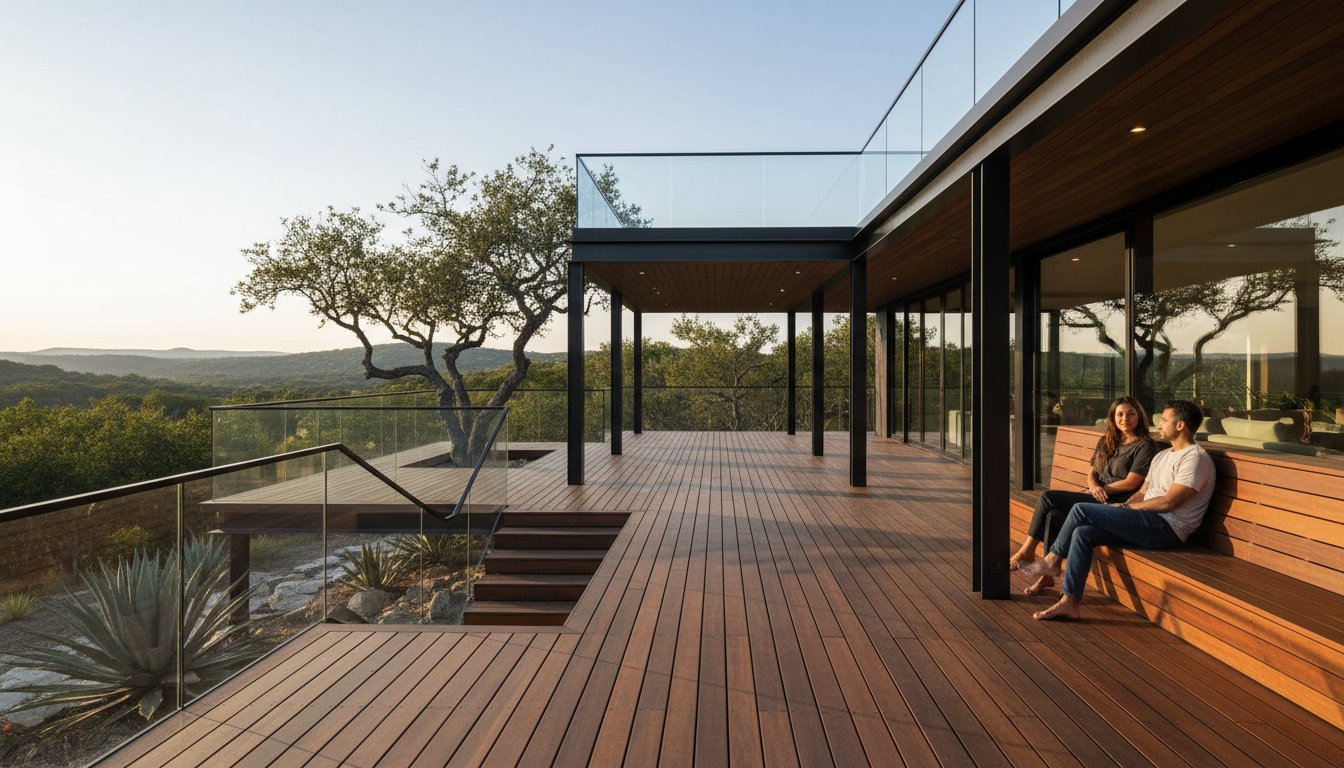
In 2024, Austin recorded 40 days of triple-digit heat, a cycle that pushed standard composite materials to their physical breaking point. You want custom decking that matches your home's high-end architecture, but you're likely tired of watching expensive "low-maintenance" boards warp and fade before the second summer. It's a common frustration for homeowners who prioritize aesthetics but keep getting stuck with generic, high-heat plastic solutions.
Investing in your outdoor space should be a strategic move for your property value, not a recurring maintenance headache. You'll learn why 3D-led engineering and architectural hardwoods like Ipe or thermally modified ash are the only materials that truly survive the Central Texas climate while maximizing your ROI. These natural choices provide a cooler surface underfoot and a structural integrity that synthetic products can't match when the sun is at its peak.
We'll break down the structural failures of plastic, the thermal advantages of premium timber, and the specific design-to-build process that ensures your project remains a permanent asset rather than a temporary fix.
Key Takeaways
- Stop settling for "off-the-shelf" kits that fail on Austin limestone; learn why high-end custom decking requires site-specific engineering to match your home’s DNA.
- Dodge the "plastic trap" of composite materials that burn feet in July and discover why thermally modified wood is the elite 30-year solution for Texas heat.
- Master the hybrid approach: combine traditional carpentry with precision steel framing for a modern aesthetic that outlasts standard wood structures.
- Eliminate guesswork with 3D design renderings and digital site scans that prove your project works in virtual reality before a single board is cut.
- Maximize your property appraisal by shifting from a basic backyard platform to an architectural investment that drives resale speed.
Defining Custom Decking: Beyond the Standard Backyard Platform
Custom decking is a site-specific engineered structure designed to match a home’s architectural DNA. It is not a generic addition or a weekend DIY project. In Austin, a deck must function as a high-performance asset that handles the unique challenges of Central Texas geography while reflecting the owner’s lifestyle. Most homeowners think a deck is just a place for a grill, but a custom build is a strategic extension of the primary living space.
The difference between a kit and a custom build
Off-the-shelf kits are designed for flat, predictable lots. They rely on 2x8 joists that often fail under the weight of high-load features. If you plan to install a 500-pound cold plunge or a heavy cedar sauna, standard framing will sag within three years. Structural integrity is the foundation of a custom build. We utilize precision metalwork and heavy-duty framing to ensure the platform remains rigid over decades of use.
Aesthetic continuity is another major separator. A kit looks like an afterthought. A custom build matches the wood grain of the deck to your interior or exterior trim, creating a seamless visual flow. This approach allows for the integration of architectural fencing and privacy screens that feel like a part of the original home design rather than a tacked-on solution. It is about creating a cohesive space where every board serves a purpose.
Why Austin’s terrain demands structural customization
Building on the Edwards Plateau means navigating solid limestone and aggressive drainage issues. You aren't building on simple dirt; you are building on a rock shelf. Standard kits fail here because they cannot handle the 15 to 20 percent slopes common in West Austin. Custom decking requires specialized steel reinforcement and custom-poured footings that are pinned directly into the limestone. This level of engineering is the only way to prevent the structure from shifting during Texas’s intense wet-dry cycles.
Precision is vital when managing the transition from indoor flooring to the outdoor Deck (building). A custom build allows for a flush-mount threshold, meaning there is no awkward step-down between your living room and the patio. This requires expert knowledge of local building codes and site-specific drainage. Without custom footings, the heavy rains common in Central Texas can cause water to pool against the foundation, leading to expensive rot and structural failure.
- Load-Bearing Capacity: Engineered for heavy features like hot tubs and outdoor kitchens.
- Limestone Anchoring: Specialized footings designed for the rocky Edwards Plateau soil.
- Seamless Transitions: Zero-threshold entries that connect indoor and outdoor spaces.
- Material Matching: Selecting wood species that complement existing architectural finishes.
A custom approach treats the deck as a strategic investment rather than a simple commodity. It solves the environmental problems that "one-size-fits-all" products ignore, ensuring the structure remains level and safe regardless of the terrain. By focusing on custom decking, you are choosing a build that is engineered to win against the elements and the clock.
Material Science: Why High-End Wood Outperforms Composite in Texas
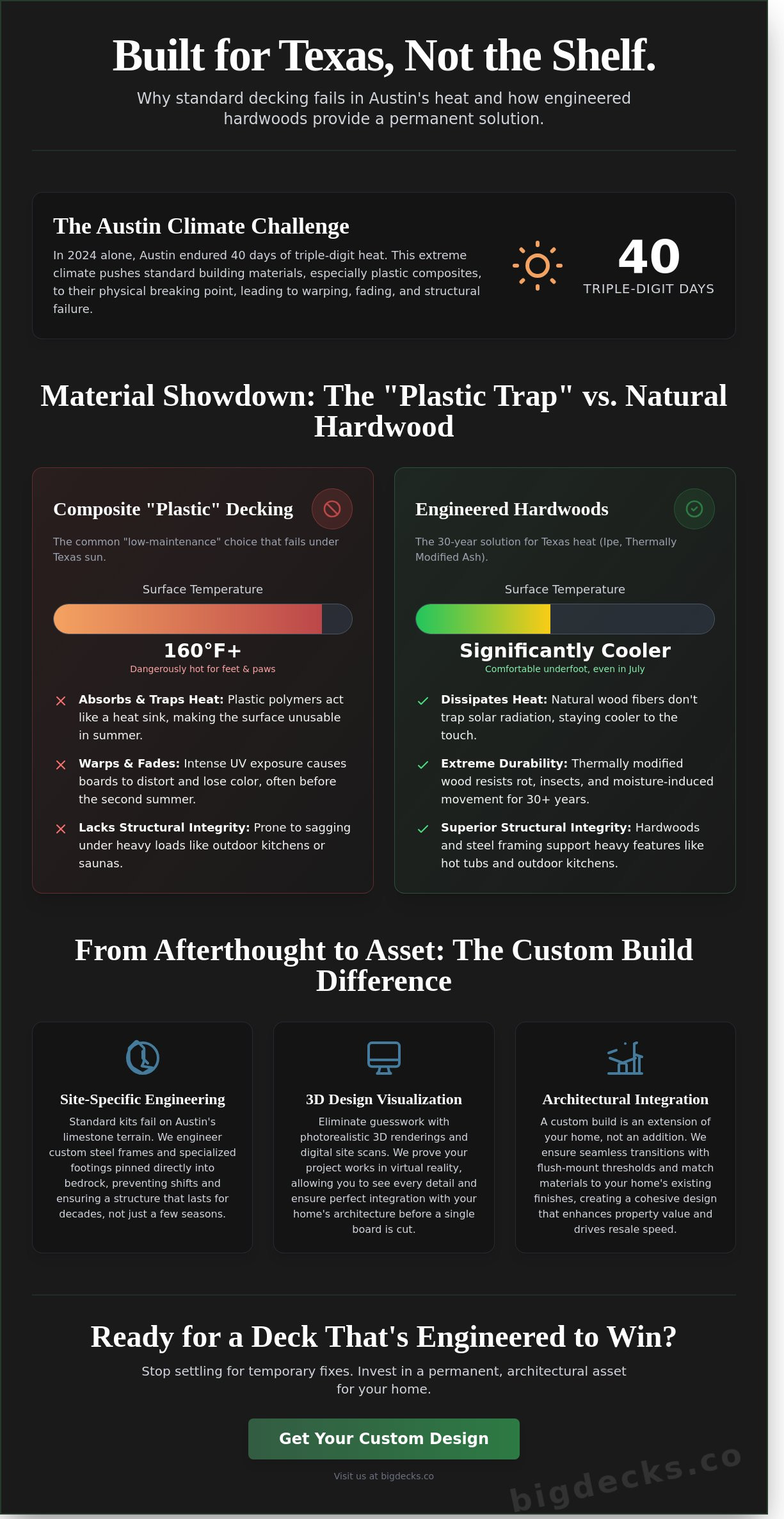
Austin summers don't play around. In July, composite decking often becomes a "plastic trap" for unsuspecting homeowners. These synthetic boards absorb solar radiation until they reach surface temperatures exceeding 160 degrees. That is hot enough to cause discomfort or even burns on bare feet and pet paws. Real wood stays significantly cooler under the Texas sun because natural fibers dissipate heat rather than trapping it like plastic polymers do.
High-end wood offers the durability and comfort homeowners expect from a premium project. When planning custom decking, the material choice determines whether the space is a usable retreat or a heat sink. Natural timber provides a tactile quality and thermal performance that synthetic materials simply cannot match in Central Texas. Choosing the right species—often by researching premium specialists like Greenhill Timbers—ensures your investment survives the brutal UV and humidity cycles of the region.
Thermally modified wood and the Austin heat test
Thermally modified wood uses a high-heat kiln process to change the cellular structure of the timber. By heating wood to over 400 degrees in an oxygen-free environment, manufacturers strip away the organic compounds that fungi and insects eat. This results in thermally modified wood that offers a 30-year warranty against rot. It is incredibly stable, meaning it won't warp or "check" when Austin's humidity spikes and drops. Using North American hardwoods like Ash for this process provides exotic performance without the environmental cost of overseas shipping.
Ipe vs. Cedar vs. Douglas Fir
- Ipe: This is the "Ironwood" of the decking world. It carries a Class A fire rating, the same as steel or concrete, making it nearly indestructible. It is so dense it doesn't float in water and resists scratches from heavy furniture or pets.
- Western Red Cedar: This is the classic choice for horizontal fences and mid-range decks. Cedar contains natural tannins that repel bugs and decay. It is lightweight, easy to work with, and brings a distinct aromatic quality to the backyard.
- Douglas Fir: This species balances cost and structural performance. It is exceptionally strong, making it ideal for the framing and large-scale platforms of a custom decking project. While it requires more diligent sealing than Ipe, its structural integrity is top-tier.
Maintenance is no longer the nightmare it was twenty years ago. Modern penetrating oils soak deep into the wood fibers rather than sitting on top like a film. This prevents the peeling and cracking seen with old-school stains. A quick cleaning and a fresh coat of oil every 18 to 24 months keeps the wood looking new. This simple routine protects your investment and ensures the wood stays supple under the sun. If you are weighing these options for your own yard, you can explore our design process to see which material fits your specific lifestyle and budget.
Engineering for Longevity: Precision Metalwork and Structural Integrity
Building a high-end deck in Central Texas requires more than just picking a wood species. It demands an engineering mindset that accounts for Austin's aggressive climate cycles. We use a hybrid approach that fuses traditional carpentry with modern steel framing to create a foundation that won't warp, twist, or sag over time. This isn't just about over-engineering; it's about ensuring your custom decking remains level and safe for decades rather than years.
Steel provides a structural precision that wood cannot match. While pressure-treated joists eventually crown and bow, steel remains perfectly straight. This allows for tighter tolerances and a sharper, more modern aesthetic. We also integrate custom welding into our designs, using metal accents to bridge the gap between the organic warmth of wood and the industrial strength of modern architecture. This structural integrity is vital for handling the drainage demands of the Hill Country. Our sub-structures are engineered to move water away from the house quickly, preventing the pooling that occurs during Central Texas flash floods where three inches of rain can fall in less than an hour.
The role of steel in modern deck design
Steel posts allow us to achieve spans that wood simply can't handle. By reducing the number of vertical supports, we create cleaner lines and more usable space beneath the deck. This metalwork integrates seamlessly with architectural fencing, creating a unified look across the entire property. In Austin's humidity, which often hits 80 percent in the early morning hours, corrosion is a legitimate threat. We solve this by using powder-coated steel exclusively. It's a non-negotiable standard that ensures the "bones" of your project remain rust-free and structurally sound regardless of the weather.
Advanced wood protection strategies
Protection starts with the right chemistry. We prioritize penetrating oils like Cutek Extreme over traditional surface stains. Surface stains act like a plastic wrap that eventually cracks and traps moisture against the wood, leading to rapid decay. Penetrating oils work differently; they soak deep into the grain to displace moisture from the inside out. This makes the re-oiling process for your custom decking much simpler because it doesn't require sanding back to bare wood. You simply clean the surface and apply a fresh coat to maintain the UV protection.
The most critical detail is the end-grain. Every time a board is cut, the "straws" of the wood are exposed. If left unsealed, these ends suck up water like a sponge, leading to rot and structural failure. We seal every single end-cut during the installation process. It's a small step that separates a professional build from a DIY project, but it's the difference between a deck that lasts fifteen years and one that lasts forty.
The Planning Phase: Visualizing Your Custom Build with 3D Design
High-stakes projects don't leave room for "maybe." If you're investing in a premium build, winging the layout is a recipe for disaster. Using 3D design renderings is how you win before the first screw is driven. It's about data, not just aesthetics. This virtual environment allows you to stress-test your ideas before committing a single dollar to lumber.
The process starts with a site scan to create a digital twin of your backyard. This isn't a rough sketch; it's a precise 1:1 replica of your property's topography and existing structures. We use this digital space to explore material and lighting options in real-time. You can swap Cedar for Douglas Fir or test how a black walnut stain looks under specific LED lighting configurations. We optimize every square inch for heavy hitters like saunas, hot tubs, and outdoor kitchens, ensuring the structural integrity supports the weight while maintaining a clean, logical flow.
Avoiding the "Oops" moment with VR
Walk through your deck before it exists. You'll see if that sectional blocks the path to the grill or if the hot tub feels cramped in the corner. We track sun angles to prevent your deck from becoming a furnace at 2:00 PM. In the Austin heat, shade is a strategic asset. Catching a design flaw in a digital file costs nothing. Fixing it mid-build can cost thousands. It's the ultimate ROI play for your custom decking project.
Austin permitting and zoning
Austin’s Development Services Department doesn't care about your "vision." They care about impervious cover limits. In neighborhoods like Westlake or Tarrytown, exceeding these limits by even 1% results in a hard stop. 3D plans provide the technical accuracy needed to breeze through HOA approvals and city permitting. We handle the red tape by presenting a digital proof that matches Austin’s strict zoning requirements, speeding up the timeline and keeping your project on track. This precision ensures your custom decking meets every local code without sacrificing style.
Don't settle for a "best guess" approach. Get a clear look at your future space by choosing a team that values precision. Start your design consultation with BigDecks today.
Investing in Value: ROI and the BigDecks Approach
Austin's real estate market rewards bold moves. A well-executed custom decking project isn't just an upgrade; it's a strategic play for your home's equity. High-end outdoor builds in neighborhoods like Tarrytown or West Lake Hills can see a significant return on investment, often recouping 70% to 80% of costs upon resale. This isn't just about adding square footage. It's about creating a definitive lifestyle statement that makes buyers move faster.
The ROI of architectural outdoor spaces
A basic concrete patio is a utility. A custom wood deck is an experience. When you analyze deck costs, look at the long-term appreciation of architectural quality. Buyers in the current market prioritize wellness and recovery. Integrating features like cold plunges or high-performance outdoor saunas into your deck design shifts the property from a standard house to a private retreat. For those with waterfront access, complementing a permanent structure with an inflatable floating party island cabana boat further enhances the luxury lifestyle appeal that drives Central Texas real estate demand. This wellness and recreation premium is the new luxury standard, driving higher appraisal values than simple landscaping ever could.
Choosing high-performance wood like Cedar or Douglas Fir signals quality to savvy inspectors and appraisers. These materials possess a natural warmth and structural integrity that synthetic alternatives lack. We treat every custom decking project as a high-stakes build where the finish matters as much as the framing. You're investing in a durable asset that ages with grace, not a temporary plastic fix that fades in the Texas sun.
Final thoughts on the BigDecks process
Our approach is built on a refusal to compromise. We combine traditional heavy-timber carpentry with modern metalwork to create structures that feel permanent and powerful. We manage the entire lifecycle of the project, from the initial design pitch to the final refinishing. This end-to-end oversight ensures the architectural intent remains intact from the first shovel in the ground to the final screw.
We refuse to build with plastic. Composite materials might promise low maintenance, but they lack the soul and the resale punch of real timber. Our team focuses on high-octane designs that utilize the best natural materials available. We build decks for homeowners who want to win the room and dominate their local market. If you're ready to stop looking at your backyard and start leveraging it, we're the strategic ally you need.
Secure Your Backyard Investment
Austin’s climate doesn't play nice with inferior materials. Plastic composites often warp or become untouchable under the July sun, while architectural hardwoods like Ipe and Thermory stay structurally sound for decades. Choosing custom decking in Central Texas requires an engineering approach that accounts for shifting limestone and extreme heat cycles. We prioritize precision metalwork and premium wood because they offer a superior return on investment compared to synthetic alternatives. Every project we handle includes a 3D visualization to eliminate the gap between your vision and the final build. This data-driven planning ensures your deck functions as a strategic asset for your home. Don't settle for a standard platform when you can build a structure designed for longevity and performance. Your property deserves a build that handles the heat as well as you do.
Ready to see your backyard in 3D? Get your custom deck bid from BigDecks.
We look forward to helping you dominate your outdoor space.
Frequently Asked Questions
How much does a custom deck cost per square foot in Austin?
Austin homeowners typically spend between $30 and $60 per square foot for professional installation according to 2024 market data from Angi. This price range fluctuates based on your choice of wood species and the complexity of the substructure. Premium materials like Ipe or high-end composite will push your investment toward the $75 mark. Factors like slope and soil stability also dictate the final project cost.
What is the best wood for a deck in the Texas heat?
Western Red Cedar is the most reliable wood for the Central Texas climate because it stays cooler than most other materials. It handles the 100-degree Austin summers without warping or becoming painful to walk on. While Douglas Fir is a durable structural choice, it needs more protection from the sun to prevent drying. Cedar's natural tannins provide a built-in defense against the rot and insects common in our humid environment.
Do I need a permit to build a deck in Austin, TX?
The City of Austin requires a permit for any deck that is more than 30 inches above the ground or exceeds 200 square feet. This ensures your custom decking meets safety codes and respects property setbacks. We handle the paperwork with the Development Services Department to keep your build legal and stress-free. Skipping this step can lead to heavy fines or forced removals during a property sale.
How long does it take to design and build a custom deck?
A standard project takes four to eight weeks from the first meeting to the final walkthrough. The design and city permit phase accounts for three to five weeks of that timeline. Actual construction usually wraps up in seven to twelve business days once the materials arrive on-site. We provide a clear schedule at the start so you know exactly when your first outdoor event can begin.
Is thermally modified wood better than composite decking?
Thermally modified wood provides the authentic aesthetic of timber with the structural stability of a synthetic material. It's an excellent choice for a custom decking project because the high-heat treatment makes the wood virtually waterproof and resistant to rot. Composite decking requires less maintenance, but it often retains more heat in the Texas sun. Thermally modified options give you a 25-year lifespan without the plastic look of many alternative products.
How often do I need to maintain a natural wood deck in Austin?
Plan to wash and reseal your natural wood deck every two years to combat the intense Austin sun. Without this maintenance, the UV rays will break down the wood fibers and turn the boards a weathered gray. A high-quality penetrating stain keeps the wood supple and prevents the cracking that leads to splinters. Inspecting the hardware and structure every 12 months ensures the deck remains safe and stable for your family.
Deck Cost Per Square Foot in Austin: A 2026 Pricing Reality Check
Planning a deck in Austin? See the real 2026 deck cost per square foot for premium Ipe & Cedar. Get our no-BS budget guide before you hire a contractor.
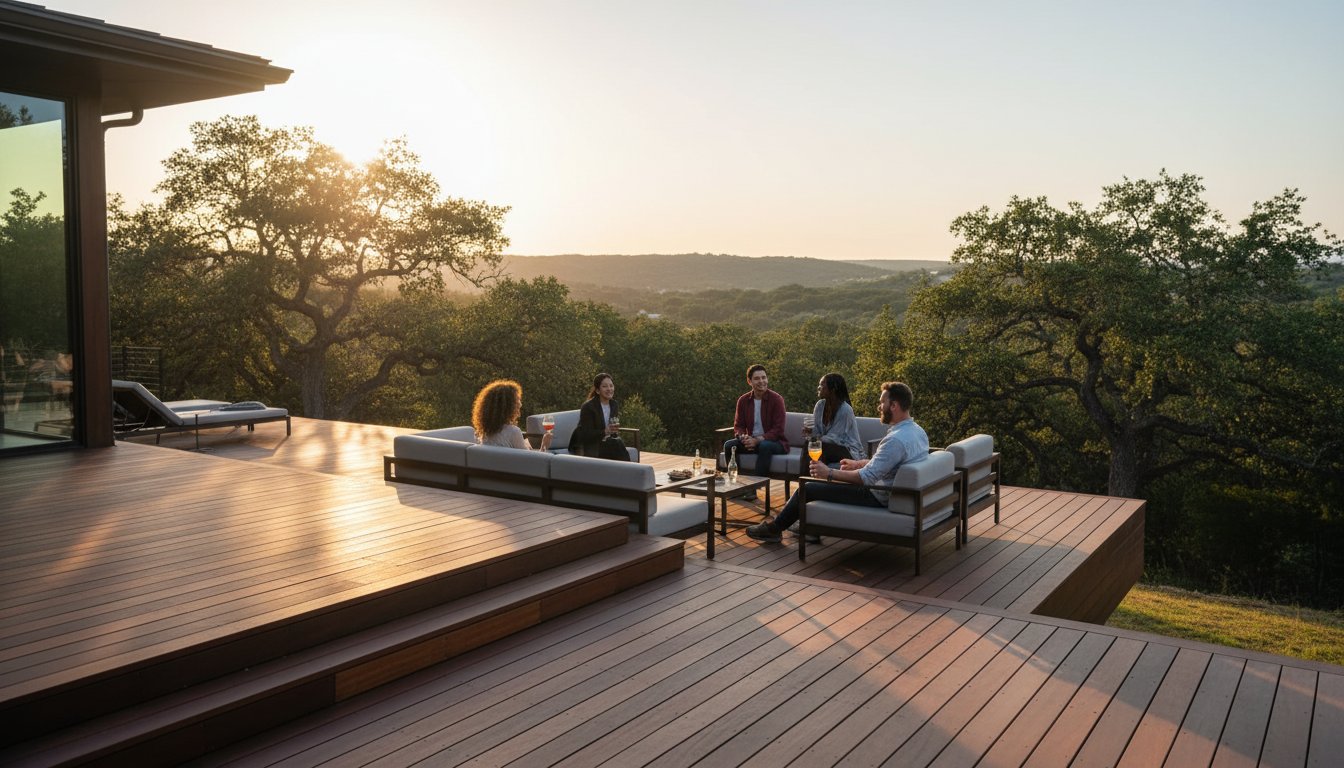
Most "starting at" prices for Austin outdoor projects are nothing more than bait designed to change the moment a contractor steps onto your property. You've likely seen the vague estimates that ignore the 12% rise in 2026 labor costs and the brutal Central Texas climate. It's frustrating to plan a high-end build when the deck cost per square foot feels like a moving target. You deserve a straight answer before you start cutting checks.
We're here to fix that with a no-BS breakdown of what it actually takes to build a premium wood deck in Austin right now. You'll get the definitive numbers for architectural-grade materials like Ipe, Cedar, and Thermory that won't buckle after two summers in the heat. We'll walk through the specific variables that influence your final quote, from site complexity to structural requirements. This guide covers the realistic budget framework you need to hire with confidence and ensure your investment delivers a massive win for your property's long-term value.
Key Takeaways
- Understand why the realistic deck cost per square foot in Austin now starts at $60 for premium wood builds that can withstand the Texas sun.
- Compare the 30-year performance of thermally modified wood against traditional Cedar to determine which material maximizes your long-term ROI.
- Learn why precision labor and engineering often exceed material costs in high-end projects and how to budget for that expertise.
- Use our tiered framework to categorize your project, whether you are planning a $25k essential platform or a $90k architectural retreat.
- Discover how 3D design renderings prevent expensive mid-build surprises and ensure your final product matches your initial vision.
The Austin Reality: Deck Cost Per Square Foot in 2026
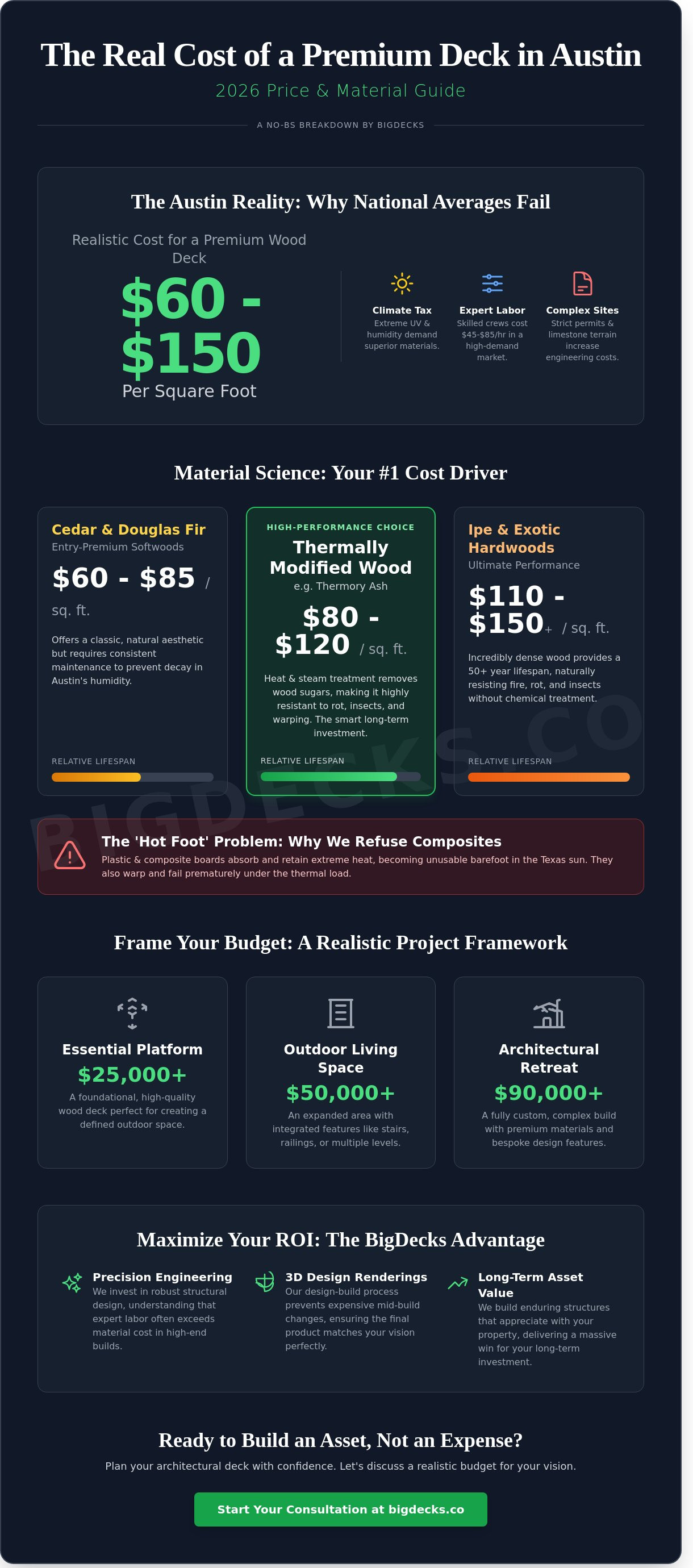
Building in Central Texas isn't getting cheaper. For 2026, homeowners should expect a deck cost per square foot between $60 and $150 for premium, custom builds. This range reflects the reality of Austin's high-demand labor market and the specific material requirements needed to survive the local climate.
Austin's extreme UV index and humidity levels act as a literal tax on low-quality builds. Standard pressure-treated lumber often warps within 24 months under the Central Texas sun. Investing in high-performance composites or thermally modified wood is a strategic move to avoid a total replacement before the decade ends. Understanding the fundamentals of deck construction is essential when evaluating these costs; structural integrity determines long-term ROI.
Why national pricing calculators lie to Austin homeowners
National averages often fail to capture the true deck cost per square foot in high-growth markets like Austin. Local labor rates for skilled carpentry crews currently range from $45 to $85 per hour, far outpacing rural benchmarks. Our local terrain often involves limestone shelves or significant slopes that require specialized footings and structural over-building. In 2026, the absolute price floor for a professionally installed custom wood deck in Austin starts at $55 per square foot.
The hidden impact of Austin permitting and code compliance
Austin’s Development Services Department enforces some of the strictest zoning and tree protection ordinances in the country. If your project sits within the critical root zone of a protected heritage oak, expect engineering fees to climb. Travis County structural requirements for load-bearing piers also add significant weight to your bottom line. You can find a deeper breakdown of these variables in our How Much Does it Cost to Build a Deck in Austin? (2026 Price Guide).
BigDecks views these costs through the lens of asset appreciation rather than just a simple expense. We focus on building structures that withstand 105-degree August afternoons without compromising their aesthetic or structural value. It’s about winning the long game of home ownership by building right the first time.
Material Science: Why Your Choice of Wood Dictates the Price
Material selection is the primary driver of your deck cost per square foot. You aren't just buying boards; you're investing in a structural asset that must survive the brutal Texas sun. Cedar and Douglas Fir represent the entry point for premium builds, typically landing between $60 and $85 per square foot. These figures reflect current deck material and labor costs for professional-grade installations. These softwoods offer a classic look but require consistent maintenance to prevent Austin humidity from causing premature decay.
If you want the ultimate performance, Ipe and exotic hardwoods are the venture capital of the decking world. You pay a significant premium upfront, but the 50-year lifespan is a calculated play for maximum longevity. These high-density woods resist fire, rot, and insects without the need for toxic chemical treatments. While exotic woods increase the deck cost per square foot at the start, they often prove cheaper over a 20-year horizon because they don't require replacement.
We take a hard stance on material quality. This is why we focus on real wood solutions that breathe and age naturally. If you are ready to evaluate which material fits your vision, you can browse our design philosophy to see how we prioritize longevity over temporary trends.
The ROI of thermally modified wood in Central Texas
Thermory is the high-performance middle ground for smart homeowners. This wood undergoes a heat and steam process that alters the cell structure, effectively cooking the sugars out of the fibers. This makes the boards unappetizing to insects and highly resistant to rot. Because the moisture has been removed, Thermory resists warping and cupping far better than standard lumber. We protect these investments with Cutek Extreme, a penetrating oil that stabilizes the wood from the inside out and keeps the grain looking sharp.
The 'Hot Foot' problem: Why plastic decks fail Austin homeowners
BigDecks refuses to build with plastic or composite materials for one simple reason: physics. Austin sees over 40 days of 100-degree weather annually, and plastic cannot handle that thermal load. Composite boards expand and contract violently in the heat, which leads to warped frames and loosened fasteners over time. They also retain heat like a cast-iron skillet. You can't walk barefoot on a plastic deck in July without risking burns. These materials also carry a heavy environmental cost and eventually end up in landfills, often losing their "fake" wood aesthetic within just a few seasons.
Beyond the Boards: Engineering and Labor Costs in Central Texas
Labor isn't just a line item. It is the engine of the project. In the Austin market, the labor component of your deck cost per square foot often exceeds the material spend. This isn't a mistake; it's a reflection of engineering reality. High-end builds require laser-level precision and specialized metal fabrication that a general handyman cannot provide.
Austin's topography is a variable you cannot ignore. Building on a 20 percent grade in the Hill Country requires deeper pier footings and heavy-duty lateral bracing. If your site has restricted access, such as a narrow side yard in Tarrytown, materials must be moved by hand. This logistical friction adds significant man-hours to the project timeline and drives up the average cost.
Structural steel framing is the ultimate power move for Austin estates. Unlike pressure-treated lumber, steel doesn't warp, crown, or rot. It creates a perfectly flat surface for high-end composites or hardwoods. It's a lifetime structural investment that pays dividends in durability, especially when supporting heavy features like outdoor kitchens or hot tubs.
The cost of skilled Austin craftsmanship in 2026
The "truck and a ladder" contractor is a liability. They often lack the specialized tools required for high-density hardwoods like Ipe or the welding rigs needed for modern steel accents. Hiring a specialist ensures your substructure outlasts the boards on top. To understand how these professional skills impact your deck cost per square foot, read our Austin Deck Labor Costs: 2026 Price Per Square Foot Guide.
Custom metalwork and architectural accents
Standard wood railings are functional, but custom steel adds architectural weight. Modern Austin designs frequently utilize custom-welded steel posts to achieve a minimalist look that thrives in the Texas sun. Steel handles 100-degree heat without the twisting or splintering common in wood components. This metalwork adds structural swagger to a backyard while providing the rigidity required for expansive, multi-level designs.
Don't focus solely on the surface boards. The real value of an Austin deck lies in the skeleton and the skill of the hands that built it. Engineering for slopes and integrating steel are the decisions that separate a five-year deck from a thirty-year legacy.
Estimating Your Project: A Realistic Budgeting Framework
Stop guessing. Austin's 2026 market demands precision. You aren't just buying wood; you're investing in a structural asset. Understanding your deck cost per square foot starts with choosing your tier of engagement. Every dollar spent should correlate to a specific outcome in durability, aesthetics, or lifestyle utility.
Tier 1: The Essential Platform ($25k–$45k). This is your entry point into high-quality outdoor living. We focus on premium Cedar or Douglas Fir. It's a clean, functional build for homeowners who value the warmth of natural wood but don't need complex multi-level geometry.
Tier 2: The Architectural Oasis ($50k–$90k). This is the sweet spot for modern Austin homes. We utilize Thermory wood for its incredible stability and rot resistance. This tier includes custom lighting packages and a full 3D design process to visualize the flow before the first board is cut.
Tier 3: The Estate Masterpiece ($100k+). This is a legacy build. We use Ipe or other high-density hardwoods paired with cold-formed steel framing. This tier often integrates high-end wellness features like built-in saunas or custom cold plunges. It's built to outlast the house itself.
Calculating the real square footage requires looking beyond the floor. Stairs, landings, and privacy screens consume significant materials and labor. These vertical elements often have a higher cost density than the flat surface of the deck. You must account for every linear foot of railing and every square foot of screening to get an accurate number.
How deck size influences your per-foot cost
Larger projects often benefit from the economy of scale. While the total project price increases, your deck cost per square foot might actually decrease. This happens because fixed costs, like permitting fees and mobilization charges, are spread across a larger area. The crew is already on-site; the equipment is already staged. For a detailed breakdown of these variables, read our New Deck Cost in Austin: A 2026 Price and Trend Guide.
Adding the BigDecks amenities
Wellness features are the definitive trend for 2026. Integrating an outdoor sauna or a cold plunge requires more than just space. These units need structural reinforcement and dedicated electrical runs. Architectural fencing is another critical consideration. Your deck shouldn't look like an island. A matching perimeter creates a cohesive environment. Horizontal wood screens provide the privacy you need in dense Austin neighborhoods while adding a high-end, modern aesthetic to your quote.
Ready to see the real numbers for your backyard? Get a custom design and quote from Big Decks.
Maximizing Your ROI: The BigDecks Design-Build Advantage
Building a high-end deck in Austin is a strategic financial move. You aren't just adding a platform to your backyard; you're expanding your home's usable footprint. In the 2026 market, homeowners expect outdoor spaces that match the quality of their interiors. To get the best return on your deck cost per square foot, you have to move past the "lowest bidder" mindset and focus on lifecycle value.
The "Buy Once, Cry Once" philosophy is the only way to survive the Texas climate. Cheap materials warp and rot within five years under the Austin sun. Investing in 30-year rated materials like capped composites or premium hardwoods ensures your asset appreciates. It turns a recurring maintenance headache into a permanent increase in property value.
The 3D design process: Engineering certainty
Every BigDecks project starts in a virtual environment. We use 3D renderings to map out every board, stair stringer, and lighting fixture before the first delivery truck arrives. This process allows you to visualize material transitions and color palettes with total clarity. It's the most effective way to prevent mid-build change orders that often inflate a project's budget unexpectedly.
Structural issues often hide in 2D plans. A 3D model reveals how the deck interacts with your home's foundation and existing roofline. This level of detail is why we focus on Custom Decks in Austin: Engineering Architectural Value for 2026. We build with the precision of a custom home; this ensures the finished product is both beautiful and code-compliant.
Long-term protection and maintenance
Maintenance is a non-negotiable part of protecting your investment. For natural wood decks, we exclusively recommend penetrating oils like Cutek Extreme. Unlike traditional stains that sit on the surface and eventually peel, Cutek works into the wood grain. It provides deep protection against moisture and UV damage from the inside out.
Budgeting for professional refinishing every 18 to 24 months is a smart move. It keeps the wood supple and prevents the graying that can hurt your home's curb appeal. Treat your deck as a strategic asset. It's a calculated addition to your net worth, not just a wooden platform.
Frequently asked questions
- Will a 3D design increase my total project cost? While there's an initial design fee, it usually saves money by eliminating construction errors and material waste.
- How much value does a deck add to an Austin home in 2026? High-quality outdoor living spaces currently see a significant recoup rate, often ranging from 65% to 80% of the build cost.
- Is Cutek Extreme better than hardware store stains? Yes. It's a professional-grade oil that doesn't require sanding between coats. This lowers your long-term labor costs and keeps your deck cost per square foot efficient over the life of the structure.
Own Your Outdoor ROI
Austin's 2026 market doesn't reward guesswork. You've seen how material science and labor shifts dictate your final deck cost per square foot. Settling for standard pressure-treated wood in the Central Texas heat is a losing strategy. High-performance materials like Thermory and Ipe aren't just upgrades; they're defensive plays against 100-degree summers and the intense humidity of the Hill Country, often providing 25 to 30 years of durability.
Success requires a clear narrative before the first board is cut. We've mastered the Austin climate by combining technical engineering with high-end aesthetics. Every project we touch includes 3D visualization because seeing the result is the only way to ensure your investment hits the mark. You don't just want a deck. You want a strategic asset that wins the neighborhood and holds its value for decades.
Stop scrolling through generic estimates and start building with precision. It's time to stop thinking about square footage and start focusing on the ultimate outcome for your property. Your future backyard is ready for its high-stakes upgrade.
Ready to win your backyard? Get a 3D design and quote from BigDecks today.
Frequently Asked Questions
Is $50 per square foot a realistic price for a deck in Austin?
No, $50 per square foot is rarely enough for a professional build in Austin's 2026 market; the average deck cost per square foot for quality projects usually starts much higher. Most high-end projects begin at $65 per square foot for basic pressure-treated wood. Labor costs in Central Texas have risen 12 percent since 2023, making the $50 benchmark a relic of the past.
Does the height of the deck increase the cost per square foot?
Yes, elevating a deck significantly increases the deck cost per square foot because of the required structural engineering and safety equipment. Any platform higher than 30 inches off the ground requires guardrails and beefier support posts, which adds roughly 15 to 25 percent to the total bill. Second-story builds also require scaffolding and more labor hours to move materials vertically, driving the price up further.
Why is Ipe decking so much more expensive than Cedar?
Ipe costs more because it's a Grade A hardwood with a Janka hardness rating of 3,510, nearly ten times harder than Western Red Cedar. While Cedar is a reliable local favorite, Ipe is imported from South America and lasts 40 to 50 years without rotting. You're paying for extreme density and a fire rating similar to concrete, which justifies the 3x price jump in raw material costs.
How much should I budget for a deck permit in Austin?
Budget at least $500 to $1,500 for the City of Austin's permitting process. The base fee for a residential building permit starts around $100, but you'll also pay for plan reviews, zoning inspections, and potential tree permits if you're building near protected oaks. These administrative costs are non-negotiable for any deck over 30 inches high or 200 square feet in size.
Will a new deck increase my Austin home's resale value?
A well-built deck typically yields a 65 to 75 percent return on investment according to the 2024 Cost vs. Value Report. In the Austin market, outdoor living space is a high-priority feature for buyers, often acting as the deciding factor in competitive bidding wars. Adding 400 square feet of functional living space increases your home's appraisal value more effectively than most interior renovations.
What happens to the price if I add a built-in sauna or hot tub?
Adding a hot tub or sauna requires a structural upgrade that typically adds $3,000 to $6,000 to the framing budget alone. A standard deck supports 40 pounds per square foot, but a filled hot tub requires a design rated for 100 pounds per square foot or more. You'll also need to account for dedicated 220V electrical lines, which require a separate electrical permit and a licensed sub-contractor.
Custom Deck Builder Austin: Engineering High-End Outdoor ROI in 2026
Looking for a custom deck builder in Austin? Learn how to vet pros, choose heat-resistant materials, and use 3D design to engineer a high-ROI outdoor masterp...
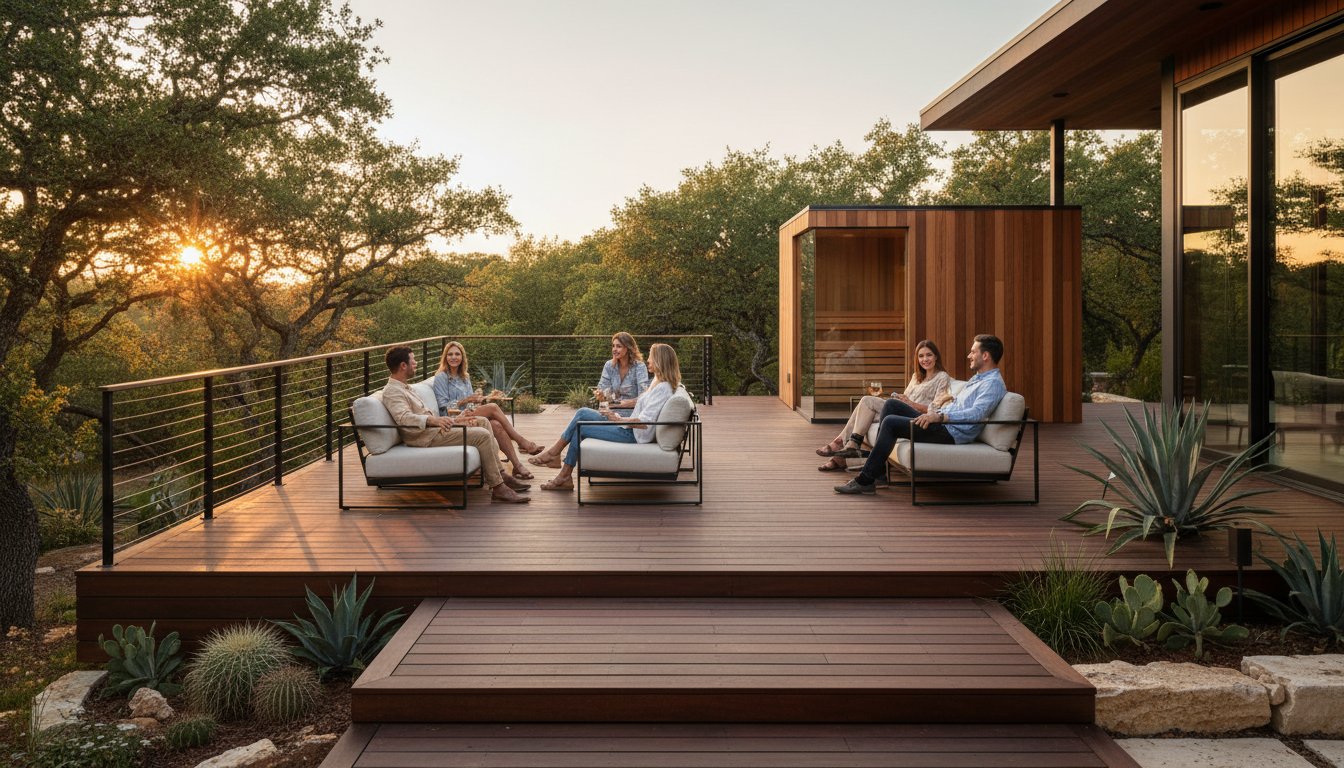
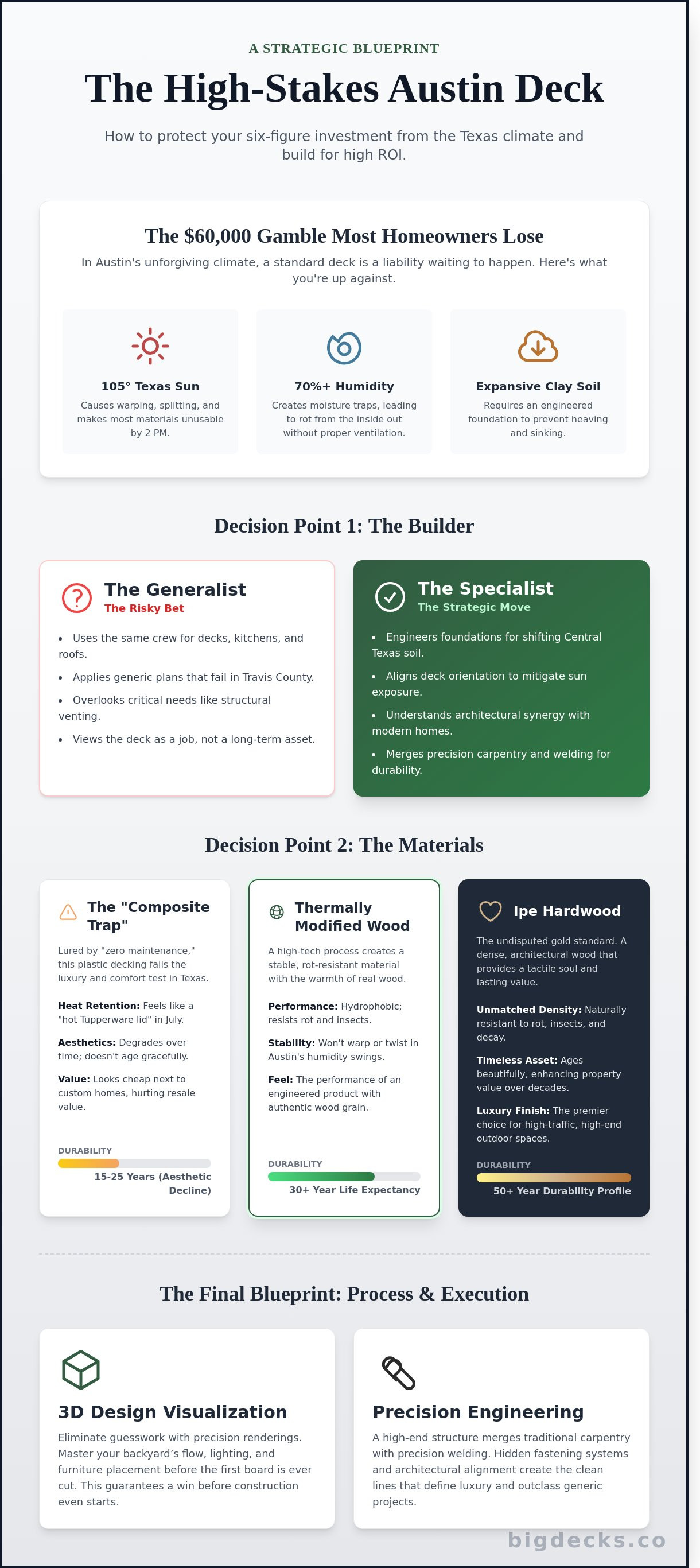
Most homeowners treat a $60,000 outdoor project like a casual hobby, only to watch their investment warp and their contractor vanish before the first summer ends. You know that a premium deck is a high-stakes asset, not a liability waiting to rot in the 105-degree Texas sun. It's a strategic play for home value, and getting it wrong is a mistake you can't afford when five figures are on the line.
Securing a custom deck builder Austin homeowners trust means looking for engineering precision over empty promises. This article gives you the blueprint to vet professionals, select architectural-grade materials that survive the heat, and use 3D design to guarantee a win before construction starts. We're diving into the specific tactics that turn a standard backyard into a high-ROI masterpiece through smart planning and professional execution.
Key Takeaways
- Hire a specialist, not a generalist. Learn how a dedicated custom deck builder in Austin handles the structural demands of shifting Central Texas soil and sloped Hill Country lots.
- Stop settling for the "composite trap." Compare the 50-year durability of architectural wood like Ipe against plastic decking that fails to survive the intense Texas heat.
- Eliminate design friction with 3D visualization. Use precision renderings to master your backyard’s flow, lighting, and furniture placement before the first board is cut.
- Streamline the local permitting process and explore how high-end wellness amenities like outdoor saunas and cold plunges drive long-term property ROI.
- Master the build. See how merging traditional carpentry with precision welding creates a high-end structure that outclasses high-volume, generic projects.
Why hiring a specialist custom deck builder in Austin is a strategic move
A general contractor often manages a kitchen remodel and a roof repair with the same crew. That doesn't work for high-end outdoor engineering. Just as you would hire a specialist like Countertops and Cabinetry By Design for a premium interior project, hiring a dedicated custom deck builder Austin homeowners trust means you're hiring a specialist who understands that Central Texas is a structural minefield. Between the shifting expansive clay soil and the steep limestone slopes of the Hill Country, your deck's foundation requires more than a standard post hole. It requires a strategic foundation plan that won't heave or sink when the weather shifts.
Engineering for 2026 property valuations requires a move away from "good enough." According to current deck construction standards, structural integrity is just the baseline. In Austin's hyper-competitive real estate market, a deck is a high-stakes asset. A specialist aligns the deck’s orientation with the sun’s path to maximize usable hours. This ensures your investment doesn't become a 140-degree furnace by 2:00 PM. We focus on the math of the build to ensure the ROI is visible, permanent, and undeniable.
The Austin humidity and heat challenge
Austin’s 100-degree summers and 70% humidity levels act like a pressure cooker for lumber. Standard pressure-treated wood often twists or splits within 24 months without precise intervention. We prioritize structural venting and specific airflow gaps to prevent moisture traps. Generic building plans designed for the Midwest fail in Travis County because they don't account for the rapid expansion and contraction cycles unique to our geography. You need a design that breathes. Without it, the wood rots from the inside out.
Architectural alignment with modern Austin homes
Luxury properties in West Lake Hills or Tarrytown demand architectural synergy with contemporary silhouettes. Precision metalwork and hidden fastening systems create the clean lines that define high-end Austin aesthetics. Stock designs from big-box retailers look cheap next to a custom home. They kill your curb appeal and drag down your eventual resale value. A strategic build uses high-performance materials like Ipe or premium composites to ensure the finish remains sharp for a decade. We build for the win, not just the weekend.
Final thoughts on Austin deck strategy
Choosing a specialist isn't just about aesthetics. It's about protecting a six-figure investment from the brutal Texas elements. At Big Decks, we treat your outdoor project like a high-stakes pitch. We aren't just swinging hammers; we're engineering a strategic ally for your property's future valuation. A custom build ensures your outdoor space remains a functional asset rather than a maintenance liability.
Material performance: Why we prioritize architectural wood over plastic
Composite decking is a retail-level solution for a high-stakes problem. Most homeowners get lured in by the "zero maintenance" pitch, only to realize their expensive deck feels like a hot Tupperware lid under the Austin sun. We don't build with plastic because it fails the luxury test every single time. As a premier custom deck builder Austin homeowners hire for long-term equity, we prioritize architectural wood that commands respect. Plastic doesn't age; it just degrades. Real timber, however, provides a tactile experience and a structural soul that synthetics can't replicate.
The "Composite Trap" is real. Beyond the aesthetic failure, synthetic boards often retain heat at temperatures that make them unusable during a Texas July. Architectural wood offers a superior return on investment because it remains a timeless asset. It's the difference between a bespoke suit and a polyester blend. When you're engineering a space for high-end ROI, you choose materials that offer a 50-year durability profile and a narrative of quality.
Thermally modified wood vs. traditional cedar
Thermal modification is a high-tech solution to an age-old problem. By using heat and steam to bake the sugars and resins out of the wood, the material becomes hydrophobic and essentially "dead" to rot and insects. While traditional cedar is a solid entry-level choice, thermally modified wood offers a 30-year life expectancy that rivals any synthetic product on the market. It's incredibly stable, meaning it won't warp or twist as the humidity fluctuates. You get the warmth of real grain with the performance of a lab-engineered material.
The case for Ipe and exotic hardwoods
Ipe is the undisputed gold standard for Austin's high-traffic outdoor spaces. It's so dense it carries a Class A fire rating, which is the same rating given to concrete and steel. This Brazilian hardwood is naturally resistant to everything the Texas climate throws at it. You can choose to oil it to maintain its rich, dark brown color, or let it "silver" naturally into a sophisticated weathered patina. Both options look stunning. Before you finalize your material list, check Austin's official deck permit guide to see how your design choices align with local building codes. Every technical detail matters when you're building for the long game.
Real wood isn't just a design choice; it's a strategic move for homeowners who value authenticity and longevity. If you're ready to stop settling for plastic and start building a legacy, explore our design-build approach to see how we handle high-performance timber.
The 3D design process: Eliminating the guesswork in your backyard
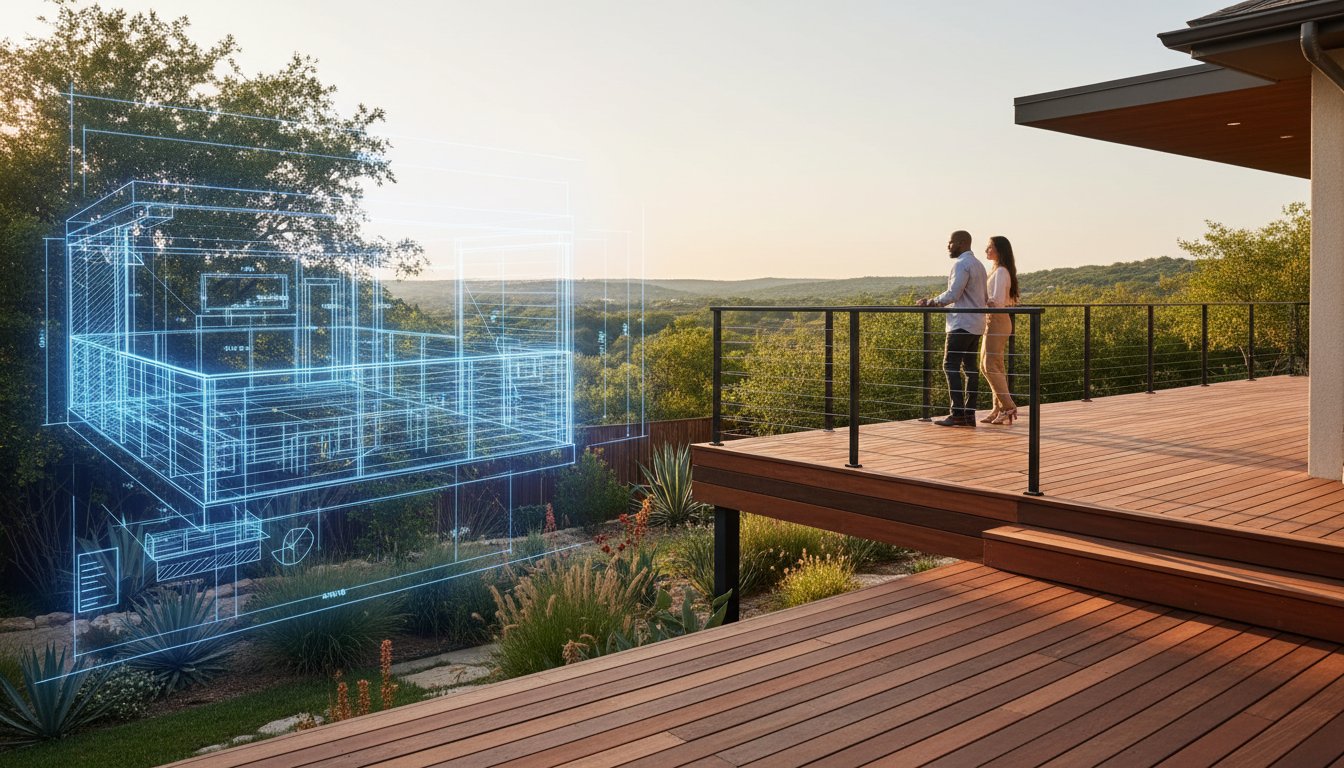
Building a high-end deck without a 3D model is like pitching a VC without a deck. You are essentially guessing with your capital. A professional custom deck builder Austin uses 3D renderings to align expectations and reality before a single pier is poured. This phase is not just about pretty pictures; it is a strategic tool used to explore lighting placement, furniture flow, and the physical transition from your back door to the yard. It turns a vague concept into a definitive plan of action.
Design fees are a smart investment that prevents five-figure mid-construction changes. By visualizing every detail early, you eliminate the risk of a project stall. In Austin, these models are also critical for navigating HOA boards and city permit offices. Providing a clear, high-resolution narrative of the project speeds up approval timelines and removes the friction often found in municipal bureaucracies. You win the room before the first board is even delivered to the site.
From site survey to virtual reality
Precision starts with laser-accurate site measurements and topography mapping. Austin's uneven terrain and limestone shelf demand technical accuracy. These 3D design renderings allow us to test realistic material textures and shadow patterns. You can see exactly where the sun hits at 4 PM in July. Walking through your deck in virtual reality creates a psychological certainty that traditional blueprints cannot match. It ensures the flow works for your specific lifestyle, from the grill placement to the lounge area.
Engineering for structural longevity
The digital phase is where we solve the heavy lifting. If you want a 5,000-pound hot tub or a custom sauna, the 3D model calculates the exact load-bearing requirements for your substructure. We integrate custom metal framing and architectural fencing directly into the master design. This stage also allows us to review research on decking materials to ensure your choice stands up to the brutal Texas climate.
Solving drainage and foundation stability in the digital phase is significantly cheaper than fixing a sinking footer three years later. Every board and bracket is accounted for, ensuring the final build is as durable as it is stunning. As a custom deck builder Austin homeowners trust for high-stakes projects, we use these models to ensure the engineering matches the aesthetic. We don't build to code; we build to last decades. This meticulous planning is how you secure a killer ROI on your outdoor investment.
Planning your Austin project: Permits, amenities, and wellness
Building a high-end deck in Central Texas requires more than a vision and a tool belt. It requires a strategy that accounts for municipal red tape and the physical weight of modern luxury. If you want your backyard ready for the June heat, your planning phase must begin at least six months prior. A professional custom deck builder Austin residents trust will tell you that the timeline isn't dictated by the wood; it's dictated by the permit office and the engineering requirements for heavy amenities.
Permitting and local codes in Travis County
Austin is notorious for its strict impervious cover limits. Most residential lots in the city are capped at 45 percent coverage. This total includes your house, driveway, and any non-permeable deck surfaces. If you exceed this, your project stops before it starts. The 2026 updates to the local residential building codes have introduced even more rigorous standards for lateral load connections and footings. Hiring professional deck builders in Austin ensures your paperwork is bulletproof. They handle the drainage analysis and setback requirements that often catch DIY-minded homeowners off guard.
Wellness integration: Saunas and cold plunges
The "Backyard Spa" is the dominant trend for 2026. Integrating a barrel sauna or a 500-pound cold plunge requires specialized structural engineering. You can't simply place a filled cold plunge on a standard deck frame. The point-load pressure can exceed 100 pounds per square foot. This demands a custom deck builder Austin expert who understands load distribution.
- Structural Reinforcement: We double the joists and utilize heavy-duty post-to-beam connectors to handle the dead weight of water-filled amenities.
- Utility Routing: Electrical for saunas and dedicated drainage for cold plunges must be integrated into the initial framing plan to avoid visible conduits.
- Architectural Privacy: Use horizontal cedar slats or steel privacy screens to create a secluded wellness zone without blocking the breeze.
Designing for the indoor-outdoor flow means matching floor heights and utilizing wide-span sliding doors. This creates a seamless transition that makes your square footage feel doubled. Every decision, from the choice of fasteners to the placement of the sauna, impacts your long-term ROI. Don't leave these details to chance.
Final thoughts
Successful projects in Austin rely on early planning and a deep understanding of Travis County constraints. By addressing the structural needs of wellness features and the reality of local codes early, you avoid costly mid-build pivots. Focus on the engineering first; the aesthetics will follow. This approach ensures your outdoor investment remains a high-performing asset for years.
Partnering with BigDecks: Precision carpentry meets modern design
BigDecks operates at the intersection of structural engineering and architectural art. We don't build generic platforms; we execute high-stakes outdoor investments. Our philosophy centers on the marriage of traditional woodcraft and precision welding. As a dedicated custom deck builder Austin homeowners trust, we focus on materials that survive the Texas sun and gain value over time.
We treat every project as a strategic asset. Most high-volume builders prioritize speed over substance, pushing "plastic" solutions that degrade within a decade. We reject that model. Our focus is on the tactile reality of real wood and the industrial strength of custom steel. This combination creates a signature aesthetic that defines high-end Central Texas living. It's a calculated approach designed for those who demand a superior return on their home improvement capital.
Expertise in high-end wood structures
Our team refuses to work with composite or plastic materials. While these products are marketed as "low maintenance," they often trap heat, sag under load, and lack the architectural gravitas of natural timber. We believe your home deserves better than a synthetic floor. Real wood offers a thermal comfort and structural integrity that plastic cannot replicate. It's a choice based on physics and long-term property value. We build for clients who want the authentic feel of a premium build.
To protect these investments, we utilize high-quality oils like Cutek Extreme. This isn't a surface film that peels; it's a penetrating stabilizer that works from the inside out. It's essential for managing the intense UV exposure and humidity fluctuations common in Austin. You can see the results of this methodology in our portfolio of custom decks across the region. We build for the future, ensuring your deck looks as sharp in ten years as it does on day one.
Taking the next step
Moving from a vision to a construction site requires a partner who values clarity over fluff. Your initial design consultation with BigDecks is a deep dive into your property's potential. We analyze topography, solar orientation, and your specific lifestyle requirements. This isn't a sales pitch; it's a technical briefing designed to identify the most efficient path to your ideal outdoor space. We help you navigate the tradeoffs between different wood species and custom metal details.
We provide a definitive "No-BS" breakdown of project costs. You'll see exactly where your capital is going, from premium timber sourcing to custom steel fabrication. There are no hidden fees or mid-project surprises. We value your time and your budget, providing a transparent roadmap that ensures a smooth build process. This level of communication is why we are the preferred custom deck builder Austin residents choose for complex, high-end projects.
While we focus on the Austin market, we find that the principles of high-end craftsmanship are shared by elite firms across the nation. For a look at how these standards are executed in luxury custom projects elsewhere, you can discover Diamond Construction and Remodel and their boutique approach to high-end home transformations.
If you're ready to win your backyard, the process starts now. We are currently booking consultations for the upcoming season. Reach out to our team to secure your place on the calendar and turn your outdoor narrative into a tangible, high-ROI reality. Let's build something that stands out and stands the test of time.
Secure your 2026 outdoor ROI
Stop settling for backyard projects and start engineering high-stakes outdoor assets. In the Austin heat, material performance is non-negotiable. We specialize in Ipe and Thermally Modified Wood because these materials are built to survive 25 years or more, not just a few seasons. Our in-house 3D visualization removes every ounce of risk from the equation. You'll see the integration of precision metalwork and architectural fencing in a digital twin of your home before a single screw is turned. This is a calculated upgrade to your property's footprint.
Partnering with a custom deck builder Austin recognizes as a leader ensures your investment pays off in both lifestyle and long-term property value. We handle the permits, the structural engineering, and the technical details that usually stall high-end builds. You get a streamlined path from concept to completion. We build for the win, ensuring your outdoor space stands as a testament to quality craftsmanship and strategic design. It's time to stop guessing and start building with precision.
Ready to see your new backyard in 3D? Get a custom bid from BigDecks today.
Frequently Asked Questions
How much does it cost to build a custom deck in Austin in 2026?
High-end outdoor builds in Austin reflect current material and labor indices. According to the 2024 Remodeling Cost vs. Value Report, a midrange wood deck addition typically recoups over 82 percent of its value. In 2026, your investment depends on specific structural engineering and premium material choices like Ipe or high-performance composites.
Do I need a permit to build a deck in Austin, TX?
You need a building permit for any deck over 30 inches above grade or any structure with a roof according to Austin City Code. The City of Austin Development Services Department requires specific site plans and structural drawings for approval. We handle the bureaucracy so you can focus on the design; we ensure every inch of your project meets local safety standards.
How long does a custom wood deck last in the Texas heat?
Pressure-treated pine usually lasts 10 to 15 years in Central Texas, while premium hardwoods like Ipe can exceed 40 years with proper maintenance. The intense UV index in Austin accelerates wood breakdown; this makes annual sealing or staining non-negotiable for traditional timber. Choosing a custom deck builder Austin trusts means selecting materials that won't warp or splinter when the thermometer hits 105 degrees.
Is thermally modified wood better than composite for Austin homes?
Thermally modified wood offers the organic feel of real timber with the stability of a lab-tested product, while composite provides a nearly maintenance-free experience. Modified wood undergoes a high-heat process that removes sugars; this makes it resistant to rot and insects without toxic chemicals. Composite decks win on longevity and color retention, but they can hold more heat under the direct Texas sun than natural wood fibers.
Can BigDecks integrate a sauna or hot tub into my existing yard?
BigDecks specializes in the structural reinforcement required to support the 5,000-pound load of a filled 6-person hot tub. Integration happens during the framing phase; we install dedicated footers and joist blocking to ensure zero structural deflection. We coordinate with your electricians to hide conduits and create a seamless transition from your spa to the main deck surface.
What is the best time of year to start a deck project in Austin?
Late fall and winter are the strategic windows to start your build if you want to be ready for spring. Austin's mild winters allow for consistent construction schedules without the 100-degree delays common in July. Starting in November or December ensures your project is finished, cured, and ready for use before the first backyard barbecue of the season.
Planning and Executing Professional Deck Work in Austin: A 2026 Guide
Planning deck work in Austin? Our 2026 guide covers durable materials, structural needs, and maintenance to build a high-ROI deck that lasts in the Texas sun.
Your current backyard vision is likely a liability waiting to happen under the relentless Austin sun. Most homeowners invest heavily in outdoor spaces only to watch the Texas heat strip away the value within 36 months. Executing professional deck work requires more than just a hammer and a permit; it demands a strategic approach to material durability and structural integrity. You already know that an unreliable contractor or the wrong wood species will turn your investment into an expensive eyesore by next summer.
This guide promises to give you the exact blueprint for building a high-ROI outdoor space that survives the 2026 climate without constant upkeep. We'll break down the specific material trade-offs, structural engineering requirements, and maintenance schedules you need to ensure your project adds lasting value to your property. We are stripping away the fluff to provide a clear, results-oriented roadmap for your next build.
Key Takeaways
- Learn how high UV indices in Central Texas impact material selection and why premium species like Ipe and Cedar are essential for durability.
- Discover how 3D visualization prevents costly mid-project changes by allowing you to finalize architectural details before construction begins.
- Understand why professional deck work in Austin requires a focus on structural foundations and custom metalwork rather than just surface-level aesthetics.
- Identify the specific maintenance routines and penetrating oils, such as Cutek Extreme, required to protect your investment from the elements.
- Master the vetting process for hiring specialized contractors who prioritize engineering and long-term ROI over the risks of a low-bid quote.
Understanding Deck Work in the Austin Climate
Successful deck work in Central Texas is more than a weekend DIY project. It is a calculated integration of architectural design, structural engineering, and material science. In Austin, your outdoor space isn't just fighting gravity; it's fighting a climate that actively tries to dismantle wood structures. To build a deck that lasts, you have to understand the specific environmental stressors of the Hill Country and the Blackland Prairie.
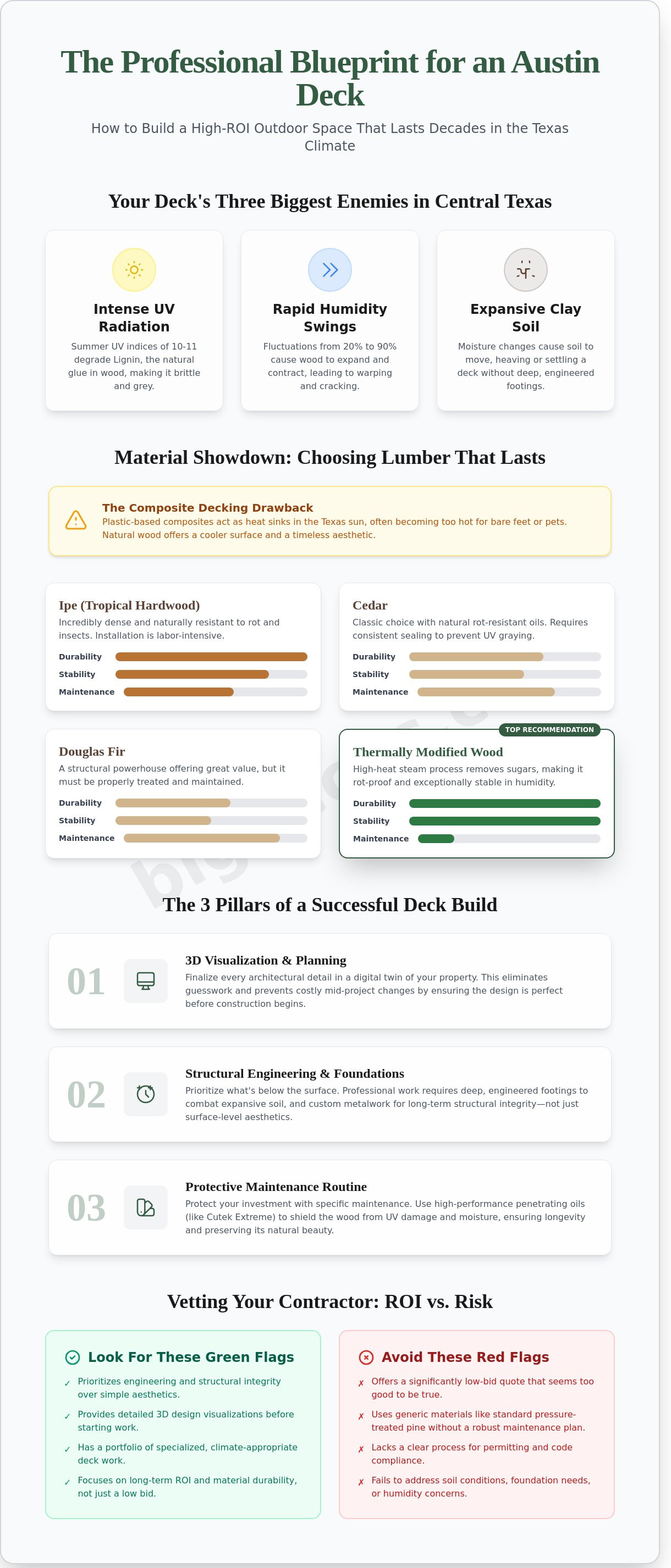
Central Texas frequently sees UV indices of 10 or 11 during the summer months. This intense radiation targets the structural integrity of your wood at a molecular level. While many homeowners view a deck as a simple platform, professional deck construction and materials must account for the relentless humidity cycles that define our region. Austin often swings from 20 percent to 90 percent humidity within a single week. These fluctuations cause wood to expand and contract rapidly, which leads to warping, checking, and fastener withdrawal if the engineering isn't precise.
Soil conditions also dictate the longevity of any local deck work. Much of Austin sits on expansive clay soil that moves significantly with moisture changes. Without deep, engineered footings, a deck can heave or settle, causing the entire frame to rack. We treat every project as a strategic build where the foundation is as critical as the finishing stain.
The Texas Sun vs. Standard Lumber
Lignin is the natural glue that holds wood fibers together. When temperatures hit 100 degrees for 40 consecutive days, UV rays penetrate the surface and degrade this lignin, leaving wood brittle and grey. Pressure-treated pine is often sold as a permanent fix, but it's actually a baseline material that requires aggressive maintenance. You'll recognize climate failure when you see "cupping" boards or deep cracks, known as checking, which allow water to rot the joists from the inside out.
Austin Permitting and Code Compliance
The City of Austin requires a residential permit for any deck that is more than 30 inches above grade or serves as part of an accessible exit. Navigating these rules involves more than just safety checks. You must account for impervious cover limits, which usually range from 20 to 45 percent of your lot size depending on your zoning. Professional deck work prioritizes these legal benchmarks because a non-compliant deck is a liability during a home sale. We focus on building to code the first time to ensure your investment is protected and your structure is safe for the long haul.
Planning Your Project: From 3D Design to Material Selection
Successful deck work starts before the first post hole is dug. Precision planning prevents expensive mid-project pivots that blow budgets and stall timelines. You need a strategy that accounts for the brutal Texas sun and your home's specific architectural flow.
Visualizing the Transformation
Static blueprints often fail to capture how shadows fall or how traffic flows during a backyard cookout. Utilizing 3d design renderings in Austin eliminates this guesswork by creating a digital twin of your property. You can test different lighting configurations and furniture layouts in a virtual environment, ensuring the final build matches your home’s existing aesthetic perfectly. This phase is about risk mitigation; it’s much cheaper to move a virtual staircase than a physical one.
The Case Against Composite Decking
Many homeowners lean toward composite materials to avoid maintenance, but Texas heat creates a significant drawback. Plastic-based boards act as heat sinks, often reaching temperatures that make them uncomfortable for bare feet or pets during July and August. Authentic wood grain offers a natural cooling effect and a timeless look that synthetic patterns can't replicate. Thermally modified wood provides a sustainable alternative, offering the durability of tropical hardwoods without the environmental baggage of plastic composites.
- Ipe: An incredibly dense tropical hardwood that resists rot and insects but requires significant labor for installation.
- Cedar: A classic choice known for its natural oils and pleasant scent, though it requires consistent sealing to prevent UV graying.
- Douglas Fir: A structural powerhouse that offers great value, provided it is treated and maintained correctly.
- Thermally Modified Wood: Our top recommendation for 30-year durability. This wood undergoes a high-heat steam process that removes organic sugars, making it essentially "rot-proof" and highly stable in fluctuating humidity.
Choosing "cheap" materials often results in a higher total cost of ownership. Low-grade pressure-treated lumber might save money upfront, but the warping and cracking caused by the Austin climate will lead to replacement in as little as 7 to 10 years. Proper deck finishing and preservation techniques are vital for any species you choose, ensuring the wood fibers remain resilient against intense UV radiation. If you're ready to see how these materials look on your property, you can explore our design options to find the right fit for your lifestyle.
Structural Foundations and Custom Metalwork
The Texas sun destroys more than just your deck boards. It cooks the frame underneath, causing wood joists to twist and pull away from their fasteners. If your foundation fails, the most expensive surface materials in the world won't save the project. Quality deck work starts with engineering that accounts for 100-degree days and the sudden flash floods that define the Hill Country climate.
Traditional wood frames are notoriously susceptible to dry rot and warping as moisture gets trapped in the tight gaps between the joists and the decking. Steel framing eliminates this risk entirely. It stays perfectly flat for decades, ensuring your investment doesn't sag, bounce, or squeak. In Central Texas, where humidity levels can swing 40% in a single day, metal provides a level of structural stability that pressure-treated lumber simply cannot match.
Managing drainage is equally critical when building on the Austin limestone shelf. Water must move away from the house and the deck's primary support points to prevent erosion or pooling. We design every substructure to handle high-volume runoff, ensuring that the ground beneath the structure stays stable. This focus on the "skeleton" of the project is what separates a five-year deck from a thirty-year outdoor living space. High-quality deck work requires looking past the surface to ensure the bones can handle the local environment.
Precision Metal Fabrication
Custom welding adds a modern, architectural edge to a project while serving a critical structural purpose. We utilize powder-coated steel and galvanized components to resist corrosion during the humid months. Combining industrial metal accents with traditional carpentry creates a high-contrast look that fits the modern Austin aesthetic. It's about building a structure that handles the weight of a full party without a whisper of movement or vibration.
Engineering for Shifting Texas Soil
Central Texas soil is notoriously unstable, often consisting of expansive clay that grows and shrinks with moisture levels. We evaluate each site to determine if helical piles or traditional concrete footings are the right choice for your specific coordinates. Helical piles act like giant screws, anchoring the deck deep into the stable strata to prevent the deck from heaving as the ground moves. This keeps your transitions to the house seamless and your sliding glass doors functioning perfectly.
If you plan to add a hot tub or a barrel sauna, the structural engineering must happen during the initial build phase. A standard residential deck supports approximately 40 to 50 pounds per square foot, but a filled six-person hot tub can require a capacity of 100 pounds per square foot or more. We reinforce these specific zones with dedicated steel beams and thickened footings. This foresight ensures your deck remains level and safe, providing the long-term utility you expect from a professional build.
The Essential Maintenance Routine for Austin Decks
Austin's climate is a relentless machine that grinds down organic materials. If you don't have a proactive plan for your deck work, the sun will turn your investment into gray tinder within 24 months. You need a schedule that treats maintenance like a strategic asset rather than a weekend chore.
Inspect your structure every six months, specifically in March and October. Check for hardware corrosion and loose boards near high-traffic zones. Don't forget your architectural fencing; vertical surfaces take less foot traffic but endure the same UV assault as the deck platform. Maintaining these vertical elements ensures the entire outdoor space ages at a uniform rate.
For homeowners who want to ensure every aspect of their property is looked after, JBM Custom Contracting offers professional property maintenance services that complement a high-end deck build by protecting the surrounding structures.
Your inspection should also include the surrounding canopy, as dead or damaged branches can pose a significant threat to your structure during a storm. If you notice a hazardous tree, contacting a specialist for emergency tree removal Austin TX is a critical step in preserving both your deck and your home’s safety.
Distinguishing between cleaning, sanding, and refinishing is vital for your long-term budget. Cleaning removes surface debris; sanding is a corrective measure for wood that has already suffered UV damage or heavy splintering. Refinishing is the complete process of returning the wood to a stable state before sealing it. Skipping the sanding phase on a weathered deck means you're just sealing in existing damage.
Cleaning and Surface Preparation
Cleaning is about chemical balance, not brute force. Use a specialized wood cleaner to lift Texas dust and organic growth without destroying the lignin that holds fibers together. Avoid high-pressure washing at all costs, especially on softwoods like Western Red Cedar. High PSI settings often exceed 3,000 pounds per square inch, which can shred wood cells and create a fuzzy texture that traps moisture. Perform a water bead test by splashing a few ounces of water on the boards. If the liquid soaks in within 30 seconds, the wood is thirsty and ready for oil.
Applying High-Performance Penetrating Oils
Traditional film-forming stains are a liability in Central Texas. These products sit on top of the wood and eventually crack when temperatures hit 105 degrees for ten consecutive days. We use Cutek Extreme because it's a synthetic penetrating oil that stays mobile inside the wood fibers. It displaces moisture from the inside out and won't peel or flake under intense heat. To maintain color, add a specific Colortone tint to your oil. This provides the UV protection needed to keep your deck looking like a high-end architectural feature. Deep penetration is the only way to ensure your deck work survives the next decade of Texas summers.
Ready to ensure your outdoor investment stands the test of time? Talk to an expert about your deck work.
Hiring a Decking Contractor: Professional Standards
Choosing a partner for your deck work requires more than a quick search and a few quotes. You're investing in a structural asset that must withstand 105-degree days and sudden Central Texas flash floods. A builder who primarily works with standard pressure-treated pine won't have the technical expertise needed for high-end wood and metal construction. These premium materials require precise engineering and specialized fasteners to manage the intense expansion and contraction cycles common in our climate. If the metal framing isn't properly isolated from certain wood tannins, you'll see corrosion and staining within the first 24 months.
Price often dictates quality in the Austin market. While a low bid looks attractive on paper, it usually leads to the highest long-term cost through premature repairs or total structural failure. Understanding how much it cost to build a deck in Austin helps you spot unrealistic estimates that compromise on safety or material grade. Design-build firms offer a streamlined path for complex backyard transformations. They handle the architectural planning and construction under one roof, reducing the risk of miscommunication between a designer and a separate crew. This integrated approach ensures the final build actually matches the initial vision without expensive change orders halfway through the project.
Questions to Ask Your Builder
Ask specifically about their experience with thermally modified wood. This material reacts differently to fasteners and moisture than standard lumber, requiring a builder who knows the specific pre-drilling and ventilation requirements. Verify their liability insurance and local Austin references to ensure they're established in the community. Review their past projects in person if possible. Look for tight miters, consistent board spacing, and how they integrate metal railings with wood framing for a seamless finish. Professional deck work is visible in these small, technical details that cheap crews tend to ignore.
The BigDecks Approach to Outdoor Living
We bridge the gap between traditional craftsmanship and modern 3D technology. Our team uses detailed renderings to ensure every structural element is optimized before the first board is cut, allowing you to see exactly how shadows and drainage will function. We select materials like Ipe or heat-treated ash specifically because they survive the local climate without warping or rotting. Investing in custom decks in Austin means building for longevity and architectural value. We don't just build platforms; we engineer outdoor environments that hold their value for decades. Our goal is to provide a finished product that looks as sharp in year ten as it did on day one.
Build for the Long Game in Austin
Austin's climate is a relentless adversary for outdoor structures. High-stakes deck work requires more than just a hammer and some boards; it demands a tactical approach to material selection and structural engineering. We use Thermory and Ipe because they're the only materials that consistently survive 100-degree Texas heat without compromising their integrity. Our process integrates in-house 3D design and custom metal fabrication to ensure your project is built on a foundation of precision rather than guesswork.
Success in high-end wood construction comes down to the details that most contractors ignore. You're investing in an asset that should enhance your property value and your lifestyle for decades. By focusing on professional standards and a rigorous maintenance routine, you protect that investment from the elements. Don't settle for a generic build when you can have a space engineered for performance and aesthetic dominance. It's about winning the room, even when that room is outdoors.
Ready to start your project? Get a professional design bid from BigDecks.
Your vision is the blueprint, and we have the expertise to execute it perfectly.
Frequently Asked Questions
Is it better to repair or replace my old wood deck in Austin?
Decide based on the 30 percent rule; if more than 30 percent of your deck boards show structural rot, replacement is the only move that protects your ROI. Surface-level graying or minor splinters are easy wins for a professional restoration. Austin's intense heat cycles fatigue wood quickly, so we inspect the joists first to ensure the foundation isn't a liability before suggesting a surface-level fix.
How long does professional deck work typically take to complete?
Most professional deck work for a standard 300 square foot project wraps up within 5 to 10 business days. This timeline includes everything from site prep to the final coat of UV protection. Larger, custom builds with integrated lighting or steel framing can extend the schedule to 3 weeks. We focus on maintaining momentum because a stalled job site is a drain on your time and your property's potential.
Does a new deck increase the resale value of an Austin home?
A professionally built wood deck delivers a 65 percent return on investment according to the 2023 Cost vs. Value Report. In the Austin market, outdoor living space is a high-stakes requirement for buyers looking for a complete lifestyle package. A killer deck effectively increases your usable square footage, making your property a dominant player when it’s time to hit the market and win the listing game.
What is the best wood for a deck in the Central Texas humidity?
Ipe and Cumaru are the undisputed champions for Central Texas because their extreme density resists the 90 percent humidity spikes we see every summer. These tropical hardwoods don't just look stunning; they refuse to rot or warp under pressure. If you prefer a classic look, Western Red Cedar is a reliable alternative due to its natural tannins, though it requires more frequent maintenance to stay in peak condition.
Do I need a permit for a deck if it is not attached to my house?
Austin building code requires a permit for any deck that exceeds 200 square feet or sits higher than 30 inches off the ground, regardless of attachment. You also have to navigate property line setbacks which typically require a 5 foot gap in most residential zones. Skipping the permit process is a rookie mistake that can stall a home sale or lead to expensive tear-outs during a city inspection.
How often should I oil my deck to prevent sun damage?
Apply a high-quality UV-rated oil every 12 to 18 months to neutralize the 2,800 hours of sunshine Austin receives annually. You'll know it's time for a refresh when water stops beading on the surface and begins soaking into the wood grain. Staying ahead of this cycle prevents the wood from checking and maintains the aggressive, high-end aesthetic your outdoor space deserves.
What is a Decking Contractor? The Austin Guide to Professional Deck Building
Hiring a decking contractor in Austin? Our guide helps you avoid costly mistakes and choose the right builder for a durable deck that survives Texas humidity.
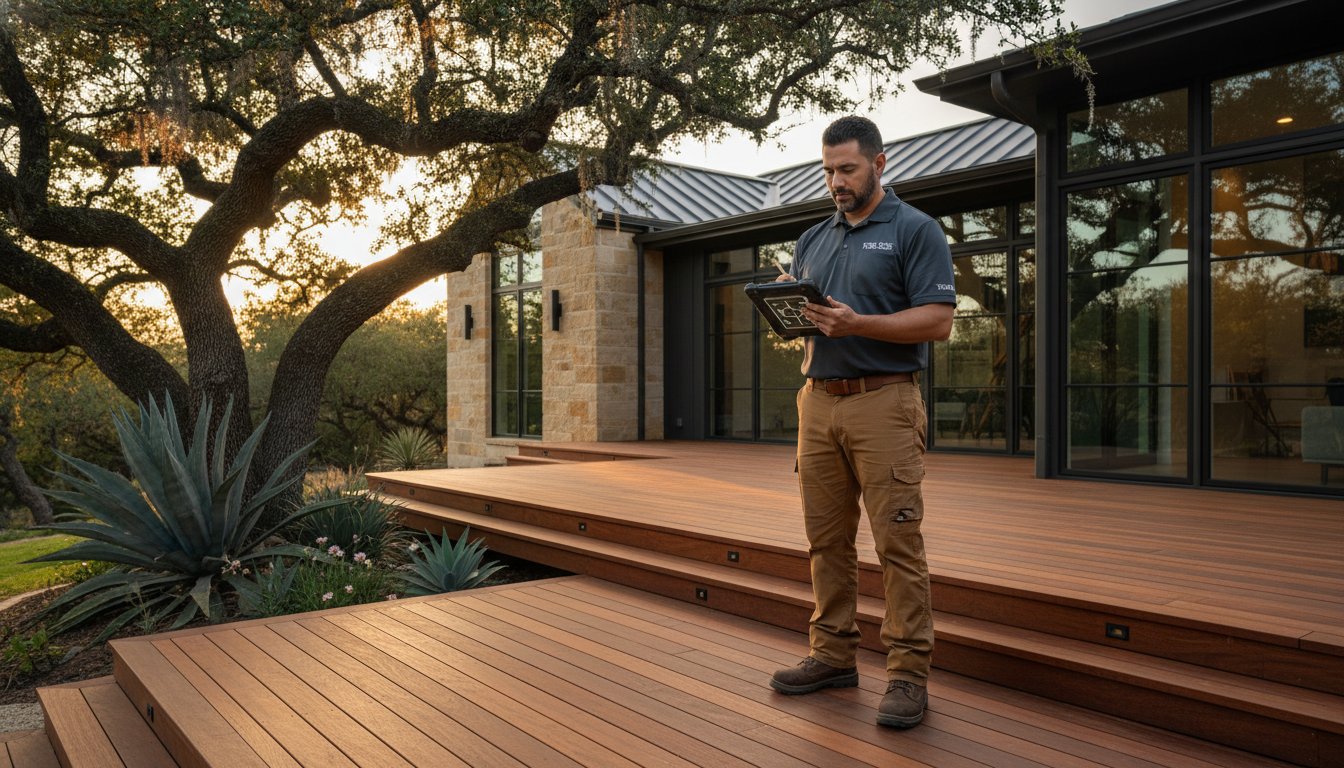
Why do 30% of Austin homeowners end up tearing out their "new" decks within five years? It's usually because they hired a general laborer instead of a specialized decking contractor who understands the brutal reality of Central Texas humidity. You already know that a deck is a high-stakes investment. It's a project that should increase your property value by 70% or more, not become a structural liability that rots before the first decade is up.
You deserve a seamless design to build process that doesn't involve chasing a contractor who disappeared mid-project or failing a Travis County inspection. We'll show you how to distinguish a true master builder from a weekend warrior so you can secure a high-end wood deck with lasting architectural integrity. This guide covers the specific technical standards, material choices, and permitting hurdles that determine whether your outdoor project is a win or a total loss. By the end, you'll have a clear roadmap to a durable, high-end outdoor space that actually delivers on its ROI.
Key Takeaways
- Identify the critical differences between a general carpenter and a specialized decking contractor who manages structural engineering and long-term ROI.
- Understand how Austin’s extreme heat, humidity, and shifting soil impact foundation requirements and material selection.
- Evaluate the performance of Ipe and thermally modified wood against composite materials to determine which best fits the Texas climate.
- Learn how to vet local builders by reviewing architectural consistency and verifying references specific to Central Texas neighborhoods.
- Discover how a 3D design-build approach eliminates construction guesswork and ensures your outdoor project integrates seamlessly with your home.
Defining the Professional Decking Contractor in 2026
A professional decking contractor is no longer just a person with a truck and a miter saw. By 2026, the industry has shifted toward high-level structural engineering and sophisticated design-build operations. These firms manage the entire lifecycle of an outdoor build, from soil composition analysis to the final coat of UV-resistant sealant. They operate like strategic allies—a role Pro-Construction has modeled for over 23 years as a general building contractor in the San Francisco Bay Area, focusing on long-term ROI and structural integrity rather than just the lowest bid.
Mastering wood science is now the baseline for any legitimate firm. This involves understanding cell structure, moisture equilibrium, and how different species react to local humidity levels. It is the difference between a deck that looks good for one summer and one that stays level for 25 years. Leading firms now integrate complex elements like barrel saunas, custom powder-coated metalwork, and outdoor kitchens into a single, cohesive structural plan.
Contractor vs. General Laborer
General laborers follow a list of tasks you provide. A specialized decking contractor provides a strategic roadmap for your entire property. They bring a minimum of $1 million in general liability insurance and specialized equipment like hydraulic pier drivers that a generalist simply does not own. Hiring unspecialized help often results in a 30% increase in long-term maintenance costs because they lack specific knowledge of deck-specific shear forces and ledger board flashing. You want a team that owns the outcome, not just the hours on the clock.
The Design-Build Evolution
The best firms now utilize 3D visualization to kill uncertainty before the first post is set. This is not just a pretty picture; it is a digital twin that accounts for sun angles and architectural fencing integration. In cities like Austin, a professional contractor is your shield against the permitting headache. They navigate the 60-day review cycles and the 20% impermeable cover limits that would stall a DIY project indefinitely. They handle the bureaucracy so you can focus on the winning result.
The Austin Factor: Why Local Specialization is Non-Negotiable
Austin is a graveyard for mediocre decks. The Central Texas climate is a relentless wood-killer, characterized by 40 plus days of triple-digit heat and sudden flash floods that dump five inches of rain in a single afternoon. A generic builder won't cut it here. You need a specialized decking contractor who understands that local environmental variables are the primary drivers of your project's ROI.
Building in Austin requires a strategic approach to material selection. When temperatures hit 105 degrees, standard pressure-treated lumber loses its moisture too fast, leading to catastrophic warping and checking. We select materials based on their ability to survive the Texas sun without turning into a structural liability or a safety hazard for your family. This is about more than aesthetics; it is about engineering a space that survives the brutal reality of the Texas sun.
Engineering for Central Texas soil
The ground beneath your feet is your deck's biggest enemy. Austin sits on a volatile mix of expansive Blackland clay and unforgiving limestone shelves. Standard deck footings often fail because the clay expands and contracts with the seasons, literally lifting foundations out of the ground. On sloped lots, this movement is even more dangerous, requiring custom steel-reinforced piers that anchor directly into the bedrock.
Residential decks in Travis County require concrete piers to reach a minimum depth of 12 inches into undisturbed natural soil or solid rock to prevent structural failure caused by soil movement. Without this precision, your investment will shift and sag within 24 months. A professional Austin decking contractor treats the foundation as a high-stakes engineering challenge, not an afterthought.
Thermal management and airflow
In July, a poorly designed deck becomes a heat island that can reach 160 degrees. This isn't just uncomfortable; it's a design failure. We utilize the science of sub-deck ventilation to create a constant flow of air beneath the surface. This prevents moisture from being trapped against the joists, which is the leading cause of internal rot in humid Central Texas environments. Proper airflow keeps the temperature down and the structural integrity up.
Terrain in neighborhoods like Westlake or Tarrytown presents unique structural hurdles. These areas often feature steep grades and rocky soil that demand specialized structural metalwork rather than traditional wood framing. By utilizing steel substructures and high-performance heat-dissipating materials, we ensure your outdoor space remains a functional asset even in the peak of a Texas summer. We build for performance, ensuring your deck wins the battle against the elements every single year.
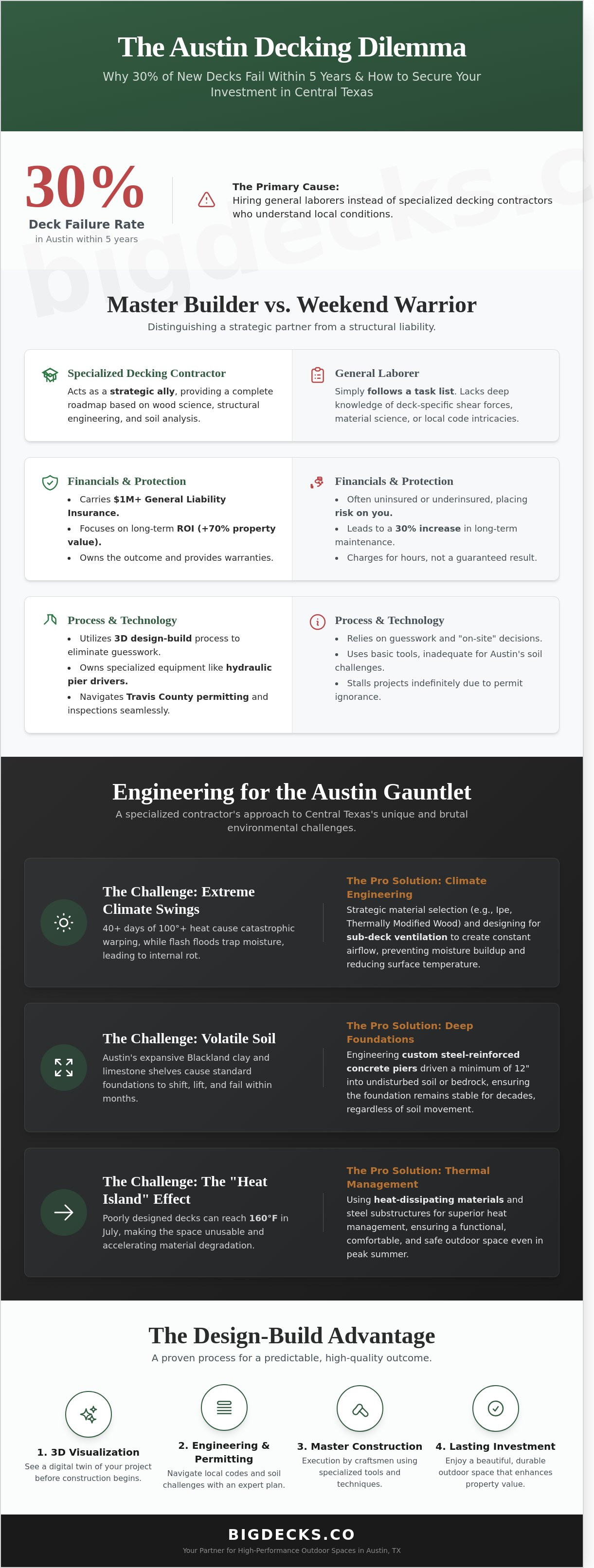
Material Strategy: Why High-End Contractors Prioritize Performance Wood
Cheap materials are a liability. A premium decking contractor doesn't sell you on the lowest bid; they sell you on the lowest cost of ownership over the next decade. The Austin sun destroys inferior products. While composite decking is marketed as a maintenance-free solution, it often fails the aesthetic test for high-end homes. It looks like plastic because it is plastic. It holds heat until it's untouchable in July and expands enough to pop fasteners. You want a deck that adds value, not a synthetic platform that depreciates like a used car.
Your contractor's material choice dictates your labor costs for the next ten years. Real wood offers a ROI that plastic can't touch, provided you choose the right species. IPE and thermally modified timbers are the gold standard. They provide the structural integrity required for complex architectural designs while maintaining a natural cooling effect that keeps the surface walkable in 100-degree weather.
Thermally Modified Wood vs. Traditional Cedar
Thermal modification is a high-tech solution to an old problem. By heating wood to over 320 degrees Fahrenheit in an oxygen-free environment, the cellular structure changes. It removes the organic compounds that fungi and insects eat. This process stops rot before it starts. While traditional Texas cedar might give you 12 years of life before the posts begin to fail, thermally modified ash or pine easily reaches a 25-year lifespan.
- Sustainability: Real wood is a carbon sink. It's more eco-conscious than petroleum-based composites.
- Durability: IPE outlasts domestic softwoods by 300 percent in high-UV environments.
- Stability: Thermally treated wood has 50 percent less movement than kiln-dried lumber.
The Precision of Custom Metalwork
The best decks in Austin aren't built on wood frames anymore. High-end projects now utilize structural steel. Wood frames warp and sag over time, but steel stays perfectly level. A professional decking contractor integrates precision welding with traditional carpentry to create a hybrid structure that's virtually indestructible. This allows for longer spans and fewer support posts, which opens up your view and creates a cleaner profile.
Custom metalwork extends beyond the frame. Architectural steel railings and custom-fabricated fencing provide a slim, modern profile that wood simply cannot achieve. We focus on 1/16th-inch tolerances. This intersection of heavy-duty engineering and refined finish work ensures your deck remains a structural asset for 40 years, not just a temporary feature. It's about building a legacy, not just a platform.
How to Vet an Austin Deck Builder Like a Pro
Hiring a decking contractor isn't a gamble; it's a high-stakes investment in your property's ROI. You need a partner who understands the specific demands of Central Texas soil and the brutal Austin sun. Don't just look at "pretty" pictures of finished projects. Look for architectural consistency. If a portfolio jumps from modern minimalist steel to rustic cedar without a clear design logic, they're likely guessing rather than engineering. A pro should show you projects that look as good three years later as they did on day one.
Verify local references with actual homeowners in neighborhoods like Westlake, Tarrytown, or Barton Hills. Ask if the crew arrived at 7:30 AM as promised or drifted in at noon. You want to see local projects within a 15-mile radius of your home to ensure the builder understands local soil expansion and drainage requirements. A legitimate pro will provide a no-BS bid that breaks down costs by line item. If you see a single vague number for "Materials," walk away. You need to see the difference between Select Structural and #2 grade lumber in writing.
The 3D design test is your ultimate litmus test. In a high-stakes build, you shouldn't pay for a single board until you've seen a digital rendering of the final product. This proves the decking contractor has solved the structural puzzles and elevation challenges before the first screw is driven. Finally, analyze the warranty with a critical eye. A 25-year manufacturer warranty on composite boards is useless if the frame rots in five years. Demand a clear, separate labor guarantee of at least 2 to 5 years to cover the actual construction work.
The Right Questions to Ask
Ask about their specific experience with Ipe or thermally modified wood. These high-end materials move differently than pressure-treated pine and require specialized fasteners. Inquire about their process for managing City of Austin tree protection ordinances. If they don't mention the Critical Root Zone (CRZ) of your Heritage Oaks, they'll get your project red-flagged by inspectors. Demand to know how they handle the "invisible" parts. High-performance joist tape and G-Tape are non-negotiable for a deck built to last 20 years in Texas humidity.
Red Flags in a Decking Quote
Vague line items are the enemy of your budget. If a quote doesn't specify wood grades or the specific brand of hidden fasteners, expect cheap substitutions mid-project. A lack of a clear 14-day timeline for the 3D design and permitting phase is another warning sign of a disorganized operation. Be wary of under-priced labor. If a quote is 30% lower than competitors, they're likely skipping insurance or using unskilled day labor. Cheap work is expensive to fix when the deck starts to sag after the first summer heatwave.
Beyond Construction: The Design-Build Advantage with BigDecks
Choosing a decking contractor involves more than finding someone who can swing a hammer. It requires a partner who understands that an outdoor space is a high-yield investment in your property's equity. At BigDecks, we've moved past the era of basic platforms. We refuse to build with hollow plastic composites that warp under the 105-degree Austin sun. Instead, we focus on high-performance materials and engineering that ensure your structure outlasts the next three owners of your home.
Our approach treats your backyard as a strategic asset. We don't just "build decks"; we engineer environments that solve problems like slope instability, privacy gaps, and heat management. By acting as a specialized decking contractor, we take full accountability for the narrative of your property, ensuring every square foot serves a functional and aesthetic purpose.
The 3D Visualization Standard
We've eliminated the "hope for the best" phase of construction. Every project starts with a precision 3D model that allows you to see exactly how shadows fall across your seating area at 4:00 PM in July. This isn't just a pretty picture; it's a financial safeguard. Homeowners who skip the 3D phase often face mid-construction changes that can cost upwards of $4,500 in wasted labor and materials. Our process lets you refine the layout and material transitions before a single board is cut. You can explore how these designs translate to long-term worth in our guide on Custom Decks in Austin: Engineering Architectural Value for 2026.
Total Outdoor Integration
A modern deck doesn't exist in a vacuum. It's the foundation for a comprehensive wellness suite. We specialize in integrating luxury amenities that standard builders won't touch. This includes custom-fitted saunas, 45-degree cold plunges, and built-in outdoor kitchens. We view architectural fencing as the essential frame for your platform, providing the structural privacy required for a true sanctuary.
- Structural Durability: We utilize heavy-duty framing and hardware designed for Central Texas soil movement.
- Wellness Ready: Our designs include the reinforced joist spacing necessary for 500-gallon hot tubs and heavy recovery equipment.
- Zero-Fluff Execution: We prioritize ROI and structural physics over generic trends.
Investing in a specialized decking contractor is about more than just aesthetics. It's about ensuring your home's outdoor narrative is one of quality, durability, and calculated design. When you build with us, you're not just adding a deck; you're installing a permanent architectural upgrade that stands as a testament to better building standards.
While this guide focuses on outdoor structures, the same principles of high-end craftsmanship apply to the rest of your home. For those seeking to elevate their interior spaces, Grand Building Construction provides expert remodeling services that exemplify these same elite architectural standards in kitchen and bathroom renovations.
Build for the Austin Decade
The Austin market doesn't reward shortcuts. A professional decking contractor should bring more than a hammer to your site; they need to bring a 3D vision and a mastery of materials that survive 100 degree Texas summers. We've seen projects fail because they relied on standard pressure-treated lumber instead of IPE or thermally modified wood. These high-performance materials are the baseline for a structure that stays stable for 25 years or more.
Integrating precision metalwork and structural steel isn't just an aesthetic choice. It's a structural necessity for the modern Austin home. Stop settling for vague sketches. You deserve a design-build process that accounts for every bolt and board before the first hole is dug. We focus on the ROI of your backyard, ensuring the engineering matches the architecture. Your project is an investment in your home's equity and your daily lifestyle. Let's build something that holds its value as long as it holds your guests.
Ready to build a deck that actually lasts? Start your 3D design with BigDecks today.
Your vision is ready for the big stage. Let's make it happen.
Frequently Asked Questions
What is the difference between a decking contractor and a general contractor?
A decking contractor is a dedicated specialist focused on outdoor structural engineering, whereas a general contractor manages a broad spectrum of home renovations. Specialists own this specific niche. They understand the shear strength of fasteners and the moisture management required for a structure to survive 20 years. Don't hire a jack-of-all-trades for a project that requires master-level precision and specific outdoor expertise.
Do I need a permit to build a deck in Austin, Texas?
You'll need a permit from the City of Austin for any deck higher than 30 inches or any structure attached to your home. Code compliance isn't optional if you value your property's resale worth. Expect to provide a detailed plot plan and structural sections to the Development Services Department before the first hole is dug. This process ensures your build meets safety standards and local zoning laws.
How much does a professional decking contractor cost per square foot in Austin?
Professional decking contractor rates in Austin currently range from $65 to $120 per square foot for premium, custom builds. This price reflects the high cost of grade-A timber and the expert labor required for complex architectural designs. If a quote comes in under $50, the builder is likely cutting corners on structural hardware or using sub-par materials that won't last five years in the Texas climate.
Why do high-end contractors avoid composite or plastic decking materials?
High-end builders reject composite materials because they're thermal traps that frequently hit 150 degrees in the Austin sun. They lack the soul, the structural rigidity, and the long-term longevity of real timber. Wood is the only choice for a high-stakes design that needs to look as good in 10 years as it does on day one. Real wood wins the aesthetic and performance game every time.
How long does a custom wood deck installation typically take?
Expect a custom wood deck installation to take 10 to 21 business days. We spend the first 48 hours letting footings cure because structural integrity isn't a place to rush. Precision takes time. A three-week window ensures every joint is tight and every board is perfectly aligned for maximum impact. Weather delays in the Austin area can occasionally add 3 to 5 days to the schedule.
What kind of maintenance does a professional wood deck require in Austin?
Your wood deck requires a professional UV-protective oil treatment every 12 to 18 months to combat the intense Texas heat. This isn't a suggestion; it's a survival strategy for your investment. Spending $2 per square foot on annual maintenance prevents the graying and cracking that destroys the value of a custom outdoor space. Consistent care keeps your deck in peak condition for decades of use.
Custom pool deck Austin: Engineering luxury for the Texas heat
Don't let the sun destroy your investment. Get expert tips for a custom pool deck in Austin built with heat-resistant materials for lasting luxury & value.
The Austin sun destroys 85% of standard pressure-treated decks within the first five years, turning a supposed sanctuary into a splintering liability. You already know that 105-degree afternoons are relentless, and settling for basic materials is just a slow way to lose money on maintenance. Building a custom pool deck in Austin requires more than a guy with a saw; it demands an engineering mindset that treats your backyard like a high-stakes asset rather than an afterthought.
We’re here to show you how to build a high-performance, architectural space that survives the Texas heat while maximizing your home's appraisal value. This isn't about generic upgrades. It's about utilizing heat-resistant materials and a strategic design-to-build roadmap that ensures your deck looks as sharp in year ten as it does on day one. You'll learn exactly which materials win against the UV index and how to execute a vision that balances low-maintenance reality with high-end aesthetics.
Key Takeaways
- Learn why standard lumber fails under Central Texas UV and which high-performance materials, like Ipe and thermally modified wood, are engineered to survive the heat.
- Understand how fusing custom metalwork with master carpentry eliminates structural "bounce" and creates a rock-solid foundation for large-scale builds.
- Discover why 3D visualization is a strategic necessity for maximizing the ROI and design accuracy of your custom pool deck Austin project.
- Get the reality on long-term maintenance and the specific penetrating oils needed to protect your investment from Austin’s extreme humidity swings.
The Austin heat is a deck killer: why standard builds fail
Austin isn't just a city; it's a high-stakes environment for outdoor construction. When you invest in a custom pool deck Austin homeowners expect a space that survives the 105-degree August spikes. Standard builds fail because they underestimate the 300 days of direct UV exposure and the 40-point humidity swings that characterize Central Texas. Most off-the-shelf solutions are designed for temperate climates, not the brutal reality of our local ecosystem.
Big box lumber is a liability here. Cheap pressure-treated pine and low-grade cedar are the fast track to structural rot. These materials are often sourced from regions with consistent moisture profiles. When they hit the Austin heat, they dry too fast, warp, and split. You aren't just buying wood; you're buying a countdown to an expensive replacement project. We see failures in 35% of standard builds before they hit the five-year mark.
The physics of the Texas sun on wood
UV rays are relentless. They target lignin, the natural polymer that holds wood fibers together. Without advanced wood preservation techniques, your deck loses its structural integrity before the second summer ends. Thermal expansion is another silent killer. On a 100-degree day, surface temperatures on dark composite boards can exceed 160 degrees. This heat causes boards to expand and contract violently, pulling fasteners loose and buckling the entire surface. Wood degradation in Austin is the rapid chemical breakdown of organic fibers caused by unrelenting UV radiation and moisture-driven cellular expansion.
Foundation failure in Central Texas limestone
Austin sits on a mix of shifting clay and stubborn limestone. This geological volatility is why 22% of standard decks show signs of sagging near the pool coping within three years. Standard pier-and-beam methods usually rely on shallow 12-inch footings that can't handle the soil movement. We see it constantly: a deck looks great for six months, then the soil shifts, and suddenly your level surface has a two-inch dip. This isn't just an eyesore; it's a safety hazard that compromises the pool's structural bond beam.
The BigDecks approach treats the foundation like a high-rise project. We analyze the specific rock density of your lot before we ever cut a board. Our custom pool deck Austin builds utilize deep-set, engineered footings designed to anchor into the limestone shelf. This isn't just construction; it's site-specific engineering that ensures your investment stays level while the ground beneath it tries to move. We build for the 10-year horizon, not the 10-month honeymoon phase.
An architectural pool deck is where high-end design meets industrial-grade durability. It moves past the "platform in the yard" mentality. It's a strategic asset designed to handle the specific thermal loads and soil stresses of Central Texas. We prioritize ROI by selecting materials that thrive under 10+ UV index ratings and engineering foundations that ignore the shifting clay. This is where engineering meets high-end design to create a space that actually lasts.
Material dominance: Ipe, cedar, and the tech of thermally modified wood
Building a custom pool deck Austin homeowners can actually use in July requires moving past the standard lumber aisle. You need materials that survive 105-degree days and high humidity without warping or splintering. For high-end residential projects, the choice usually narrows down to two elite categories: South American hardwoods or high-tech thermally modified timber. These materials don't just look better; they perform on a different level than the softwoods found at big-box retailers.
Ipe is the undisputed heavyweight champion of the decking world. Often called ironwood, it carries a Janka hardness rating of 3,680 lbf, making it nearly eight times harder than California Redwood. This density gives it a Class A fire rating, which is the same rating awarded to steel and concrete. It's a massive win for home resale value because an Ipe deck is a 40 to 70-year asset. It doesn't rot, it doesn't feed insects, and it's heavy enough to stay put during Central Texas windstorms.
We intentionally avoid composite and plastic decking for premium Austin projects. While marketing claims they are "low maintenance," the reality is different in the Texas heat. On a 100-degree afternoon, composite boards can reach surface temperatures of 150 degrees or more. They become heat sinks that are impossible to walk on barefoot. Natural wood breathes and dissipates heat. If you're investing in a luxury outdoor space, you want a material that feels cool and looks authentic. If you're weighing these options for your backyard, you can view our recent material comparisons to see how these premium woods age in the Central Texas sun.
Ipe vs. thermally modified wood
Maintenance is the primary differentiator here. Ipe is a dense powerhouse that requires an annual application of UV-protectant oil to maintain its deep brown hue. If left alone, it turns a sophisticated silver-gray. Thermally modified wood, like Ash or Pine, offers a similar aesthetic but with even greater dimensional stability. While Ipe is nearly indestructible, thermally modified woods are lighter and easier to work with, often resulting in lower labor costs during the installation phase.
The science of thermal modification
Thermal modification is a high-tech "cooking" process that happens in oxygen-free kilns. By heating the wood to extreme temperatures, the sugars and resins that normally attract rot and insects are stripped away. Thermal modification alters wood cell structure at 400 degrees Fahrenheit by degrading hemicellulose and sealing cell walls to eliminate the hygroscopic behavior that causes swelling and shrinking. This makes the wood 50% more stable than traditional cedar.
According to the Wood Handbook, the physical properties of timber are directly tied to moisture content and cell integrity. Because the thermal process removes the "food" for fungi, these boards become naturally rot-resistant without the use of toxic chemicals. This is the smart play for Austin's humid nights. You get the beauty of natural grain with the performance of a lab-engineered product. It's a sustainable choice that ensures your custom pool deck Austin project stays level and true for 30 years or more.
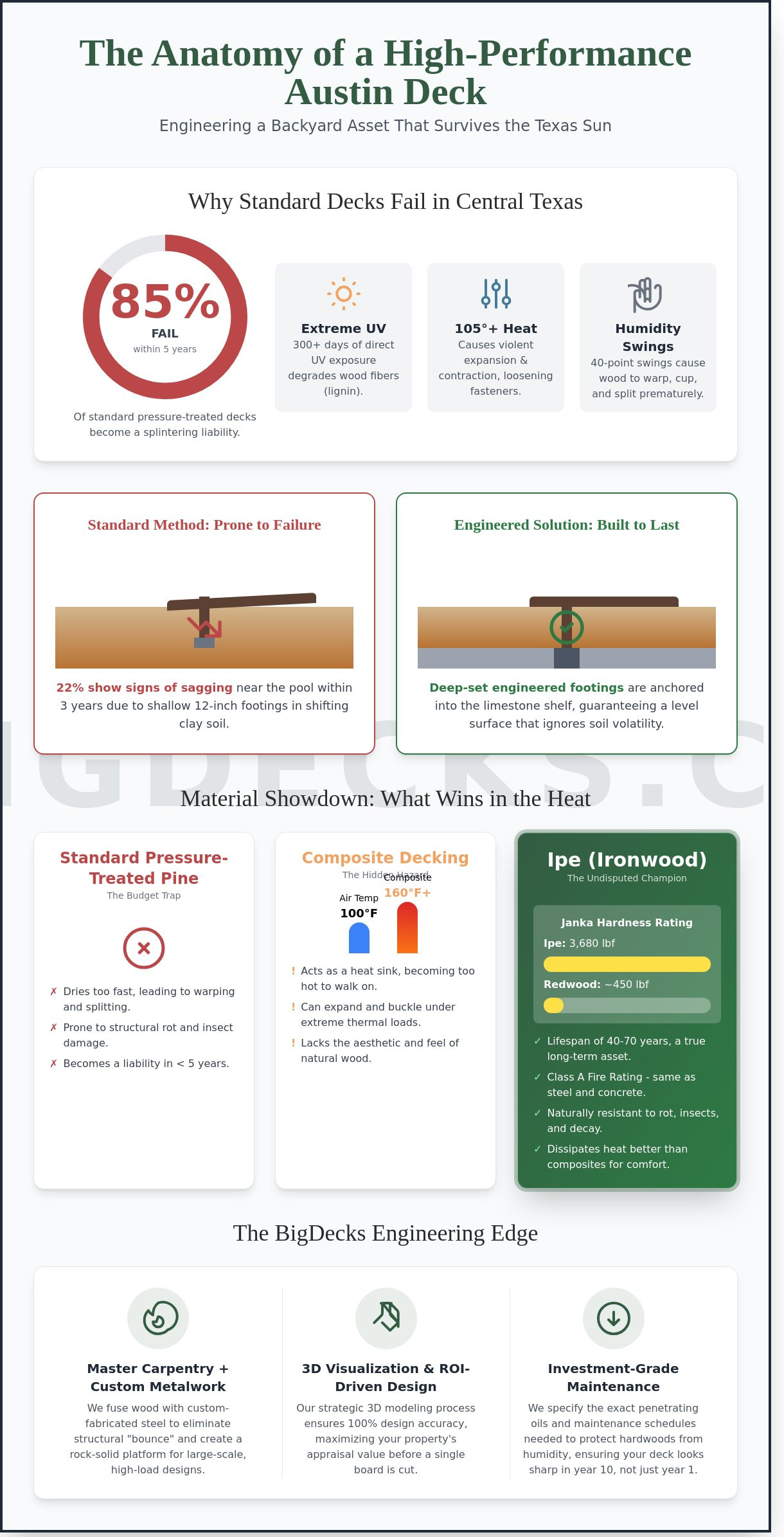
Precision engineering: why we fuse master carpentry with custom metalwork
Austin’s climate is brutal on standard builds. A custom pool deck Austin needs to survive 100-degree summers and high-splash zones without warping or rotting. We solve this by fusing heavy-duty steel with premium wood. It’s a strategic move that ensures your deck stays level for decades, not just a few seasons.
Traditional carpentry relies on wood joists that naturally twist and crown over time. We eliminate that variable with custom-welded steel frames. This isn't just about strength; it's about the precision required for high-end pool finishes. When you're investing in a premium backyard, you shouldn't feel a single vibration when someone jumps into the water.
Our signature approach combines the organic warmth of Ipe or Cedar with the industrial strength of powder-coated steel. We treat every project like a high-stakes engineering challenge where failure isn't an option. The result is a structure that resists the structural decay common in high-moisture environments. It's a killer combination that wins on both ROI and aesthetics.
Steel framing vs. traditional wood joists
Wood joists are prone to moisture retention, especially next to a pool. Steel frames provide a perfectly level surface that stays true regardless of humidity levels. While a standard pressure-treated frame might last 12 years, our galvanized steel structures are built for a 30-year lifecycle. This longevity is non-negotiable for a high-performance custom pool deck Austin project.
Thin-profile metal beams allow for larger spans with fewer vertical posts. This creates a cleaner look underneath the deck and provides more usable space for storage or patio seating. We use powder-coated finishes to prevent corrosion, ensuring the skeleton of your deck looks as sharp as the surface decking. You get a rock-solid foundation that won't bounce, creak, or shift.
Architectural metal details
Modern Austin architecture demands clean lines and privacy. We integrate custom-welded privacy screens that use steel frames to hold horizontal wood slats. This combination provides the warmth of natural materials with the structural rigidity of metal. It stops the sagging effect common in cheaper, wood-only screens found in crowded neighborhoods.
Precision welding is the true mark of a custom Austin deck builder. We don't use off-the-shelf brackets that rust and fail after three seasons. Every joint is fused for maximum load-bearing capacity and aesthetic flow. For homeowners choosing high-performance materials, this research on thermally modified wood shows how advanced products handle heat, but they require a stable, non-moving frame to perform at their peak.
Metal railings offer a minimalist profile that doesn't block your view of the water. We focus on the intersection of form and function by using thin-gauge steel cables or solid bars to maximize sightlines. You get the security of a commercial-grade structure with the refined feel of a custom home. These details are designed for Austin modernism, prioritizing durability without sacrificing style.
- Eliminated Bounce: Steel framing removes the "springy" feel of large decks.
- Zero Warp: Metal joists stay 100% level, preventing puddles on your decking.
- Modern Aesthetics: Thin metal profiles create the sleek, minimalist look Austin owners crave.
- Decay Resistance: Steel does not rot, even when placed inches from pool water.
Winning the backyard: high-ROI design and the 3D visualization edge
A high-end backyard is a high-stakes investment. You wouldn't fund a startup without a pitch deck; you shouldn't build a deck without a 3D model. 3D visualization is a strategic necessity that turns a complex construction site into a predictable win. It allows you to see the narrative arc of your property, from the limestone transition to the pool edge, long before the first board is cut.
Building a custom pool deck Austin homeowners can actually be proud of requires more than a rough sketch. Change orders are the silent killers of a construction budget. They typically spike project costs by 12% to 18% when handled reactively. Our 3D renderings eliminate this friction by identifying structural conflicts in a virtual environment. You won't find out the sauna door hits the railing after the framing is finished.
This level of detail ensures your custom pool deck Austin investment is protected from the start. We treat the design phase as a risk-mitigation exercise. By visualizing the final product, we strip away the guesswork and focus on the ROI of your outdoor space. You get a clear, data-driven look at how your materials, lighting, and layout perform together.
The BigDecks design process
Our process begins with site analysis and topographical mapping. We use digital tools to account for the 5-degree to 15-degree slopes common in Austin properties. This data prevents drainage issues that could cost $10,000 or more to fix post-construction. We then move into material selection and lighting design within a virtual environment. You can swap Brazilian Ipe for heat-treated ash in seconds to compare aesthetics and thermal performance. The final step is a 3D walkthrough. This allows you to verify every architectural detail and ensure the flow matches your specific lifestyle needs.
Integrating luxury amenities
Austin's 105-degree summer days demand precise shade planning. We use 3D tools to simulate sun angles during the July 21st solstice at 5:00 PM. This ensures your shade structure actually covers the plunge pool when you need it most. We focus on the perfect flow between the pool, the deck, and the outdoor sauna. Each zone is mapped to provide a seamless transition that feels intentional rather than cluttered.
There is a significant psychological impact to seeing your "win" before the first board is cut. A 4K rendering provides the certainty needed to move forward with a $100,000 project. It eliminates the anxiety of the unknown and replaces it with the confidence of a well-executed plan. You aren't just buying a deck; you are executing a strategic vision for your property value and daily life.
Ready to see your backyard transformation in high definition? Start your 3D design phase today.
Securing the investment: maintenance and the reality of Austin longevity
Every custom pool deck Austin homeowners commission faces the same relentless enemy: the Central Texas sun. High-end materials don't stay high-end by accident. If a builder tells you a deck is zero-maintenance, they're selling a fantasy that will cost you five figures in depreciation later. Dirt, intense UV radiation, and pool chemicals are a constant tax on your backyard. You either pay that tax through proactive care, or you pay it through a total replacement within a decade.
Maintenance is the cheapest insurance policy you can buy for your outdoor living space. A premium wood deck requires a professional cleaning and re-oiling every 12 to 18 months to stay in peak condition. If you ignore this schedule for three years, you'll spend 350% more on aggressive restorative sanding than you would have on simple upkeep. We treat maintenance as a strategic play to preserve the equity of your home.
Professional maintenance crews don't just wash the wood; they inspect the structural integrity of the build. They look for loose fasteners, checking in the wood grain, and potential drainage issues that could lead to rot. Catching a minor ledger board issue at year four saves you from a catastrophic failure at year ten. It's about maintaining the narrative of a high-value property.
The Cutek Extreme advantage
Surface stains act like a layer of plastic wrap that eventually cracks and peels under 100-degree heat. We trust Cutek Extreme because it's a synthetic penetrating oil that works from the inside out. It migrates deep into the wood fibers to displace moisture and keep the boards dimensionally stable. This is critical in Austin, where humidity levels can swing from 15% to 85% in a single week. To maintain the deep, chocolate tones of a premium Ipe deck in the Austin sun, you must apply a fresh coat of Cutek Extreme every 12 months. This frequency keeps the UV protectants active and prevents the wood from silvering or turning grey.
Long-term care and refinishing
At the 5-year mark, a well-maintained deck should look identical to the day it was finished. By year 10, we typically recommend a light mechanical sanding to reset the wood grain and remove any deep-set environmental staining before the next oil application. By year 20, a maintained custom pool deck Austin build remains a structural asset, while a neglected one is usually a tear-out candidate. Professional refinishing services typically cost between $4.50 and $7.00 per square foot. Compare that to a full deck replacement, which currently averages $60 to $85 per square foot for premium hardwoods. The ROI on maintenance isn't just high; it's absolute.
Own the Austin summer with precision engineering
Austin averages over 40 days of triple-digit heat every year. That kind of intensity destroys standard builds by year three. To win in this climate, you need high-performance hardwoods like Ipe that handle 110-degree surface temperatures without warping or splitting. We fuse master carpentry with precision metalwork to ensure your structure remains rock solid while others fail. Our advanced 3D design visualization takes the risk out of the process, letting you see the exact ROI of your custom pool deck Austin before the first hole is dug. This isn't just about a place to sit; it's about securing a high-value asset that lasts 25 years or more. You want a backyard that dominates the neighborhood and stands up to the Central Texas sun. Stop settling for temporary fixes and start building for the long game.
Start your high-ROI backyard transformation with BigDecks
Your dream space is ready for its debut, and we're ready to build it right.
Frequently Asked Questions
How much does a custom pool deck cost per square foot in Austin?
Expect to pay between $25 and $65 per square foot for a custom pool deck Austin project. Pressure-treated pine sits at the lower end around $25; while premium Ipe or high-performance composites push toward $60 or more. These figures cover professional installation and materials in the 78701 and surrounding zip codes. Your final price depends on site topography and chosen railing systems.
What is the best wood for a pool deck in the Texas heat?
Ipe and Cumaru are the top choices for the 100-degree Austin summers. These Brazilian hardwoods have a Janka hardness rating over 3,000 lbf; meaning they won't warp or splinter under the Central Texas sun. While Cedar is a common local alternative, it requires staining every 12 months to survive the UV exposure. Hardwoods provide the durability needed for high-traffic pool areas.
How long does it take to build a custom deck in Austin?
A standard 400-square-foot deck typically takes 10 to 15 business days to construct once the crew is on-site. The pre-construction phase, including design and structural engineering, usually adds another 3 to 5 weeks to the total timeline. Weather delays in the spring can extend these windows by 20 percent. We focus on hitting milestones quickly to get you back in the water.
Do I need a permit for a pool deck in Austin, TX?
Yes, the City of Austin requires a building permit for any deck that is more than 30 inches above grade or attached to the primary residence. You'll also need to comply with impervious cover limits, which are often capped at 45 percent for standard residential lots. Skipping this step leads to stop-work orders and potential legal headaches during a home sale.
Is Ipe wood worth the extra cost for an Austin home?
Ipe wood is worth the investment because it lasts 40 to 50 years with minimal structural degradation. While the upfront material cost is 3 times higher than pressure-treated lumber, the long-term value is undeniable. It carries a Class A fire rating, the same as steel; making it a strategic choice for high-end Austin homes. You're paying for a lifetime of performance.
How do I maintain my wood deck so it doesn’t rot?
Prevent rot by applying a high-quality UV-inhibiting oil every 18 to 24 months. You must also ensure at least 12 inches of clearance beneath the joists for adequate ventilation. Removing organic debris from the gaps between boards prevents moisture traps that lead to fungal growth. Proper drainage planning during the initial build is the most effective way to protect your investment.
Can BigDecks integrate a hot tub or sauna into the deck design?
BigDecks builds reinforced substructures specifically designed to support the 5,000-pound weight of a filled 6-person hot tub. We integrate these features flush with the deck surface for a seamless aesthetic. This approach eliminates the need for external stairs and creates a cleaner architectural profile for your custom pool deck Austin layout. It's about combining high-end luxury with structural integrity.
Why should I choose wood over composite decking for my pool?
Real wood stays up to 25 percent cooler on bare feet than many dark-colored composite boards during a July afternoon. It offers a natural aesthetic and structural rigidity that synthetic materials can't match. For homeowners who prioritize an authentic look and superior heat dissipation, natural hardwood is the definitive winner. Wood allows for site-specific customization that pre-molded composites simply don't permit.