

How to waterproof a wood deck in Austin: The professional guide to wood longevity
Learn how to waterproof a wood deck in Austin for 20+ years. Ditch peeling sealers and use pro-grade penetrating oils to protect your investment from Texas h...
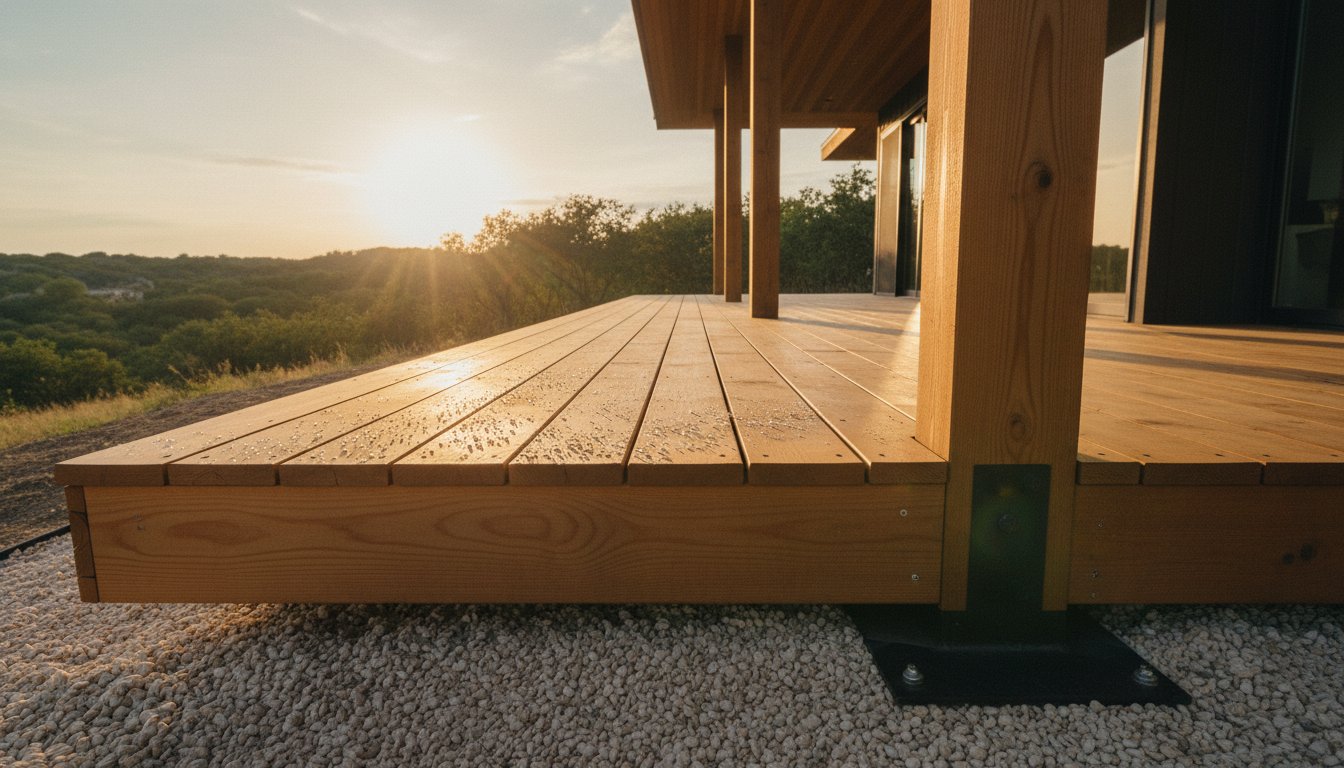
Most homeowners treat deck maintenance like a recurring tax they're forced to pay every twelve months. You've likely seen the results of standard big-box sealers; they peel like a bad sunburn and leave your Western Red Cedar looking like scrap lumber within two seasons. Central Texas is brutal on organic materials. Learning how to waterproof a wood deck correctly is the difference between a structural asset and a constant maintenance liability.
You deserve a deck that maintains its architectural integrity and clean lines for decades without an annual labor-intensive overhaul. We build with heavy 4x12 Douglas Fir and 6x6 posts because we understand how to protect the investment from the inside out. This guide details the specific materials and penetrating oils required to beat the heat and keep your wood stable.
You'll learn why Cutek Extreme is the only finish we recommend for professional results. We'll also cover the architectural details, from steel bases to moisture-shedding framing, that ensure your deck remains clean and functional for twenty years or more.
Key Takeaways
- Stop using film-forming stains that peel and trap moisture in the extreme Central Texas heat.
- Master how to waterproof a wood deck using high-performance penetrating oils that travel deep into the grain to displace moisture.
- Learn the critical preparation steps and why you must never apply oil finishes in the direct 100-degree sun.
- Protect your investment with "heavy build" engineering, including 6x6 posts on steel bases to eliminate ground-level rot.
Why standard deck sealers fail in Central Texas
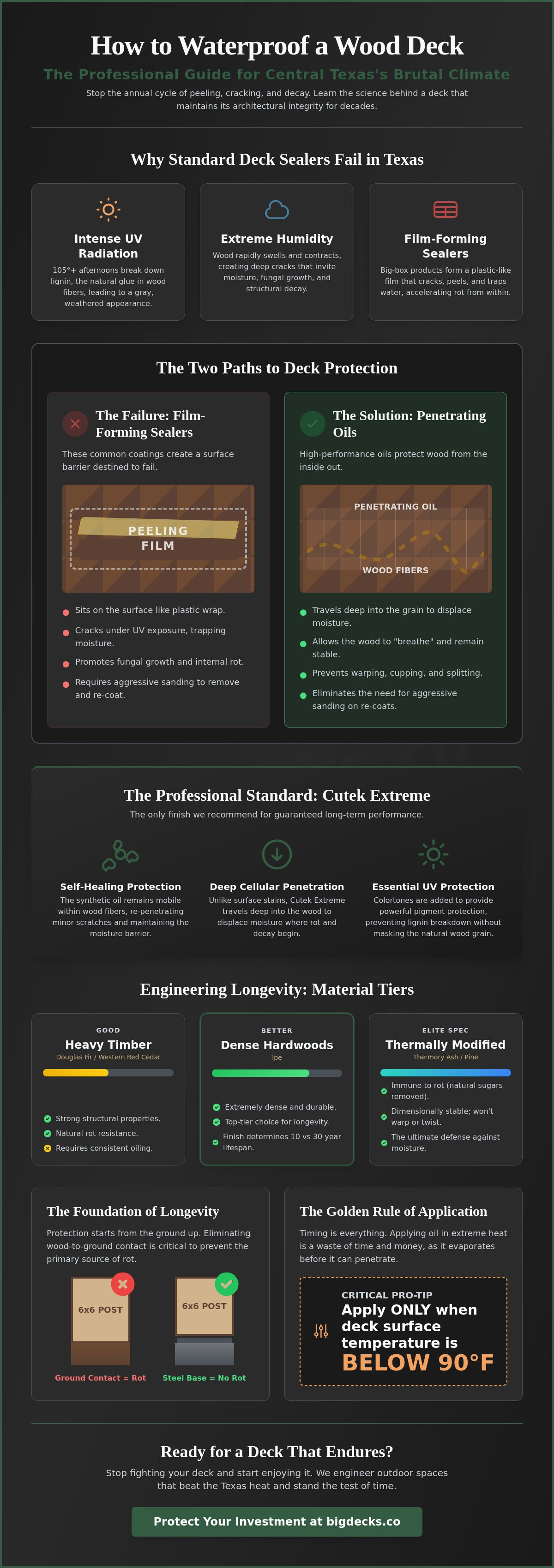
Austin’s climate is a specialized torture chamber for timber. You deal with 105-degree afternoons followed by 90% humidity and sudden flash floods. Standard big-box sealers aren't built for this intensity. They rely on film-forming resins that sit on the surface like cheap plastic wrap. When the sun hits, that film cracks. When the rain follows, water gets trapped underneath. You end up with a peeling, grey liability that looks like a failure instead of a high-value asset.
Learning how to waterproof a wood deck in Central Texas requires a shift in perspective. It isn't about creating a static, plastic seal. It's about managing how the wood interacts with its environment. If you treat high-end materials like Western Red Cedar or thermally modified ash as if they were inanimate plastic, you've already lost the game. When your luxury deck starts to peel within twelve months, the psychological cost is high. It stops being a place of relaxation and starts looking like a maintenance nightmare.
The science of wood cell collapse
UV radiation is the primary aggressor in Travis County. High-intensity rays break down lignin, which is the natural polymer acting as the glue for wood fibers. Once the lignin fails, the fibers detach and wash away. This process accelerates during the brutal expansion and contraction cycle of 100-degree days. Wood swells in the humidity and shrinks in the heat; this mechanical stress creates deep cracks that invite structural decay.
Waterproofing vs. moisture regulation
Professional wood finishing prioritizes breathability over total blockage. Wood is a cellular material that must move moisture in and out to remain stable. If you apply a non-breathable surface coating, you trap liquid water inside the grain. This creates a greenhouse effect for fungal growth and internal rot. When researching how to waterproof a wood deck, the goal is moisture regulation. We only use Cutek Extreme because it penetrates deep into the wood cells. It stays active inside the timber, displacing moisture while allowing the wood to breathe, which prevents the warping and splitting common with inferior products.
Selecting materials and high-performance penetrating oils
Success in how to waterproof a wood deck starts with material selection. You can't rely on a surface film to fight the Texas sun. BigDecks builds with heavy 4x12 Douglas Fir and Western Red Cedar because they handle structural loads and moisture differently than cheap box-store lumber. Ipe remains a top-tier choice for density; however, the finish you apply determines if that investment lasts ten years or thirty. We skip the hardware store sealers and focus on high-performance chemistry that actually integrates with the wood fibers.
Why Cutek Extreme is the professional standard
Cutek Extreme is a high-performance synthetic oil that protects wood from the inside out. Unlike rigid stains that sit on top and eventually peel, this oil travels deep into the grain to displace moisture at the cellular level. This creates a self-healing effect; as the wood expands and contracts in the Austin humidity, the oil remains mobile within the fibers to maintain protection. For our intense UV index, we use Colortones to provide essential pigment protection without masking the natural grain. Research from the USDA Forest Products Laboratory in their guide on Finishes for Wood Decks confirms that penetrating finishes outperform film-forming coatings in high-exposure environments. We exclusively recommend this system because it eliminates the need for aggressive sanding during maintenance cycles.
Thermally modified wood: the ultimate moisture defense
Thermally modified wood like Thermory Ash or Pine changes the durability equation for Central Texas. The process involves heating the timber to over 400 degrees Fahrenheit in a specialized kiln, which removes natural sugars and moisture. This makes the wood "dead" to the elements; it won't rot because the food source for fungi is gone. It stays dimensionally stable even during a flash flood or a triple-digit August heatwave. We often specify these materials when engineering architectural value for 2026 and beyond. If you want a deck that won't warp, twist, or cup, this is the elite spec. We can help you review material performance data to see which species fits your project's specific solar exposure.
The professional process for applying Cutek Extreme
Austin heat kills decks. Applying oil in 100-degree direct sun is a waste of capital. The wood surface gets too hot, causing the oil to flash off before it can penetrate the grain. Aim for a window where the surface temperature stays below 90 degrees. This ensures the oil moves deep into the fibers. It's the only way to master how to waterproof a wood deck for the long haul.
Preparing the canvas: Sanding and cleaning
Preparation is 90 percent of the result. New lumber arrives with mill glaze; this is a crushed layer of fibers from the sawmill that blocks absorption. You must sand this off. Stick to 60-80 grit sandpaper. If you go higher, you polish the wood and seal the pores. The USDA guide to finishing exterior wood confirms that surface prep dictates finish lifespan. Clean the wood, sand it right, and let it dry completely before the first drop of oil touches the surface.
Application and maintenance cycles
We use 24ft+ continuous boards to eliminate weak points and create clean lines. To avoid lap marks on these long runs, apply Cutek Extreme along the entire length of the board without stopping. Use a wet on wet technique. Apply the first coat, wait for it to migrate into the wood, and apply the second while the grain is still receptive. This maximizes the oil load deep inside the timber.
Austin humidity is unpredictable. Don't trust the clock for drying times. Use the walk-on test. If the wood feels tacky or leaves a footprint, it isn't ready. Once it's bone dry, your deck is protected. Establish a maintenance cycle every 12 to 18 months. This schedule prevents the need for aggressive chemical stripping in the future. Check our guide on how much it costs to build a deck in Austin to see how professional finishing protects your long-term investment.
Ready to build a deck that stands up to the Texas sun? Let’s discuss your material and finish options.
Engineering for drainage and structural protection
BigDecks builds with a heavy build philosophy. We don't use flimsy materials that flex and sag over time. We use oversized framing to eliminate the structural dips where water pools and rot begins. When you are evaluating how to waterproof a wood deck, the physical engineering matters as much as the chemical seal. A rigid, over-engineered frame ensures water sheds off the surface instead of sitting in low spots.
Our 6x6 posts on elevated steel bases are non-negotiable. This setup creates a permanent break between the wood and ground-level moisture, preventing the end grain from wicking up water like a straw. We also enforce strict board spacing standards. Wood needs to breathe to survive. Proper gaps allow debris to fall through and air to circulate, drying the underside of the boards and the joists after a heavy Austin downpour.
The hidden heroes of our builds are joist tape and custom flashings. We apply high-performance tape to the top of every joist before the decking goes down. This creates a waterproof barrier that prevents moisture from trapped between the boards and the frame. It's a critical step in how to waterproof a wood deck for the long haul, protecting the skeleton of your investment from the inside out.
Architectural details that prevent rot
We utilize 4x12 Douglas Fir for its massive structural integrity and clean, architectural lines. These heavy members provide the visual mass required for high-end design while resisting the warping common in smaller lumber. We pair this wood with precision metalwork. Steel bases keep the primary posts 1 to 2 inches off the concrete, ensuring zero contact with standing water. This design-led approach treats moisture defense as an integrated feature rather than an afterthought.
The ROI of professional deck maintenance
Maintenance is a calculated financial move. Annual oiling with Cutek Extreme costs a small fraction of a full deck replacement. Without professional care, most decks in Central Texas require a total rebuild every 10 to 12 years. By maintaining the wood's cell structure, you extend that lifecycle to 25 years or more. A pristine deck is a strategic asset for your home valuation, turning a potential liability into a major selling point. It is the difference between a depreciating structure and a high-performance outdoor space.
Schedule a professional deck inspection with BigDecks to secure your structure's future.
Mastering Central Texas wood longevity
Austin's climate is brutal on timber. Standard film-forming sealers will fail because they cannot handle the rapid expansion and contraction caused by our intense heat and humidity. Understanding how to waterproof a wood deck correctly means moving away from hardware store products and toward high-performance penetrating oils like Cutek Extreme. This is the only finish we recommend because it protects the wood from the inside out, ensuring 4x12 Douglas Fir and Western Red Cedar boards remain stable for decades.
Success requires more than just a good oil. It demands architectural precision, including 6x6 posts on steel bases and oversized framing engineered for maximum drainage. Our Austin-based team focuses on high-performance builds using thermally modified wood and architectural timber. We prioritize clean lines and honest materials that stand up to the sun without compromising on structural integrity. If you're tired of temporary fixes, it's time to build for the long game.
Ready to protect your investment? Let’s talk about your deck design and maintenance.
Your deck should be a permanent asset, not a recurring maintenance headache.
Frequently asked questions
How often should I waterproof my wood deck in Austin?
You should apply a maintenance coat of Cutek Extreme every 12 to 24 months to combat the intense Central Texas sun. Austin's UV index frequently reaches 10 or higher during the summer months, which aggressively breaks down wood lignin. Refreshing the oil every two years ensures the wood remains hydrophobic and structurally sound.
Can I apply Cutek Extreme over an old deck stain?
You cannot apply Cutek Extreme over an existing film-forming stain or paint. This penetrating oil requires an open wood grain to soak into the timber; old sealers act as a barrier that prevents absorption. You must strip the old finish back to raw wood using a professional stripper or mechanical sanding before you begin the process of how to waterproof a wood deck effectively.
Is thermally modified wood really waterproof?
Thermally modified ash is highly resistant to rot and moisture, but it is not completely waterproof. The thermal modification process cooks out the sugars that attract fungi, yet the wood remains a natural material that can grey and check over time. We use Cutek Extreme on modified timber to stabilize the moisture content and preserve the deep, architectural aesthetic of the wood.
What happens if I don't seal my cedar deck in the Texas heat?
Unsealed Western Red Cedar will begin to grey and develop surface cracks within 12 months of exposure to the Texas climate. The heat forces natural oils to evaporate, leading to cupping, warping, and checking in 6x6 posts and 4x12 framing. Proper sealing is the only way to protect your investment from the structural fatigue caused by rapid moisture cycles.
Do I need to waterproof the underside of my second-story deck?
You must coat all six sides of your decking boards to prevent the wood from cupping. If you only seal the top surface, the underside will absorb moisture at a different rate, creating internal tension that twists the boards. For second-story decks, treating the underside also ensures a clean, uniform look for the area below the structure.
Thermally Modified Wood: The Austin Homeowner’s Guide to Durable Decking
Tired of warped decks in Austin? Our guide to thermally modified wood shows how to get a durable, low-maintenance deck that survives the intense Texas heat.
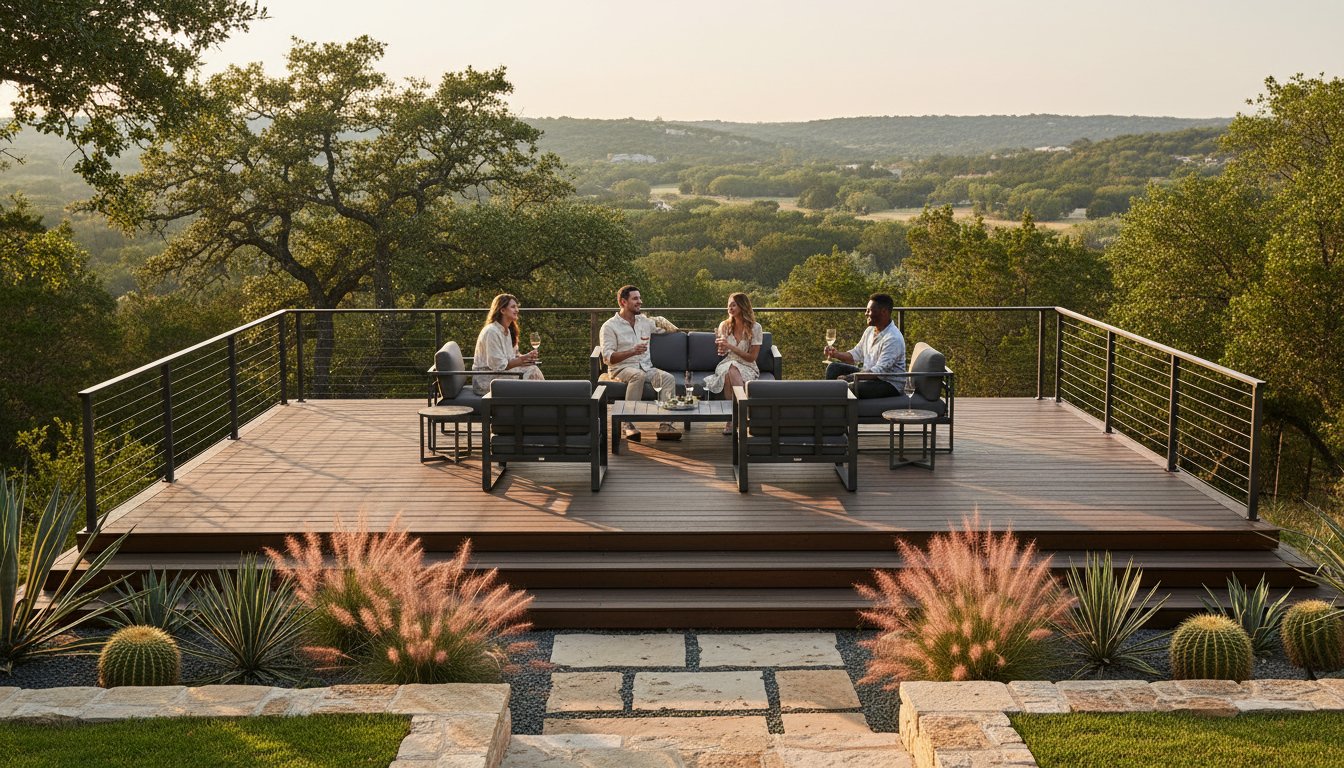
Your neighbor’s cedar deck is already a warped, splintered mess, and it hasn't even seen its third Austin summer. It’s a predictable failure. Traditional lumber isn't built to survive 105 degree afternoons followed by a Central Texas humidity spike. You deserve a better ROI than a structure that looks like a roller coaster after 24 months. This is why thermally modified wood is the strategic choice for homeowners who want the soul of real timber without the maintenance nightmare of softwoods.
We know you’re tired of the plastic look of composite but hate the thought of watching real timber warp in the heat. This guide proves you can have a 25 year lifespan and the elite aesthetic of high end hardwoods without the soul crushing maintenance. You’ll see how this heat treated lumber resists rot, stays dimensionally stable during humidity swings, and remains significantly cooler underfoot than synthetic alternatives. We’re stripping away the fluff to explain the costs, the science, and why this is the smartest play for a premium Austin deck.
Key Takeaways
- Understand why Austin’s extreme UV exposure destroys standard pressure-treated pine and how to choose a material that resists rot and silvering.
- Explore the science of thermally modified wood to see how a chemical-free, high-heat process creates a molecularly stable and durable deck board.
- Compare the long-term maintenance costs and installation advantages of modified timber against traditional luxury options like Ipe and Cedar.
- Identify the best high-performance applications for your project, including sag-resistant horizontal fencing and deck surfaces that stay cool under the Texas sun.
- Learn how a design-build approach with 3D modeling ensures your material selection maximizes both architectural beauty and property ROI.
Why Austin Climate Demands Thermally Modified Wood
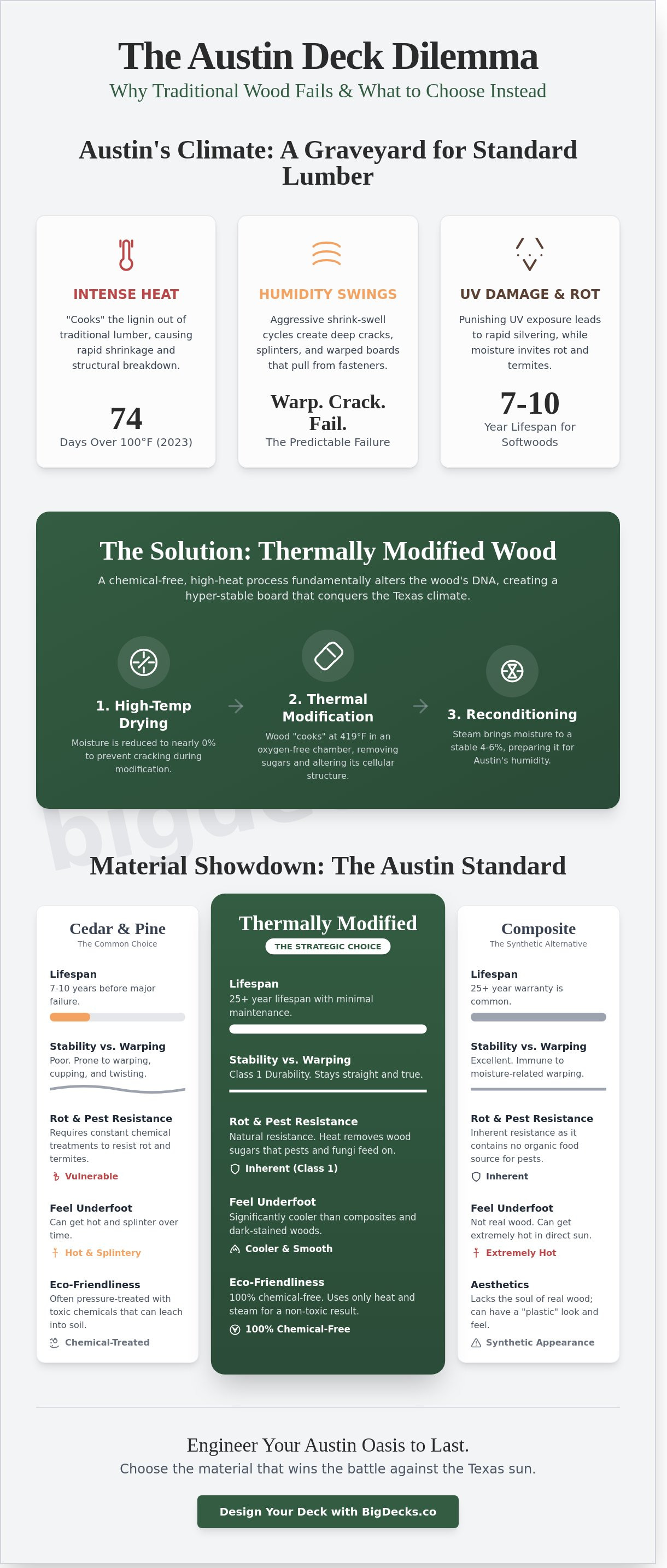
Austin's climate is a graveyard for standard softwoods. Pressure-treated pine and untreated cedar often fail within 7 to 10 years because they cannot survive the 40-degree temperature swings and punishing UV index. Central Texas sees an average of 25 days over 100 degrees annually; this heat literally cooks the lignin out of traditional lumber. This process leads to rapid silvering and structural breakdown that turns a premium investment into a liability. Thermally modified wood offers a "set it and forget it" stability that traditional materials simply cannot provide.
The Austin Heat Stress Factor
In 2023, Austin recorded 74 days with temperatures hitting triple digits. This intense heat bakes moisture out of standard boards, causing them to shrink rapidly and lose structural integrity. When the inevitable flash floods arrive, the wood swells just as fast. This aggressive shrink-swell cycle creates deep structural cracks and warped boards that pull away from their fasteners. Because thermally modified wood is processed at temperatures reaching 419 degrees Fahrenheit, its moisture content remains consistently low, usually between 4% and 6%. This dimensional stability ensures your high-end architectural lines stay straight through every drought cycle.
Rot and Pest Resistance in Central Texas
Standard lumber relies on toxic chemical injections to ward off termites and rot. Thermally modified wood uses a high-heat steam process to remove hemicellulose, which are the natural sugars that Austin pests crave. Without these sugars, the wood is no longer a viable food source for wood-boring insects or rot-inducing fungi. This material achieves Class 1 durability, the highest rating available in the industry. It means your deck can last 25 years or more without the rot issues common in Douglas Fir or local cedar. Consider these performance advantages:
- Class 1 Durability: Rated for a 25 plus year lifespan in outdoor conditions.
- Sugar-Free: Heat treatment removes the biological food source for termites.
- Zero Toxins: Safe for bare feet and pets without chemical leaching.
Choosing the right material is about managing the ROI of your outdoor space. While cedar might look good on day one, it requires constant staining to fight the silvering caused by Austin's UV exposure. Thermally modified options provide a consistent, dark aesthetic that ages gracefully and holds its shape. You get a deck that performs like a strategic asset rather than a maintenance project. It is the professional choice for homeowners who want to win the battle against the Texas sun.
The Science of Thermal Modification: More Than Just Baking
Thermal modification isn't a surface-level treatment or a chemical soak. It is a fundamental shift in the wood's DNA. By using only high heat and steam, we move beyond traditional lumber limits to create a product that handles the brutal Austin sun without flinching. The process requires temperatures exceeding 375°F, which effectively "cooks" the sugars and compounds out of the cells. This leaves behind a material that is hydrophobic; it practically refuses to absorb water, making it immune to the typical expansion and contraction that destroys standard decks.
The result is a board that is dark, rich, and chocolate brown all the way through to the core. You won't find any green chemical tints or superficial stains here. Because the cellular structure is permanently altered at a molecular level, the wood becomes dimensionally stable. It stays flat, straight, and resists rot because the nutrients that fungi and insects usually feed on have been carbonized. It is a clean, non-toxic solution for homeowners who want the performance of tropical hardwoods without the environmental guilt.
The Three Stages of Modification
The transition to thermally modified wood happens in three distinct, controlled phases. First, high-temperature kiln drying strips the wood of its moisture until it reaches nearly 0%. This prep work ensures the wood won't crack during the intense heat of the second stage. Next, the wood "cooks" in an oxygen-free environment to prevent combustion. This is where the chemical-free transformation occurs, altering the hemicellulose. Finally, the wood undergoes controlled cooling and reconditioning. We introduce steam to bring the moisture content back to a stable 4% to 7%, ensuring the final product is ready for the humidity swings of Central Texas.
Species Matters: Ash vs. Pine vs. Radiata
Not all species react the same way to the kiln. Selecting the right wood depends on your specific goals for durability and aesthetics. Thermally modified Ash is often called the "Ipe killer" because it offers incredible hardness and a sophisticated grain pattern that rivals expensive imports. It carries a Class 1 durability rating, meaning it's built to last 25 years or more in direct ground contact scenarios. If you are looking for a high-end finish that can take a beating, ash is the clear winner.
For those prioritizing value, modified Pine is a cost-effective entry point. It outperforms standard cedar in every metric, especially regarding rot resistance and stability. However, many Austin homeowners are moving toward Radiata Pine for its clear, knot-free appearance. It provides a sleek, modern look that fits perfectly with contemporary architectural designs. If you are still weighing these options, you can view our material comparison guide to see how these species perform in real-world builds. Each species offers a unique balance of cost and character, but all benefit from the same high-heat science that makes them Austin-ready.
Thermally Modified Wood vs. The Austin Standards
Austin deck builds usually default to three traditional materials: Cedar, Ipe, or Composite. Each choice carries a specific trade-off that often catches homeowners off guard after the first three summers. Cedar rots without constant intervention; Ipe is a logistical nightmare to install; and Composite retains enough heat to cause discomfort in July. Thermally modified wood bridges these gaps by offering the structural stability of a tropical hardwood with the thermal performance of a natural timber.
Ipe is often praised for its 50 year lifespan, but it's an environmental burden that destroys expensive carbide saw blades during construction. Thermory ash provides comparable durability without the 5,000 mile shipping route from the Amazon. It weighs roughly 35% less than Ipe. This weight reduction translates to faster installation times and lower labor costs for the homeowner. BigDecks views this material as the strategic middle ground for luxury builds because it delivers the prestige of real wood without the high-stress maintenance of softwoods.
Composite decking relies on petroleum-based resins that act as heat sinks. On a 105 degree Austin afternoon, composite surface temperatures can peak at 160 degrees, making it impossible to walk on barefoot. Natural wood remains significantly cooler. Because the modification process removes the sugars that absorb moisture, the boards don't warp or cup like standard lumber. You get the organic feel of a high-end outdoor living space without the plastic aesthetic or the scorching surface temperatures.
The cost-benefit analysis for homeowners
A Cedar deck might save you $6,000 on the initial quote, but that "saving" disappears by the seventh year. Professional staining and sealing in Central Texas costs approximately $3.50 per square foot every two years. Over a 15 year period, the cumulative maintenance spend on Cedar often exceeds the total price of a premium thermally modified wood installation. Homeowners can choose to re-oil the wood to keep its deep chocolate hue or let it weather to a sophisticated silver-gray. Either way, the structural integrity remains intact without the constant need for chemical sealants.
Sustainability and the eco-conscious build
Most exotic hardwoods are harvested from sensitive ecosystems where tracking legal sourcing is difficult. In contrast, modified woods utilize domestic, sustainably managed forests. The modification process uses only high heat and steam, meaning zero toxic chemicals are injected into the lumber. This makes the boards 100% biodegradable at the end of their life cycle. It also ensures that no harmful runoff enters Austin's local groundwater or the Edwards Aquifer during heavy rain cycles. It's a clean, high-performance solution that respects the local environment.
Best Applications for Your Austin Backyard Project
Austin's climate eats standard building materials for breakfast. You need a material that handles 105-degree August afternoons and sudden flash floods without flinching. Thermally modified wood provides the structural stability required for high-performance applications, moving beyond simple flooring to become a versatile tool for total outdoor transformations.
Designing the Modern Horizontal Fence
Horizontal fences are the gold standard for modern Austin curb appeal, but they often suffer from a fatal flaw: sagging. Standard cedar or pressure-treated boards eventually bow under their own weight, which ruins the clean lines of a contemporary design. Thermally modified wood is the secret weapon for these projects because the heat-treatment process removes the moisture and sugars that cause timber to warp or twist.
We recommend pairing these ultra-straight boards with custom black powder-coated steel posts for a high-contrast, industrial look. This combination ensures your privacy screen stays perfectly aligned for decades. If you are planning a perimeter upgrade, explore our guide on horizontal fences to see how these materials create a true privacy fortress. It is about building a structure that looks as sharp in year ten as it does on day one.
Poolside Decks and Water Features
Concrete and limestone pool surrounds are notorious heat magnets that scorch bare feet by noon. Thermory decking remains significantly cooler than stone or composite alternatives, often staying 20 to 30 degrees lower in surface temperature during peak sun exposure. Its hydrophobic nature means it does not soak up pool chemicals or water, which prevents the rot and cupping common in traditional wood decks.
Many Austin homeowners are now integrating outdoor saunas and cold plunges into their backyard layouts. This timber thrives in these high-moisture environments. You get a splinter-free surface that resists mold growth, even when it is constantly exposed to splashes and steam. It creates a cohesive design play that connects your pool, deck, and wellness features into one high-end narrative.
Architectural Cladding and Accents
The utility of this material extends to the walls of your home. Using thermally modified wood for architectural cladding provides a modern facelift that rivals the look of expensive tropical hardwoods like Ipe. It functions as a durable rainscreen, protecting your home’s exterior while adding organic warmth to cold materials like glass and steel. It is a strategic move for homeowners looking to increase property value through high-end, low-maintenance aesthetics.
Ready to see these materials in action? Browse our latest Austin project gallery to find inspiration for your next build.
Engineering Your Austin Oasis with BigDecks
We don’t just build decks. We engineer architectural value for Austin property owners who treat their homes as high-yield assets. A deck should be a definitive statement of quality, not a maintenance liability that drags down your appraisal. By utilizing thermally modified wood, we provide a material that survives the Central Texas heat while maintaining the soul of real timber. Our team bridges the gap between traditional carpentry and precision metalwork, ensuring every joint is tight and every structural element is over-engineered for longevity.
We stripped away the plastic and the fluff long ago. Our commitment is to premium, organic materials that perform under pressure. This isn't about following trends; it's about building a permanent outdoor solution that complements the sophisticated architecture found in Austin's most competitive neighborhoods. We focus on results that look as good in year ten as they do on day one.
Visualizing Your Project in 3D
Our design process eliminates the guesswork of high-end construction. We use advanced rendering tools to capture the specific aesthetic of thermally modified species, allowing you to see the deep, toasted tones before we cut a single board. This isn't just a visual aid; it is a strategic planning tool. We simulate the natural graying process so you can decide exactly how your deck will evolve over the next decade. By placing materials strategically, we maximize your ROI and minimize future upkeep costs, ensuring the design remains as functional as it is stunning.
Ready to Upgrade Your Backyard Strategy?
The era of temporary wood decks is over. Austin homeowners are moving toward permanent solutions that offer a 30-year lifecycle and zero structural compromise. Our custom deck services serve as the starting point for this transition. We focus on the major milestones of your property's lifecycle, delivering a finished product that wins the room every time. Stop settling for standard builds and start investing in a space that reflects your standards. Schedule your Austin design consultation with BigDecks to see how we can transform your backyard into a high-performance architectural asset.
Own the Backyard You Deserve
Austin’s heat doesn't negotiate with standard lumber. Choosing thermally modified wood means you're investing in a material that's been engineered at 400 degrees to resist rot and warping for decades. It's the difference between a deck that looks tired in five years and one that carries a 30 year warranty on Thermory products. You aren't just buying boards; you're securing a high performance asset that survives the Texas sun without the constant maintenance cycle of traditional pine.
Our team handles the heavy lifting of precision craftsmanship right here in Austin. We don't guess on the final outcome. We use expert 3D visualization to show you exactly how your project looks and functions before the first board is even cut. You get a strategic partner focused on durability and high level design. It's time to stop settling for temporary fixes and build something that stands the test of time.
Build a deck that actually lasts-get your BigDecks quote
Your backyard is ready for a serious upgrade that pays off every single summer.
Frequently Asked Questions
Does thermally modified wood require any maintenance in the Texas sun?
Thermally modified wood needs a UV-inhibiting oil application every 12 to 18 months if you want to retain its original dark brown color. The Austin sun delivers high UV loads that bleach natural timber quickly. If you don't apply a finish like Cutek Extreme, the boards will transition to a silver patina, though the wood remains structurally sound and resistant to rot.
Is thermally modified wood as strong as Ipe or other hardwoods?
Ipe is denser with a Janka hardness rating over 3,500 lbf, but thermally modified wood wins on dimensional stability. Thermory Ash typically tests around 1,300 lbf, which is plenty of strength for high-traffic residential decks. It doesn't have the internal tension found in tropical hardwoods, meaning your boards won't cup, twist, or warp when the Texas humidity spikes to 90%.
Can I leave thermally modified wood to turn gray naturally?
You can leave the wood to weather naturally without voiding the 30-year warranty or risking structural failure. This silvering process usually takes 6 to 12 months depending on how much direct sunlight your deck receives. Many homeowners in Central Texas choose this route because it eliminates the need for biennial staining while providing a clean, modern aesthetic that fits the local landscape.
Is thermally modified wood more expensive than cedar in Austin?
Expect to pay about 60% to 80% more for thermally modified wood than you would for premium Western Red Cedar. While cedar might cost $5 per linear foot, Thermory Ash often sits between $9 and $12 per linear foot in the Austin market. The higher upfront cost is a strategic play for longevity, as this material is rated to last 30 years compared to the 15-year average lifespan of cedar.
How long does a thermally modified wood deck last?
A thermally modified wood deck is engineered to last 25 to 30 years even in harsh climates. The modification process uses heat over 400 degrees Fahrenheit to remove the sugars and moisture that lead to decay. This results in a Class 1 durability rating, which is the highest possible standard for timber longevity and performance in outdoor environments.
Is thermally modified wood resistant to termites in Central Texas?
Termites and other wood-boring insects generally avoid this material because the thermal process destroys the nutrients they need to survive. By cooking out the hemicellulose and natural starches, the wood becomes an invisible food source for pests. You get the benefit of a 100% natural product that doesn't require the toxic chemical injections found in standard pressure-treated lumber.