

Privacy Screen for the Deck: Austin Design & Material Guide
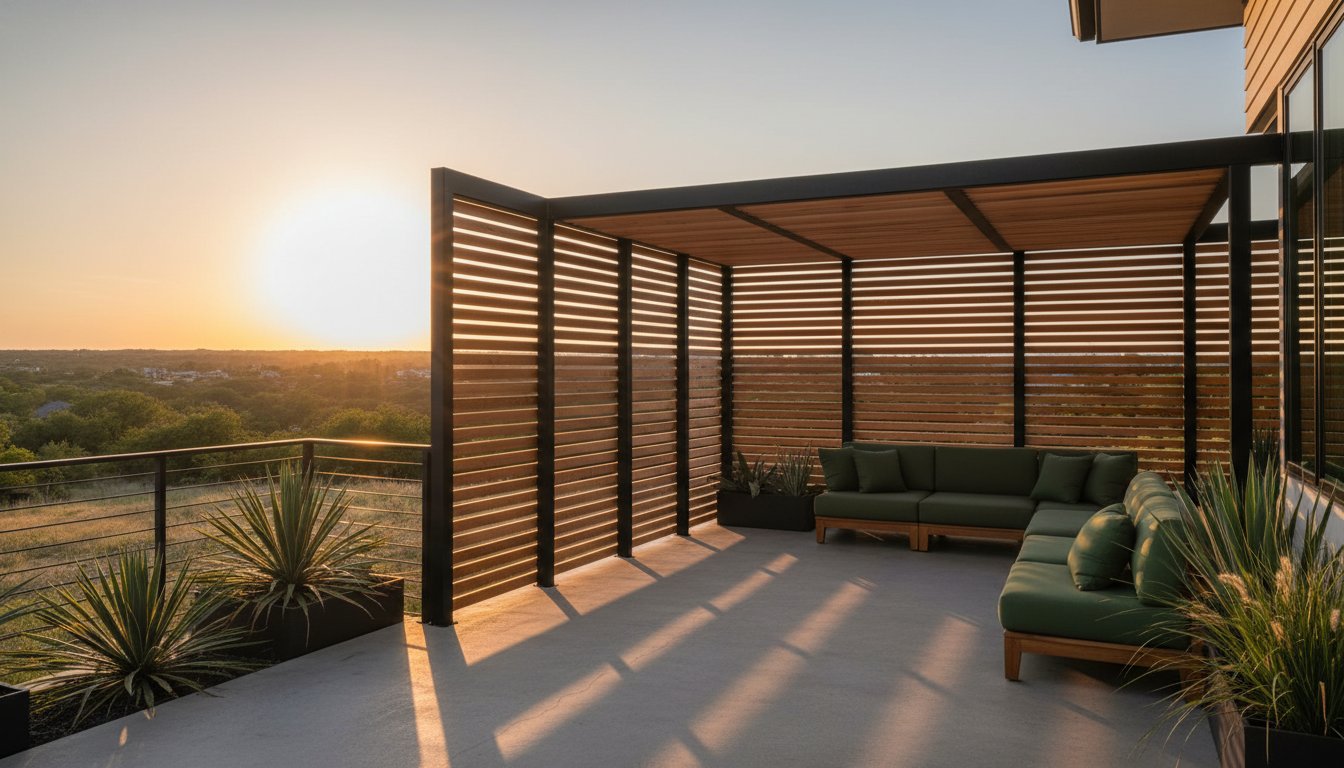
Why spend $75,000 on a custom outdoor living space only to feel like you're performing on a public stage? You want to enjoy a quiet evening without making accidental eye contact with the neighbors in Austin's dense residential developments. It is frustrating when a premium investment feels exposed, especially when cheap plastic screens warp and fade after a single July in 107-degree heat. Choosing a high-end privacy screen for the deck is about more than just hiding; it's a strategic move to reclaim your peace and maximize your property's ROI.
This guide reveals how to build architectural barriers that thrive in the Central Texas climate while elevating your home's modern aesthetic. We will break down the structural performance of horizontal cedar and powder-coated steel designs that handle the afternoon sun without buckling or losing their finish. You'll learn the exact material specs and design layouts needed to create a secluded oasis that complements modern aesthetics while surviving the harshest Texas summers.
Key Takeaways
- Identify which high-performance materials survive the brutal Texas UV index and why plastic or vinyl options are a liability in the Austin climate.
- Discover why engineering a privacy screen for the deck requires structural metal posts to withstand high-velocity winds and intense summer heat.
- Learn how to move beyond basic "fence-on-a-deck" looks toward integrated architectural designs that maximize your outdoor ROI.
- Understand the strategic placement needed to neutralize the "fishbowl effect" common in modern, high-density Austin residential developments.
- See how a 3D design process eliminates construction anxiety by visualizing how screens integrate with your existing siding and deck structure.
Why your Austin deck needs a strategic privacy screen
A privacy screen for the deck is far more than a decorative afterthought; it's a permanent architectural extension of your home's footprint. In Austin’s high-density residential developments like Mueller or Easton Park, the "fishbowl effect" is a genuine design challenge that limits how homeowners use their outdoor space. A strategic screen provides the visual seclusion necessary for relaxation while doubling as a critical shield against the brutal Texas afternoon sun.
Custom-built solutions outperform off-the-shelf products because they integrate directly into the deck’s substructure. While homeowners often research different types of privacy fences for inspiration, a deck-mounted screen requires specific engineering to handle local wind loads and thermal expansion. Investing in a tailored design ensures the structure complements your home’s aesthetic rather than looking like a DIY weekend project.
The psychology of the private outdoor oasis
Visual boundaries directly dictate how often you actually step outside. Data suggests that homeowners are 40% more likely to use their outdoor spaces daily when they feel shielded from the street and neighboring windows. By defining the perimeter, a privacy screen for the deck creates an intimate "room" feel without the $30,000 overhead of a full roof structure. In the aggressive Austin real estate market, these defined outdoor living zones can boost home resale value by approximately 5% to 8% by increasing the perceived functional square footage.
Seclusion vs. claustrophobia
Successful design is about blocking the view, not the breeze. Finding the right height is a tactical decision: a 6-foot screen typically secures privacy for seated guests, while an 8-foot height is necessary to block sightlines from elevated neighbor decks. To avoid a cramped feeling, use semi-transparent patterns like horizontal cedar slats with 0.5-inch gaps. This specific spacing maintains essential airflow, preventing heat traps and keeping the deck surface up to 15 degrees cooler during July and August. Strategic placement allows you to target specific eyesores or intrusive angles while preserving your own views of the Hill Country or city skyline.
Material showdown: What actually survives the Texas sun
Austin’s UV index regularly hits 11. That’s a death sentence for inferior materials. Most "maintenance-free" options like vinyl or cheap composites fail the thermal stability test in Central Texas. They warp, sag, and lose their structural integrity within 24 months of exposure. BigDecks refuses to install plastic or vinyl privacy screens because we don't build projects that require a do-over in two years.
We focus on materials with high thermal stability. Wood and steel don't just look better; they handle the 40-degree temperature swings common in our region. To keep wood from checking or graying prematurely, we rely on penetrating oils like Cutek Extreme. Unlike surface stains that peel and flake, Cutek works into the grain to provide a moisture barrier from the inside out. It’s a professional-grade solution for a high-end privacy screen for the deck that actually lasts.
Thermally modified wood: The 30-year solution
Thermory is the gold standard for durability. The wood undergoes a heat-treatment process at 400 degrees Fahrenheit in a vacuum. This removes the organic compounds that fungi and bacteria feed on. It’s essentially "cooked" wood that resists rot for up to 30 years. In Austin's humidity, this stability is non-negotiable. It stays straight where standard pressure-treated lumber would twist into a pretzel. Maintenance is simple; a fresh coat of oil every 18 to 24 months keeps the deep chocolate hue intact.
Western Red Cedar and custom metalwork
Western Red Cedar remains the classic choice for a modern privacy screen for the deck. We typically use 1x4 or 1x6 horizontal slats to create a clean, architectural feel. However, wood alone can sag over long spans. We integrate powder-coated steel frames to provide the rigidity a 6-foot tall screen requires. This prevents the "smile" effect seen on cheap DIY builds. For homeowners seeking zero maintenance, laser-cut aluminum panels are a permanent alternative. These panels provide 85% opacity while allowing airflow, which is critical for comfort during a July heatwave. If you are ready to see how these materials fit your space, you can explore our custom deck design options to find the right balance of wood and metal.

Architectural styles that elevate your backyard ROI
Slapping a standard fence on top of a deck kills your home's curb appeal. You need an integrated architectural feature that looks like it was born with the house. Matching your screen's material to your existing siding or perimeter fence creates a cohesive visual narrative. This isn't just about blocking a neighbor's view; it's about strategic asset management. A well-designed privacy screen for the deck can increase the perceived value of your outdoor space by 15% to 20%.
Clean lines are the hallmark of a professional build. We prioritize hidden fasteners because exposed screws rust and distract the eye. A fastener-free surface looks intentional and expensive. This level of detail is critical if you're using the screen as a backdrop for high-end amenities. For instance, outdoor saunas are surging in Austin. A custom screen provides the 100% seclusion required for a recovery zone while acting as a high-contrast frame for a cedar barrel or modern cabin sauna.
Modern horizontal slat designs
Austin lots are shrinking, often falling under 0.2 acres in central neighborhoods. Horizontal lines draw the eye outward, making a tight 15-foot deck feel significantly wider. We recommend 0.5-inch spacing between slats. This gap size maintains 90% visual privacy while allowing 100% of the breeze to pass through. For homeowners wanting more texture, the shadow box technique uses 1.5-inch depth offsets to create shifting shadows that change throughout the day. It turns a flat wall into a 3D architectural statement.
Live walls and integrated greenery
Wood is a solid foundation, but plants add life. Combining a cedar frame with native Texas Star Jasmine creates a living privacy screen for the deck. This isn't just for aesthetics. In July, when Austin temperatures routinely hit 105 degrees, these plants act as natural evaporative coolers. Through transpiration, a dense live wall can drop the immediate air temperature by 5 to 8 degrees. Use a heavy-duty powder-coated steel mesh as a trellis to ensure the structure lasts 15 years or more without sagging under the weight of the vines.
Engineering for the elements: Wind heat and HOA rules
A privacy screen for the deck is more than a visual barrier; it is a 72-inch tall sail caught in a 60-mph Central Texas thunderstorm. If a builder treats a vertical screen like a standard fence, the first spring gust will turn your deck joists into splinters. Engineering for Austin's climate requires a shift from decorative thinking to structural reality. You aren't just blocking a neighbor's view; you're managing massive lateral loads that can compromise the entire deck frame.
Structural integrity and wind loads
Physics doesn't care about your aesthetic. When wind hits a solid surface, it creates lateral pressure that multiplies at the base of the post. Toe-nailing posts into the decking boards is a guaranteed failure point. We've seen 4x4 timber posts snap or pull entire rim joists loose because they lacked the leverage to fight the wind. BigDecks utilizes heavy-gauge metal posts and through-bolting directly into the primary frame. This ensures the load transfers into the foundation of the house or the concrete footings rather than just the surface boards.
- Leverage: A 6-foot screen exerts 3 times the torque of a standard 36-inch railing.
- Hardware: We use 0.5-inch galvanized carriage bolts for structural attachments.
- Material: Steel or aluminum posts are mandatory for any screen exceeding 48 inches in height.
Austin permitting and neighbor relations
Austin code generally limits residential privacy structures to 6 feet in height before requiring specific variances or set-back adjustments. Building a massive wall that blocks a neighbor's view of the Hill Country is the fastest way to trigger a code enforcement visit. We follow the "Good Neighbor" rule, ensuring the privacy screen for the deck looks as polished from the street as it does from your lounge chair. This proactive design approach often bypasses the 30-day HOA review delays that kill project momentum.
Most Austin HOAs require a formal site plan and material sample before they sign off. Providing a 3D render that shows exactly how the screen integrates with the existing roofline usually secures approval on the first attempt. If you want to build a structure that stands up to the city inspector and the weather, consult with a professional design-build team to handle the technical details.
Building the ultimate Austin retreat with BigDecks
Most homeowners struggle to visualize how a privacy screen for the deck changes their backyard flow. We solve this by treating your project like a high-stakes investment rather than a simple weekend renovation. You need a space that functions as well as it looks, especially when you are integrating complex elements like outdoor saunas or steel-framed architectural screens. Our team focuses on the technical details that ensure your retreat feels like a private sanctuary.
See it before you build it
Our 3D design process removes the guesswork. We create lifelike renderings where you can compare 1.5-inch slat spacing against 0.75-inch gaps to find the perfect balance of airflow and seclusion. You will see exactly how the August sun hits your deck at 4:00 PM, allowing us to pivot the screen angle for maximum shade. This visual data lets us adjust material choices in real-time. If the initial design exceeds the budget, we swap species or adjust the screen's footprint instantly to keep the project on track without losing the architectural intent.
The BigDecks commitment to quality
We do not use plastic or composite mimics that sag over time. Our builds rely on the durability of real wood and the structural integrity of precision-welded steel. This combination ensures your privacy screen for the deck survives 100-degree Austin summers without warping or losing its shape. You work directly with our local design and construction team, ensuring the narrative of your backyard stays consistent from the first pitch deck to the final walkthrough. Schedule your 3D design consultation today to start the process.
The journey from concept to completion follows a disciplined timeline. After the design is locked, we move into the fabrication phase where traditional carpentry meets modern welding. A typical high-end project takes 14 to 21 days from the first post hole to the final walkthrough. We focus on the synergy between your custom deck and the screen, ensuring every joint is tight and every weld is ground smooth. This meticulous approach creates a cohesive outdoor ecosystem that stands up to the Texas climate while providing the ROI you expect from a premium build.
Build a perimeter that wins the room
Austin's sun hits 105 degrees for 40 plus days a year. You can't afford materials that warp or buckle under that kind of heat. Selecting thermally modified wood or Western Red Cedar ensures your privacy screen for the deck remains a structural asset for 20 years instead of five. Our team integrates expert metalwork with precision carpentry to navigate strict HOA rules without sacrificing your aesthetic vision. We leverage high-end 3D visualization for every project to eliminate design friction and guarantee the final result matches your expectations. This isn't just about blocking a neighbor's view; it's about engineering a high-value retreat that withstands the Texas elements. We specialize in these high-stakes builds because we know the difference between a temporary fix and a permanent solution. Your backyard is a major investment that deserves a strategic approach. Let's build something that survives the season and dominates the neighborhood.
Ready to win your backyard? Get a custom 3D design from BigDecks.
Frequently Asked Questions
Do I need a permit for a privacy screen on my deck in Austin?
You won't need a separate permit if the screen is under 6 feet tall and integrated into a deck that sits less than 30 inches above the ground. However, the City of Austin Development Services Department requires a permit for any structure over 200 square feet or anything physically attached to your house. If your project involves structural changes to an existing deck or exceeds 72 inches in height, you'll need to submit plans to ensure compliance with local zoning rules.
What is the best wood for a privacy screen in the Texas heat?
Ipe and Western Red Cedar are the most durable materials for a privacy screen for the deck in the 105-degree Texas heat. Ipe is a dense hardwood that carries a Class A fire rating and resists warping even during 30-day stretches of triple-digit temperatures. Cedar is a reliable mid-range option that naturally resists rot, though it requires a UV-rated stain every 24 months to prevent the wood from bleaching and cracking under the intense Austin sun.
How high can a deck privacy screen be without violating code?
Austin residential code typically limits privacy screens to 6 feet in height when measured from the deck surface. If your deck is elevated, this 72-inch limit still applies to ensure you don't obstruct the neighbors' light or views in a way that violates city ordinances. Some properties with a 5-foot setback from the property line may allow for taller structures, but staying at the 6-foot mark avoids the need for a special variance or neighbor signatures.
Can a privacy screen withstand high winds in Central Texas?
A professionally engineered screen survives 70 mph wind gusts if you incorporate specific gaps for airflow. Solid walls act like sails and put immense pressure on your deck's structural posts during spring storms. We recommend a 0.5-inch gap between horizontal slats to reduce the wind load by roughly 30 percent. This design choice protects your framing from high-velocity pressure while still providing 95 percent visual privacy for your outdoor living area.
How much does a custom architectural privacy screen cost?
A custom architectural privacy screen in Austin typically costs between $1,800 and $4,500 depending on the material grade and total linear footage. For a standard 10-foot section, budget approximately $150 per linear foot for Cedar or up to $325 per linear foot for a powder-coated steel frame with Ipe slats. These figures include professional labor and high-grade stainless steel fasteners that won't rust or cause black streaks on the wood over time.
Will a privacy screen block the breeze on my deck?
Your screen won't block the breeze if you use a slatted design with 0.5-inch gaps between the boards. We often install slats at a 45-degree angle to create a louvered effect that funnels the prevailing southerly breeze onto your seating area. This configuration maintains 90 percent privacy from surrounding homes while preventing the deck from becoming a stagnant heat trap during July and August. It's a strategic way to stay cool without sacrificing your seclusion.