

New Deck Cost in Austin: A 2026 Price and Trend Guide
Get the real 2026 new deck cost in Austin. Our guide covers durable materials, permitting, and ROI to help you avoid expensive mistakes in the Texas climate.
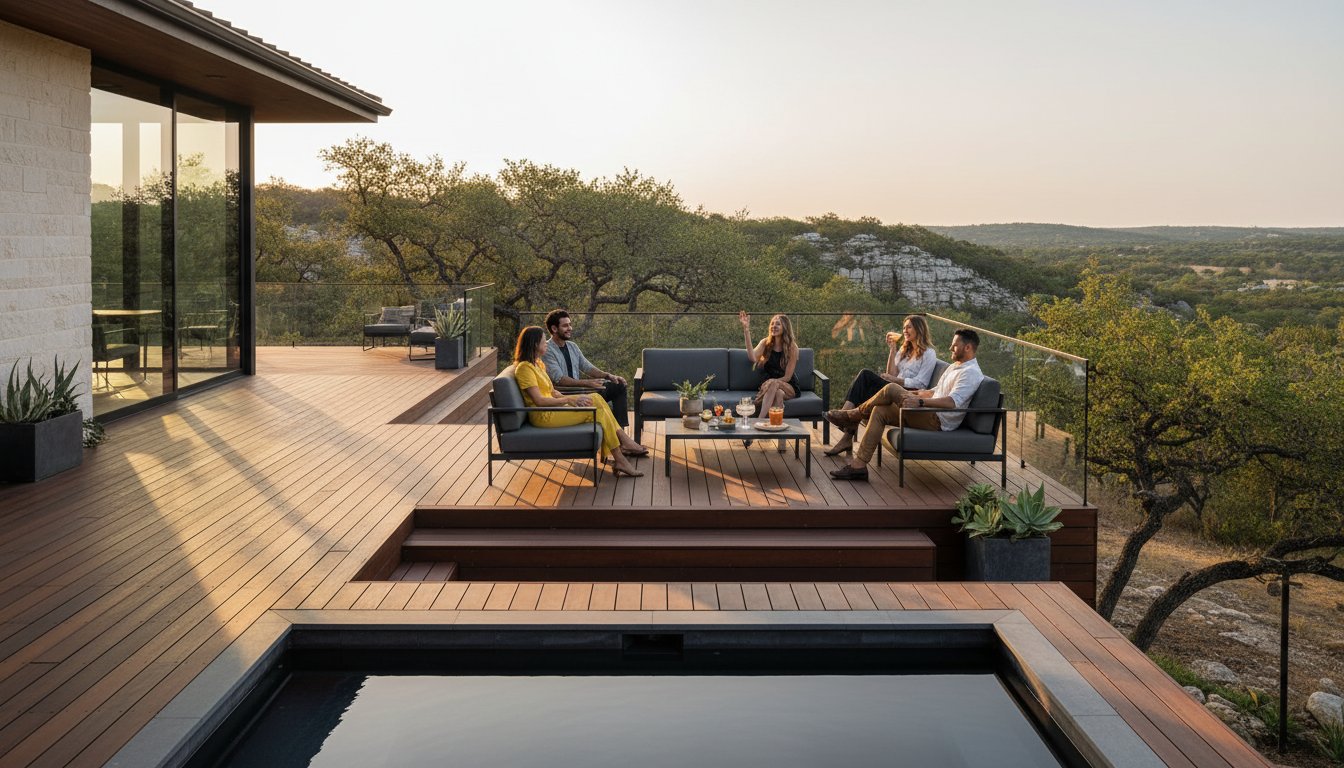
The cheapest deck you can build in Austin is almost always the most expensive mistake you'll ever make. You likely already know that the Central Texas sun and 80% humidity turn standard pressure-treated wood into a warped, splintering mess in less than five seasons. It's frustrating to watch a major investment rot while you're still navigating the city's complex building codes. We've seen homeowners lose $20,000 or more because they underestimated the reality of our local climate and the cost of doing things twice.
I'm stripping away the marketing fluff to give you a transparent, expert breakdown of the actual **new deck cost** for 2026. You deserve a realistic budget for a premium 30-year space that stands up to 105-degree August afternoons without constant maintenance. We'll examine the 12% price shift in high-end composites, the hidden fees in Austin's permitting process, and the specific material choices that offer the best ROI for your property. This guide ensures your next build is a strategic win rather than a financial drain.
Key Takeaways
- Stop relying on outdated $25-per-square-foot estimates and learn the actual 2026 new deck cost for a professional Austin build.
- Compare the durability of Ipe against thermally modified wood to choose a material that survives the Central Texas sun for decades.
- Navigate Austin’s complex permitting landscape and rising labor rates to ensure your project stays on track and up to code.
- Discover how 3D visualization and high-end amenities like cold plunges transform a simple platform into a strategic home asset.
- Analyze the real-world ROI of custom outdoor spaces and why the "cost of waiting" is your biggest financial risk this year.
The Austin Reality: What Does a New Deck Cost in 2026?
Austin is no longer a budget-friendly secret; it is a high-stakes real estate battlefield. If you are researching a new deck cost based on 2019 data, you are looking at a fantasy. The market has matured, and the era of the cheap, $25-per-square-foot platform is dead. In Central Texas, a professional deck is now an engineered extension of the home, built to withstand brutal sun and shifting clay soils.
Building a deck in 2026 requires a strategic mindset. You aren't just buying lumber and screws; you are investing in a structural asset that impacts your property's appraisal. The baseline has shifted because specialized labor and high-performance materials are the new standard for Austin homeowners who value ROI over temporary fixes.
Understanding the Price Per Square Foot in Central Texas
Square footage is a deceptive metric that only tells 40% of the story. While it helps estimate the surface area, it ignores the critical costs of site preparation, pier depth, and complex framing. An entry-level pressure-treated wood deck carries a different financial profile than a multi-level architectural masterpiece using premium hardwoods or heat-resistant synthetics. A deep dive into deck construction materials reveals that modern engineering demands more than just slapping boards together; it requires precision and high-grade fasteners that prevent warping.
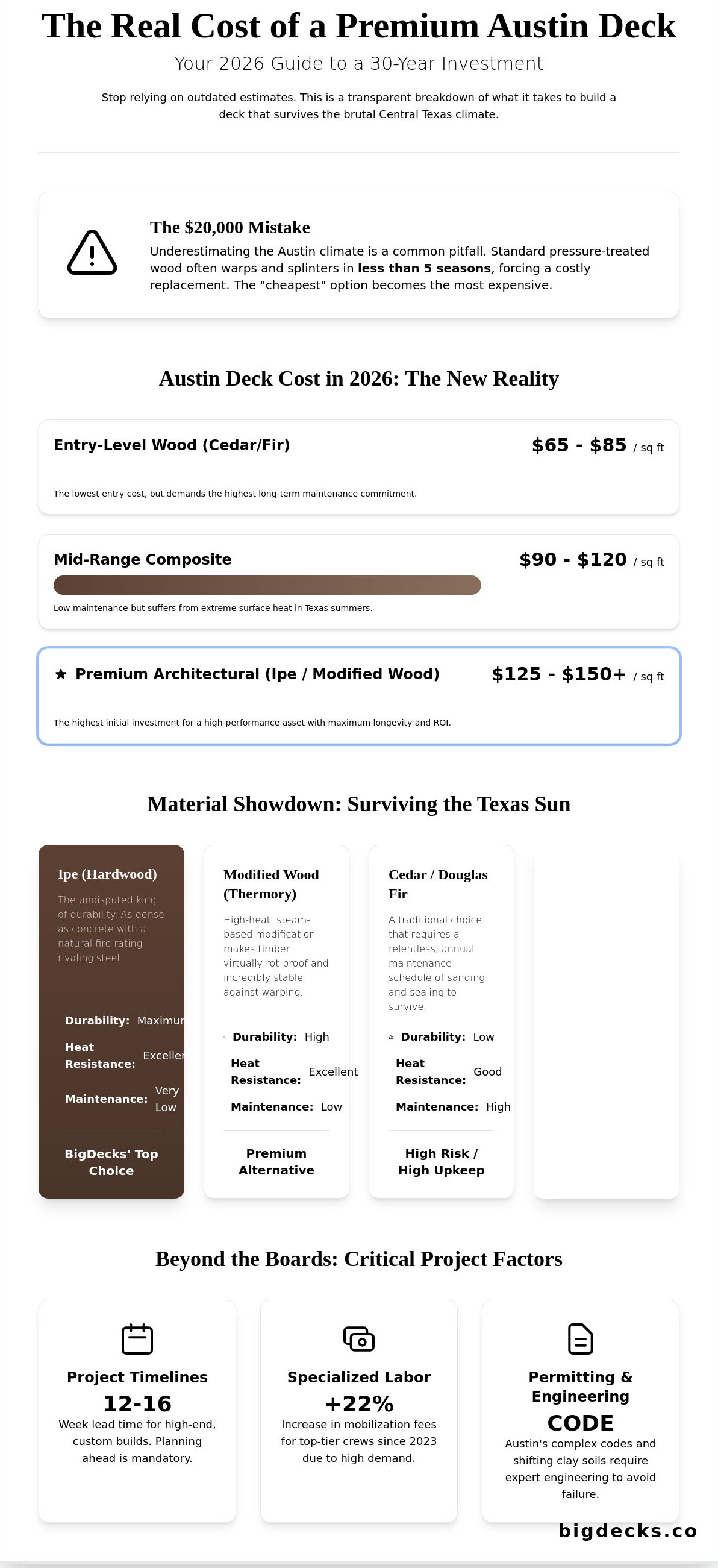
The average 2026 Austin deck price range is $65 to $150 per square foot. This range accounts for the volatility in material logistics and the demand for builders who actually understand local building codes. If a quote falls below this range, the builder is likely cutting corners on structural hardware or skipping the permitting process entirely.
- Entry-Level Wood: $65 - $85 per square foot.
- Mid-Range Composite: $90 - $120 per square foot.
- Premium Architectural Structures: $125 - $150+ per square foot.
Why 2026 Market Trends Are Shifting Toward Quality
Austin property values have reached a point where a "disposable" deck is a liability. Smart homeowners are moving away from cheap materials that require annual sanding or fail within a decade. They are choosing longevity because a high-end backyard investment is now a primary differentiator in the Travis County housing market. Quality is a hedge against future maintenance costs.
Current demand has also redefined the timeline of a project. Mobilization fees for top-tier crews have increased by 22% since 2023, reflecting the scarcity of master-level craftsmanship. Expect lead times of 12 to 16 weeks for high-end builds. Planning early isn't just a suggestion; it is a requirement to secure a slot with a builder who treats your outdoor space like a high-performance asset.
Material Selection: The Biggest Variable in Your Project Budget
Your material choice isn't just an aesthetic preference. It's the primary engine of your new deck cost. In the brutal Austin climate, the sun acts as a physical weight on your investment. Choosing the wrong board today means funding a total replacement in seven years. We categorize materials into two camps: those that survive the Texas heat and those that surrender to it.
Cedar and Douglas Fir represent the traditional baseline. They offer a lower entry price but require a relentless maintenance schedule. If you skip a year of sealing, the UV rays will warp the fibers beyond repair. For homeowners playing a longer game, Ipe and thermally modified timber have become the 2026 gold standard. These materials aren't just wood; they're high-performance assets designed to endure decades of exposure without structural failure.
The True Cost of Premium Hardwoods and Modified Timber
Cheap wood is a long-term liability. You save on the front end but pay a premium every two years in staining, sanding, and board replacement. Thermory uses a high-heat, steam-based process to alter the wood's molecular structure. This makes the timber virtually rot-proof and incredibly stable. While the latest construction spending data shows residential investment reaching new highs, the smartest capital is moving toward these modified products.
Ipe remains the undisputed king of durability. It's as dense as concrete and carries a natural fire rating that rivals steel. In custom architectural designs, we account for a 15 percent material waste factor to ensure every board meets our visual standard. Premium hardwoods arrive straighter and more consistent than standard lumber, which reduces labor hours during the precision phase of the build. It's a strategic trade-off: higher material spend for lower long-term maintenance costs.
Why BigDecks Avoids Composite and Plastic Alternatives
We don't build plastic decks for one simple reason: the barefoot test. Austin summers regularly push surface temperatures on composite decking to 150 degrees. If you can't walk on your deck at 2 PM in July, the space is useless. Plastic-capped boards also suffer from structural sagging over time. They lack the natural rigidity of timber, often resulting in a "bouncy" feel that degrades the premium experience of the home.
Environmental and aesthetic limitations also play a role. Plastic decks look like a boardroom floor, not a high-end outdoor retreat. They don't age; they just fade. We prioritize real wood because it breathes, stays cooler underfoot, and offers a superior ROI. You want a killer result that feels authentic to the Texas landscape. You can explore our natural timber projects to see how real wood outperforms synthetic imitations in high-stakes designs.
The 2026 timber market is a global chess match. Shipping costs for Ipe from Brazil and Thermory from Scandinavia are tied to international fuel surcharges and port efficiency. This volatility means your new deck cost is influenced by factors far beyond the Austin city limits. We secure our supply chains months in advance to protect your budget from these sudden market shifts.
Beyond the Boards: Engineering and Labor Costs in Austin
Austin's building codes don't care about your aesthetic. They care about structural integrity. Your new deck cost depends heavily on what happens before the first board is laid. Permitting through the City of Austin currently takes 4 to 8 weeks, and local inspections are notoriously strict.
Labor rates for master carpenters in Central Texas rose 12% between 2023 and 2025. This increase directly impacts the total new deck cost for homeowners seeking premium finishes. Skilled labor is scarce, and the best crews now command a significant premium for their technical expertise.
Site preparation often hides the biggest budget killers. Demolition of an old structure usually costs between $1,500 and $4,000. If your yard has drainage issues, you'll need French drains or regrading to prevent water from pooling under the frame.
These aren't optional extras. They're survival requirements for a long-lasting build. Remodeling's 2024 Cost vs. Value Report shows that professional installation and high-quality materials are the primary drivers of long-term project value.
Dealing with Austin’s Unique Soil and Foundation Requirements
West Austin is essentially a giant rock. Excavating footings in solid limestone requires specialized pneumatic equipment, which adds $150 to $300 to the cost of every hole. If your property sits in the Edwards Aquifer recharge zone, expect additional environmental oversight and strict impervious cover limitations. Building on a 15-degree slope requires engineered piers that can triple the foundation budget compared to a flat lot in North Austin.
The Value of Skilled Carpentry and Precision Metalwork
Standard deck builders use nails and pressure-treated pine. Modern architectural projects require precision. Custom steel framing is the new standard for 2026 because it allows for longer spans and thinner profiles. This work requires certified welders, not just carpenters. Professional project management reduces the risk of expensive errors. A single failed framing inspection can delay a project by two weeks and cost thousands in rework.
Design Complexity and the High-End Amenity Factor
Design isn't an afterthought; it's the roadmap that keeps your project from veering into a financial ditch. Your new deck cost will always reflect the precision of the planning phase. High-end builds in Austin now require more than just a sketch on a napkin. They demand structural engineering and integrated utility planning to avoid expensive field corrections. Design fees typically range from 3% to 8% of the total project budget, acting as insurance against the chaos of mid-build pivots.
How 3D Visualization Saves Money by Preventing Rework
3D rendering usually costs between $1,500 and $4,500 depending on the project scope. This upfront investment is a fraction of the $7,000 or more you might pay for a single mid-build change order to relocate a staircase or shift a built-in kitchen. Visualization allows you to see material transitions, like the jump from composite decking to stone masonry, before the first board is cut. In neighborhoods like Steiner Ranch or Circle C, 3D models help secure HOA and City of Austin approvals up to 15 days faster by removing ambiguity from the permit application.
Integrating Saunas, Cold Plunges, and Outdoor Amenities
Wellness is the dominant trend for 2026. Integrating these features requires more than just floor space. A standard deck is engineered for a live load of 40 pounds per square foot; however, a filled hot tub or sauna can exceed 100 pounds per square foot. Reinforcing the framing to handle this weight adds roughly $15 to $25 per square foot to that specific zone. Cold plunges also require dedicated drainage and foundation engineering to prevent water pooling. These additions aren't just for luxury; they significantly boost the ROI of an Austin home by tapping into the high-demand "backyard spa" market.
Don't overlook the "invisible" budget eaters. Professional lighting packages add $2,500 to $8,000 but ensure the space is usable after sunset. Electrical and plumbing runs, especially when trenching through Austin’s limestone, start at $3,000. Architectural fencing often scales with the deck project to provide privacy. High-end horizontal slat fencing currently costs between $75 and $120 per linear foot, creating a cohesive, high-stakes aesthetic that standard pressure-treated pickets can't match.
Evaluating Your Return on Investment for an Austin Deck
Austin’s real estate market in 2026 continues to value usable square footage, but buyers now prioritize how that space functions outdoors. Your new deck cost represents a strategic capital improvement rather than a simple home repair. Data from Central Texas home sales shows that premium outdoor living spaces recoup roughly 72% of their initial price during a sale. Beyond the resale value, the cost of waiting is a real financial drain. Construction labor and high-grade timber prices have risen 5.2% annually since 2023. Delaying a $55,000 project for two years could easily add $5,800 to the final invoice.
Maintenance math is where smart homeowners win. Professional oiling for a hardwood deck costs about $1,200 every 24 months. Over a decade, that is $6,000 spent on preservation. Neglecting this leads to UV damage and structural rot, eventually forcing a full deck replacement that could cost $40,000. Spending that $6,000 saves you $34,000 over the life of the structure. Choosing a partner who understands these cycles matters more than finding the lowest bidder who disappears once the last screw is driven.
Longevity vs. Upfront Cost: The 30-Year Perspective
Think of a $50,000 investment over a 30-year lifespan. It breaks down to roughly $1,660 per year. Compare that to a low-budget $25,000 deck built with inferior materials. In the brutal Austin sun, these cheap builds often fail within 7 years. That budget deck actually costs you $3,571 per year because you are rebuilding it three times in the same window. The psychological ROI is just as vital. A deck that doesn't creak, warp, or splinter provides a daily sense of luxury that low-end options can't replicate.
Starting Your Project with BigDecks
We start every budget conversation with total transparency. Our team doesn't guess; we use real-time market data to price your project accurately so your new deck cost stays predictable. The process begins with a 3D design consultation so you can visualize the flow and scale of your space before any dirt is moved. Schedule your design session with the BigDecks team today.
Lock In Your Austin Backyard Strategy
Austin's real estate landscape doesn't reward hesitation. By 2026, navigating your new deck cost requires a sharp focus on material longevity and structural integrity. Choosing thermally modified wood isn't just a design preference; it's a tactical financial move that can triple the lifespan of your investment compared to standard pressure-treated lumber. Local labor markets in Austin remain competitive. This makes Austin-based precision carpentry the deciding factor between a five-year fix and a twenty-year asset. We specialize in these high-stakes builds, combining local expertise with the technology needed to de-risk your project from day one.
You deserve to see the final product before construction starts. Our process includes full 3D design visualization to ensure every dollar spent translates into measurable home value. We focus on thermally modified wood to ensure your deck survives the 100-degree Texas summers for decades. Don't leave your ROI to chance when you can build with absolute certainty. We're ready to bring your vision to life with the precision and boldness that Austin demands. Let's build something that makes a statement.
Ready to see your backyard in 3D? Get a custom BigDecks quote today.
Frequently Asked Questions
How much does a 20x20 deck cost in Austin in 2026?
Expect to pay between $28,000 and $52,000 for a 20x20 deck in Austin by 2026. This range covers everything from pressure-treated pine to high-end composites. Material prices are projected to rise 4% annually over the next two years. Your new deck cost depends heavily on site topography and whether you choose a simple platform or a multi-level design. Get the numbers right before you break ground.
Does a new deck require a permit from the City of Austin?
You need a permit from the City of Austin for any deck over 30 inches tall or any structure attached to your home. Austin’s Technical Criteria Manual is strict about setbacks and impervious cover limits. Don't skip this step. Unpermitted work can trigger a 10% penalty on permit fees or even force a complete tear-down during a property sale. We handle the red tape so you don't have to.
How much does labor typically cost for deck building per square foot?
Labor costs for deck building in Central Texas currently range from $35 to $65 per square foot. This figure covers framing, decking installation, and railing assembly. Complex builds with curved boards or hidden fasteners sit at the top of that range. Specialized crews in Austin often book out 12 weeks in advance. Factor that lead time into your project planning to ensure your build stays on track.
Is Ipe or Thermory wood worth the extra cost for a Texas deck?
Ipe and Thermory are worth the investment if you plan to own the property for more than 15 years. Ipe lasts 40 to 50 years even in the brutal Texas sun, while Thermory Ash offers a 25 year rot-resistance rating. You'll pay 3 times more upfront than you would for cedar. However, the lifecycle cost is lower because you won't replace the boards every decade. It's a long-term play.
How long does it take to build a custom deck in Austin?
A custom deck project typically takes 4 to 8 weeks from the initial design meeting to the final walkthrough. The actual construction phase usually lasts 10 to 15 business days for a standard 400 square foot project. Permitting through the City of Austin adds another 3 to 5 weeks to the front end of that schedule. We move fast, but quality framing requires precision and zero shortcuts.
Will a new deck increase my property taxes in Travis County?
Adding a permanent deck will likely increase your property tax assessment in Travis County. The Travis Central Appraisal District views a deck as a property improvement that adds market value. If your new deck cost is $40,000, your appraised value may climb by a similar margin. It's a direct trade-off; you're building equity while paying for the privilege. High-end outdoor spaces are major assets in the Austin market.