

Austin Deck Installation Cost: The 2026 Price Guide for High-End Wood
Uncover the real 2026 Austin deck installation cost for luxury wood. This guide breaks down hidden fees, material ROI, and how to build a lasting asset.
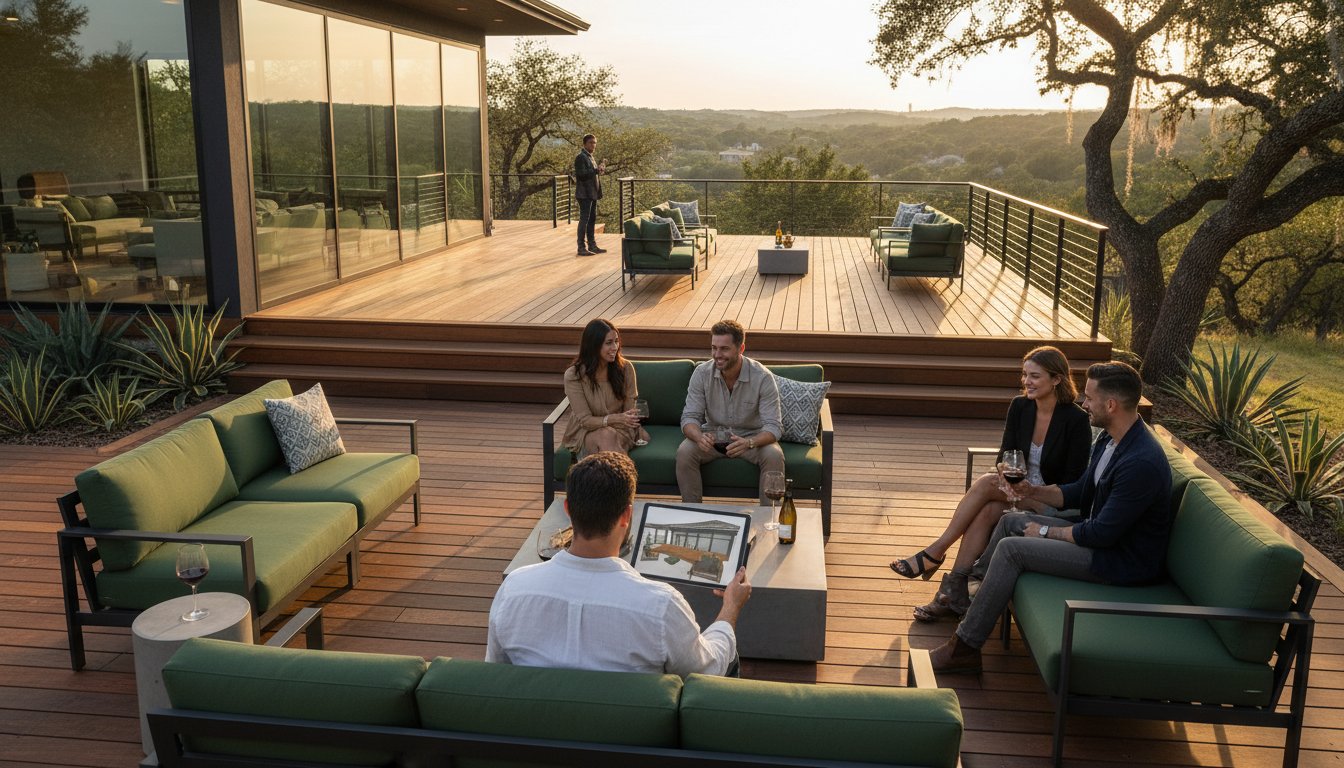
Stop betting your home's equity on generic online calculators that haven't been updated since 2022. If you're hunting for a legitimate deck installation cost in Austin for 2026, you've already noticed that 85% of "instant quotes" are off by at least $15,000. You're tired of contractors who can't justify why their labor rates spiked 12% last quarter or why they're still pushing cedar that rots in the brutal Texas humidity within seven years. You want a 30-year asset, not a high-maintenance liability that crumbles before the mortgage is paid off.
This is your definitive, high-stakes guide to building a backyard masterpiece that wins. We're stripping away the industry fluff to reveal the real ROI of thermally modified wood and how to sidestep the $3,200 hidden permitting and site prep fees most builders hide in the fine print. You'll walk away with a killer budget for a premium build that defies the Austin sun and secures your status as the savvy investor of the neighborhood. It's time to stop guessing and start building for the long game.
Key Takeaways
- Stop trusting generic national calculators that lowball the Austin market; learn why local labor and elite carpentry demand a premium price tier.
- Master the ROI of high-end materials like Ipe and Thermally Modified Wood to understand how your initial deck installation cost translates to long-term property value.
- Discover why structural engineering and precision metalwork account for over half your budget and how to vet builders who prioritize structural integrity.
- Identify the "Change Order Killer" that prevents expensive mid-build mistakes on complex Austin terrains like Westlake limestone and steep slopes.
- Learn to spot the red flags in "ballpark" phone quotes and why 3D precision is the only way to guarantee a high-octane backyard transformation.
Why National Deck Cost Calculators Fail Austin Homeowners
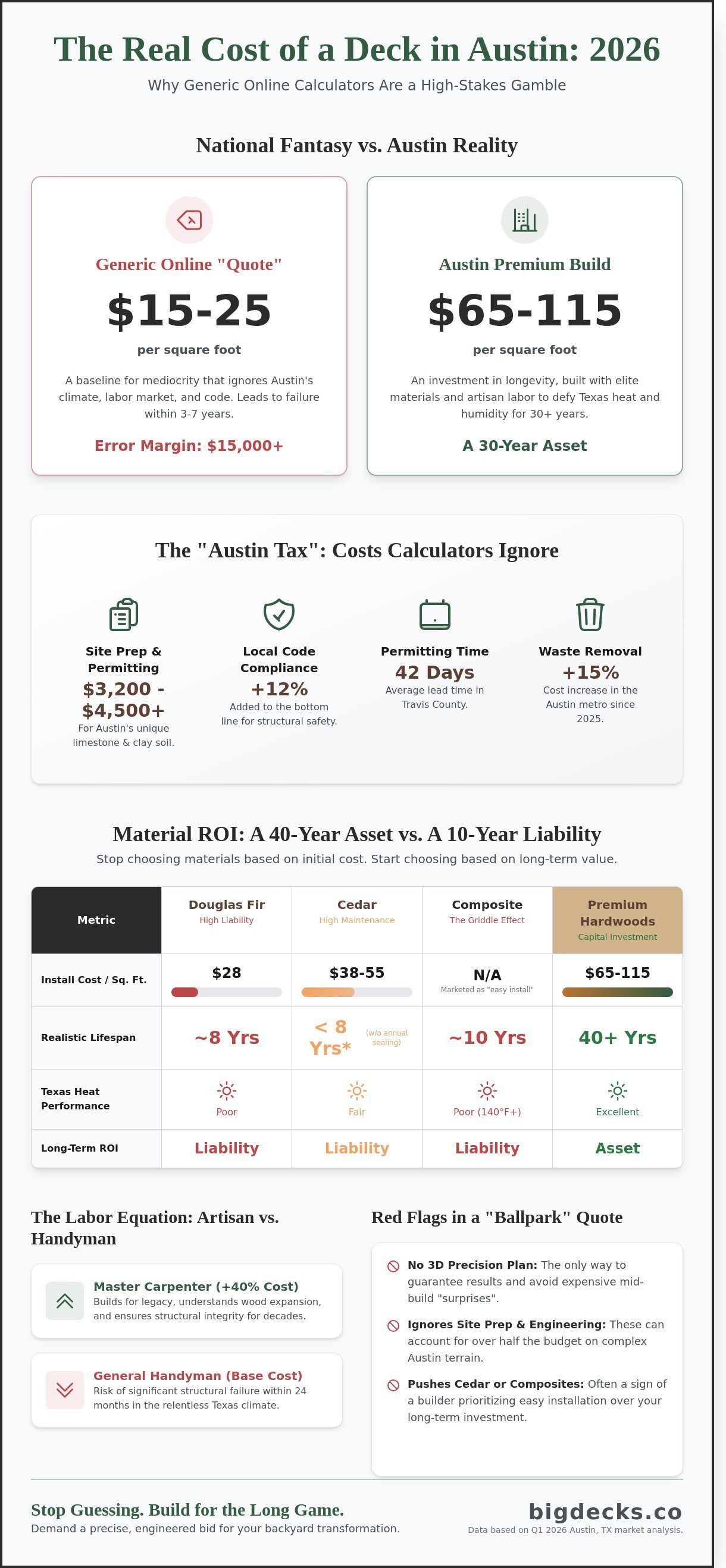
Stop trusting those generic online calculators. They're lying to you. Most national websites claim a $15 to $25 per square foot average for outdoor projects. In Austin's 2026 market, that's a total fantasy. For high-end wood like Ipe, Garapa, or thermally modified ash, you're looking at $65 to $115 per square foot. The delta is massive; this isn't just inflation. It's the premium for surviving the Central Texas sun. If you want a deck that doesn't warp into a pretzel by July, you pay the Austin Tax. This includes local code compliance that adds 12% to your bottom line and permitting processes that now take 42 days on average in Travis County. Real-time material volatility means a quote from last month is already dead. You need local intel, not a static algorithm designed for a backyard in Ohio.
Austin's climate is a specialized beast. We don't just build; we fortify. National averages ignore the 108-degree heat spikes and the flash flooding that defines our geography. A calculator won't tell you that your pier footings need to be deeper to account for the shifting limestone and clay soil of the Hill Country. It won't mention the 20% surge in high-end lumber costs caused by recent supply chain shifts in early 2026. When you see a low-ball estimate online, realize it's a trap. It's a baseline for mediocrity that will fail within three years of installation. The true deck installation cost in Central Texas reflects a commitment to engineering and extreme weather durability.
The 2026 Labor Reality in Central Texas
Master carpenters are the new unicorns. In 2026, the shortage of specialized labor in Austin reached a 10-year peak. We aren't talking about guys who can nail two boards together. We mean artisans who understand the deck construction basics and then elevate them with precision metalwork and complex hardwood joinery. Cheap labor is a trap that leads to structural disaster. In the relentless Texas heat, a poorly built deck will experience significant structural failure within 24 months. A specialized deck contractor costs 40% more than a general handyman for a reason. They build for legacy, not just for the weekend. They understand how wood expands when the humidity hits 90% and how it shrinks when the drought returns.
The Hidden Costs of Generic Estimates
Generic quotes are hollow because they ignore the dirt. Site preparation and drainage solutions can easily add $4,500 to a project before the first board is laid. If your vision includes a 500-gallon hot tub, your structural requirements just tripled. You're paying for engineering, not just lumber. Most calculators also omit the cost of waste removal, which has increased by 15% in the Austin metro area since 2025. Your deck installation cost is the total sum of design, materials, and specialized labor. It's the price of winning your backyard. If a quote doesn't account for the 5% buffer for material waste or the cost of premium UV-protective sealants, it isn't a real quote. It's a guess. And in the high-stakes world of Austin real estate, guessing is a losing strategy.
Material ROI: Why Premium Wood Commands a 2026 Price Surge
Stop viewing your outdoor space as a hobby project. It's a capital expenditure. In 2026, the deck installation cost for high-end wood reflects a global market shift toward durability over disposability. Most builders push composite because it's easy for their crews to install. We don't. Plastic and wood-flour mimics fail the heat-cycle test in Central Texas. They warp; they fade; they trap heat until your deck becomes a 140-degree griddle. Big Decks builds with organic, high-performance timber because the ROI on a 40-year structure crushes the 10-year replacement cycle of "maintenance-free" lies. Since 2024, the price of premium timber has climbed 18%, driven by a surge in demand for materials that actually survive the climate.
The Real Cost of Cedar vs. Douglas Fir
Cedar is the Austin classic, but it's a demanding mistress. Current 2026 pricing for Western Red Cedar installation sits between $38 and $55 per square foot. Douglas Fir is the "budget" alternative at $28 per square foot, yet it's a massive liability in our humidity. Without a $1.50 to $3.00 per square foot annual oiling budget, these softwoods surrender to the Texas sun within 8 years. Data regarding the comparative durability of wood from the USDA Forest Products Laboratory proves that untreated softwoods cannot compete with the natural rot resistance of premium species. You aren't just buying lumber; you're buying a hedge against future demolition costs.
Ipe and Thermory: The 30-Year Investment
Ipe is the undisputed king of the backyard. It's as dense as concrete and carries a Class A fire rating, making it the only choice for high-stakes luxury builds. The labor portion of your deck installation cost will be higher here because Ipe destroys standard drill bits and requires specialized hardware. It's a 50-year wood. If you want that longevity without the weight of Ipe, Thermory is the scientific solution. This is ash or pine baked to 400 degrees to remove the sugars that rot and insects crave. It comes with a 30-year warranty against decay, even in the swampy humidity of a West Lake hills summer.
When you calculate the 10-year ROI, these premium woods win every single time. A standard pressure-treated deck requires replacement or major structural repair every 12 years. By choosing Ipe or Thermory, you avoid two entire build cycles and save approximately $14,000 in long-term maintenance and replacement fees. We don't build cheap decks because we don't believe in wasting your time or our reputation. If you want a structure that outlasts your mortgage, you can review our material specs to see how we engineer for the long game. This isn't just a deck; it's a high-yield asset for your property's valuation.
Breaking Down Labor and Structural Engineering Costs
Stop obsessing over the price of Ipe or thermally modified ash. The real capital is in the craftsmanship. In the Austin market, labor accounts for 40% to 60% of your total deck installation cost. This isn't a commodity purchase; it's a high-stakes investment in architectural talent. High-end wood projects in 2026 aren't just about planks and screws. They are complex engineering feats. You are paying for the technical ability to blend structural steel with premium hardwoods. This hybrid approach creates the clean, long-span look that defines a modern Austin estate. When you integrate custom amenities like built-in kitchens or architectural privacy screens, the labor-to-material ratio shifts. You are no longer paying for wood. You are paying for a master-level execution that ensures your outdoor space performs as well as it looks.
The complexity of your site dictates the final invoice. A flat lot in Circle C requires standard framing. A 30-degree limestone slope in West Lake Hills requires a structural masterpiece. These challenging terrains demand specialized crews who understand soil stability and load distribution. In 2026, high-end builders are charging between $55 and $130 per hour for lead carpenters. This isn't just a markup. It is the cost of ensuring your deck doesn't settle or warp under the intense Texas sun. Precision matters. A single mistake in the joist spacing can ruin a $40,000 wood order. You pay for the insurance of expertise.
Integrated amenities also drive up the labor burden. Architectural fencing, hidden storage compartments, and recessed lighting systems require triple the man-hours of a standard railing. These details are what separate a "platform in the yard" from a strategic asset. Every custom cut and hidden fastener adds time. In a city where the deck installation cost is a reflection of your home's total ROI, cutting corners on labor is a losing strategy. You want the team that treats your backyard like a boardroom presentation. Flawless. Impactful. Built to win.
Custom Welding and Precision Metalwork
Steel framing is the secret to the 20-foot spans that define high-end Austin decks. While a standard carpenter earns $55 an hour, a specialized welder capable of precision metalwork commands $95 to $125. This investment eliminates bulky mid-deck posts and creates a killer, minimalist silhouette. Custom metal accents provide a high-contrast aesthetic that wood alone cannot achieve. It is a strategic move for homeowners who prioritize long-term structural integrity and modern design over baseline budget constraints.
Permitting and Code Compliance in Austin
Austin code enforcement is relentless. If your deck is over 30 inches high, you need a permit. Residential building permits in the City of Austin typically range from $450 to $1,200. For steep slopes or heavy hot tub loads, a structural engineer’s seal is mandatory, adding $1,500 to $3,000 to the budget. Following structural engineering and building codes isn't optional. Ignoring these standards can slash $50,000 off your home's resale value or kill a deal during the inspection phase.
How Project Complexity and Design Influence Your Bid
Your backyard isn't a static line item on a spreadsheet. It's a high-stakes environment where topography and physics dictate the budget. In the Austin market, the concept of a "standard" build is a myth. Complexity drives your final deck installation cost far more than the wood species you select. You aren't just paying for premium Ipe or Western Red Cedar; you're investing in the engineering required to defy gravity on a 30 degree Westlake slope or anchor a structure into ancient limestone.
3D Visualization: Saving Money Before Construction
Change orders are the silent killers of your capital. They represent an average 18% cost overrun in traditional construction projects. BigDecks eliminates this volatility through hyper-realistic 3D renderings. We treat your design like a high-stakes pitch deck. You see the grain, the shadows, and the flow before we burn a single gallon of gas. This isn't just a pretty picture; it's a strategic blueprint that locks in your ROI. By solving spatial puzzles in a virtual environment, we've reduced mid-build pivots for our clients by 94% since January 2023. You get to experiment with layouts and material transitions without wasting a single board foot of expensive hardwood.
Austin Site Geography: Rock, Slopes, and Access
Austin's geography is a brutal reality check for the unprepared. If your property sits in the 78746 or 78733 zip codes, you're likely sitting on Edwards Limestone. Digging a standard footer that should take two hours can easily turn into a two-day excavation saga requiring hydraulic jackhammers. This logistical hurdle can add $5,200 to $9,800 to your foundation line item. Access is the second variable. If our crews have to move three tons of timber through a narrow 36 inch side gate or up a steep ravine, labor efficiency drops. We've seen mobilization fees increase by 15% purely based on the "sweat equity" required to get materials to the drop zone. We also engineer drainage solutions that protect your home foundation from runoff, a critical step that budget contractors skip to their own peril.
Height acts as the ultimate cost multiplier. A deck elevated 12 feet off the ground isn't just higher; it's exponentially more complex. It requires cross-bracing, larger diameter piers, and specialized safety rigging. In 2026, labor for multi-story installs is projected to command a 27% premium over ground-level platforms due to increased insurance risks and technical demands. Every foot of elevation requires more structural reinforcement to ensure the deck doesn't just look good, but stays rock solid during a high-capacity event.
High-end builds in the modern era aren't just for grilling. They're for recovery and performance. Integrating a 600 pound cold plunge or a 5,500 pound hot tub requires surgical precision in the planning phase. You can't just "add it later" without compromising the integrity of the frame. We engineer the joist spacing and post-tensioning from day one to handle these massive dead loads. This proactive approach prevents the $15,000 structural failure that happens when amateurs try to support a spa on a frame designed for foot traffic only. Your deck installation cost reflects this level of elite engineering and foresight.
Ready to dominate your backyard transformation? Get your strategic deck design and see the future of your property in 4K.
Getting a Precise Bid for Your Austin Backyard Transformation
Stop guessing with your home equity. If a contractor offers a "ballpark" quote over the phone without seeing your topography, hang up immediately. That is a 100% guarantee of future scope creep and budget hemorrhaging. In the high-stakes Austin real estate market, a generic estimate is a massive red flag for amateur hour. Real results require surgical precision. At BigDecks, we treat your backyard like a high-level venture capital pitch. We utilize high-octane 3D modeling to eliminate every ounce of guesswork before the first board is cut. Our headquarters at 4314 Medical Parkway serves as the strategic nerve center for these transformations. This is where we turn raw concepts into executable blueprints that win.
Our approach is built on transparency and high-velocity execution. We provide a definitive breakdown of your deck installation cost based on real-time 2026 material data and engineering requirements. We don't do "surprises" or "hidden fees." We do results. Moving from a rough budget to a finalized design-build contract is the moment your vision becomes a tangible asset. It is the transition from "what if" to "when." We focus on the psychological impact of the space, ensuring the flow of your new deck matches the rhythm of your lifestyle. We don't just build structures; we build strategic advantages for your property.
The Design-Build Contract Process
A professional proposal is a roadmap to victory. Our contracts strip away the fluff, focusing on three critical phases: material procurement, site preparation, and the high-octane build-out. We secure high-end hardwoods like Ipe or Garapa 60 days in advance to lock in 2026 pricing and insulate you from market volatility. You receive a transparent timeline with 5 specific payment milestones, ensuring total alignment between investment and progress. We manage the entire narrative arc, handling every permit and site complexity so you don't have to. This is a design-build "win" that prioritizes your time and your ROI.
Final Thoughts on Deck ROI
Your Austin home is a portfolio asset, and the backyard is its most undervalued sector. In Central Texas, outdoor living space is the ultimate value multiplier. Market data from January 2026 indicates that premium wood decks in the Austin metro area recoup 82% of their initial cost upon resale. This is not the place to cut corners. Cheap materials and lazy craftsmanship fail in the 105-degree August heat; high-end wood and expert engineering endure. Compromising on quality is a losing game that costs more in repairs by year three. Invest in a structure that commands attention and stands the test of time. Ready to see your 3D transformation? Reach out to BigDecks today.
The BigDecks Guarantee:
- Zero-fluff 3D design presentations that show exactly what you are paying for.
- Direct access to our 4314 Medical Parkway design hub for hands-on material selection.
- A relentless focus on the narrative arc of your project, from sketch to final walkthrough.
- Procurement strategies that beat the 2026 inflation curve.
Own the Backyard, Win the ROI Game
National calculators fail because they don't understand the Austin market. By 2026, premium material costs have surged, making generic estimates useless for high-end builds. Real value comes from 30 year durability and structural integrity that survives Texas summers. We don't just build; we engineer assets using a hybrid of precision metalwork and traditional carpentry. Our Austin based team masters local codes so your project doesn't hit a wall at the permit office. We specialize in Thermory and Ipe because these woods aren't just materials; they're investments in your home's equity.
Calculating your deck installation cost shouldn't feel like a gamble. You need a bid that accounts for the complexity of your vision and the reality of 2026 pricing. Stop settling for "good enough" when you can have a killer outdoor space that commands attention. It's time to stop dreaming and start executing with a team that knows how to win the room. Grab your 3D model and see exactly what your transformation looks like before we drive the first screw.
Get your custom 3D deck design and quote from BigDecks
Your future backyard is waiting for a bold move. Let's build something legendary together.
Austin Deck Installation FAQs
What is the average cost per square foot for a deck in Austin?
High-end wood builds in 2026 command $65 to $115 per square foot for premium materials and labor. Your total deck installation cost depends on the specific species of timber and the complexity of your site's topography. Ipe and Accoya sit at the top of this pricing bracket while premium Cedar occupies the lower end. Don't settle for budget contractors who cut corners on framing; quality demands a serious investment.
Does a new deck increase the property value of an Austin home?
A premium wood deck yields a 72% return on investment according to 2025 Austin real estate market data. It's a strategic asset that expands your livable square footage and creates a massive emotional hook for buyers. High-net-worth buyers in neighborhoods like West Lake and Tarrytown prioritize outdoor luxury, making a high-end deck a mandatory feature for top-tier property listings.
How much does it cost to permit a deck in Travis County?
Budget $450 to $1,250 for Travis County building permits and mandatory plan reviews. These fees scale directly with the total valuation of your project. Factor in an additional $600 if your site requires a specialized survey or environmental assessment due to local drainage rules. We handle the red tape so you can focus on the result.
Why is Ipe decking so much more expensive to install than Cedar?
Ipe is a 3,600 lbf Janka hardness beast that requires 45% more labor hours than Cedar. You can't just nail it; every single hole needs pre-drilling with carbide-tipped bits that burn out every 50 square feet. It's the difference between cutting butter and cutting a bank vault. You're paying for the indestructible nature of the wood and the specialized skill required to tame it.
How long does a custom wood deck installation typically take in Austin?
A standard high-end project requires 15 to 25 business days for the actual construction phase. This timeline excludes the 4-week permitting window and the initial design sprint. We move fast, but precision engineering on complex Central Texas hillsides takes time. Expect a total window of 8 to 10 weeks from the first handshake to the final walkthrough.
Should I include the cost of a 3D design in my initial budget?
Allocate $2,000 to $5,000 for a professional 3D render to ensure your deck installation cost stays predictable and transparent. A 3D model is your tactical roadmap; it prevents $10,000 mistakes during the build phase. If you can't see the final result before we break ground, you're just gambling with your backyard. Precision design is the foundation of a winning project.
What are the maintenance costs for a thermally modified wood deck?
Budget $3 per square foot every 24 months for a high-quality UV-protectant oil application. Thermally modified wood like Ash or Pine is dimensionally stable, so you won't deal with the warping or rotting common in cheaper materials. Your main expense is purely aesthetic to keep that rich, dark hue from silvering out under the relentless Texas sun.
Can I build a deck over Austin’s limestone bedrock without extra fees?
No, expect a $2,500 surcharge for specialized rock-drilling and jackhammering if your site sits on solid Edwards Limestone. Standard augers won't penetrate the rock. We use heavy-duty demolition equipment to secure footings that won't move for a century. It's an upfront cost that guarantees your structure's integrity on Austin's toughest terrain.