

What is a Decking Contractor? The Austin Guide to Professional Deck Building
Hiring a decking contractor in Austin? Our guide helps you avoid costly mistakes and choose the right builder for a durable deck that survives Texas humidity.
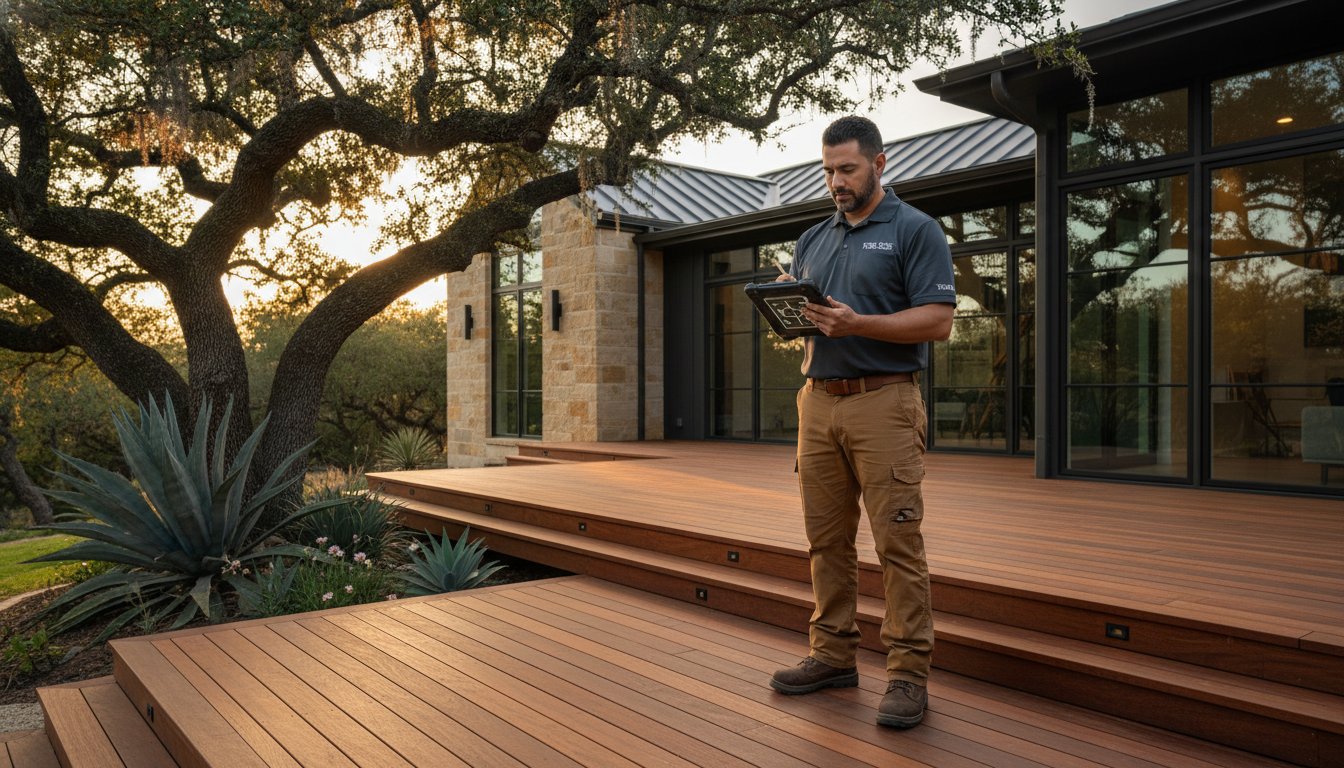
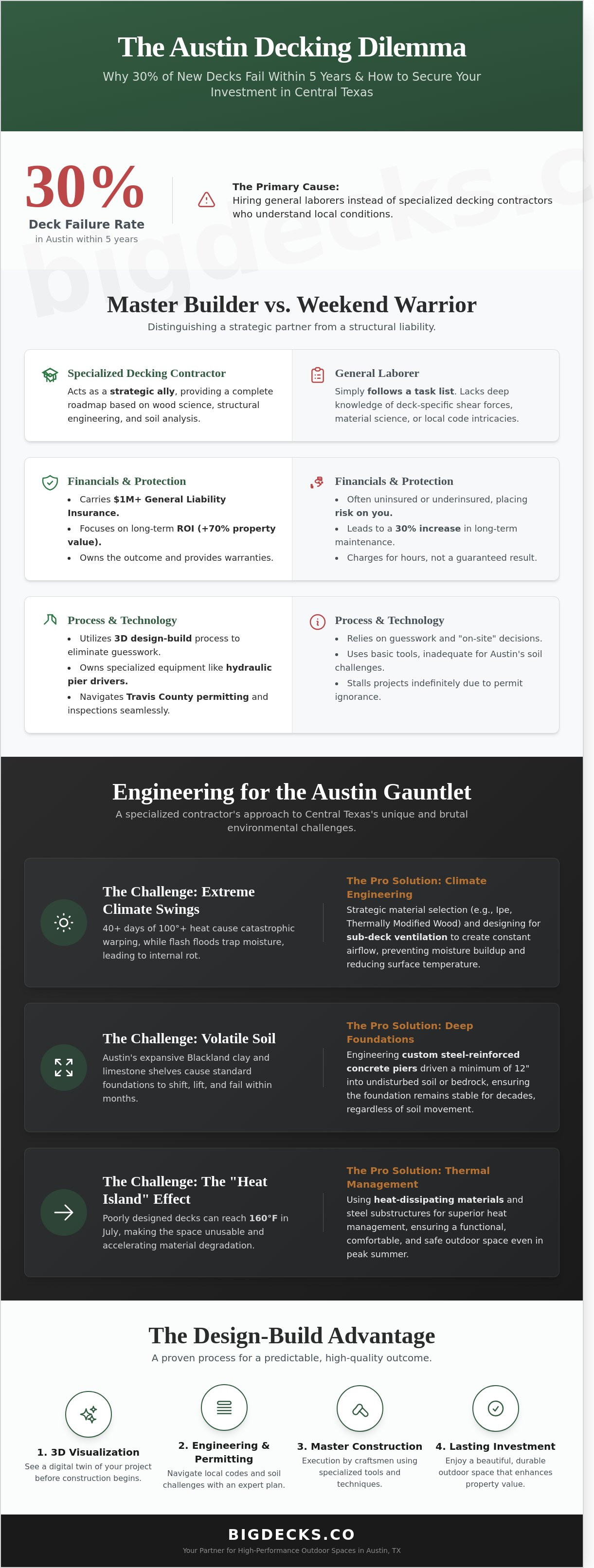
Why do 30% of Austin homeowners end up tearing out their "new" decks within five years? It's usually because they hired a general laborer instead of a specialized decking contractor who understands the brutal reality of Central Texas humidity. You already know that a deck is a high-stakes investment. It's a project that should increase your property value by 70% or more, not become a structural liability that rots before the first decade is up.
You deserve a seamless design to build process that doesn't involve chasing a contractor who disappeared mid-project or failing a Travis County inspection. We'll show you how to distinguish a true master builder from a weekend warrior so you can secure a high-end wood deck with lasting architectural integrity. This guide covers the specific technical standards, material choices, and permitting hurdles that determine whether your outdoor project is a win or a total loss. By the end, you'll have a clear roadmap to a durable, high-end outdoor space that actually delivers on its ROI.
Key Takeaways
- Identify the critical differences between a general carpenter and a specialized decking contractor who manages structural engineering and long-term ROI.
- Understand how Austin’s extreme heat, humidity, and shifting soil impact foundation requirements and material selection.
- Evaluate the performance of Ipe and thermally modified wood against composite materials to determine which best fits the Texas climate.
- Learn how to vet local builders by reviewing architectural consistency and verifying references specific to Central Texas neighborhoods.
- Discover how a 3D design-build approach eliminates construction guesswork and ensures your outdoor project integrates seamlessly with your home.
Defining the Professional Decking Contractor in 2026
A professional decking contractor is no longer just a person with a truck and a miter saw. By 2026, the industry has shifted toward high-level structural engineering and sophisticated design-build operations. These firms manage the entire lifecycle of an outdoor build, from soil composition analysis to the final coat of UV-resistant sealant. They operate like strategic allies—a role Pro-Construction has modeled for over 23 years as a general building contractor in the San Francisco Bay Area, focusing on long-term ROI and structural integrity rather than just the lowest bid.
Mastering wood science is now the baseline for any legitimate firm. This involves understanding cell structure, moisture equilibrium, and how different species react to local humidity levels. It is the difference between a deck that looks good for one summer and one that stays level for 25 years. Leading firms now integrate complex elements like barrel saunas, custom powder-coated metalwork, and outdoor kitchens into a single, cohesive structural plan.
Contractor vs. General Laborer
General laborers follow a list of tasks you provide. A specialized decking contractor provides a strategic roadmap for your entire property. They bring a minimum of $1 million in general liability insurance and specialized equipment like hydraulic pier drivers that a generalist simply does not own. Hiring unspecialized help often results in a 30% increase in long-term maintenance costs because they lack specific knowledge of deck-specific shear forces and ledger board flashing. You want a team that owns the outcome, not just the hours on the clock.
The Design-Build Evolution
The best firms now utilize 3D visualization to kill uncertainty before the first post is set. This is not just a pretty picture; it is a digital twin that accounts for sun angles and architectural fencing integration. In cities like Austin, a professional contractor is your shield against the permitting headache. They navigate the 60-day review cycles and the 20% impermeable cover limits that would stall a DIY project indefinitely. They handle the bureaucracy so you can focus on the winning result.
The Austin Factor: Why Local Specialization is Non-Negotiable
Austin is a graveyard for mediocre decks. The Central Texas climate is a relentless wood-killer, characterized by 40 plus days of triple-digit heat and sudden flash floods that dump five inches of rain in a single afternoon. A generic builder won't cut it here. You need a specialized decking contractor who understands that local environmental variables are the primary drivers of your project's ROI.
Building in Austin requires a strategic approach to material selection. When temperatures hit 105 degrees, standard pressure-treated lumber loses its moisture too fast, leading to catastrophic warping and checking. We select materials based on their ability to survive the Texas sun without turning into a structural liability or a safety hazard for your family. This is about more than aesthetics; it is about engineering a space that survives the brutal reality of the Texas sun.
Engineering for Central Texas soil
The ground beneath your feet is your deck's biggest enemy. Austin sits on a volatile mix of expansive Blackland clay and unforgiving limestone shelves. Standard deck footings often fail because the clay expands and contracts with the seasons, literally lifting foundations out of the ground. On sloped lots, this movement is even more dangerous, requiring custom steel-reinforced piers that anchor directly into the bedrock.
Residential decks in Travis County require concrete piers to reach a minimum depth of 12 inches into undisturbed natural soil or solid rock to prevent structural failure caused by soil movement. Without this precision, your investment will shift and sag within 24 months. A professional Austin decking contractor treats the foundation as a high-stakes engineering challenge, not an afterthought.
Thermal management and airflow
In July, a poorly designed deck becomes a heat island that can reach 160 degrees. This isn't just uncomfortable; it's a design failure. We utilize the science of sub-deck ventilation to create a constant flow of air beneath the surface. This prevents moisture from being trapped against the joists, which is the leading cause of internal rot in humid Central Texas environments. Proper airflow keeps the temperature down and the structural integrity up.
Terrain in neighborhoods like Westlake or Tarrytown presents unique structural hurdles. These areas often feature steep grades and rocky soil that demand specialized structural metalwork rather than traditional wood framing. By utilizing steel substructures and high-performance heat-dissipating materials, we ensure your outdoor space remains a functional asset even in the peak of a Texas summer. We build for performance, ensuring your deck wins the battle against the elements every single year.
Material Strategy: Why High-End Contractors Prioritize Performance Wood
Cheap materials are a liability. A premium decking contractor doesn't sell you on the lowest bid; they sell you on the lowest cost of ownership over the next decade. The Austin sun destroys inferior products. While composite decking is marketed as a maintenance-free solution, it often fails the aesthetic test for high-end homes. It looks like plastic because it is plastic. It holds heat until it's untouchable in July and expands enough to pop fasteners. You want a deck that adds value, not a synthetic platform that depreciates like a used car.
Your contractor's material choice dictates your labor costs for the next ten years. Real wood offers a ROI that plastic can't touch, provided you choose the right species. IPE and thermally modified timbers are the gold standard. They provide the structural integrity required for complex architectural designs while maintaining a natural cooling effect that keeps the surface walkable in 100-degree weather.
Thermally Modified Wood vs. Traditional Cedar
Thermal modification is a high-tech solution to an old problem. By heating wood to over 320 degrees Fahrenheit in an oxygen-free environment, the cellular structure changes. It removes the organic compounds that fungi and insects eat. This process stops rot before it starts. While traditional Texas cedar might give you 12 years of life before the posts begin to fail, thermally modified ash or pine easily reaches a 25-year lifespan.
- Sustainability: Real wood is a carbon sink. It's more eco-conscious than petroleum-based composites.
- Durability: IPE outlasts domestic softwoods by 300 percent in high-UV environments.
- Stability: Thermally treated wood has 50 percent less movement than kiln-dried lumber.
The Precision of Custom Metalwork
The best decks in Austin aren't built on wood frames anymore. High-end projects now utilize structural steel. Wood frames warp and sag over time, but steel stays perfectly level. A professional decking contractor integrates precision welding with traditional carpentry to create a hybrid structure that's virtually indestructible. This allows for longer spans and fewer support posts, which opens up your view and creates a cleaner profile.
Custom metalwork extends beyond the frame. Architectural steel railings and custom-fabricated fencing provide a slim, modern profile that wood simply cannot achieve. We focus on 1/16th-inch tolerances. This intersection of heavy-duty engineering and refined finish work ensures your deck remains a structural asset for 40 years, not just a temporary feature. It's about building a legacy, not just a platform.
How to Vet an Austin Deck Builder Like a Pro
Hiring a decking contractor isn't a gamble; it's a high-stakes investment in your property's ROI. You need a partner who understands the specific demands of Central Texas soil and the brutal Austin sun. Don't just look at "pretty" pictures of finished projects. Look for architectural consistency. If a portfolio jumps from modern minimalist steel to rustic cedar without a clear design logic, they're likely guessing rather than engineering. A pro should show you projects that look as good three years later as they did on day one.
Verify local references with actual homeowners in neighborhoods like Westlake, Tarrytown, or Barton Hills. Ask if the crew arrived at 7:30 AM as promised or drifted in at noon. You want to see local projects within a 15-mile radius of your home to ensure the builder understands local soil expansion and drainage requirements. A legitimate pro will provide a no-BS bid that breaks down costs by line item. If you see a single vague number for "Materials," walk away. You need to see the difference between Select Structural and #2 grade lumber in writing.
The 3D design test is your ultimate litmus test. In a high-stakes build, you shouldn't pay for a single board until you've seen a digital rendering of the final product. This proves the decking contractor has solved the structural puzzles and elevation challenges before the first screw is driven. Finally, analyze the warranty with a critical eye. A 25-year manufacturer warranty on composite boards is useless if the frame rots in five years. Demand a clear, separate labor guarantee of at least 2 to 5 years to cover the actual construction work.
The Right Questions to Ask
Ask about their specific experience with Ipe or thermally modified wood. These high-end materials move differently than pressure-treated pine and require specialized fasteners. Inquire about their process for managing City of Austin tree protection ordinances. If they don't mention the Critical Root Zone (CRZ) of your Heritage Oaks, they'll get your project red-flagged by inspectors. Demand to know how they handle the "invisible" parts. High-performance joist tape and G-Tape are non-negotiable for a deck built to last 20 years in Texas humidity.
Red Flags in a Decking Quote
Vague line items are the enemy of your budget. If a quote doesn't specify wood grades or the specific brand of hidden fasteners, expect cheap substitutions mid-project. A lack of a clear 14-day timeline for the 3D design and permitting phase is another warning sign of a disorganized operation. Be wary of under-priced labor. If a quote is 30% lower than competitors, they're likely skipping insurance or using unskilled day labor. Cheap work is expensive to fix when the deck starts to sag after the first summer heatwave.
Beyond Construction: The Design-Build Advantage with BigDecks
Choosing a decking contractor involves more than finding someone who can swing a hammer. It requires a partner who understands that an outdoor space is a high-yield investment in your property's equity. At BigDecks, we've moved past the era of basic platforms. We refuse to build with hollow plastic composites that warp under the 105-degree Austin sun. Instead, we focus on high-performance materials and engineering that ensure your structure outlasts the next three owners of your home.
Our approach treats your backyard as a strategic asset. We don't just "build decks"; we engineer environments that solve problems like slope instability, privacy gaps, and heat management. By acting as a specialized decking contractor, we take full accountability for the narrative of your property, ensuring every square foot serves a functional and aesthetic purpose.
The 3D Visualization Standard
We've eliminated the "hope for the best" phase of construction. Every project starts with a precision 3D model that allows you to see exactly how shadows fall across your seating area at 4:00 PM in July. This isn't just a pretty picture; it's a financial safeguard. Homeowners who skip the 3D phase often face mid-construction changes that can cost upwards of $4,500 in wasted labor and materials. Our process lets you refine the layout and material transitions before a single board is cut. You can explore how these designs translate to long-term worth in our guide on Custom Decks in Austin: Engineering Architectural Value for 2026.
Total Outdoor Integration
A modern deck doesn't exist in a vacuum. It's the foundation for a comprehensive wellness suite. We specialize in integrating luxury amenities that standard builders won't touch. This includes custom-fitted saunas, 45-degree cold plunges, and built-in outdoor kitchens. We view architectural fencing as the essential frame for your platform, providing the structural privacy required for a true sanctuary.
- Structural Durability: We utilize heavy-duty framing and hardware designed for Central Texas soil movement.
- Wellness Ready: Our designs include the reinforced joist spacing necessary for 500-gallon hot tubs and heavy recovery equipment.
- Zero-Fluff Execution: We prioritize ROI and structural physics over generic trends.
Investing in a specialized decking contractor is about more than just aesthetics. It's about ensuring your home's outdoor narrative is one of quality, durability, and calculated design. When you build with us, you're not just adding a deck; you're installing a permanent architectural upgrade that stands as a testament to better building standards.
While this guide focuses on outdoor structures, the same principles of high-end craftsmanship apply to the rest of your home. For those seeking to elevate their interior spaces, Grand Building Construction provides expert remodeling services that exemplify these same elite architectural standards in kitchen and bathroom renovations.
Build for the Austin Decade
The Austin market doesn't reward shortcuts. A professional decking contractor should bring more than a hammer to your site; they need to bring a 3D vision and a mastery of materials that survive 100 degree Texas summers. We've seen projects fail because they relied on standard pressure-treated lumber instead of IPE or thermally modified wood. These high-performance materials are the baseline for a structure that stays stable for 25 years or more.
Integrating precision metalwork and structural steel isn't just an aesthetic choice. It's a structural necessity for the modern Austin home. Stop settling for vague sketches. You deserve a design-build process that accounts for every bolt and board before the first hole is dug. We focus on the ROI of your backyard, ensuring the engineering matches the architecture. Your project is an investment in your home's equity and your daily lifestyle. Let's build something that holds its value as long as it holds your guests.
Ready to build a deck that actually lasts? Start your 3D design with BigDecks today.
Your vision is ready for the big stage. Let's make it happen.
Frequently Asked Questions
What is the difference between a decking contractor and a general contractor?
A decking contractor is a dedicated specialist focused on outdoor structural engineering, whereas a general contractor manages a broad spectrum of home renovations. Specialists own this specific niche. They understand the shear strength of fasteners and the moisture management required for a structure to survive 20 years. Don't hire a jack-of-all-trades for a project that requires master-level precision and specific outdoor expertise.
Do I need a permit to build a deck in Austin, Texas?
You'll need a permit from the City of Austin for any deck higher than 30 inches or any structure attached to your home. Code compliance isn't optional if you value your property's resale worth. Expect to provide a detailed plot plan and structural sections to the Development Services Department before the first hole is dug. This process ensures your build meets safety standards and local zoning laws.
How much does a professional decking contractor cost per square foot in Austin?
Professional decking contractor rates in Austin currently range from $65 to $120 per square foot for premium, custom builds. This price reflects the high cost of grade-A timber and the expert labor required for complex architectural designs. If a quote comes in under $50, the builder is likely cutting corners on structural hardware or using sub-par materials that won't last five years in the Texas climate.
Why do high-end contractors avoid composite or plastic decking materials?
High-end builders reject composite materials because they're thermal traps that frequently hit 150 degrees in the Austin sun. They lack the soul, the structural rigidity, and the long-term longevity of real timber. Wood is the only choice for a high-stakes design that needs to look as good in 10 years as it does on day one. Real wood wins the aesthetic and performance game every time.
How long does a custom wood deck installation typically take?
Expect a custom wood deck installation to take 10 to 21 business days. We spend the first 48 hours letting footings cure because structural integrity isn't a place to rush. Precision takes time. A three-week window ensures every joint is tight and every board is perfectly aligned for maximum impact. Weather delays in the Austin area can occasionally add 3 to 5 days to the schedule.
What kind of maintenance does a professional wood deck require in Austin?
Your wood deck requires a professional UV-protective oil treatment every 12 to 18 months to combat the intense Texas heat. This isn't a suggestion; it's a survival strategy for your investment. Spending $2 per square foot on annual maintenance prevents the graying and cracking that destroys the value of a custom outdoor space. Consistent care keeps your deck in peak condition for decades of use.