

Deck Companies in Austin: Why Design-Build Beats Commodity Carpentry
Tired of decks warping in the Austin heat? Our guide helps you vet local deck companies and choose a design-build firm for a 30-year outdoor oasis.
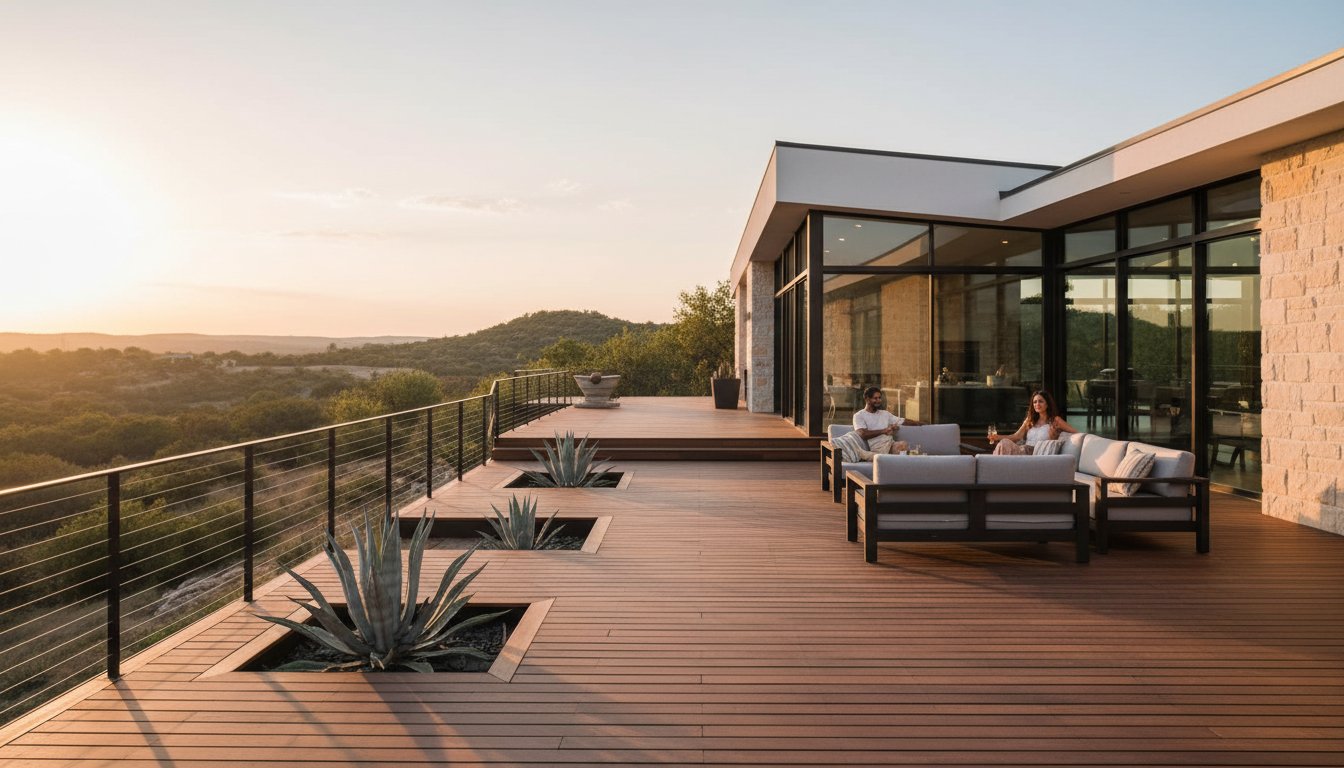
Most Austin decks are engineered to fail before the second summer heatwave hits. You've likely seen it happen; a neighbor spends $20,000 on a project that warps, splinters, and fades into an eyesore within 24 months. It's the inevitable result of hiring commodity carpenters who prioritize speed over structural science. You already know that the 105-degree Texas sun is a brutal critic of cheap materials and lazy design, yet many homeowners still settle for "good enough" until the wood starts to curl.
Choosing between local deck companies requires more than just comparing bids; it's about finding a partner that understands design-build methodology. This article will teach you how to identify builders who use premium materials and architectural planning to create a 30-year outdoor space. We'll explore the specific materials that survive the Central Texas climate and explain why a design-first approach prevents the project management nightmares that plague standard construction jobs. You're about to learn how to secure a modern, high-performance deck that looks as sharp in a decade as it does on day one.
Key Takeaways
- Distinguish between commodity builders and design-build firms to ensure your project survives Austin’s unique soil expansion and intense UV exposure.
- Leverage 3D visualization to eliminate construction guesswork and prevent expensive mid-project changes by seeing the final result before work begins.
- Compare the heat retention of composite materials against the 30-year durability of thermally modified wood to choose the right surface for the Texas heat.
- Vet Austin deck companies by auditing their insurance, local licensing, and ability to execute complex architectural designs rather than simple platforms.
- Learn to position your deck as a strategic outdoor oasis by integrating privacy features and modern architectural fencing for maximum curb appeal.
Navigating the Austin Deck Company Landscape in 2026
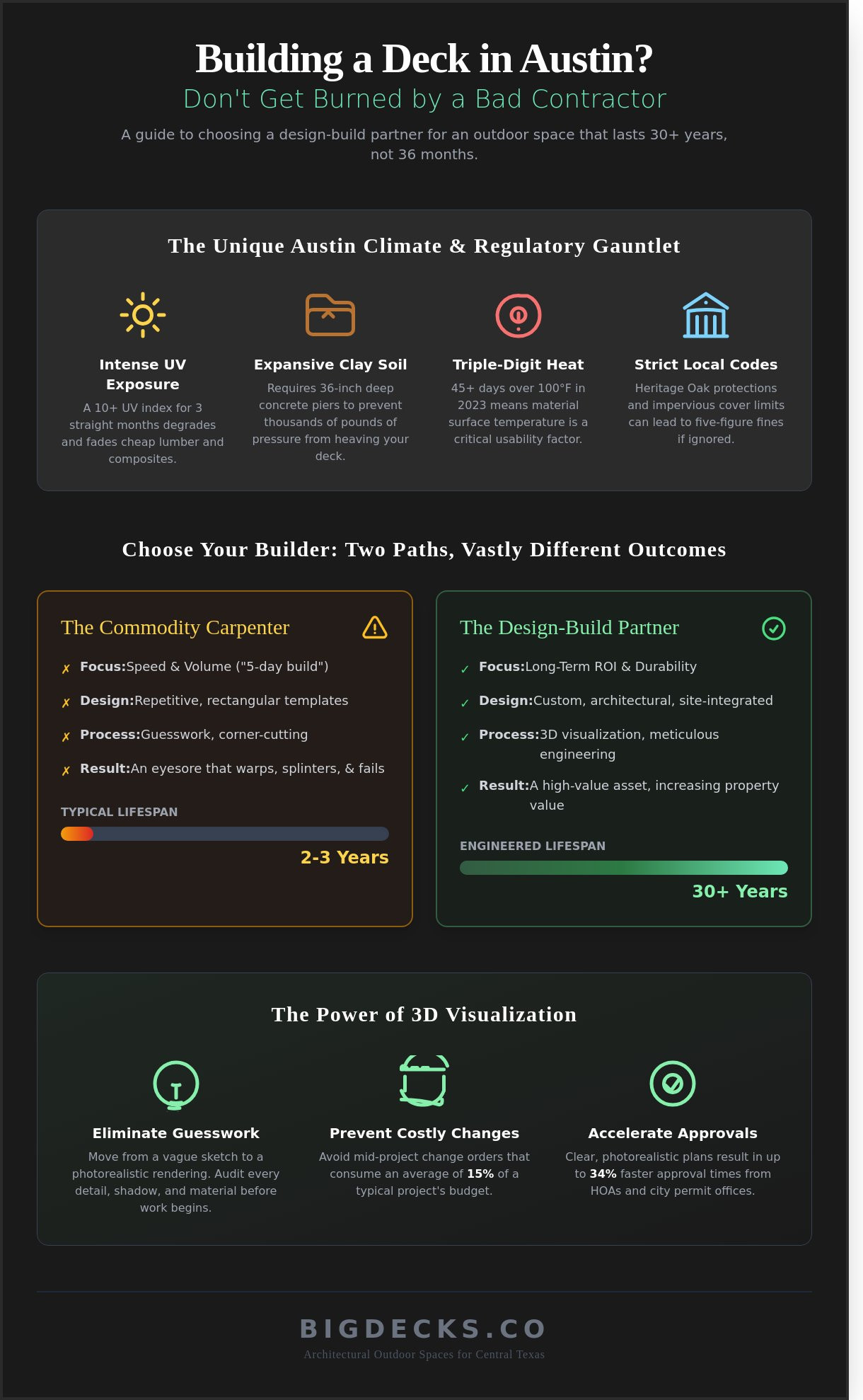
Austin is a brutal environment for outdoor structures. If you are researching deck companies in 2026, you aren't just buying a platform for a grill; you are making a capital investment in a climate that actively tries to destroy lumber. The Central Texas sun delivers UV levels at a 10+ index for three months straight, while the ground beneath your feet shifts with aggressive intent. Success requires more than a hammer and a truck.
The local market consists of three distinct tiers. Handymen often charge $30 to $50 per hour but rarely carry the professional liability insurance required for major structural work. Big-box installers prioritize volume, using standardized kits that ignore the specific slope of your lot. Custom design-build firms occupy the top tier, managing everything from the 12-week municipal permitting backlog to complex engineering for multi-level builds. Choosing the lowest bid in this environment is a guaranteed path to structural failure within 36 months.
Soil is the silent killer of Austin decks. The Blackland Prairie region features expansive clay that exerts thousands of pounds of pressure as it hydrates and dries. Without 36-inch deep concrete piers and proper drainage planning, your deck will heave and pull away from your home's ledger board. A professional Deck construction overview highlights that while the surface looks simple, the engineering below the dirt determines the lifespan of your project.
The Commodity Installer vs. The Design Partner
Commodity builders sell by the square foot and focus on speed. They want your project finished in five days so they can move to the next zip code. Their portfolios usually feature repetitive, rectangular designs that don't account for your home's architectural flow. You can spot them by their lack of detail regarding site-specific drainage or solar orientation.
Design partners operate like strategic allies. They analyze your property's narrative arc and focus on long-term ROI. These deck companies prioritize site integration, ensuring the wood grain and structural lines complement your existing space. They don't just build a box; they design a high-value asset that increases your property's appraisal by 70% or more of the project cost.
Why Local Austin Expertise Matters
Austin's Development Services Department enforces strict tree protection ordinances and impervious cover limits. If your builder doesn't understand the "Critical Root Zone" of a Heritage Oak, you could face five-figure fines. Local experts navigate these 2021 International Residential Code (IRC) requirements daily, ensuring your project doesn't get red-tagged halfway through construction.
Climate-specific design is the final piece of the puzzle. Austin experienced 45 days of triple-digit temperatures in 2023, making shade structures a necessity rather than an upgrade. A local pro understands how to orient your deck to catch the prevailing south-to-north breeze while blocking the punishing 4 PM western sun. This isn't just about aesthetics; it is about creating a functional space you can actually use in July.
The Design-Build Advantage: Why 3D Visualization is Non-Negotiable
Stop guessing. Most homeowners start a project with a rough sketch and a prayer. That's a recipe for a 20% budget overrun. High-end deck companies use 3D visualization to move from "maybe" to "exactly." It's about psychological certainty. You see the grain of the Ipe and the shadow cast by the pergola at 4:00 PM in July. This isn't just a pretty picture; it's a digital twin of your future asset.
3D design kills the expensive mid-construction change order. In traditional builds, 15% of project costs often get eaten by "I didn't realize it would look like that" moments. Seeing the structure in a three-dimensional space allows you to audit the flow before a single nail is driven. You're not just buying a deck; you're approving a verified architectural plan. This level of clarity is why smart investors explore our design process before committing to a build.
Securing HOA and city approvals in Austin is a notorious bottleneck. A 2D blueprint often leaves too much to the imagination of a skeptical board member. Photorealistic renderings provide the "narrative arc" they need to say yes. We've seen 3D presentations result in 34% faster approval times because they eliminate the ambiguity that causes bureaucrats to hit the pause button. It shows you've done the homework on setbacks, height restrictions, and aesthetic harmony.
Visualizing material transitions is where the real value lies. Austin builds often demand a mix of textures. You might want black powder-coated steel railings against a Western Red Cedar deck. Understanding the physical and mechanical properties of wood is vital here. Wood expands and contracts at different rates than metal or stone. 3D modeling reveals these friction points early. It ensures the transition from your limestone patio to your wood deck is seamless and structurally sound.
The 3D Rendering Process: See It Before You Build It
Our process uses lifelike renderings to test every variable. We place your actual patio furniture into the model to ensure you have 36 inches of clearance for walking paths. We simulate lighting to see how your recessed deck lights interact with the Austin night sky. BigDecks uses these tools to identify structural clashes, like a support beam blocking a basement window, long before the lumber arrives. It aligns your vision with reality, ensuring the final result is a "win" on day one.
Planning for Multi-Amenity Spaces
Modern backyards are becoming private wellness centers. Integrating saunas, hot tubs, and cold plunges requires more than just extra space. It requires heavy engineering. A standard hot tub can weigh 6,000 lbs when filled; a large cedar sauna adds another 2,000 lbs of concentrated load. We engineer the substructure for these specific weight loads during the design phase. This creates a cohesive narrative for the entire backyard, ensuring your wellness equipment feels like a built-in feature rather than an afterthought. We treat your backyard like a high-stakes pitch, where every element must justify its place in the layout.
- Cost Savings: Reduces change orders by an average of $4,500 on mid-sized projects.
- Accuracy: Models are accurate within 1/8th of an inch.
- Speed: Permits are often processed 2-3 weeks faster with clear architectural visualizations.
Material Intelligence: Why Premium Wood Beats Plastic in Central Texas
Austin summers don't negotiate. When the thermometer hits 105 degrees, your choice of decking material becomes a matter of physical comfort and long-term ROI. Many deck companies push composite because it’s a high-margin product that’s easy to install, but they rarely mention the thermal reality of plastic in the Texas sun. Real wood isn't just an aesthetic choice; it’s a performance requirement for homeowners who actually want to use their outdoor space in July. Choosing the right material ensures your investment survives the climate while providing a surface you can actually walk on.
The Problem with Composite in Austin
Composite decking is essentially a blend of wood flour and recycled plastic. While it’s marketed as maintenance-free, it struggles with massive thermal expansion. In a typical 100-degree Austin afternoon, composite boards can reach surface temperatures exceeding 150 degrees. That is hot enough to cause discomfort or even burns on bare feet and paws. Beyond the heat, the plastic content causes boards to expand and contract significantly, which often leads to warped fasteners and gaps that look sloppy after just two seasons. Most composite products are also non-recyclable, meaning your deck eventually becomes permanent landfill waste once the plastic degrades.
Thermally Modified Wood: The Austin Game Changer
Thermally modified wood, like Thermory, is the 30-year solution for the Central Texas climate. The process involves heating North American ash or pine to 415 degrees in a specialized, oxygen-free kiln. This high-heat treatment changes the wood at a molecular level, removing the sugars and resins that typically lead to rot and decay. The result is a board that is remarkably stable. It won't warp, twist, or cup like standard pressure-treated lumber. You can leave it untreated to age into a sophisticated silver patina, or apply a penetrating oil like Cutek Extreme every two years to maintain its deep, natural tones and moisture protection.
Ipe and Cedar for Austin Luxury
For high-end builds, Ipe remains the undisputed heavyweight champion. This Brazilian hardwood is so dense it doesn't float in water and carries a Class A fire rating, the same as steel or concrete. It’s naturally resistant to the termites and wood-boring insects common in Travis County. If Ipe is the king, Western Red Cedar is the local classic. Cedar contains natural oils that act as a preservative, and its low density means it stays much cooler underfoot than any synthetic alternative. Both materials offer a tactile quality and organic look that plastic simply cannot replicate, especially in high-end architectural designs.
Custom Metalwork and Structural Integrity
A premium wood deck is only as good as the skeleton beneath it. While some deck companies still rely on wood posts that rot in Austin’s shifting clay and limestone soil, we prioritize structural longevity. Combining traditional carpentry with precision steel framing provides a level of stability that wood alone cannot match. Adhering to rigorous Austin building codes and industry safety standards ensures your deck remains a safe, rigid asset for decades. Beyond the frame, custom metalwork like black powder-coated steel railings or architectural accents adds a modern, edgy aesthetic that balances the warmth of the wood. This hybrid approach delivers a structure that looks like a piece of fine furniture but performs like a commercial bridge.
How to Vet Austin Decking Contractors: Red Flags and Real Questions
Hiring the wrong crew turns your backyard into a structural liability. You aren't just buying wood; you're investing in a high-value asset that needs to withstand Central Texas heat. Most deck companies talk a big game, but the real pros prove their worth through documentation and rigorous process. Follow these five steps to filter out the amateurs and find a partner who delivers results.
Step 1: Verify specialized insurance and local credentials. Don't settle for a verbal "we're covered." Demand a Certificate of Insurance (COI) that specifically lists general liability and workers' compensation. In Austin, a legitimate business should also have a registered contractor license with the city's Development Services Department. If they can't produce these documents within 24 hours, they aren't a professional firm.
Step 2: Scrutinize the portfolio for architectural complexity. Anyone can build a flat platform on level ground. Look for projects that feature elevation changes, integrated masonry, or complex structural spans. Ask to see photos of the framing before the top boards went on. The "skeleton" of the deck tells you more about their skill than the finished surface ever will.
Step 3: Confirm material sourcing and supplier leverage. Professional builders don't buy their lumber at big-box retail stores. Ask which local yards they use, such as TimberTown or BMC. Established relationships mean they get first pick of high-quality Ipe or Western Red Cedar. If they're waiting in line at a home improvement store for individual boards, your project will suffer from inconsistent material quality.
Step 4: Evaluate the project management stack. High-end construction requires high-end communication. Ask if they use tools like Buildertrend or CoConstruct to track progress. You should receive a clear schedule with defined milestones. If their "management tool" is a series of fragmented text messages, expect delays and budget creep.
Step 5: Demand transparency on permitting and lead times. Austin's permitting process is notoriously slow, often taking 6 to 10 weeks for approval. A contractor who claims they can start tomorrow without a permit is a massive red flag. They're either cutting corners or operating illegally, both of which put your property at risk of a "stop work" order.
Questions Most Homeowners Forget to Ask
Ask how they handle drainage and site runoff. A wood deck that sits in standing water will rot in five years regardless of the wood species. Inquire about their plan for the Blackland Prairie soil; this heavy clay expands and contracts with moisture. If they don't mention digging piers to a specific depth, usually 18 to 24 inches, they don't understand Austin's geology. Finally, confirm if they use in-house crews or 100% subcontracted labor. In-house teams provide better quality control and accountability.
Red Flags in the Bidding Process
The "back of the napkin" quote is the fastest way to lose money. A professional bid should be a detailed, multi-page document with line items for labor, materials, permitting fees, and disposal. Beware of contractors who refuse to provide a 3D design or a CAD plan. You need to see the vision before the first hole is dug. Also, watch out for pressure to use specific "in-stock" composite materials. This often means they're trying to offload old inventory or lack the specialized skill required for high-end wood joinery.
Ready to see what a professional build looks like? Start your project with BigDecks today.
Beyond the Platform: Creating a Strategic Outdoor Oasis
A deck is the foundation of a high-stakes outdoor lifestyle. In Austin, where privacy is a premium and the sun is relentless, leading deck companies know that a simple platform isn't enough. You need a cohesive strategy that integrates utility, recovery, and aesthetic dominance into a single footprint. This isn't just about square footage. You're building a strategic asset. Every inch of your property must work toward a high-performance return on investment.
The 2024 trend toward the "Wellness Backyard" has shifted how we design these spaces. We're seeing a 35 percent increase in requests for integrated sauna pads and dedicated cold plunge stations. These features require specialized structural planning to handle the weight of 100-gallon tubs and the electrical needs of infrared units. By planning these zones during the initial build, you avoid the messy, expensive retrofits that plague standard backyard projects. Design for the daily win.
Architectural fencing: The frame for your deck
Horizontal cedar fencing provides the essential visual boundary for a modern Austin home. We move away from the "picket fence" look, opting for 1x4 clear cedar slats with precise 0.25-inch gaps. This creates a linear texture that makes a small lot feel 20 percent larger. Using 2x2 steel tube frames or powder-coated posts prevents the sagging common in 100 percent wood fences. It ensures your perimeter remains sharp for 20 to 25 years.
Privacy screens function as functional art. We often install 8-foot vertical louvers or tiered wood panels to block the neighbor's second-story view without suffocating the airflow. These structures use the same high-grade timber as the deck. It creates a seamless visual narrative from the back door to the property line. You get total seclusion without feeling boxed in.
The BigDecks philosophy: Build once, build right
We prioritize wood and metal because they represent real durability. Plastic composites often fade or warp under the 105-degree Austin summer. A properly maintained Ipe or Garapa deck remains structurally sound for 40 years. Our focus is on the long-term ROI. A custom wood deck typically recovers 65 to 75 percent of its cost in immediate home equity. This far outpaces the value of "fluff" upgrades like temporary landscaping or thin-gauge metal furniture. We build for the long game.
Every decision we make is grounded in construction logic and site-specific data. We account for soil expansion in Central Texas and the specific UV exposure of your lot. This isn't a generic kit. It's a custom-engineered environment designed to win. Start your 3D design journey with BigDecks today to see how we can align your vision with a build that lasts.
Choosing the right materials and a strategic layout ensures your outdoor space remains a valuable asset. Focus on durability and timeless design rather than chasing every passing trend. A well-built wood deck is a permanent upgrade to your lifestyle and your property portfolio. Build once. Build right. Win the room.
Own Your Austin Backyard Strategy
Austin is saturated with commodity deck companies that treat your home like a generic math problem. You need a strategic asset, not just a wooden platform. By 2026, the standard for Central Texas outdoor living has shifted toward high-performance materials like thermally modified wood that survives 105-degree summers. Our Austin-native design-build team kills the guesswork by utilizing precision 3D visualization before a single board is cut. This ensures your project hits the mark the first time.
This isn't just carpentry; it's a high-stakes investment in your property's narrative and long-term ROI. You shouldn't settle for a contractor who cuts corners when you can partner with specialists who understand the intersection of architectural integrity and local climate demands. Stop guessing about how your space will look and start making data-driven decisions for your home. Take control of the process and eliminate the risk of a botched build. It's time to play for keeps and build something that lasts for decades.
Win your backyard with a custom BigDecks 3D rendering
Frequently Asked Questions
How much does a custom deck cost per square foot in Austin?
Custom wood decks in Austin typically range from $35 to $65 per square foot. Your final price depends on the lumber grade and site complexity. A standard 200 square foot pressure treated project starts around $7,000; premium Ipe or Cedar builds often exceed $15,000. High end deck companies factor in the 15 percent price volatility seen in the lumber market since 2022 to provide a locked in quote.
Is wood or composite better for the Texas heat?
Wood is the superior choice for the 100 degree Austin summer because it dissipates heat naturally. Composite boards can reach surface temperatures of 150 degrees, which makes them impossible to walk on barefoot. If your backyard lacks 60 percent shade coverage, natural timber provides the best ROI for comfort. It's a thermal reality that plastic simply can't beat.
Do I need a permit for a deck in Austin, TX?
You need a permit from the City of Austin for any deck over 30 inches high or larger than 200 square feet. This process involves a $200 to $500 fee and a review of your site plan. Professional deck companies handle this bureaucracy to ensure your build meets the 2021 International Residential Code. Skipping this step risks a 100 percent fine on permit costs later.
How long does it take an Austin deck company to finish a project?
Most Austin deck projects take 7 to 14 days to complete once the crew breaks ground. The planning and permitting phase adds another 3 to 6 weeks to the total timeline. Weather is the biggest variable; Central Texas averages 34 inches of rain annually, which can stall a build by 2 or 3 days. We focus on velocity to get you outside faster.
What is the best wood for a deck in Central Texas?
Western Red Cedar is the gold standard for Central Texas because it resists rot and handles the 65 percent average humidity. For those looking for a 40 year lifespan, Ipe is the ultimate win. It's a dense hardwood that ignores pests and UV damage. Choosing the right species is the difference between a killer asset and a maintenance nightmare.
How do I maintain a wood deck in Austin’s humidity?
You must clean and seal your wood deck every 18 months to fight Austin’s humidity and UV rays. Use a penetrating oil based stain with a high UV rating to prevent the wood from graying. This 48 hour process protects your investment from the 300 days of Texas sun. Neglecting this leads to a 25 percent reduction in the deck’s usable lifespan.