

How Much Does it Cost to Build a Deck in Austin? (2026 Price Guide)
Wondering how much does it cost to build a deck in Austin? Our 2026 guide breaks down local labor, materials, and permit fees for a no-BS budget.
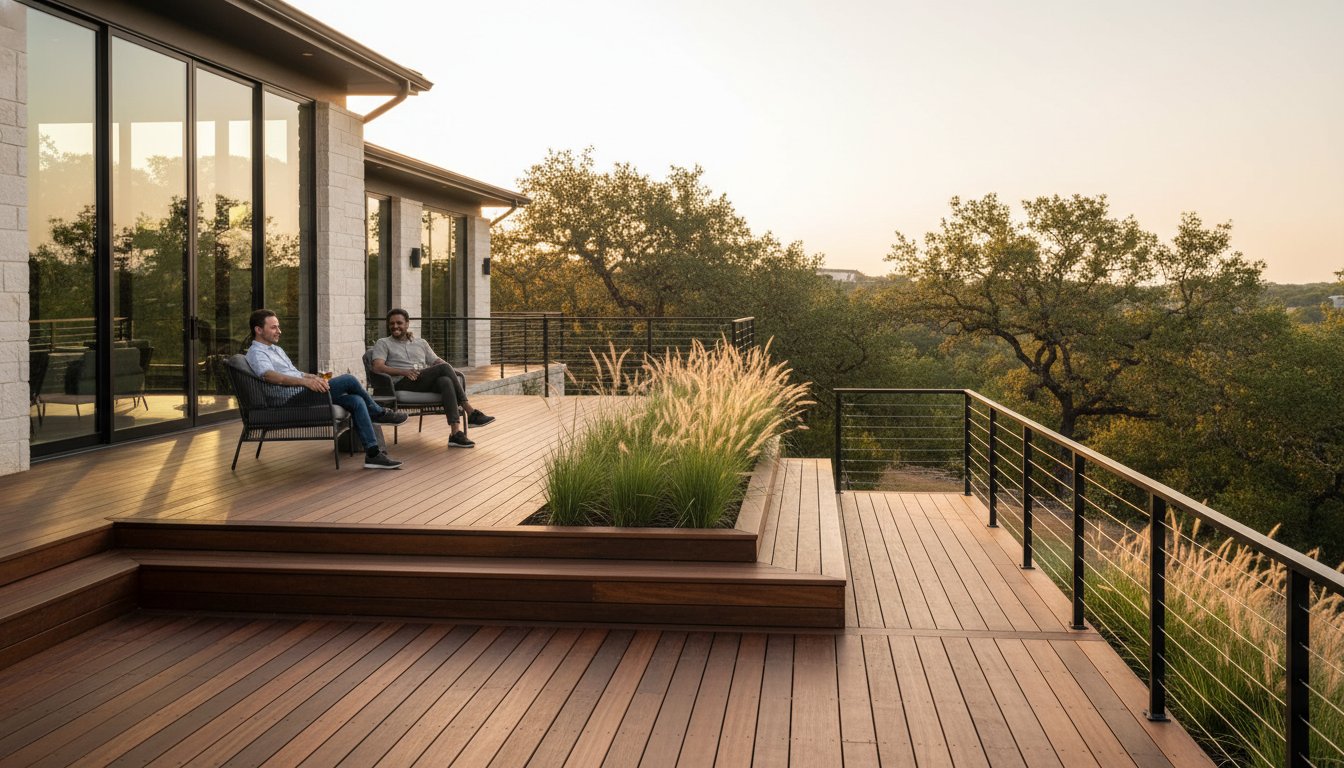
Most online deck calculators are off by at least 35% because they ignore the reality of Austin's specific permitting fees and the current demand for premium materials. You've likely seen conflicting price data that makes planning your backyard feel like a high-stakes guessing game. We're cutting through the noise to show you exactly how much does it cost to build a deck in Austin for the 2026 season.
You deserve a transparent breakdown that accounts for Central Texas weather and the rising cost of skilled local labor. This guide provides a no-BS look at the investment required for everything from pressure-treated basics to high-ROI exotic hardwoods. We'll walk through a clear budget framework and the hidden permitting factors that determine your final invoice.
You're about to learn how to balance long-term durability with architectural design so you can choose a builder with total confidence. We'll explore three distinct pricing tiers and the specific material choices that actually stand up to the relentless Texas sun.
Key Takeaways
- Stop relying on generic national averages that ignore the "Austin Premium" on skilled labor and the reality of Central Texas heat.
- Compare the performance and maintenance tradeoffs between local favorites like Cedar and high-durability investments like IPE hardwoods.
- Navigate the specific permitting and engineering requirements mandated by Austin Development Services for elevated builds or steep lots.
- Get a transparent, no-BS breakdown of how much does it cost to build a deck in the current Austin market, including often-overlooked "invisible" fees.
- Learn how 3D visualization and a precision-build philosophy eliminate budget surprises while maximizing your project's 30-year ROI.
Why national deck cost estimates fail in Austin
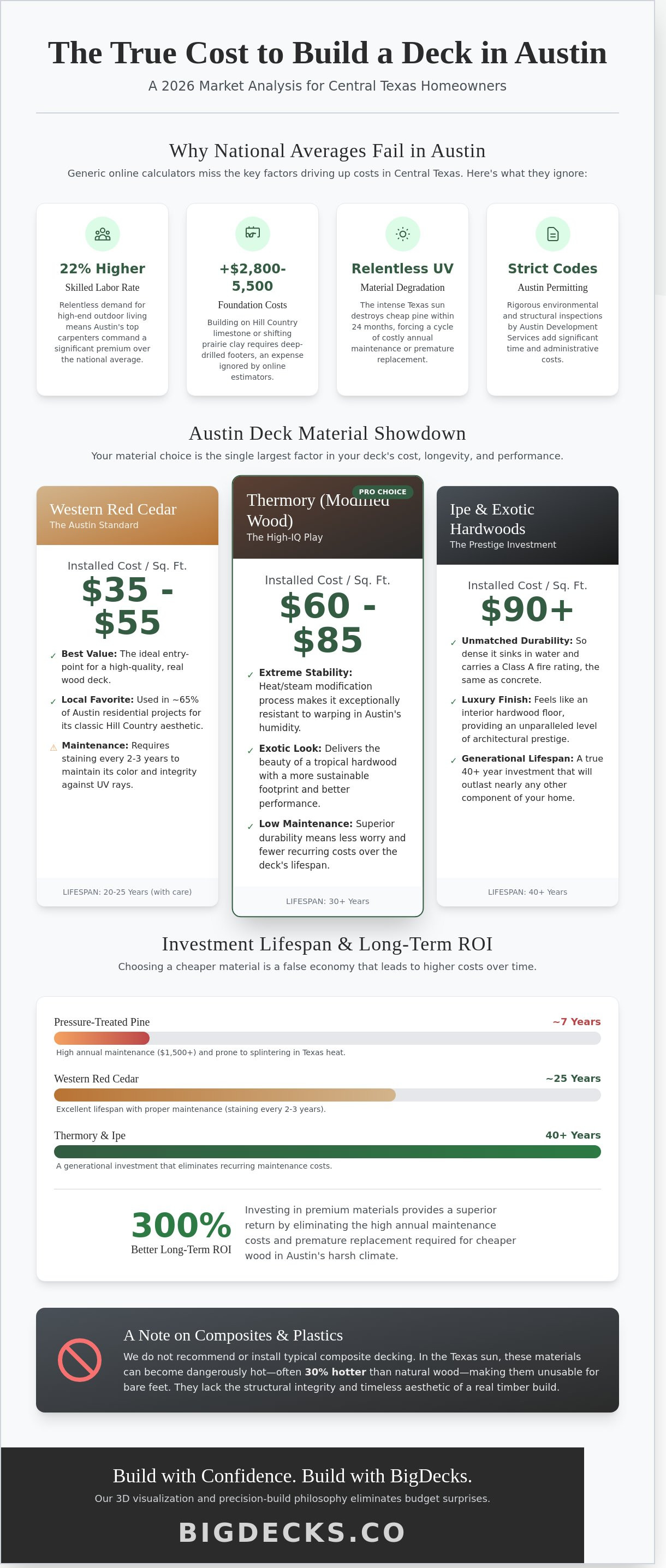
National pricing websites often quote $30 to $60 per square foot for a new deck. In Austin, those numbers are a fantasy. If you're asking how much does it cost to build a deck in Central Texas, you have to account for the "Austin Premium." Skilled carpentry labor in this city commands a 22% higher rate than the national average because the demand for high-end outdoor living is relentless. You aren't just paying for wood; you're paying for the expertise to handle Austin's unique terrain and climate.
Building on the limestone of the Hill Country or the shifting Blackland Prairie clay requires specific engineering. National estimates assume flat, soft dirt. Austin projects often require diamond pier foundations or deep-drilled concrete footers to prevent the structure from pulling away from the house as the soil moves. These structural requirements can add $2,800 to $5,500 to a project before the first deck board is even laid. A simple platform might work in the Midwest, but an Austin property demands a legitimate architectural outdoor space.
The cost of the Texas sun
The Austin UV index stays above 9 for most of the summer. This radiation destroys the lignin in standard pressure-treated pine, causing it to splinter and cup within 24 months. Choosing cheap materials is a liability that forces homeowners into a $1,500 annual maintenance cycle. Investing in heat-resistant hardwoods or high-performance composites provides a 300% better long-term ROI by eliminating those recurring costs and keeping the surface cool enough for bare feet in July.
Austin market dynamics in 2026
By 2026, material procurement in Central Texas has reached a new price floor. Local demand for luxury outdoor spaces has pushed lead times for premium contractors to five months or more. Low-ball bids from "trunk-slammers" usually result in mid-project change orders that increase the final bill by 20% to 30%. Knowing how much does it cost to build a deck means looking at the total contract price, not just the initial estimate. A professional build is a strategic investment in your property's appraisal value.
- Labor rates: Austin carpenters earn 22% above the national median.
- Foundation depth: Local codes often require 36-inch footings in shifting soil.
- Material lifespan: Cheap pine lasts 7 years here; composites last 25+.
- Permitting: Austin's rigorous environmental inspections add time and administrative costs.
Breaking down Austin deck material costs: Wood vs. the world
Austin's climate is a relentless test for any outdoor structure. Between the scorching July heat and the erratic humidity spikes, your material choice determines if your investment lasts 40 years or 4. When calculating how much does it cost to build a deck, the raw materials represent the largest variable in your final invoice.
Western Red Cedar remains the Austin standard for a reason. It offers a natural resistance to decay and a classic aesthetic that fits the Hill Country vibe. While it requires a consistent staining schedule every 2 to 3 years, it provides the best entry point for a high quality, real wood project. Roughly 65% of local residential projects still utilize cedar for its balance of performance and price.
For those playing the long game, Ipe and exotic hardwoods are the ultimate power move. These materials are so dense they carry a Class A fire rating and sink in water. You are paying for a 40 year lifespan and a level of prestige that cheaper alternatives cannot touch. If you want a deck that feels like a luxury interior floor, this is your material.
We champion Thermally Modified Wood, specifically Thermory, as the high IQ play for the 2026 market. By using heat and steam to alter the wood's cellular structure, Thermory becomes remarkably stable. It won't warp or swell when the Austin humidity hits 90%. It gives you the exotic look without the environmental footprint or the Ipe price tag.
You won't find us pushing plastic or composite boards. While big box retailers love them, these materials retain massive amounts of heat in the Texas sun, often reaching temperatures 30% higher than natural wood. They look like contact paper and fail to offer the structural soul of a real timber build. We build for performance, not for convenience.
Price per square foot by material
In the 2026 Austin market, material costs have stabilized but remain premium. These figures represent the total installed cost, including labor and standard substructures.
- Western Red Cedar: $35 to $55 per square foot.
- Thermory (Thermally Modified): $60 to $85 per square foot.
- Ipe and Exotic Hardwoods: $90+ per square foot.
Structural framing and metalwork costs
The skeleton of your deck matters as much as the skin. Standard pressure treated pine framing is the budget baseline, but precision steel framing is the modern gold standard. Steel stays perfectly level forever; it won't rot, twist, or sag over a 20 year period. While steel framing can add 25% to 35% to your structural costs, the ROI is found in a deck that never squeaks or slopes.
Custom metalwork is where a project gains its architectural edge. Integrating custom welded steel railings or powder coated accents changes the entire narrative of the build. These elements require specialized labor and on site welding, which typically accounts for 15% of the total project budget. Understanding how much does it cost to build a deck with these custom features requires a look at the complexity of the fabrication, not just the linear footage of the rail.
Final thoughts on materials: choose for the climate you have, not the one you want. Real wood and steel are the only materials that survive Austin with dignity.
The "invisible" costs: Permitting, engineering, and Austin labor
Most homeowners focus on the price of composite boards, but the "invisible" line items often dictate the final budget. Understanding the labor cost to build a deck per square foot is only half the battle. You also have to account for the city's red tape and the physical reality of your lot. These factors can swing a quote by thousands of dollars before the first pier is even poured.
Navigating Austin city code
Austin Development Services doesn't move fast. In 2026, permit approval times average 8 to 12 weeks for residential projects. Zoning laws are strict about impervious cover, which usually caps at 45% for standard residential lots. If your deck pushes you over that limit, you'll need specialized drainage or pervious decking materials. These adjustments often add $15 to $22 per square foot to your site preparation costs. Hiring a builder who knows local inspectors saves you from the "failed inspection" loop that kills project momentum.
Engineering and site preparation
Central Texas isn't flat, and your deck design has to respect the topography. If you're building on a steep lot in Westlake or near Lake Travis, standard post holes won't cut it. Structural engineering fees for elevated decks now range from $2,800 to $5,200. This ensures your investment doesn't slide down a limestone hill during a spring downpour. Site prep also includes demolition of old structures. Removing a 200-square-foot wood deck typically costs $1,200 to $2,500 depending on the height and accessibility.
The skilled labor shortage
Master carpenters in Austin are in high demand, and their rates reflect that expertise. You might find a low-bid crew willing to work for 30% less, but you'll likely pay for it later. The cost of "doing it twice" because of poor flashing or improper ledger attachment is often double the original quote. Professional builders carry General Liability and Workers' Comp insurance, which adds roughly 10% to 15% to the labor bid. This isn't fluff; it's the price of making sure you aren't liable if a worker gets hurt on your property. Knowing how much does it cost to build a deck means looking at these protections as necessary investments rather than optional extras.
Site clearing and drainage solutions are the final piece of the labor puzzle. If your yard has poor runoff, you'll need to install French drains or regrade the soil to prevent water from pooling under the new structure. In the Austin market, these drainage fixes average $3,500 per project. Ignoring these steps leads to rot and foundation shifts, regardless of how expensive your decking boards are.
ROI and architectural value: Investing in a 30-year deck
Austin real estate is a high-stakes game where every square foot of your property must perform. A custom deck isn't just a platform; it's a strategic asset that builds significant equity. In Travis County, high-end outdoor living spaces can recoup 65% to 75% of their initial cost during a home resale. Generic builds rot and depreciate, but an architectural deck is a 30-year investment that holds its ground. Smart owners don't see this as a simple expense; they see it as a capital improvement that secures the property's future value.
Calculating the new deck cost over time
Stop looking at the sticker price and start looking at the lifecycle of the build. When you calculate the new deck cost, you have to factor in the 30-year horizon. A cheap deck requires total replacement in roughly 12 years, effectively doubling your long-term spend. Investing in penetrating oils like Cutek Extreme is a non-negotiable move for serious homeowners. These oils protect the timber's core and stabilize the wood, cutting refinishing labor costs by 40% over the life of the structure. This isn't just about aesthetics; it's about preserving the structural integrity of your investment against the brutal Texas sun.
The psychological ROI is equally potent for those living in high-pressure environments. A functional, killer backyard eliminates the friction of hosting and provides a high-octane space for daily recovery. It's the difference between a wasted yard and a usable outdoor lounge that works as hard as you do.
Design as a value multiplier
Generic designs are a liability that buyers will eventually use to negotiate your price down. They look dated within five years and lack the structural integrity that modern buyers demand. Custom architectural builds, featuring integrated fencing and precision lighting, act as a massive value multiplier. Precision lighting and custom fencing aren't just accessories; they are the features that define the project's worth and curb appeal.
In the current Austin market, "turnkey" luxury is the gold standard for buyers. They are willing to pay a 15% premium for outdoor spaces that require zero immediate work and offer total privacy. Integrating high-performance amenities like saunas and cold plunges further separates your property from the pack. It changes the narrative from a simple renovation to a high-end wellness retreat that commands attention. When you evaluate how much does it cost to build a deck, remember that you're paying for a long-term result, not just a pile of materials.
The BigDecks strategy: From 3D design to final build
BigDecks doesn't guess. We execute. Our strategy revolves around eliminating the "maybe" from your project. When you ask how much does it cost to build a deck, you deserve an answer that doesn't shift once the dirt is turned. We've refined a process that bridges the gap between high-concept design and rugged construction logic.
The "Precision Build" philosophy is our standard. We combine traditional high-end carpentry with structural metalwork to create decks that outlast the mortgage. Our bidding process is transparent and direct. We strip away the fluff found in typical contractor quotes, focusing instead on the raw math of materials and expert labor. It's about ROI and structural integrity, not sales pitches.
The value of 3D design renderings
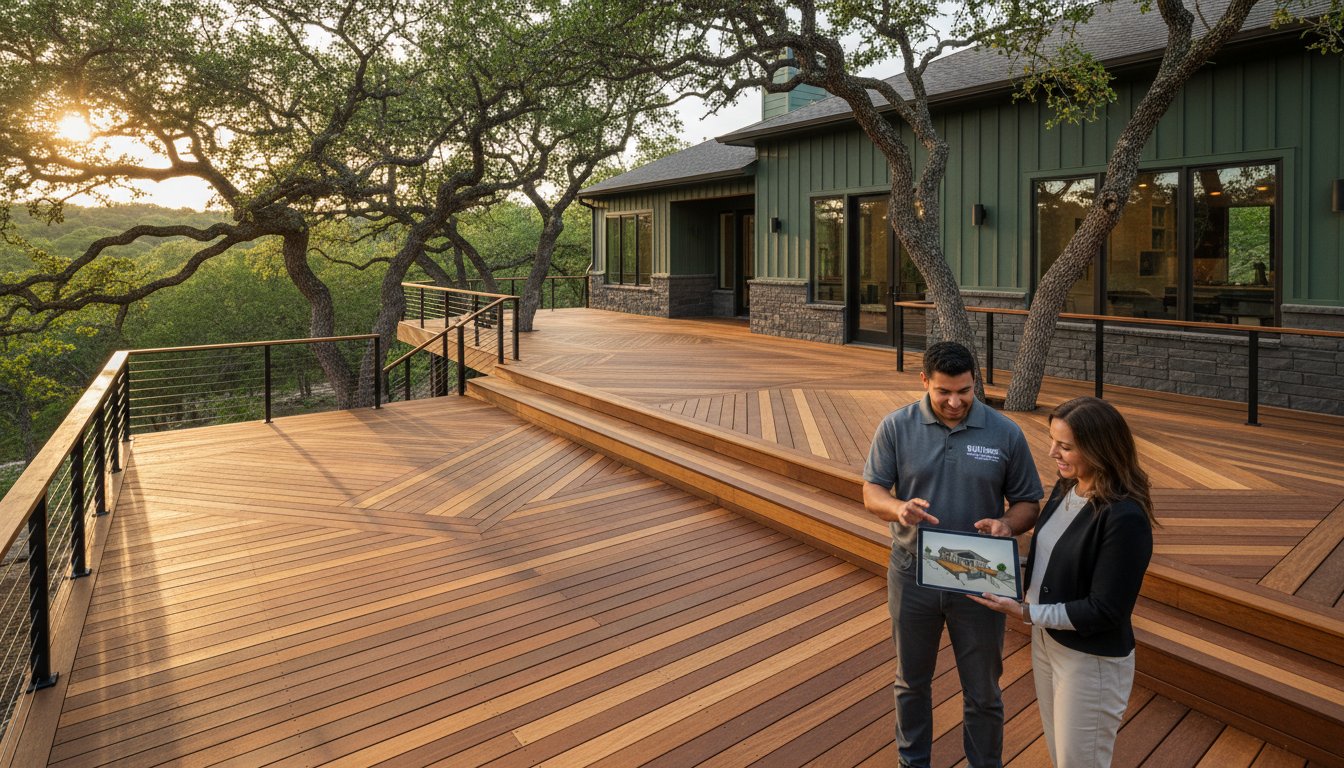
We build your deck twice. The first build happens in a high-fidelity digital environment. Our 3D modeling allows you to toggle between premium composites and Brazilian hardwoods in real time. You can see exactly how the 5 PM Austin sun hits your outdoor kitchen before we buy a single beam. This digital-first approach is a financial firewall. It reduces structural change orders by 18% on average, keeping your budget locked in.
Renderings also serve as a tactical advantage for regulatory hurdles. Providing a high-resolution 3D visualization often secures approval from Austin neighborhood HOAs 10 days faster than standard architectural sketches. It removes the guesswork for board members. When they see the final result clearly, the "yes" comes much faster.
Next steps for your project
Stop scrolling and start building. The first step is scheduling a site consultation with the BigDecks team. We come to your backyard to analyze the terrain, drainage, and structural requirements. To make this meeting high-impact, have your property survey and a target budget range ready. This allows us to move straight into the design phase without wasting time on unrealistic concepts.
Building in Central Texas requires a specific mindset. The 105-degree summers and sudden flash floods destroy mediocre builds within five years. We focus on longevity by using weather-resistant fasteners and reinforced framing. Your deck should be a permanent asset, not a recurring maintenance headache. Let's build something that wins.
Frequently Asked Questions
How long does the 3D design process take?
Most initial renderings are completed within 5 to 7 business days after the site consultation. This ensures we have accurate measurements before the creative work begins.
Will the 3D design show my specific house?
Yes. We model your home's exterior to ensure the deck feels like a seamless architectural extension rather than an afterthought.
Does the quote change after the design is finalized?
Our goal is budget certainty. Once the 3D design is approved and the contract is signed, the price is locked unless you request a specific change in scope during the build.
Secure Your Austin Outdoor Investment
Austin isn't a market for the timid or the ill-prepared. National price calculators consistently fail to account for the $3,500 engineering hurdles and the specific labor rates of Central Texas. If you want a 30-year asset, you have to look beyond the surface level. Determining how much does it cost to build a deck in 2026 means accounting for high-performance materials like Thermally Modified Wood that won't warp when temperatures hit 108 degrees. Our Austin-based expert team specializes in precision metal and wood integration to ensure your structure is as stable as it is stunning. We don't just build; we engineer for maximum ROI and architectural dominance in a competitive housing market.
Every decision you make now impacts your property value for the next three decades. We utilize advanced 3D design strategies to eliminate the guesswork and technical friction that plague standard builds. You deserve a backyard that reflects your standards and survives the Texas elements without constant maintenance. Stop settling for vague estimates and start with a plan that wins. Your property is a high-stakes investment, so treat it like one. Let's build a deck that stands the test of time.
Start Your Austin Deck Transformation with a 3D Design Quote
Frequently Asked Questions
How much does a typical 200 square foot wood deck cost in Austin?
A standard 200 square foot pressure treated wood deck in Austin currently ranges from $5,400 to $9,600 for professional installation. If you opt for Western Red Cedar, prices climb between $8,800 and $14,200. These figures cover the structural frame and decking boards but exclude premium additions like integrated LED lighting or custom steel railings.
Does the City of Austin require a permit for all deck builds?
Austin requires a building permit for any deck that sits more than 30 inches above the ground or is attached to your home. Even for freestanding structures, you'll need a permit if the deck exceeds 200 square feet in total area. Building without one can result in a 100 percent permit fee penalty and potential orders to dismantle the entire structure.
Which is cheaper in the long run: Cedar or Thermally Modified Wood?
Thermally modified wood is the superior financial move because it lasts 25 years with significantly less warping than Cedar. While Cedar costs 18 percent less at the initial purchase, it requires staining every 24 months to prevent rot. Over a 15 year period, the maintenance labor and material costs for Cedar make it $4,500 more expensive than thermally modified alternatives.
How much should I budget for deck labor costs in 2026?
Budget between $40 and $65 per square foot for skilled labor in 2026. This rate accounts for the 12 percent rise in local insurance and specialized tool overhead since 2024. Expert crews in Central Texas typically command 45 percent of the total project budget to ensure the build meets rigorous structural safety standards and local codes.
Can I save money by using composite decking instead of wood?
You won't save money on the initial invoice because composite materials cost 35 percent to 60 percent more than traditional wood. However, the reality of how much does it cost to build a deck shifts when you factor in the 10 year ROI. Composite eliminates the $900 annual power washing and staining bill, allowing the material to pay for its own premium by year eight.
How does a sloped lot affect the total cost of building a deck?
A sloped lot increases your total construction bill by 25 percent to 40 percent due to complex engineering requirements. Steep grades demand deeper concrete piers, additional structural bracing, and specialized scaffolding to keep the crew safe. If your Austin yard drops more than 36 inches across the deck span, expect to pay an extra $3,200 for heavy duty support posts and reinforced footings.
Hiring Deck Builders in Austin? The Strategic Checklist for 2026
Hiring deck builders in Austin? Our 2026 checklist helps you vet pros, choose heat-resistant materials, and avoid costly mistakes for a high-performance deck.
A cheap deck is the fastest way to set $30,000 on fire in the Texas sun. When 105-degree heat hits, low-grade lumber doesn't just age; it weaponizes, warping and splintering until your oasis becomes a structural liability within 18 months. You've likely seen the horror stories of contractors who talk a big game but deliver vague quotes and disappearing acts as soon as the frame is up.
Securing the elite deck builders austin property owners trust requires a move away from hope and toward a cold, calculated strategy. This 2026 checklist is your professional playbook for vetting contractors, auditing material durability, and demanding the 3D previews necessary to visualize your ROI before a single board is cut. We're diving into the technical standards and contract safeguards that ensure your outdoor space is a high-performance asset rather than a maintenance nightmare.
Key Takeaways
- Stop betting on "carpenters" and start vetting design-build firms equipped to handle Austin’s brutal 100-degree days and flash flood risks.
- Avoid the heat retention myth by choosing thermally modified wood over composite materials that burn feet in the August sun.
- Demand a 3D visualization audit to integrate luxury features like cold plunges and saunas into your build before construction begins.
- Use our strategic checklist to filter deck builders austin and secure a contractor who navigates HOA permits and local codes with precision.
- Protect your investment with the BigDecks standard of precision metalwork and high-performance wood treatments for maximum long-term ROI.
Why hiring deck builders in Austin requires a strategic approach
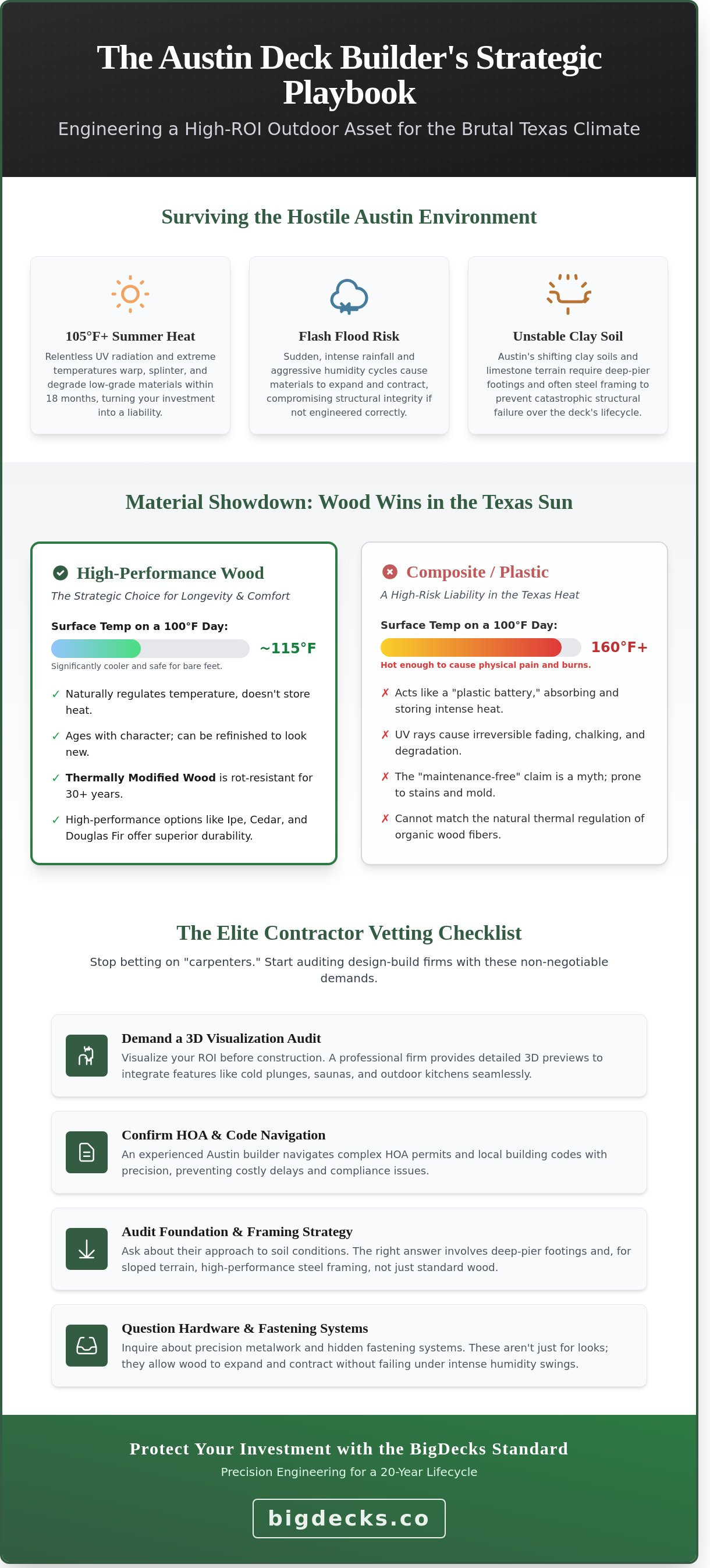
Austin is a hostile environment for mediocre construction. Hiring deck builders austin homeowners can trust means looking past the aesthetic and focusing on the engineering. Between the 105-degree summer streaks and the sudden 4-inch flash floods, your outdoor space is under constant assault. If you treat this like a simple weekend project, the Texas sun will warp your investment within 24 months.
Understanding what is a deck in a technical sense is just the baseline. In Central Texas, it's a structural asset that must withstand heavy UV exposure and shifting clay soils. A standard carpenter might build to code, but a design-build firm builds for a 20-year lifecycle. Cheap labor often skips the deep-pier footings required for our limestone-heavy terrain, leading to catastrophic structural failure when the ground shifts during our intense drought-to-deluge cycles.
A high-ROI outdoor living space in 2026 isn't just about square footage. It's about the psychological win of a seamless indoor-outdoor transition that holds its value. You're not just buying lumber; you're investing in a strategic extension of your home's footprint. This requires a partner who understands the high-stakes game of Austin real estate and the technical demands of our unique geography.
The Central Texas environmental audit
UV radiation in Austin is relentless, often stripping the moisture from standard pressure-treated lumber in a single season. This leads to checking, splitting, and hardware pull-out. We focus on humidity cycles that cause wood to expand and contract aggressively. Precision metalwork and hidden fastening systems aren't just for looks; they provide the mechanical room your materials need to move without snapping under the pressure of 90 percent humidity mornings and 100-degree afternoons.
Setting your project goals
You aren't just building a platform; you're engineering equity. Define your primary objective early. Is this a high-traffic entertainment hub for hosting or a private retreat designed to boost resale value? Aligning your budget with these architectural expectations is the difference between a "good enough" patio and a high-ROI asset. Building a custom deck in Austin requires more than just a permit. It demands a narrative that fits your home's existing footprint while solving for 2026's climate realities.
Winning the outdoor living game in Central Texas requires a partner who treats your backyard like a high-stakes pitch. You need deck builders austin residents rely on for technical precision and bold design, not just a hammer and a truck. Every board, bracket, and footing is a strategic decision that affects your long-term bottom line.
The Austin material checklist: why wood wins over plastic
Choosing materials isn't about aesthetics; it's about thermal physics and long-term ROI. Many deck builders in Austin will try to sell you on expensive composite boards by claiming they are maintenance-free. That is a myth that dies the moment you step outside in August. In the Texas heat, the wrong material choice becomes a liability rather than an asset.
Wood vs. composite in the Texas sun
On a 100-degree Austin afternoon, composite decking can reach surface temperatures of 160 degrees. That is hot enough to cause physical pain to bare feet or pets. Wood stays significantly cooler because it doesn't store heat like a plastic battery. While composite manufacturers have improved their cooling tech, they still can't beat the natural thermal regulation of organic fibers.
Aesthetic degradation is another factor. UV rays eventually break down the polymers in plastic decking, leading to chalking and permanent fading that you can't fix. Real wood ages with character. If you want the ultimate performance, thermally modified wood is the modern gold standard. It is heat-treated to remove organic sugars, making it rot-resistant for 30 years without the toxic chemicals found in traditional pressure-treated lumber.
Consider these high-performance options for your project:
- Ipe: An incredibly dense hardwood that carries the same fire rating as concrete and steel.
- Western Red Cedar: A classic choice that offers natural tannins to fight off Texas insects.
- Douglas Fir: Superior structural strength for the heavy-duty rafters required in covered structures.
Structural material requirements
The foundation matters more than the finish. For the steep grades and rocky terrain found in the Hill Country, wood framing is often a liability. Steel framing is the strategic move for 2026. It provides a perfectly level surface that won't warp, twist, or sag over a 25-year horizon. This precision metal fabrication allows for longer spans and fewer vertical posts, preserving your view.
Fastener selection is where average builds fail. Austin’s humidity and sudden temperature swings cause wood to expand and contract aggressively. Standard galvanized screws often corrode or snap within 8 years. Insist on 305-grade or 316-grade stainless steel fasteners. They cost roughly 45% more than standard options, but they ensure the structural integrity of the deck remains intact for decades.
Plastic decking also carries a hidden environmental cost. It is a petroleum-based product that cannot be easily recycled, meaning it eventually sits in a landfill for centuries. Sustainable wood captures carbon and can be refinished multiple times. When you are vetting deck builders austin homeowners trust for high-end results, prioritize those who understand the lifecycle of these materials.
The design and engineering audit for Central Texas homes
Austin’s terrain is a challenge, not a suggestion. Building on a 15% grade requires more than just lumber; it requires a strategic audit of your property’s physics. The best deck builders Austin has to offer don't just guess at structural integrity, they engineer it into the initial pitch to ensure your investment doesn't shift when the Texas soil does.
The power of 3D renderings
Static blueprints are obsolete for high-end builds. We use high-fidelity 3D models to map every material transition, from the grain of your Ipe boards to the texture of your existing limestone pavers. This digital precision typically reduces change orders by 18% because you've already walked through the space virtually. You can toggle lighting scenarios for a 9:00 PM summer night or check how the July sun hits your lounge area before committing to a $80,000 project. It turns a vision into a predictable outcome.
Bathing amenities and structural loads
Integrating a cedar sauna or a cold plunge is a significant engineering requirement, not a simple add-on. A standard 6-person hot tub weighs roughly 800 pounds empty, but exceeds 5,500 pounds once you add water and people. We utilize custom steel subframes and reinforced concrete footings to manage these 100-pound-per-square-foot loads. Proper drainage is equally critical for these features. We design integrated troughs that divert 100% of splash-out water away from your home’s foundation to prevent soil erosion and wood rot.
Austin’s Hill Country topography often features grades exceeding 12% that demand specialized foundation work. Engineering for these slopes requires deep-drilled piers or helical piles that reach stable strata beneath the surface. We treat architectural fencing as a structural extension of the deck rather than a decorative afterthought. This creates a cohesive visual line while providing the lateral stability needed for elevated platforms. Every bolt and bracket is a calculated move to ensure the structure remains rock-solid for 25 years or more.
- Weight Distribution: Custom metalwork supports heavy architectural features without bulky wood posts.
- Topography Management: Tiered layouts turn steep drops into functional, multi-level living zones.
- Material Synergy: Digital tools help visualize how modern decking meets traditional Texas masonry.
This phase is about de-risking your project. By identifying drainage paths and load-bearing requirements now, you avoid the structural failures that plague amateur builds. It's the difference between a deck that looks good for a season and a legacy outdoor space that performs for decades.
Five non-negotiable questions for your Austin deck contractor
Hiring deck builders in Austin requires more than a handshake and a rough estimate. You're making a capital investment in your property. If a contractor can't answer these five questions with technical precision, they aren't the right partner for your project. You need experts who understand the local terrain and the high-stakes nature of luxury construction.
- How do you navigate Austin's permitting and HOA gauntlet? The City of Austin Development Services Department is notorious for delays. Your builder must have a proven system for handling site plans, tree protection ordinances, and impervious cover limits.
- Will I see a 3D model before construction? 2D blueprints don't show how the sun hits your deck at 4 PM in July. Demand a high-fidelity model to visualize the flow, furniture placement, and overall ROI.
- What is your track record with Ipe and thermally modified wood? These materials behave differently than pressure-treated pine. Ipe has a 40 year lifespan but requires specialized pre-drilling and specific carbide blades.
- How do you engineer for Central Texas soil movement? Our clay expands and contracts. Ask about helical piers or footings dug 24 inches deep to hit stable limestone, especially on sloped lots in the Hill Country.
- What is the 5 year maintenance roadmap? A deck is a living asset. Your builder should provide a specific schedule for cleaning and UV protection to ensure the wood doesn't silver prematurely.
Vetting for professional authority
Don't settle for general experience. Ask for specific projects completed in West Lake Hills or Tarrytown where local code is strictly enforced. A legitimate decking contractor understands that modern Austin builds often require a hybrid approach. Steel framing provides a dead-level surface for expensive hardwoods and won't warp or rot like traditional timber. Verify their general liability insurance covers specialized carpentry, not just basic handyman tasks.
The quote transparency test
Low bids are often a trap. If an estimate lacks line items for material procurement, waste removal, or site preparation, you'll pay for it later in change orders. Transparent deck builders in Austin list every fastener and structural post. Compare quotes based on the net value rather than the bottom line. A bid that is 15% lower often cuts corners on structural hardware or uses sub-par lumber grades that will crack within 12 months. Demand clarity on who handles the site cleanup and daily logistics.
Maximizing your outdoor ROI with BigDecks
BigDecks treats every project as a high-stakes investment rather than a simple home improvement task. When you evaluate deck builders austin, look for a philosophy that merges traditional carpentry with the structural integrity of precision metalwork. This hybrid approach ensures your substructure remains stable even as the volatile Austin soil shifts. We build for the 30-year horizon, focusing on engineering that survives 105-degree summers and sudden freezes.
Your project begins with a comprehensive 3D design phase. This isn't just a visual aid; it's a technical blueprint that defines every joist and fastener. Using 3D modeling allows you to visualize sun angles and traffic flow before we break ground. It eliminates the 15% budget creep often seen in projects with vague sketches. You get a clear, data-driven plan that maximizes every square foot of your property and avoids costly mid-construction changes.
Long-term durability and maintenance
Austin's climate is brutal on organic materials. The UV index regularly hits 10 or higher, which destroys standard surface stains within 24 months. We use Cutek Extreme, a high-performance penetrating oil that stays active inside the wood grain. This oil displaces moisture from the inside out, preventing the "gray out" effect and deep structural cracks. It's a proactive strategy for wood health that beats surface-level stains every time.
Maintaining your ROI requires a commitment to recurring care. Re-oiling your deck every 18 to 24 months isn't just an aesthetic choice; it's a financial one. Regular maintenance can extend the life of a cedar or hardwood deck by 150%, saving you tens of thousands in replacement costs later. Penetrating oils make this process simple. You don't have to sand the surface back to bare wood; you simply clean and recoat. It's a streamlined system designed for the homeowner who values their time and their property value.
Final thoughts
The strategic framework for hiring deck builders austin comes down to one factor: partnership. You aren't just looking for someone to swing a hammer. You need a team that understands local building codes, material science, and long-term asset management. We prioritize transparency and technical excellence over quick fixes. This ensures your outdoor space remains a high-value extension of your home for decades. If you're ready to move beyond basic construction, it's time to build something that lasts; for readers who want to discover Cascade Outdoor Services and their expert approach to structural restoration, their standards serve as a guide for durable outdoor living.
Own Your Outdoor ROI
Building a high-end deck in 2026 is a calculated move that requires more than just a hammer and basic lumber. You've learned that choosing thermally modified wood or Ipe is the only way to beat the Texas heat while ensuring a 40 year lifespan for your investment. Precision matters. Most deck builders austin has available won't provide the engineering audit or custom welding necessary for a truly permanent structure. You need a partner that treats your backyard like a high-stakes asset.
BigDecks eliminates the guesswork by providing advanced 3D visualization for every project. We don't just build; we engineer outdoor environments that maximize your property's value through specialized materials and expert metalwork. It's time to stop looking at catalogs and start looking at results. You deserve a space that reflects your standards and stands up to the Central Texas sun without compromise.
Secure your 3D design rendering and start your build with BigDecks
Your vision is ready for the big stage, so let's get to work.
Frequently Asked Questions
Do I need a permit for a deck in Austin, TX?
You need a permit for any deck that sits more than 30 inches above the ground or attaches directly to your home. The Austin Development Services Department requires these approvals to ensure your project meets local safety and fire codes. Skipping this step creates a massive liability during resale; smart homeowners secure their permits to protect their investment and ensure the build is up to code. Beyond structural safety, ensuring your home's security during and after construction is vital—Prestige Mobile Locksmith provides the professional lock and key services Austin residents rely on for total peace of mind.
How much does a custom deck cost per square foot in Austin?
Budget between $45 and $95 per square foot for high end results from the deck builders austin residents hire for premium outdoor living. A standard 400 square foot project typically requires a capital investment of $18,000 to $38,000 depending on material choice and site complexity. These figures reflect 2026 market rates for professional grade construction, engineering, and high performance materials that survive the Texas sun.
Which wood is best for the Central Texas climate?
Ipe is the undisputed king for the 105 degree summers in Central Texas. This ultra dense hardwood carries a Class A fire rating and resists rot for 40 years with minimal intervention. If you want a killer aesthetic at a different price point, Western Red Cedar is a solid alternative; just plan to reseal it every 24 months to combat the intense UV exposure that degrades softer grains.
How long does a typical deck build take in Austin?
A professional crew usually completes the physical construction in 14 to 21 days. However, you should account for a 6 week lead time to navigate the City of Austin permitting queue and material logistics. We focus on high octane execution once we break ground; our goal is to close the loop quickly so you can start seeing an ROI on your new space.
Why should I choose wood over composite for my Austin home?
Natural wood stays 20 percent cooler than most composite products when the August sun is relentless. While composite wins the maintenance game, real wood offers a sophisticated look and a tactile experience that high end buyers crave. It is a strategic choice for homeowners who prioritize thermal comfort and the timeless appeal of a natural material that breathes in the heat.
Can you build a deck on a sloped yard with limestone?
Limestone is a superior foundation once you penetrate the surface with specialized hammer drills. We anchor 12 inch concrete footings directly into the rock to ensure the structure never shifts, even on the steep grades found in West Austin. It requires more technical precision than a flat dirt lot, but the result is an incredibly stable deck that leverages the natural strength of the Texas landscape.