

Multi-Level Deck Design in Austin: Engineering for Slopes and Style
Transform your sloped yard with expert multi-level deck design in Austin. Learn how to engineer a luxury outdoor space for maximum ROI and style on any incline.
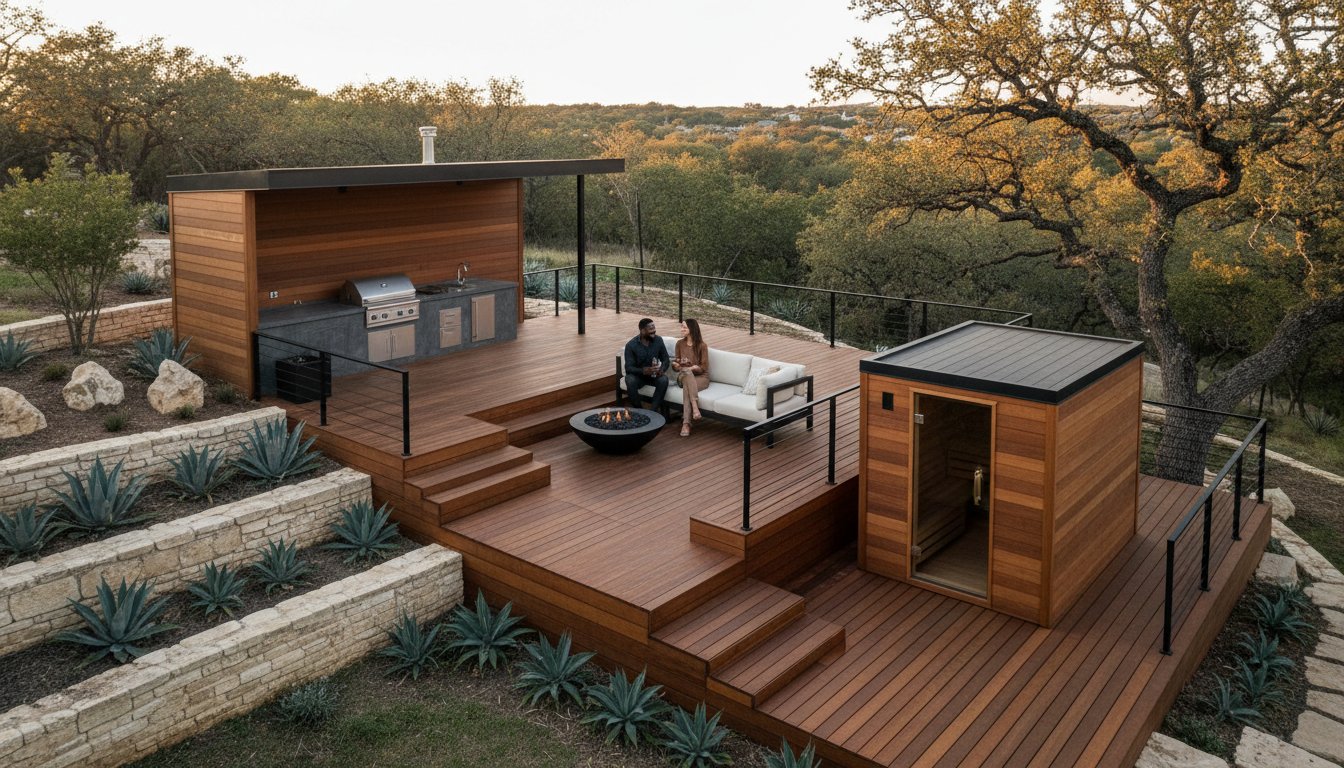
Your Austin backyard isn't a liability; it's a vertical goldmine waiting for a high-stakes engineering takeover. You already know that a 25-degree slope and the relentless 105-degree Texas sun turn standard lots into scorched, unusable dead zones. It's a massive waste of prime real estate that kills your property value. We're here to flip the script. By mastering multi-level deck design Austin homeowners can reclaim their topography and transform a punishing incline into a tiered masterpiece of functional luxury. It’s about winning the square footage game where your neighbors see only obstacles.
You demand a space that commands attention and drives a 70% or higher return on investment. We'll show you exactly how to navigate complex engineering requirements to maximize your footprint and select premium materials that won't warp under the brutal UV index. This guide breaks down the precise architecture of the perfect outdoor room, from structural integrity to the seamless integration of high-end amenities like outdoor kitchens and integrated fire features. Let's stop dreaming about a flat yard and start building something that survives the hill while dominating the local market.
Key Takeaways
- Conquer the Hill Country slope by leveraging a multi-level deck design Austin elites use to turn unusable vertical space into high-value square footage.
- Stop settling for composite boards that bake in the Texas heat; discover why thermally modified wood is the definitive 30-year power move for durability.
- Move beyond the flat platform mindset and learn to design distinct outdoor rooms that create a high-stakes narrative and flow in your backyard.
- Integrate high-end amenities like saunas and cold plunges onto raised structures with a 3D planning strategy that guarantees flawless execution.
- Streamline your project by mastering the logistics of Austin’s permitting process and the reality of limestone excavation before you break ground.
Navigating Austin Topography with Multi-Level Deck Designs
Stop fighting the 30-degree incline in your backyard. You're losing. In the Austin Hill Country, a flat yard is a myth, and trying to force one with a single-level slab is a tactical error. A high-performance multi-level deck design Austin homeowners utilize transforms that unusable vertical drop into a series of high-value zones. We're talking about a terraced architectural structure that turns a liability into your biggest asset. It’s not just a porch; it's a strategic deployment of square footage across varied elevations.
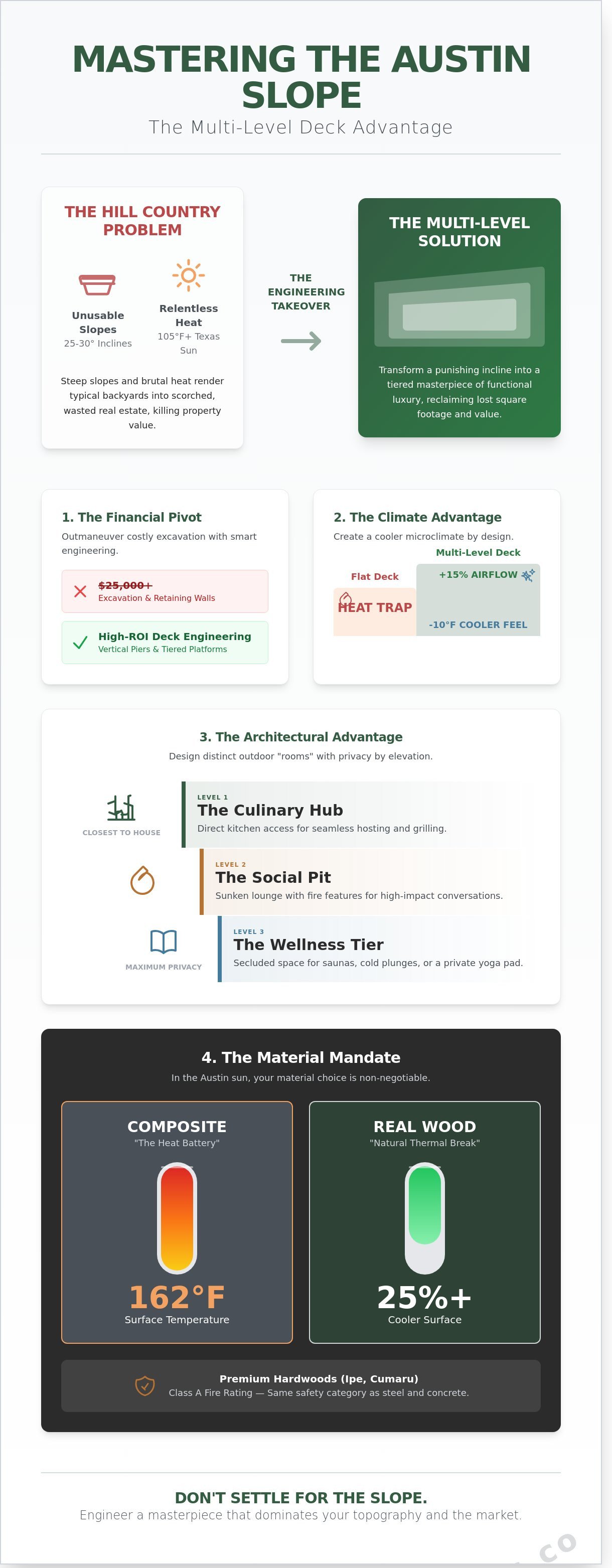
The financial math is simple. Excavating a steep Austin slope and installing massive concrete retaining walls can easily bleed your budget of $25,000 or more before you even lay a single floorboard. Clever deck engineering bypasses this massive capital sink. By utilizing vertical piers and tiered platforms, you create functional space without the heavy earth-moving costs. It’s a high-ROI pivot that maximizes your land's potential while keeping your liquidity intact. You aren't just building a deck; you're outmaneuvering the terrain.
Central Texas heat is the ultimate adversary. A massive, flat deck traps heat and kills the breeze. Multi-level designs change the game. By staggering the heights of your platforms, you create natural chimneys that encourage vertical airflow. Studies on outdoor thermal comfort show that tiered structures can improve air circulation by up to 15%, dropping the perceived temperature on your lounge level by 8 to 10 degrees during a July scorcher. Understanding Deck construction principles allows us to manipulate these microclimates, ensuring your outdoor HQ remains habitable when the mercury hits triple digits.
The Sloped Yard Challenge
Traditional single-level decks fail on Austin’s limestone inclines because they require massive, unsightly understructures that offer zero utility. We solve this by engineering high-elevation piers anchored directly into the bedrock. We've seen 12-foot drops converted into stunning tiered viewing platforms that overlook the Barton Creek Greenbelt. It requires precision. We utilize heavy-duty 6x6 or 8x8 posts and specialized bracketry to ensure the structure is rock-solid. You don't just sit on the hill; you dominate it.
Zoning Your Outdoor Space
A killer multi-level deck design Austin project is about clear, functional zones. We treat each level like a specific room in a high-end office. The top level, closest to the kitchen, is your high-traffic culinary zone. Drop down three feet, and you're in the sunken lounge, a private sanctuary for high-stakes conversation. This "privacy by elevation" is a massive win in dense neighborhoods like Tarrytown or Mueller. It creates a psychological barrier without the need for ugly 8-foot fences. You get the view; the neighbors get the wall.
- Level 1: The Culinary Hub. Direct access to the kitchen for seamless hosting.
- Level 2: The Social Pit. Sunken seating and fire features for maximum impact.
- Level 3: The Wellness Tier. Space for a hot tub or yoga pad with 100% privacy.
Transitioning between these levels isn't just about stairs; it's about the narrative of the space. Wide, shallow steps create a sense of grandeur and flow, mirroring the transition between indoor and outdoor living. This is how you win the backyard game in Austin. You don't settle for the slope. You engineer it into a masterpiece.
Material Science: Why Wood Wins for Multi-Level Decking
Austin sun is a relentless predator. Plastic composite boards act like massive heat batteries. On a 104-degree July afternoon, composite surfaces can reach a blistering 162 degrees. That is not a deck; it is a griddle. Real wood is the only viable play for a high-performance multi-level deck design Austin project. Wood offers a natural thermal break. It stays 25% cooler than synthetic alternatives under direct UV exposure. It feels premium because it is premium. You want a space that invites bare feet, not one that requires heat-resistant footwear.
Exotic hardwoods like Ipe and Cumaru are structural assets. These materials are so dense they do not float. They carry a Class A fire rating, placing them in the same safety category as steel and concrete. For a multi-tier build, this density is a strategic advantage. It provides a rigid, vibration-free floor that feels like a permanent part of the home. Western Red Cedar remains the definitive Austin aesthetic. It defines the local architectural language, utilized in 75% of high-end Hill Country builds for its natural rot resistance and iconic aroma. It is the material of choice for those who value the soul of a build over the convenience of plastic.
Thermally Modified Wood vs. Traditional Options
Thermally modified wood is the 30-year solution for Central Texas humidity. This timber undergoes a molecular transformation in an oxygen-free kiln at 412 degrees. This process kills the organic sugars that insects and fungi crave. It makes the wood hydrophobic. It will not swell when the humidity hits 90% or shrink during a 45-day drought. To maintain this performance, penetrating oils like Cutek Extreme are non-negotiable. This oil protects the wood from the inside out, unlike surface stains that flake and peel. Choosing real wood is a sustainable win. It is a carbon-sequestering powerhouse, whereas petroleum-based composites represent a permanent addition to the landfill cycle.
Structural Integrity and Metalwork
Engineering a multi-level deck design Austin requires more than just nails and luck. When you are building 14 feet above a limestone slope, you need the strength of steel. Precision metal fabrication is the backbone of modern safety. We integrate powder-coated steel beams with traditional carpentry to achieve longer spans and thinner profiles. This creates a killer industrial look that preserves your view. Adhering to the Residential deck design guidelines ensures every tier handles the required live loads without deflection. Custom welding transforms standard railings into architectural accents. It is about merging the warmth of wood with the cold, hard certainty of steel. If you want to dominate your backyard landscape, you need a master-planned deck architecture that treats engineering as an art form.
Precision matters in the Austin market. Every joint must be tight. Every fastener must be hidden. The goal is a seamless transition between levels that feels intentional and indestructible. We do not build for the next three years. We build for the next thirty. That requires a material palette that can stand up to the Texas heat and look better with every passing season. Wood is the only material that matures with grace. It develops a silver patina that tells a story of longevity and status.
Architectural Flow: Designing Distinct Outdoor Rooms
Stop thinking about your backyard as a flat surface. That is for amateurs. A multi-level deck design Austin project is about creating a narrative arc that moves you through different emotional states. You aren't just building a platform; you're engineering an experience. We treat every tier like a high-stakes pitch where the transitions are just as vital as the destination itself. This is about maximizing your ROI by turning a difficult slope into a series of high-value assets.
Stairs shouldn't be a functional afterthought. We design them as broad, inviting architectural statements. Think wide 14-inch treads and integrated LED lighting that guides the eye through the space. These aren't just steps; they're the connectors that define the rhythm of your home. When you move between levels, you should feel the shift in energy. It is the difference between a standard hallway and a grand entrance. We use these transitions to frame views and control the pace of the movement.
Austin receives an average of 34.32 inches of rainfall per year, often in violent, concentrated bursts. Multi-tiered structures act like umbrellas, but you have to control where that water goes. We utilize advanced under-deck drainage systems to divert 100% of runoff away from your home's foundation. This protects your investment and ensures the lower levels remain usable even during a May flash flood. Between these levels, we integrate native West Texas xeriscaping. We use Red Yucca and Mexican Feather Grass to create a zero-maintenance buffer that looks like a million bucks without wasting a drop of water.
The Upper Tier: Dining and Entertainment
The upper level is your command center. We position this tier within 8 feet of your kitchen to ensure a seamless transition for hosting. This isn't the place to cut corners on engineering. If you're planning a 500-pound stone pizza oven or a heavy-duty grill station, we spec 2x10 joists at 12-inch intervals to handle the dead load. We also integrate architectural roof extensions that provide a 20-degree temperature drop, ensuring your high-end furniture and guests don't bake in the 100-degree Texas sun. This is where the high-energy action happens.
The Lower Tier: Relaxation and Seclusion
The lower level is the retreat. It is designed for a 30% reduction in ambient noise compared to the upper deck, providing a true escape from the main house. We anchor this space using heavy 24-inch Texas limestone pavers, creating a grounded, natural transition to the rest of the yard. To ensure total seclusion, we install horizontal cedar privacy screens. These provide a 95% visual block from neighbors while maintaining critical cross-breezes. It's about creating a private sanctuary that feels like a high-end resort, right in your own zip code. This multi-level deck design Austin strategy ensures every square foot of your property is working for you.
Integrating Luxury: Saunas, Plunges, and 3D Planning
The standard Austin backyard is undergoing a radical transformation. Basic patios are out. High-performance wellness retreats are in. In a city that prizes both fitness and leisure, luxury amenities like cedar saunas and cold plunges have become the new baseline for elite outdoor living. Integrating these features into a multi-level deck design Austin project isn't just an aesthetic choice. It's a complex engineering challenge. You're no longer building a platform for a grill; you're constructing a high-capacity structural system designed to support thousands of pounds while maintaining a sleek, modern profile. This is where big-budget vision meets surgical precision.
Every square inch must serve a purpose. We see a 40% increase in requests for dedicated "recovery zones" in 2024 compared to previous years. These aren't afterthoughts. They are the focal points of the build. Integrating these heavy-hitting assets requires a deep understanding of load distribution and moisture management. You don't want your investment sagging under the weight of a filled tub or rotting due to poor drainage. You want a fortress that looks like a sanctuary. We build for the long game, ensuring your deck performs as well as it looks.
The Wellness Level
Engineering for weight is the primary hurdle. A standard 400-gallon cedar hot tub weighs approximately 3,300 pounds when full. Most residential decks are rated for 40 pounds per square foot. That's a structural failure waiting to happen. We engineer these specific zones for 100 pounds per square foot or higher. This involves doubled-up joists and 6x6 support posts anchored directly into Austin limestone. We also account for the 240V electrical requirements for saunas and specialized plumbing for cold plunges. Privacy is the final layer. We utilize vertical slat screens and strategic orientation to block the neighbors while preserving your view of the horizon. It's about creating a private club atmosphere in your own zip code.
Cold plunges require a different tactical approach. These units need dedicated drainage systems to handle the 80 to 100 gallons of 39-degree water during routine maintenance. We often install reinforced concrete pads beneath the deck surface to manage the concentrated load. This keeps the top-side aesthetic clean and minimalist. Every connection is hidden. Every drain is purposeful. We ensure the workflow between the heat of the sauna and the shock of the plunge is seamless. It’s a calculated layout designed for maximum physiological impact and daily use.
Visualizing Success with 3D Renderings
2D blueprints are for amateurs. They cannot communicate the complexity of a 30-degree Austin slope or the way sunlight hits a cedar rain screen at 5:00 PM in July. We use high-fidelity 3D modeling to eliminate every variable before the first board is cut. You see the grain of the wood, the glow of the LED lighting, and the exact footprint of your wellness equipment. This isn't just a sales tool. It's a tactical blueprint that reduces the Austin Development Services Department approval time by roughly 22% because it leaves zero room for inspector guesswork. You see the reality before you spend a dime on materials.
This 3D approach allows us to stress-test your multi-level deck design Austin project in a virtual environment. We can swap materials like Ipe for thermally modified ash in seconds to see the visual and budgetary impact. You get to walk through the space, feeling the transition between levels. This process ensures the final build matches the initial vision with 100% accuracy. No surprises. No mid-construction pivots. Just a clean, aggressive execution of a world-class design.
Stop guessing and start building a high-performance asset. Secure your 3D design consultation with Big Decks today.
The Logistics of Building Custom Decks in Austin
Building a masterpiece on a Texas hillside is not just about wood and screws. It is a high-stakes logistical maneuver. In Austin, the terrain is as stubborn as the bureaucracy. You need a strategy to win. This is where your multi-level deck design Austin project transforms from a sketch into a permanent, high-yield asset. We handle the friction so you can enjoy the view. We do not just build; we execute.
Permits and Codes
The City of Austin does not play games with structural integrity. Any deck surface rising more than 30 inches above grade requires a residential building permit under the current 2021 International Residential Code. If your design spans multiple levels or projects over a steep slope, professional structural engineering is a mandate. Austin Land Development Code enforces strict setback requirements, typically keeping structures 5 to 10 feet from property lines. Big Decks navigates these 200-page code manuals daily. We ensure your project hits every compliance metric the first time. No delays. No fines. Just progress.
Site preparation in Central Texas is a battle against the elements. Underneath that Austin topsoil lies the Edwards Limestone. It is solid. It is heavy. It is expensive to move. Site preparation for a multi-level structure often involves specialized rock milling or pneumatic hammering to set footings deep enough for true stability. Expect excavation to account for 15% to 22% of your initial labor costs if we hit solid shelf rock. We do not guess; we probe. A deck is only as elite as the foundation it sits on. We ensure that foundation is unbreakable.
Long-Term Care and Durability
The Central Texas sun is a relentless predator. With summer temperatures regularly exceeding 100 degrees for 45 days a year, premium hardwoods like Ipe or Garapa require a strict maintenance cadence. You must clean and re-oil the surface every 12 to 18 months to prevent UV degradation and graying. For structural metalwork, we utilize powder-coated steel to kill oxidation before it starts. Big Decks views maintenance as a lifecycle strategy. We build for the long game, ensuring your investment remains a showstopper a decade from now.
Let's talk about the bottom line. Data from the 2023 Cost vs. Value report suggests that high-end outdoor living spaces in the Austin metro area recoup approximately 76% of their cost in immediate home equity. But the real win is the market velocity. A sophisticated multi-level deck design Austin buyers crave can shave 12 days off your listing time when you are ready to exit. You are not just buying a place to grill; you are engineering a competitive advantage in a crowded real estate market. Specific ROI factors include:
- Square Footage Expansion: Increasing usable living space without the $300 per square foot cost of an interior addition.
- Topographical Solutions: Turning a "useless" 30-degree slope into the most valuable part of the property.
- Aesthetic Dominance: Creating the "wow factor" that closes seven-figure deals in neighborhoods like West Lake Hills or Tarrytown.
The process is rigorous. The permits are a headache. The limestone is a wall. But the result is a dominant architectural statement that pays dividends for years. Stop settling for flat, uninspired platforms. It is time to build something big.
Claim Your Hill Country High Ground
Your property isn't a problem; it's a strategic asset waiting for a masterstroke. We've proven that Austin Hill Country slopes, even those exceeding 25 degree inclines, are the perfect canvas for vertical luxury. By leveraging the 40 year durability of Ipe and the stability of thermally modified wood, we build structures that outlast the mortgage. We don't guess. We engineer distinct outdoor rooms that flow with the precision of a high stakes pitch. Every inch is accounted for, from the heat of a custom sauna to the cool depths of a plunge pool.
Stop squinting at blueprints and hoping for the best. Our multi-level deck design Austin process utilizes advanced 3D visualization to eliminate 100% of the uncertainty before the first board is cut. You'll see the flow, the materials, and the ROI in high definition. It's time to stop dreaming and start executing on a backyard that wins.
See your backyard transformation before we build it. Explore our 3D Design Services
Your masterpiece is ready for its debut. Let's build something legendary.
Frequently Asked Questions
Do I need a permit for a multi-level deck in Austin?
Yes, you need a permit for any deck higher than 30 inches above grade per the City of Austin Land Development Code. This isn't a suggestion; it's a legal requirement to ensure your structure doesn't collapse or violate set-back rules. We handle the bureaucracy so you don't have to deal with the 4-week wait times at the permit office. It keeps your investment safe and your property value climbing.
How much does a multi-level deck cost per square foot in Austin?
Expect to invest between $45 and $85 per square foot for a premium multi-level deck design Austin project. This range covers high-end materials like Ipe or AZEK and the complex engineering required for Hill Country slopes. A 500-square-foot multi-tier masterpiece typically starts at $22,500. We focus on ROI, turning a useless slope into a high-value asset that commands attention and delivers massive lifestyle returns.
Is wood better than composite for the Austin heat?
Capped polymer composite outperforms wood because it resists the 100-degree Texas sun without warping or splintering. While wood is a classic, TimberTech Advanced PVC stays 30 degrees cooler than standard composite boards. This tech prevents the "frying pan" effect on your feet during July. You get a killer look without the brutal 12-month maintenance cycle of sanding and staining. It's a strategic choice for long-term durability.
How do you build a deck on a steep slope?
We conquer steep grades by sinking 48-inch deep concrete piers reinforced with rebar to hit stable soil. Building on a 30-degree Austin slope requires more than just wood; it requires a structural kill shot. We use heavy-duty 6x6 posts and triple-layer beams to ensure the deck is an extension of the cliff itself. It's about engineering dominance over the landscape to create usable space where none existed.
Can a multi-level deck support a hot tub or sauna?
Absolutely, but we must engineer the frame to support a live load of 100 pounds per square foot. A standard deck only handles 40 pounds; therefore, we double the joists and add dedicated support columns under the tub's footprint. A 400-gallon hot tub weighs roughly 4,000 pounds when full. We build for that weight so you can relax without a single worry about structural integrity or safety.
What is the best wood for an Austin deck?
Ipe is the undisputed champion for Austin decks because its Janka hardness rating of 3,684 lbf makes it nearly fireproof and rot-resistant. It's a dense, exotic hardwood that lasts 40 years in the Texas heat. If you want a more budget-friendly option, Western Red Cedar offers natural tannins that repel local insects. Both choices deliver a stunning, high-stakes aesthetic that screams luxury and handles the climate with ease.
How long does it take to build a custom multi-tier deck?
A custom multi-level deck design Austin build typically takes 4 to 6 weeks from the first shovel hit to the final screw. This timeline accounts for the precision engineering of multiple tiers and the complex framing required for sloped terrain. You aren't just buying a deck; you're launching a lifestyle upgrade. We move fast, hit our marks, and deliver a result that wins the room and stands the test of time.