

Multi-level deck design ideas for Austin backyards
Discover architectural multi-level deck design ideas for sloped Austin backyards. Turn your steep lot into a stunning asset with heavy timber and smart zoning.
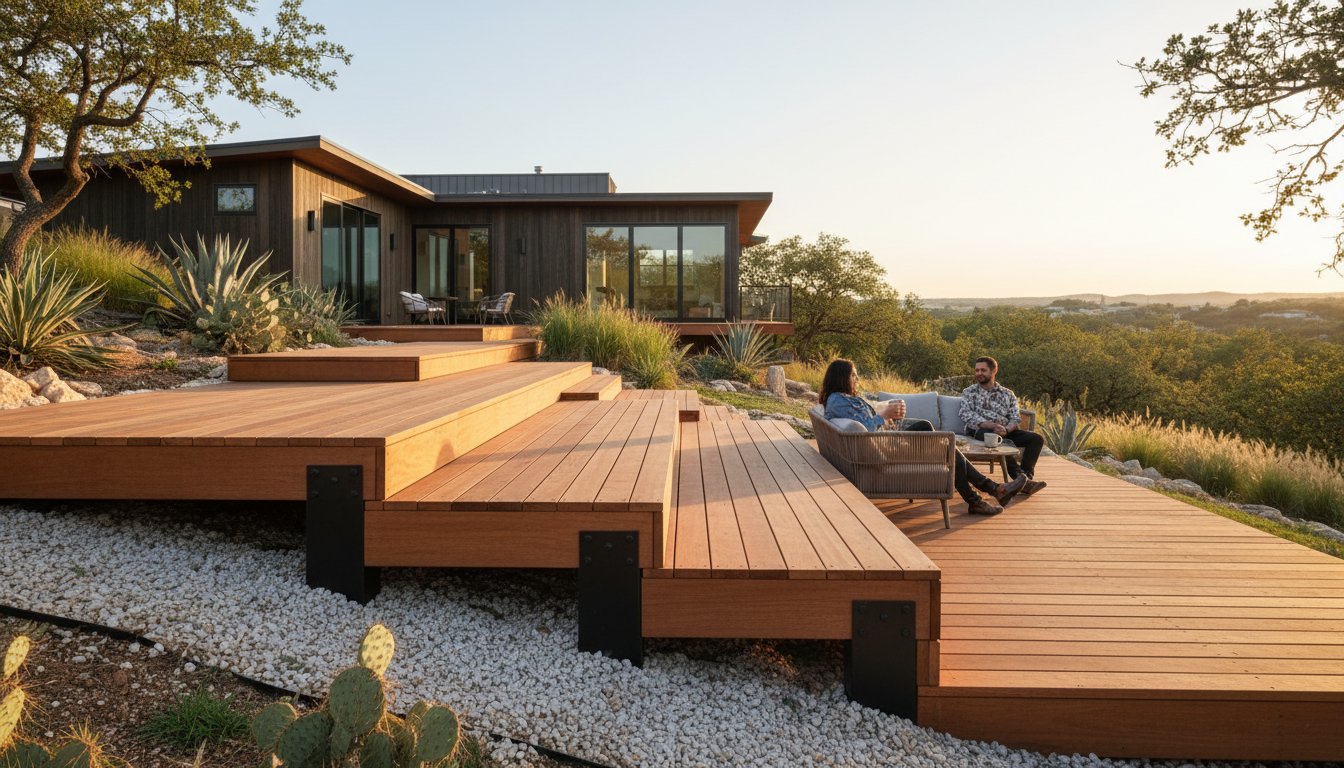
Most Austin homeowners view a steep slope as a structural liability that effectively deletes half of their usable acreage. You likely realize that a standard flat deck perched on a hill often looks like a flimsy afterthought and does little to solve the flow between your kitchen and the yard. This article explores architectural multi-level deck design ideas that turn elevation into a strategic advantage by using heavy timber framing and functional zoning.
We prioritize structural integrity with 6x6 posts on steel bases and 4x12 Douglas Fir beams to ensure the build remains rock-solid for decades. You will learn how to navigate complex grades while selecting materials like Western Red Cedar and Cutek Extreme that actually survive the Texas climate. We avoid the thin, cheap look of composite and instead focus on generous proportions and honest, heavy materials.
We are going to break down how to organize your layout into distinct zones to maximize your property ROI. You will see how a design-led approach creates a seamless transition from your back door to the lowest tier of your lot without sacrificing calm composition or structural durability.
Key Takeaways
- Navigate Austin’s sloped terrain using architectural tiers that follow the natural grade of the land.
- Prioritize structural integrity with a heavy build featuring 4x12 Douglas Fir joists and 6x6 posts on steel bases.
- Implement multi-level deck design ideas to define functional zones for grilling and lounging without obstructing views.
- Utilize 3D visualization to solve the technical challenges of elevated builds and ensure permitting accuracy.
Why Austin's sloped terrain requires a multi-level deck strategy
Austin isn't flat. If you're building in West Lake or the Hill Country, you're likely staring at a 20-degree grade that makes your backyard useless. A single, massive platform feels like a stage, not a home. Multi-level deck design ideas solve this by using architectural tiers that follow the natural grade of the land. This verticality turns a steep slope into a series of strategic platforms. It creates a transition from the back door to the lawn that feels intentional, not forced. The Deck (building) acts as a structural anchor for the entire property, bridging the gap between the house and the rugged terrain.
Solving the slope with tiered architecture
Skip the massive, imposing retaining walls. They're expensive and often look like highway infrastructure. Tiered architecture breaks the elevation change into manageable steps. This approach maintains your views of the canyon while adding layers of privacy from the neighbors. We use 6x6 posts anchored on steel bases to handle the load on high-elevation builds. It’s about balancing scale. A single high deck looks spindly; tiered levels provide the visual weight needed for a high-stakes design. We focus on heavy framing and clean lines to ensure the structure looks integrated into the hillside.
Defining zones for cooking and lounging
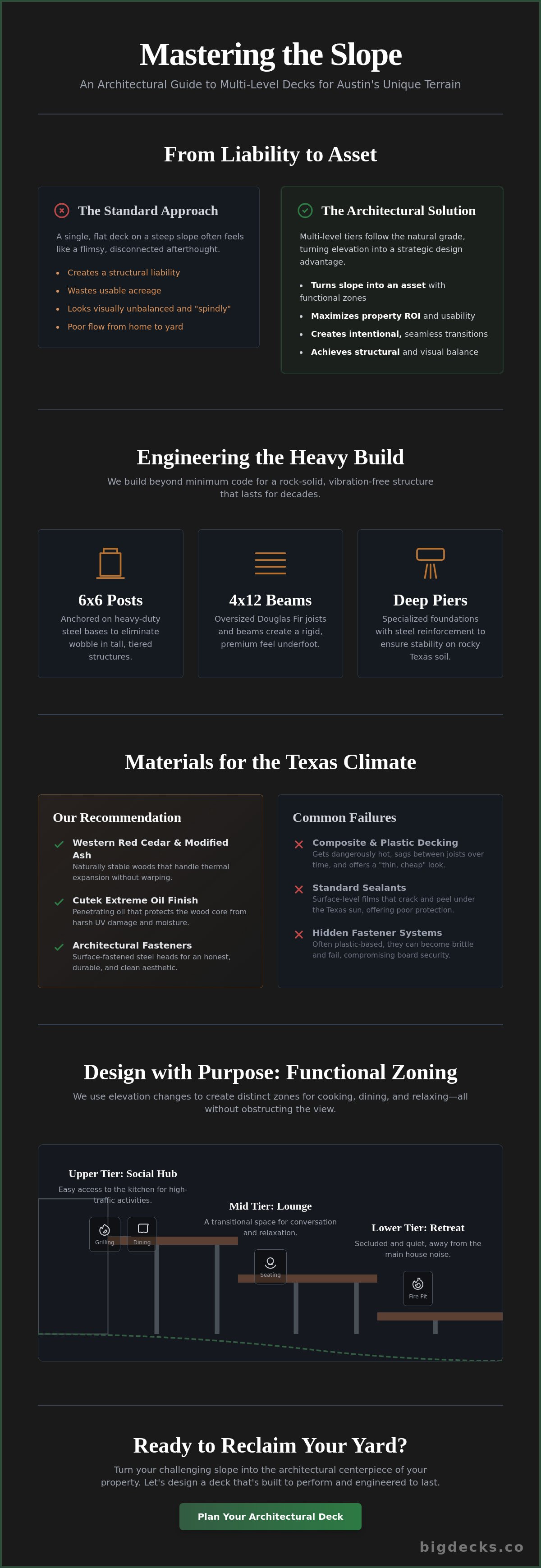
Zones drive the layout. We design the upper tier for high-traffic outdoor kitchens and dining. This keeps the grill close to the interior pantry and minimizes the distance you carry heavy trays. Lower, secluded tiers work best for fire pits or quiet relaxation away from the house noise. We utilize 24ft+ continuous boards of Western Red Cedar or 4x12 Douglas Fir to eliminate messy seams in these functional areas. Every level gets finished with Cutek Extreme to protect the grain against the Texas sun. Natural traffic flow between these areas ensures the deck feels like a cohesive plan rather than a series of afterthoughts. Smart multi-level deck design ideas prioritize how you actually move through the space during a party or a quiet evening.
Engineering the heavy build for elevated deck structures
Most Austin builders settle for the minimum code requirements. We don't. Our multi-level deck design ideas start with a heavy build philosophy that prioritizes structural integrity over margin. We utilize oversized framing and 4x12 Douglas Fir joists to create a rigid, vibration-free platform. This isn't just about strength; it's about the feel underfoot. High-performance custom decks in Austin require 6x6 posts anchored to heavy-duty steel bases. This setup eliminates the wobble common in tall, tiered structures. While many resources, such as Oregon's Permit-Ready Deck Construction Guide, provide a solid baseline for safety, we push beyond those standards with precision metalwork and massive timber sections.
Choosing materials for the Texas heat
Plastic and composite deck boards often fail in the Central Texas sun. They get hot enough to blister skin and they sag between joists over time. We prefer thermally modified ash and Western Red Cedar because they handle thermal expansion without warping. We finish every project with Cutek Extreme. It's the only penetrating oil we recommend for protecting the wood core from UV damage. For the aesthetic, we use surface-fastened steel nail heads. It's an honest, architectural look that celebrates the build rather than hiding it.
Foundation and drainage requirements
Building on rocky soil demands specialized engineering. We drill deep piers with steel reinforcement to ensure your foundation won't shift. On a multi-level build, water management is critical. We design drainage paths between tiers to prevent water from pooling on lower levels or rotting the frame. Effective multi-level deck design ideas must also account for heavy amenities. If you're planning a hot tub on an upper deck, the engineering changes completely. We calculate those static and dynamic loads early to ensure the structure stays rock solid for decades. We can help you evaluate your site and material options before you commit to a build.
Defining functional zones with architectural wood and metal
Effective multi-level deck design ideas rely on elevation to define purpose. Walls block the breeze and the view; level changes create boundaries without the clutter. A seven-inch drop is often enough to separate a high-heat grilling station from a clean lounge area. We utilize custom metalwork railings with slim profiles to maintain these zones. This approach keeps sightlines toward the Hill Country open while providing the structural safety required for elevated builds.
Stairs shouldn't be a cramped transition. We design generous, wide treads that function as bleacher-style seating during large gatherings. By using 4x12 Douglas Fir or Western Red Cedar, these steps feel permanent and substantial. Integrating built-in planters and heavy timber benches anchors the deck to the natural slope of your yard. We prioritize 24ft+ continuous boards to eliminate mid-field seams, creating a sleek, architectural finish that highlights the wood's natural grain.
Luxury amenities on lower tiers
The lower levels of a multi-level build are the ideal location for high-performance recovery tools. We position outdoor saunas in Austin on dedicated bottom tiers to keep heat and steam away from the primary living areas. These zones require heavy-duty engineering. For hot tubs or cold plunges, we use reinforced framing with 6x6 posts on steel bases and joists spaced 12 inches on center. Architectural fencing provides the necessary privacy for bathing areas without suffocating the space.
Lighting and atmosphere
Atmosphere is built through shadow and light. We hide LED strip lighting directly under stair treads to provide safety and a modern, floating aesthetic. This placement emphasizes the texture of thermally modified ash or cedar without the glare of overhead fixtures. Level changes naturally create depth at night, casting shadows that make the structure feel like a part of the landscape. We recommend surrounding the perimeter with native West Texas plantings. These species handle the heat and frame the deck's clean lines. Every piece of wood is treated with Cutek Extreme to ensure the finish stands up to the intense Texas sun.
Planning your multi-level build with 3D visualization
Flat sketches are a liability for complex projects. They fail to capture how different elevations interact with your home's existing roofline or the natural slope of your yard. In Austin, you need 3D design renderings in Austin to navigate the city's strict permitting process for tiered structures. These models do more than show aesthetics; they prove that your multi-level deck design ideas are structurally sound and compliant with local setbacks before the first post is set.
Virtual modeling allows you to test the scale of your furniture and the flow of foot traffic. You can see exactly how an eight-person dining table fits on the upper tier without crowding the grill station. It eliminates the guesswork, ensuring the transition between levels feels natural rather than cramped. This level of planning is the difference between a high-performance build and a costly mistake. We use these models to verify sightlines, ensuring your new railing doesn't obstruct the very views you're trying to capture.
Budget drivers for tiered decks
Adding levels increases the structural requirements of the frame. It's helpful to review how much does it cost to build a deck in Austin when your design moves from a single plane to a multi-tiered system. The complexity of the ledger connections and the need for additional 6x6 posts on steel bases will impact the final bid. Choosing premium materials like Ipe or Thermory ash adds to the upfront cost but provides a superior ROI through longevity and visual impact. Architectural design is an investment in the long-term value of the property; precision costs more than basic carpentry, but it pays for itself in durability.
The BigDecks approach to design
We combine traditional, heavy carpentry with modern 3D technology. Our builds prioritize clean lines and generous proportions, often utilizing 24ft+ continuous boards of Western Red Cedar or 4x12 Douglas Fir to minimize seams. We focus on a design-led consultation to ensure every tier serves a specific purpose. Every board is finished with Cutek Extreme to protect the wood against the Texas climate. We don't just build decks; we engineer outcomes that win. Start your project by scheduling a consultation to review your multi-level deck design ideas with our team.
Mastering the Austin slope
Building on a hillside requires more than a standard blueprint. It demands an engineering mindset that accounts for the unique gravity of the Hill Country. We focus on heavy build specs, using 6x6 posts on steel bases and 24ft continuous boards to eliminate unnecessary seams. This structural integrity is the foundation for all multi-level deck design ideas, ensuring your tiers remain level and rigid under the Texas sun.
Our process uses precision 3D modeling to map your yard's elevation before construction begins. We prioritize honest materials like Western Red Cedar and 4x12 Douglas Fir, finished exclusively with Cutek Extreme for long-term durability. By defining clear functional zones with architectural wood and metal, we turn a difficult grade into a strategic advantage for your home. You don't need a generic contractor; you need a partner who understands the physics of a heavy build.
Let’s talk about your multi-level deck design.
Your backyard has the potential to be the most impressive part of your property.
Frequently asked questions
How many levels should my deck have for a sloped yard?
Most Austin backyards with a significant slope require two or three levels to create functional, flat zones. Each level should ideally drop 7 inches to match the height of a standard stair riser; this keeps the transition natural and safe. Your multi-level deck design ideas should focus on creating distinct areas for cooking and lounging rather than building one massive, steep staircase.
Do multi-level decks cost significantly more than single-level ones?
Tiered structures require a higher investment because the framing complexity increases with every level change. You'll need more footings, additional 6x6 posts on steel bases, and specialized hardware to secure the different elevations. The labor involved in engineering a stable, multi-tiered system is more intensive than a standard flat platform build.
What is the best wood for a multi-level deck in the Austin heat?
Western Red Cedar and thermally modified ash are the most durable options for the intense Central Texas sun. We use 4x12 Douglas Fir for the primary framing because its density prevents the warping often seen in lighter materials. To protect the wood from UV degradation and moisture, we only use Cutek Extreme finish to keep the grain stable and rich.
Is a permit required for a multi-level deck in Austin, TX?
The City of Austin requires a building permit for any deck surface that sits more than 30 inches above the ground. Since multi-level deck design ideas almost always involve elevated platforms, you'll need to submit structural plans for approval. We handle the technical drawings and permitting process to ensure the structure complies with all local building codes.
How do you ensure an elevated deck doesn’t shake or wobble?
We eliminate sway by using a heavy build approach that features 6x6 posts and oversized framing members. Stability is reinforced through diagonal lateral bracing and surface-fastened exposed steel nail heads that bite deep into the timber. This method creates a rigid, high-performance structure that remains rock solid even at significant heights.