

Custom Metal Deck Railings in Austin: Architectural Precision for High-End Decks
Upgrade your view with custom metal deck railings in Austin. Learn how slim steel profiles and precision engineering create a durable, high-end look.
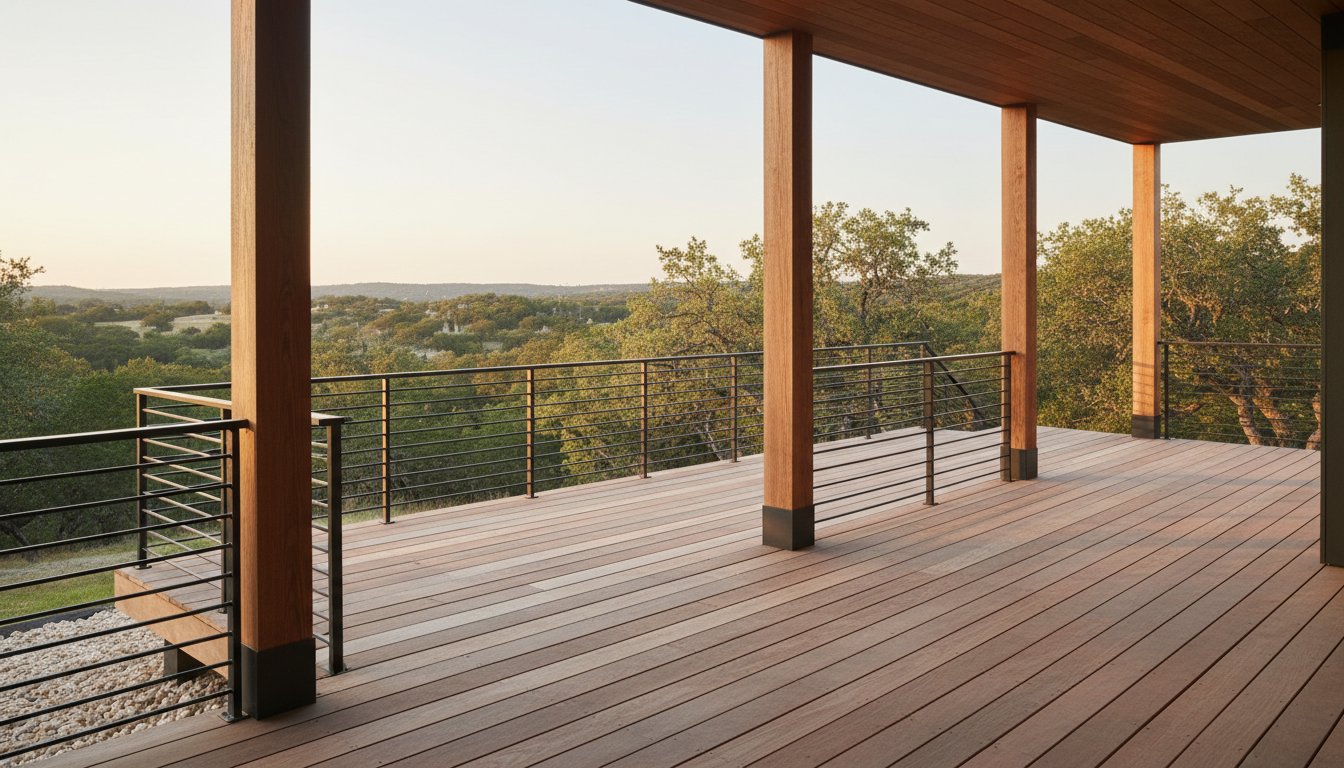
Most Austin decks are built with railings that feel like a cage. Thick, builder-grade pickets and warping wood don't just block the Hill Country view; they kill the architectural flow of a high-end build. Integrating custom metal deck railings in Austin allows you to achieve a slim, modern silhouette that handles the 100-degree Texas heat without flinching. You deserve a structure that feels like a permanent extension of your home, not a generic add-on that requires a weekend of sanding and staining every spring.
You probably agree that a deck is only as good as the view it preserves. This article explains how to pair precision-engineered steel with heavy timber framing, such as 6x6 posts on steel bases, to create a high-performance aesthetic. We'll break down the technical trade-offs between different metal profiles and show you how to ensure your investment outlasts the next decade of Central Texas weather. You will learn how to combine these modern lines with honest materials like Western Red Cedar finished with Cutek Extreme for a result that is both bulletproof and visually stunning.
Key Takeaways
- Ditch bulky wood pickets for slim steel profiles that prioritize your view over visual clutter.
- See why custom metal deck railings Austin require 6x6 posts on steel bases to eliminate rattling and structural failure.
- Compare steel, cable, and glass to find the material that survives the Texas sun and maximizes airflow.
- Leverage 3D design and precision shop-welding to guarantee an architectural fit that wood-frame builders cannot replicate.
Why custom metal railings are the standard for modern Austin decks
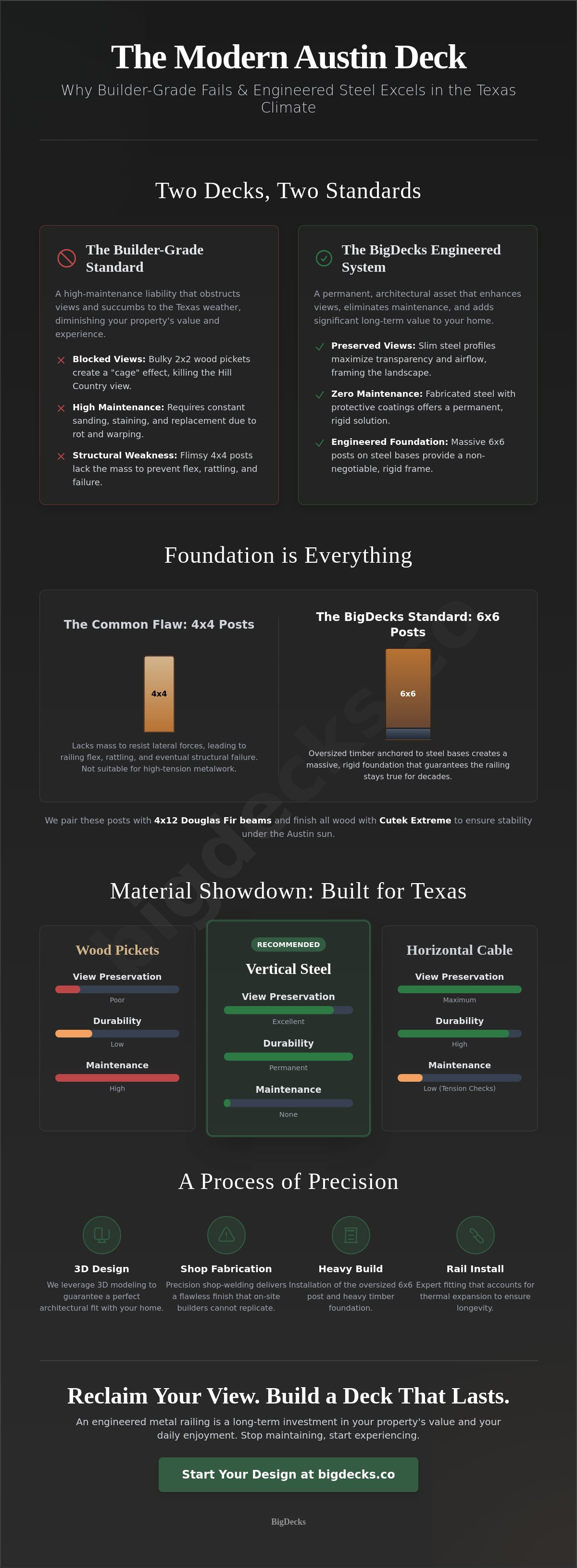
Most decks in Austin suffer from visual noise. Traditional 2x2 wood pickets create a heavy, dated aesthetic that clutters the horizon and blocks the breeze. We replace that bulk with the slim, aggressive profile of fabricated steel. Custom metal deck railings Austin allow the landscape to take center stage, especially for elevated Hill Country builds where the view is the primary asset. Minimalism isn't just a style; it's a strategy to reclaim your property's visual potential.
Durability is non-negotiable in Central Texas. The combination of intense heat and localized humidity destroys inferior materials. Wood balusters eventually shrink, check, and rot; they require constant sanding and staining to stay functional. Steel is different. It provides a permanent, rigid solution that doesn't yield to the elements. An architectural railing system prioritizes both structural integrity and aesthetic minimalism. These systems function as high-performance guard rails without the clumsy, oversized footprint of traditional carpentry.
Steel vs. cable: choosing your silhouette
Vertical steel pickets offer a timeless, architectural look that echoes classic ironwork with a modern twist. They provide a sense of permanence and strength that complements heavy timber framing. Horizontal cable systems are the choice for maximum transparency. They create a modern feel that practically vanishes from a distance. Both options utilize high-tension components to ensure safety while maintaining the sharp, clean lines required for high-end custom metal deck railings Austin.
The impact on property value in Central Texas
High-end buyers in Austin are savvy and time-poor. They prioritize low-maintenance assets over high-maintenance chores. Installing metal railings is a strategic play for long-term ROI. It signals quality and durability to future owners, removing the "maintenance tax" associated with wood. When you invest in custom decks in Austin, the railing is the definitive finishing touch that secures the architectural value of the entire project. Wood is a liability; steel is an asset.
Engineering the "heavy" build: structural framing for metalwork
Custom metal deck railings Austin require a foundation that doesn't budge. Metal is unforgiving. If your substructure flexes even a fraction of an inch, your railing will rattle or lose tension. We solve this with a heavy build strategy that treats the deck frame like a structural bridge rather than a backyard platform. This approach eliminates the "flimsy" feel common in mass-market construction.
The BigDecks standard starts with 6x6 posts anchored to steel bases. We don't use 4x4 posts because they lack the mass to resist the lateral force of high-tension metalwork. We pair these posts with 4x12 Douglas Fir beams or thermally modified ash to create a rigid, non-negotiable foundation. We finish all wood components with Cutek Extreme to ensure the framing remains stable under the Austin sun. This massive scale ensures the rail mounting stays true for decades. We use surface-fastened steel nail heads and precision welding to deliver an honest, industrial finish that looks as strong as it feels.
Oversized framing as a design choice
Generous proportions in the substructure support the delicate, architectural lines of the metal railing above. Builder-grade 4x4 posts look desperate next to custom steel. By using oversized 6x6 timber, we create a visual weight that balances the thin profile of the metal. It’s a deliberate design move that signals quality from the street level to the top rail. When installing custom metal deck railings Austin, we prioritize this visual hierarchy to ensure the deck looks anchored to the landscape.
Managing thermal expansion in 100-degree heat
Austin’s summer heat is a physical variable that most builders ignore. Metal expands and contracts significantly when temperatures swing from 40 to 105 degrees. We account for this movement with slotted mounting holes and high-grade protective coatings to prevent binding or finish failure. Every weld and fastener is positioned to handle this cycle without compromising the structural integrity of the build. If you want to discuss how these materials perform on your specific site, we can help you evaluate your framing options before you commit to a design.
Material selection and protection for the Austin climate
Austin's climate is a brutal testing ground for exterior finishes. Between the 100-degree summer streaks and flash floods, materials that work in other regions fail here within 24 months. Fabricated steel is our standard for custom metal deck railings Austin because it offers the rigidity needed for oversized framing. We prefer it over flimsy aluminum alternatives. Stainless steel cable provides a minimalist aesthetic that stays cool to the touch. Tempered glass creates a high-end look but carries a higher maintenance cost. Choosing the right custom metal deck railings Austin requires understanding how these materials react to 105-degree exposure.
We use industrial-grade powder coating for every steel component. This isn't a cosmetic choice. A high-quality powder coat acts as a thermal barrier, reducing surface temperatures so you can actually use the handrail in July. It also seals the steel against the humidity that triggers rapid oxidation. An estimated 65% of residential contractors use off-the-shelf kits from big-box stores to save time. This is a mistake. These kits are designed for flat ground and standard angles. They fail to accommodate the aggressive slopes of Central Texas lots, leading to awkward gaps and structural weaknesses.
Why Cutek Extreme is non-negotiable
When wood meets metal, moisture traps are inevitable. We only use Cutek Extreme because it's a deep-penetrating oil, not a surface film. Standard stains peel within 12 months when the metal hardware expands and contracts in the heat. Cutek stays inside the wood grain, protecting the contact points where 6x6 posts meet steel bases. It ensures the wood breathes while remaining hydrophobic. It doesn't crack, and it doesn't fail when the sun hits the steel.
Glass railings: the high-maintenance tradeoff
Glass offers an unobstructed view but creates a localized greenhouse effect. In the Austin sun, glass panels trap heat on your deck, raising the ambient temperature by several degrees. The limestone dust common in Central Texas also clings to the surface. This requires professional cleaning every 30 days to maintain clarity. It's a premium look that demands a premium maintenance schedule. If you want the view without the heat, stainless cable is the smarter play.
The BigDecks process: from 3D design to precision install
Precision starts in a digital environment. We use 3D design renderings to model how the railing silhouette interacts with your specific view. This isn't just a sketch. It's a virtual reality stress test for your architecture. We analyze how the steel lines hit the horizon before a single piece of metal is cut. Once the design is locked, we move to custom fabrication. Every component of your custom metal deck railings Austin project is welded to the exact dimensions of your deck. We don't use adjustable kits or flimsy off-the-shelf components. We build for permanence.
Our "heavy" install process ensures every post is perfectly plumb and every rail is rock-solid. We prioritize oversized framing and 6x6 posts on steel bases for maximum stability. This isn't about meeting code; it's about exceeding it. The final walkthrough ensures every weld is clean and every board is treated with Cutek Extreme. We verify that the 24ft+ continuous boards are seated perfectly and the exposed steel nail heads are aligned with surgical precision.
Visualizing the final product
The shadow lines of your railing matter as much as the steel itself. A 3D model prevents design regrets by showing exactly how the railing profile breaks the light. You can explore different top rail materials like Ipe or Western Red Cedar in the virtual space. This allows you to compare textures and grain patterns against the steel before we strike the first arc. It's about seeing the ROI of your design choices before the build begins.
Low-pressure consultation for your project
Choosing the right railing profile is a strategic decision. We help you think through material choices and long-term durability before you commit to a fabrication bid. We focus on the psychological impact of the design and the honest reality of maintenance. Let's look at your site together and determine which profile fits your architecture. We'll help you find the win for your backyard project.
Build for the long game
A deck is only as strong as its weakest connection. Most railings fail because they're an afterthought. We don't do afterthoughts. We treat custom metal deck railings Austin as a structural extension of your home's architecture. Every project starts with 3D visualization to lock in the sightlines and Red Dot-inspired design details. We cut the steel once. We get it right the first time.
Precision metal fabrication isn't just about the finish. It's about engineering. We focus on heavy builds that handle Austin's heat without rattling or sagging. You're investing in a permanent architectural feature that prioritizes clean lines and honest materials. Stop settling for off-the-shelf solutions that look dated before the permit is closed. We nail the details others ignore because that's how you win the room.
Let's design your custom deck railing
Your property deserves a finish that reflects the quality of the build underneath.
Frequently asked questions
Do metal deck railings get too hot to touch in Austin?
Dark metal surfaces on custom metal deck railings Austin projects can hit 150 degrees Fahrenheit by mid-afternoon, making them uncomfortable for bare hands. We solve this by specifying wide wood top rails, like 2x6 Western Red Cedar, to provide a reliable cool-touch surface. Treating the wood with Cutek Extreme ensures it stays stable and beautiful, while the heavy-duty steel frame handles the structural heavy lifting your project requires.
How much do custom metal railings cost per linear foot in Austin?
The investment for custom metal deck railings Austin homeowners choose depends on the gauge of the steel and the complexity of the architectural narrative. We focus on high-performance materials that drive long-term ROI rather than the cheap, thin-walled alternatives found at big-box retailers. Your project price will reflect the precision welding, specialized powder coating, and the engineering required to deliver a clean, minimalist result that wins the room.
Are cable railings safe for kids and pets?
Cable railings are a fortress for your family when they are engineered and tensioned with professional precision. We utilize 316-grade stainless steel cables pulled to 200 pounds of force to ensure they never deflect enough to fail a 4-inch sphere safety check. This results in a secure, high-stakes design that protects your kids and pets without blocking a single inch of your killer view or compromising on safety.
Does Austin building code allow horizontal railings?
Austin building code permits horizontal railings because the 2015 International Residential Code update officially removed the old ladder effect restrictions. You can legally install horizontal steel bars or cable systems as long as you maintain the mandatory 4-inch spacing between each rail. We focus on ensuring every connection is over-engineered to comply with local safety standards while maintaining the stunning, architectural lines of a high-end build.
How often do I need to maintain my metal deck railings?
Metal railings are a low-maintenance asset that only requires a quick cleaning twice a year to maintain their appearance. A simple rinse with mild soap removes Austin limestone dust and keeps the powder-coated finish looking like day one. If your design includes timber accents, a quick coat of Cutek Extreme once a year keeps the wood from graying and ensures the 6x6 posts on steel bases remain rock solid, a signature of the Big Decks build.
Custom Decks in Austin: Engineering Architectural Value for 2026
Design high-end custom decks in Austin that last. This guide covers climate-proof materials, 3D modeling, and navigating permits for a valuable home addition.
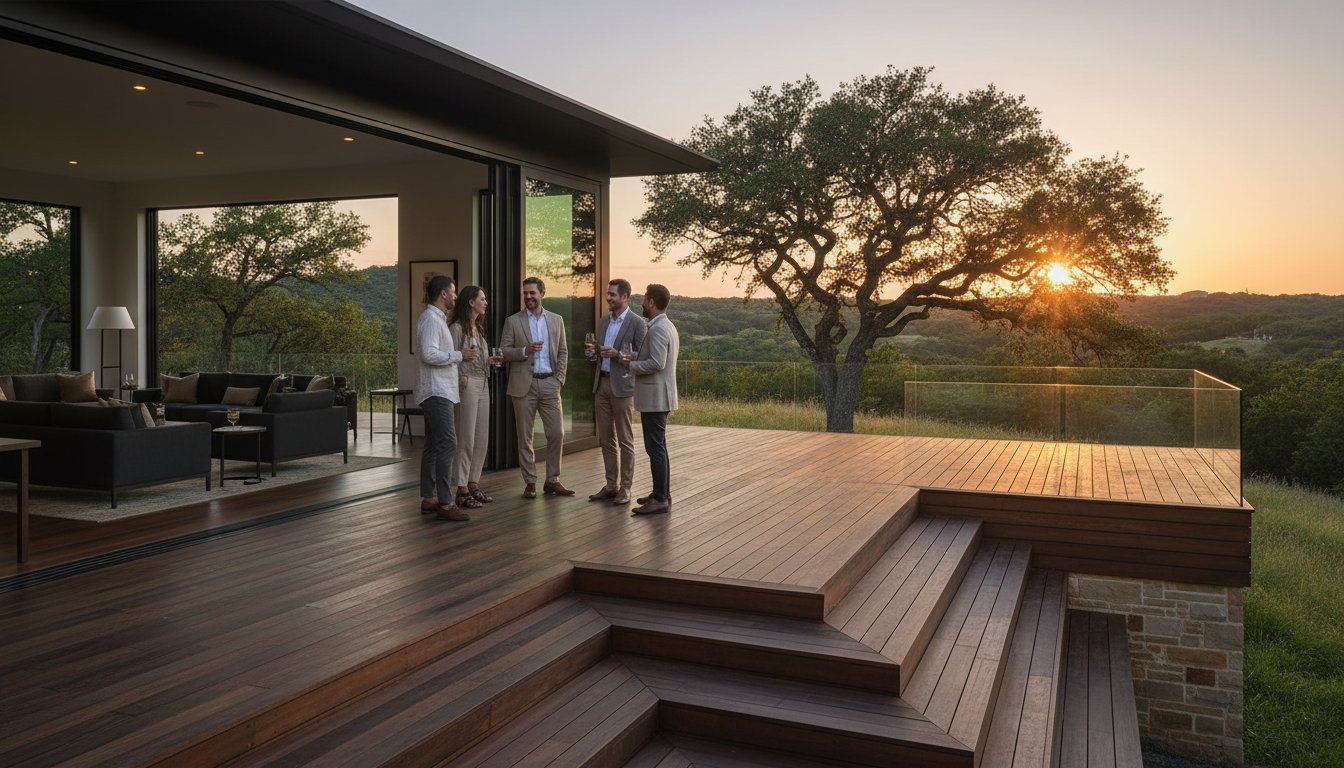
In Austin, a standard wooden platform isn't an outdoor living space; it's a liability waiting for the July sun to warp it into a $20,000 bonfire. You already know that building in Central Texas requires more than just a hammer and some cedar. Between the 90 percent humidity spikes and the city's aggressive impervious cover limits, many custom decks fail long before they pay for themselves. It's a high-stakes game where cheap materials and poor planning lead to expensive repairs.
You're about to learn how to engineer a high-end, climate-resilient architectural asset that survives the 105-degree August heat while adding measurable value to your property. We'll show you how to secure visual certainty through advanced 3D modeling before a single board is cut. This guide covers the specific material science required to beat the Austin climate, the strategy for navigating strict local permitting, and the design choices that ensure your outdoor space matches your home's unique architecture.
Key Takeaways
- Engineer your deck as a structural extension of your home’s architecture to ensure it survives Austin’s extreme heat and humidity.
- Identify why thermally modified wood is the superior choice over plastic composites that often warp or degrade under the intense Texas sun.
- Use 3D visualization as a strategic tool to lock in your project's ROI and eliminate design gaps before construction begins.
- Navigate the regulatory hurdles of Central Texas, specifically the "impervious cover" rules that dictate your project's total footprint.
- Learn how to build custom decks that function as legacy architectural assets by prioritizing specialized engineering over general contracting.
Why custom decks in Austin require a different engineering logic
Building custom decks in Central Texas is not a simple matter of laying boards over a frame. In Austin, a deck functions as a structural extension of your home's architecture rather than a standalone platform. This distinction matters because the engineering must account for the specific load-bearing requirements of the house and the volatile soil conditions found in the Hill Country. When a deck is treated as an afterthought, it lacks the structural integrity to handle the stressors unique to this region.
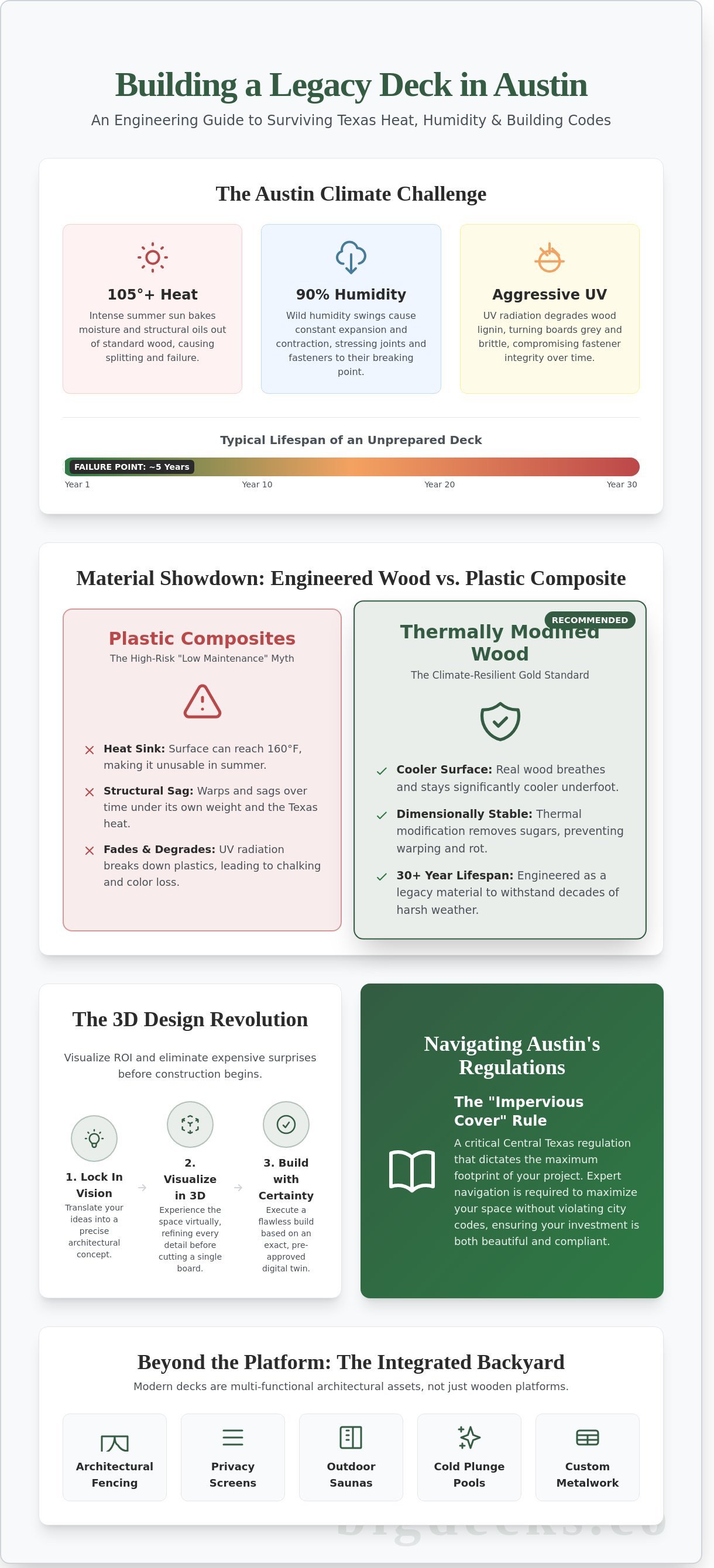
The "Austin Factor" refers to the brutal combination of 100-degree summer days and high humidity levels that fluctuate wildly. This environment creates a high-stakes scenario for any organic material. Standard construction methods often rely on basic pressure-treated pine, which typically fails within 5 years in this climate. The wood dries out too quickly, loses its structural oils, and begins to splinter. To survive here, a deck requires a logic that prioritizes moisture management and heat dissipation from the ground up.
Professional builders recognize that "standard" is a recipe for rot. Basic decks often use undersized joists and insufficient flashing, leading to water trapped against the house siding. In the Austin heat, this trapped moisture creates a breeding ground for fungi and wood-destroying insects. Transitioning to a custom engineering mindset means selecting materials and fastening systems designed to withstand the relentless expansion and contraction cycles that define our seasons.
The Central Texas climate challenge
UV radiation in Austin is exceptionally aggressive, hitting levels that literally bake the lignin out of wood cells. This process turns boards grey and brittle, compromising their ability to hold fasteners over time. Humidity fluctuations add another layer of stress, causing low-grade Decking materials to warp, cup, and develop deep "checking" or cracks along the grain. These aren't just cosmetic issues; they represent the physical breakdown of the wood's structural capacity.
Thermal movement is the primary enemy of Austin deck longevity. Because temperatures can swing 40 degrees between a scorching afternoon and a cool limestone-cooled night, every joint and fastener is under constant tension. Engineering for this requires specific gap spacing and hidden fastening systems that allow the material to breathe without shearing the screws. Without this precision, the deck will eventually pull itself apart at the ledger board.
Beyond the platform: The integrated backyard
Modern homeowners are moving away from simple rectangular decks in favor of multi-functional, architectural outdoor living spaces. This shift integrates structural elements like architectural fencing, privacy screens, and specialized amenities directly into the deck's footprint. We are seeing a surge in projects that incorporate "staycation" features, such as outdoor saunas and cold plunge pools, which require specialized load-bearing calculations and moisture-proof sub-structures.
Custom metalwork has become a staple in high-end Austin builds to provide the necessary structural rigidity. Steel posts and powder-coated railings offer a modern aesthetic while ensuring the deck remains rock-solid for decades. By using metal in high-stress areas, builders can achieve longer spans and thinner profiles that wood alone cannot support. This integration of steel and premium timber creates a space that feels like a permanent part of the home rather than a temporary outdoor addition.
Material science: Why we kill the plastic deck narrative
Plastic decking companies sell a dream of zero maintenance that evaporates the moment the Austin sun hits 100 degrees. While composite boards are marketed as the easy choice, they fail the most basic Texas test. Thermal performance is the dealbreaker. On a standard July afternoon, dark composite decking can reach surface temperatures of 160 degrees. Wood remains significantly cooler underfoot. For homeowners investing in high-end custom decks, the reality is that plastic feels cheap, retains heat, and eventually sags under its own weight.
We prioritize materials that handle the expansion and contraction cycles of the Hill Country. Real wood breathes. It handles the UV load without turning into a heat sink. If you want a deck that lasts 30 years and adds actual value to your estate, you have to look past the plastic wrap and toward advanced material science. Wood is the only choice for an elite outdoor experience that remains functional during a Texas summer.
The elite wood hierarchy
Thermally modified wood, specifically Thermory, is the gold standard for 2026. This process uses heat and steam to cook the sugars out of the wood. This makes it naturally rot-resistant without toxic chemicals. It yields a board that is dimensionally stable; it won't warp, twist, or cup even in 90% humidity. It provides the longevity of a tropical hardwood with a much lower carbon footprint. This is the peak of modern construction tech for homeowners who demand the best.
Ipe remains the ironwood of the industry for a reason. Its density is so high that it carries a Class A fire rating, the same as concrete or steel. This is a critical factor when adhering to Austin's building codes in wildfire-prone areas. For a more traditional Austin aesthetic, Western Red Cedar offers a classic look for custom decks. It's naturally insect-resistant, though it requires more frequent sealing to prevent silvering in the sun. Cedar is perfect for vertical accents and pergolas where weight is a consideration.
Maintenance as a strategic asset
The term zero maintenance is a marketing lie. Every outdoor structure requires care to combat the elements. We view maintenance as a strategic asset that protects your five-figure investment. Using high-quality penetrating oils like Cutek Extreme allows the wood to stay hydrated from the inside out. This prevents the cracking and splintering common in neglected structures. It keeps the cells supple and the grain pattern vibrant for decades.
A proactive schedule for maintenance and refinishing ensures your deck looks as good in year ten as it did on day one. Most homeowners find that spending 2% of the project cost on annual care is far cheaper than replacing a failing composite structure in twelve years. If you want to see how these materials perform in real-world conditions, you can view our recent builds to compare the finishes. High-performance wood isn't just a material choice; it's a financial decision that pays dividends in durability and comfort.
The 3D design revolution: Visualizing ROI before the first cut
Building high-end custom decks in Austin requires more than a rough sketch on a napkin. It demands a strategic architectural phase where every variable is stress-tested before a single board is purchased. At BigDecks, we treat 3D visualization as the "pitch deck" for your backyard. It's the only way to align every stakeholder, from the homeowner to the HOA board, ensuring the vision matches the final build. This isn't just about pretty pictures; it's about winning the room and securing your investment. We don't just build; we engineer an experience that starts in a digital environment.
Risk mitigation through 3D renderings
The most expensive words in construction are "I didn't think it would look like that." Using 3D design renderings eliminates the expectation gap that often plagues traditional builds. By modeling the project in a virtual environment, we prevent mid-construction change orders that typically inflate budgets by 12% or more. We visualize how your new space integrates with existing structures and xeriscaping, ensuring the transition is seamless. Seeing is believing, and it's the only way to justify a high-end budget with absolute certainty.
Precision matters when navigating Austin's official building codes and setback requirements. Our process treats design as a separate, critical phase of the architectural journey. We test material textures, such as the contrast between toasted oak and powder-coated steel, to ensure the aesthetic hits the mark. We also analyze spatial flow digitally to ensure the layout works for your specific use case. If a staircase blocks a view or a walkway feels cramped, we fix it in the software, not on the job site. This proactive approach saves time and keeps the project on a predictable trajectory.
Designing for the Austin lifestyle
Austin's climate is a relentless design factor. We use sun-path analysis to optimize for shade, integrating pergolas or steel structures exactly where the July heat hits hardest. A deck that's unusable at 4:00 PM is a failed investment. Our 3D models allow us to simulate shadows throughout the day, ensuring your outdoor lounge remains a sanctuary rather than an oven. This level of detail allows you to see exactly how your furniture fits and where the natural light creates the best ambiance for evening entertaining.
Spatial planning for heavy amenities is another area where visualization pays off. If you're planning for a hot tub or a cold plunge, the structural requirements and "splash zones" must be mapped out early. We also prioritize architectural fencing in our designs to create private urban oases in dense Austin neighborhoods. This creates a cohesive narrative for the property, where every element, from the wood grain to the lighting placement, serves a specific purpose. High-performance custom decks shouldn't just exist; they should perform under pressure. By the time the first cut is made, the outcome isn't a guess. It's a foregone conclusion.
Navigating Austin’s building codes and construction costs
Building in Austin isn't a casual weekend project. It's a high-stakes navigation of the city's Land Development Code where a single oversight kills your ROI. You are operating in one of the most regulated construction environments in Texas. Success requires a strategic approach to both the budget and the bureaucracy. If you don't have a plan for the Austin Development Services Department, you don't have a project.
The regulatory landscape in Central Texas is designed to manage rapid growth and environmental sensitivity. This means every square inch of your property is scrutinized. You aren't just paying for a place to grill; you're paying for the right to modify your land. Understanding the math behind the permits is just as vital as choosing the right wood or composite. It's the difference between a seamless build and a project that stalls for six months in review.
The impervious cover hurdle
Impervious cover is the primary obstacle for Austin homeowners. Most residential lots, specifically those with SF-2 or SF-3 zoning, are capped at 45% total coverage. This limit includes your house footprint, driveway, walkways, and even your pool. In many cases, a large deck can push a property over the legal limit, resulting in a denied permit. You need a decking contractor who understands how to calculate these ratios before the design phase begins.
There are ways to play the game. Creative designs using slatted surfaces with specific gaps can sometimes be classified as pervious if they sit over a gravel bed that allows rainwater to reach the soil. This isn't a loophole you can guess your way through. It requires precise execution and a deep knowledge of local zoning. If your contractor doesn't mention impervious cover during the first site visit, they aren't the right partner for an Austin build.
2026 Cost breakdown for custom builds
The market has shifted significantly over the last 24 months. In 2026, high-end custom decks in Austin typically range from $60 to $150 per square foot. This isn't just a "Austin tax"; it's a reflection of the complexity required to build on the rocky, uneven terrain of the Hill Country. Labor accounts for roughly 50% of your total spend because you are paying for precision. Securing footings into Edwards Plateau limestone requires specialized equipment and significant man-hours.
Material choices drive the rest of the volatility. While Western Red Cedar remains a local staple, high-performance composites and modified woods like Accoya carry a 30% price premium. You also have to account for the "hidden" costs that amateurs overlook. Engineering stamps for decks over 30 inches tall now cost between $1,500 and $3,500. Permitting fees and site surveys add another $1,200 to $2,500 to the bottom line. These are fixed costs that don't change regardless of your deck's size.
- Site Complexity: Steep grades or limestone outcroppings can increase foundation costs by 40%.
- Custom Fabrication: Steel framing and custom-welded handrails add durability but increase the initial investment.
- Permit Timelines: Expect a 6 to 10 week wait for Austin residential permit reviews in the current climate.
Don't let the bureaucracy dictate your lifestyle. Get a professional site evaluation to see exactly what is possible on your lot and how to maximize your buildable area within city limits.
Building your legacy: The BigDecks construction framework
Building a high-end outdoor space in the Austin heat is a high-stakes investment. Most homeowners treat the project as a simple addition, but we view custom decks as engineered assets that must perform under pressure. Our framework rejects the "good enough" mentality of local handymen. We merge the soulful texture of traditional carpentry with the surgical precision of industrial metalwork. This hybrid approach ensures your structure doesn't just look stunning on day one; it remains structurally sound for decades.
Hiring a general contractor for a specialized build is a strategic error. A "jack-of-all-trades" lacks the specialized tooling required for 1/16th-inch joinery or the specific knowledge of Central Texas soil expansion. BigDecks operates as a dedicated design-build unit. We focus exclusively on outdoor architecture, which allows us to master the nuances of hidden fastening systems and joist protection that generalists overlook. When you prioritize specialized expertise, you eliminate the risk of premature rot and structural sagging.
Our project lifecycle is designed for clarity and momentum. We start with a high-stakes site audit to evaluate topography, drainage, and sun exposure. This moves into a high-fidelity 3D rendering phase where we stress-test the design virtually. You see the final result before we break ground. During construction, our crew maintains a relentless pace without sacrificing the "killer" execution of every joint. We finish with a comprehensive walkthrough, ensuring every weld and oil application meets our 100% precision standard.
Settling for an average deck in Austin is a losing strategy. The combination of intense UV rays and flash flooding destroys subpar builds within five to seven years. A BigDecks project is built to a higher standard, utilizing materials that offer a 25% higher return on enjoyment and property value compared to standard pressure-treated wood. We don't just build platforms; we build legacies that stand as a testament to quality and intentional design.
The BigDecks signature style
Our aesthetic defines the modern Austin look by fusing natural warmth with industrial grit. We specialize in the marriage of premium hardwoods like Ipe or Western Red Cedar with powder-coated steel framing. This isn't just for show; steel frames provide a 30-year lifespan and perfectly level surfaces that wood alone cannot match. We exclusively use high-performance penetrating oils that saturate the wood fibers rather than forming a film that eventually peels. Every fastener we drive is chosen for its corrosion resistance and sheer strength.
Your next move
The difference between a backyard and a private sanctuary is the courage to start the design process. Stop settling for a patch of grass and start building an environment that wins. A professional site evaluation is the most valuable first step you can take to understand the true potential of your property. We identify the technical constraints and the aesthetic opportunities that others miss. Start your Austin backyard transformation with BigDecks today.
Building in Austin requires a builder who understands the local climate and the demands of high-end property owners. Our framework is built on transparency, technical mastery, and a refusal to cut corners. Whether you are looking for a sleek hillside retreat or a robust entertaining hub, we provide the strategic execution needed to turn your vision into a permanent reality. Don't leave your legacy to chance; choose the team that treats every board and beam as a critical component of a larger victory.
Engineer Your Austin Outdoor Legacy
Building custom decks in Central Texas isn't just about aesthetics; it's about surviving a climate where 105-degree August days are the baseline. You're choosing between a structure that warps in three seasons or one engineered with Thermory and Ipe to last 30 years. Our framework replaces the fragile plastic narrative with heavy-duty custom metalwork and architectural precision designed for 2026 property values.
Every BigDecks project starts with high-end 3D visualization. This isn't a vague sketch. It's a data-driven model that accounts for Austin's specific building codes and site topography. We eliminate the guesswork so you see the exact ROI before construction begins. You aren't just adding square footage; you're investing in a structural asset that handles the heat and the hills with zero compromise.
Ready to build the best deck in Austin? Get your 3D design started with BigDecks.
Let's build something that stands the test of time.
Frequently Asked Questions
How much does it cost to build a custom deck in Austin?
A professional installation for custom decks in Austin typically ranges from $15,000 to $65,000 based on 2024 market data. Basic pressure-treated builds start on the lower end, while premium hardwood projects or multi-level designs often exceed the $45,000 mark. Your final investment depends on material choice, site topography, and integrated features like built-in seating or lighting.
Do I need a permit for a deck in Austin, Texas?
You must obtain a building permit if your deck is more than 30 inches above the ground or covers more than 200 square feet. The City of Austin Development Services Department enforces these rules to ensure your structure meets safety codes. Expect the permitting process to take between 4 and 9 weeks depending on current city backlog and project complexity.
What is the best wood for a deck in the Austin climate?
Ipe and thermally modified ash are the most durable options for the Central Texas environment. Ipe features a 40 year lifespan because its extreme density resists the UV degradation caused by 100 degree summer days. Thermally modified wood is a smart alternative that doesn't warp or twist when Austin humidity fluctuates between 30% and 90%.
How long does the 3D design process take?
The 3D design phase typically takes 7 to 14 days from your initial site consultation. This window includes the time needed to create a digital twin of your home and refine the structural layout. You'll usually go through two rounds of revisions during this period to finalize material colors and spatial flow before construction starts.
Why should I avoid composite decking for my Austin home?
Composite decking retains heat and can reach surface temperatures of 150 degrees in direct Texas sunlight. This makes the surface uncomfortable for bare feet and pets during the peak summer months. While it requires less staining, the plastic components expand and contract significantly, which can lead to warped boards or loose fasteners over a 10 year period.
What is thermally modified wood and why is it better for Texas?
Thermally modified wood is natural timber cooked in an oxygen-free kiln at temperatures exceeding 400 degrees Fahrenheit. This process removes the organic sugars that attract insects and reduces the wood's moisture content to nearly 0%. It's better for Texas because it's rot-resistant and stays roughly 25% cooler than synthetic materials under the afternoon sun.
How does impervious cover affect my deck project in Austin?
Austin residential lots are often capped at 45% impervious cover, which limits how much of your land can be covered by non-porous structures. Since traditional decks count toward this total, a large project might push you over the legal limit. We solve this by using specific spacing techniques or pervious materials to ensure your build stays compliant with city drainage regulations.
How often does a wood deck in Austin need maintenance?
Expect to clean and reseal your wood deck every 12 to 24 months to protect it from intense UV exposure. High-traffic areas or sections with direct southern exposure might need attention every 18 months to prevent the wood from graying. Staying on this schedule can extend the functional life of your deck by 15 years or more.
Building a custom deck in Central Texas requires a balance of smart material choices and a clear understanding of local building codes. Focus on durability and heat resistance to ensure your outdoor space remains a high-value asset for years to come.