

Rooftop Deck Austin TX: The Residential Design and Construction Guide
Your guide to building a rooftop deck Austin TX homeowners love. Learn engineering, materials, and how to beat city permits for a safe, stunning vertical space.
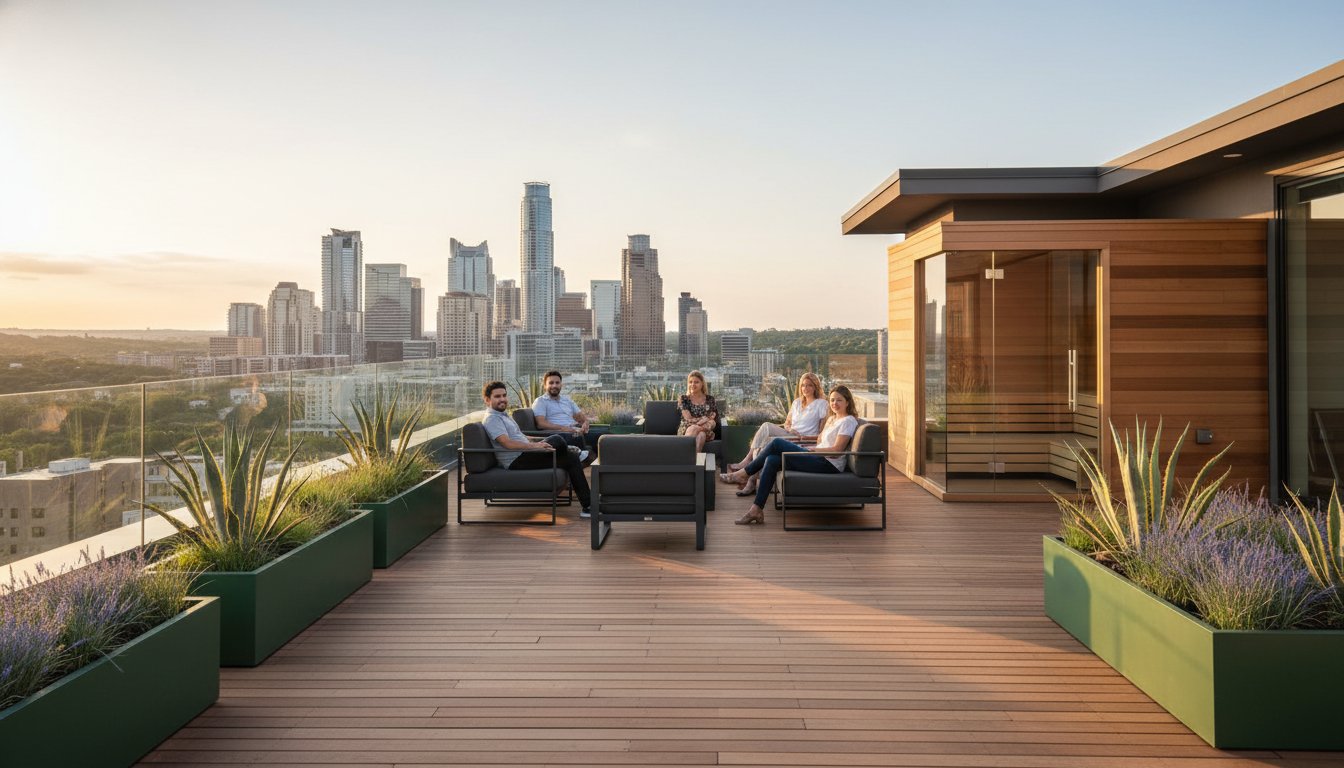
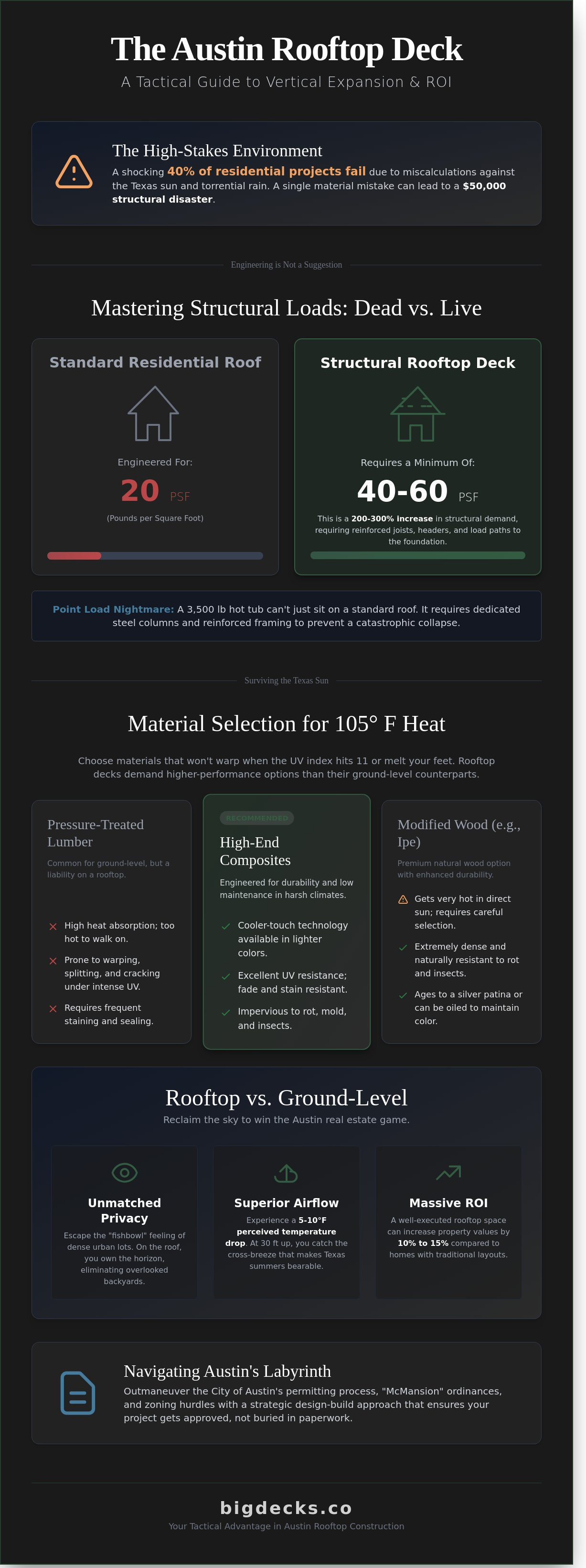
Your rooftop shouldn't be a liability; it should be your home's greatest ROI. Yet, 40% of residential projects fail because they can't handle the 105-degree Texas sun or a single 4-inch downpour. Building a rooftop deck Austin TX homeowners actually enjoy requires more than just a view; it requires a strategic offensive against physics and bureaucracy. You're not just adding square footage; you're engineering a high-stakes environment where one material mistake can lead to a $50,000 structural disaster.
You already know that the City of Austin permitting process is a labyrinth designed to kill momentum. We agree that the fear of a roof leak or a structural collapse is enough to keep any homeowner up at night. This guide is your tactical advantage. You'll learn the exact engineering requirements for load-bearing safety, the specific materials that won't warp when the UV index hits 11, and the legal shortcuts to navigate local codes. We're giving you the clear, 3D-to-build roadmap to ensure your project is a stunning victory rather than a costly cautionary tale.
Key Takeaways
- Stop settling for backyard fences and start capturing the downtown skyline with a strategic vertical expansion.
- Master the structural engineering math—dead loads vs. live loads—to ensure your high-end build is as safe as it is stunning.
- Beat the 105-degree heat by choosing materials that won't melt your feet on a rooftop deck Austin TX.
- Outmaneuver Austin’s "McMansion" ordinance and zoning hurdles with a design-build process that actually clears the City of Austin desk.
- Transform your roof into a high-stakes wellness retreat by integrating saunas and cold plunges with precision logistics.
The Rise of the Austin Rooftop Deck: Why Homeowners are Building Up
Austin isn't getting any bigger, but your footprint can. If you're building in 78702 or 78704, you know the drill. Lot sizes are shrinking. Backyards are becoming a luxury of the past. A rooftop deck Austin TX isn't just a home improvement project; it's a strategic vertical expansion. In the context of Central Texas urban density, we define a residential rooftop deck as a structural, load-bearing platform integrated into the home's primary framing. This is the ultimate play for the modern homeowner who refuses to choose between a prime location and a spacious outdoor life.
The value proposition is undeniable. You're capturing views that ground-level decks simply cannot reach. Whether it's the glowing skyline of Downtown Austin or the rolling silhouettes of the Hill Country, a rooftop deck turns a standard residential lot into a high-value observation post. This solves the "small backyard" problem common in neighborhoods like East Austin and Zilker. When your yard is a 10-foot strip of grass, you don't compromise; you move the party to the sky.
There's a critical distinction between a "roof terrace" and a structural rooftop deck. A terrace is often a cosmetic addition to a flat surface. A structural deck is a powerhouse. It's engineered to support 100-pound-per-square-foot loads, outdoor kitchens, and heavy-duty furniture. Success starts with the bones. You have to understand flat roof construction principles to ensure your investment doesn't leak or fail under pressure. This is where the distinction between a hobbyist and a professional build becomes clear.
Maximizing Urban Footprints in Central Texas
The 2023 HOME Initiative changed the game for Austin residential density. As Accessory Dwelling Units (ADUs) and modern builds pack tighter into urban lots, roof access has become the new standard. It's about the psychological benefit of "open air" living. In high-density areas, a ground-level patio can feel like a cage. A rooftop deck provides a sense of liberation and literal breathing room. From a real estate perspective, the ROI is massive. Data from local appraisals in 2023 suggests that a well-executed rooftop space can increase property values by 10% to 15% compared to adjacent homes with traditional layouts.
Rooftop vs. Ground-Level Decks
Privacy is the primary currency in crowded Austin neighborhoods. Ground-level decks are often overlooked by neighbors or separated only by a six-foot fence. On the roof, you own the horizon. You're also escaping the stagnant heat of a fenced backyard. Austin saw 40 days of 100-degree temperatures in 2023. At ground level, the heat is trapped. At 30 feet up, you're catching the cross-breeze that makes a Texas summer bearable.
- Privacy: Eliminate the "fishbowl" feeling of modern urban lots.
- Airflow: Experience a 5 to 10-degree perceived temperature drop due to wind exposure.
- Durability: Rooftop decks often utilize high-end composites or modified woods that resist the intense UV rays of the Texas sun better than ground-level pressure-treated lumber.
The cost-to-value ratio favors the bold. While the entry price for a structural rooftop deck is higher than a platform deck, the utility is incomparable. You aren't just building a deck; you're reclaiming the sky. It's a calculated move for homeowners who want to win the Austin real estate game.
Engineering and Structural Realities for Austin Homes
Engineering isn't a suggestion. It's the backbone of your ROI. In the high-stakes world of Austin real estate, a rooftop deck Austin TX project fails or succeeds before the first board is cut. You're dealing with two distinct forces: dead load and live load. Dead load covers the permanent weight of the structure, including the joists and decking. Live load accounts for the 15-person party you're hosting on a Friday night. Most Austin residential roofs are engineered for 20 pounds per square foot of live load. A functional deck requires at least 40 to 60 pounds per square foot. That's a 200% increase in structural demand that requires a killer strategy.
Our structural engineers don't just sign off on plans; they recalculate the entire load path from the roof rafters down to the foundation. You can't just "drop" a 3,500-pound hot tub onto a standard truss system. That's a point load nightmare. Without reinforced headers and dedicated steel columns, you aren't building a retreat. You're building a structural collapse. We analyze the existing framing to ensure the home can handle the added pressure of luxury amenities without bowing or cracking the drywall in the rooms below.
Existing roof slopes present another challenge. Most Austin homes feature a 1/4-inch per foot slope for drainage. Your deck needs to be perfectly level for furniture and foot traffic. We solve this by utilizing adjustable systems that compensate for the pitch without blocking water flow. Precision is the only way to win this game.
Weight Distribution and Framing
Steel is the gold standard for rooftop stability in Central Texas. It offers a higher strength-to-weight ratio than traditional pressure-treated timber. While wood warps and checks under the 100-degree Austin sun, steel stays straight and true. We utilize specialized sleeper systems or adjustable pedestals to distribute weight evenly across the roof surface. This technical guide for rooftop decks provides a deep dive into how these systems manage structural loads without compromising the building envelope. When calculating weight, we account for every variable:
- People: 60 lbs per square foot for peak occupancy.
- Furniture: Heavy iron or custom stone pieces.
- Amenities: 400-pound saunas or 150-pound outdoor kitchen units.
The Importance of Waterproofing Integrity
Your roof's primary job is keeping water out. A deck shouldn't change that. We utilize "floating" deck systems that rest on the roof membrane rather than piercing it with thousands of screws. This preserves the 20-year warranty on your TPO or EPDM roof. If a crew punctures your seal, the repair costs will cannibalize your equity. Proper drainage is non-negotiable. If water pools under your deck for more than 48 hours, you're looking at rot and mold. We maintain clear paths to gutters and scuppers to ensure runoff moves quickly. Floating systems are the gold standard because they allow for easy maintenance access. If you need to inspect the membrane in 10 years, you simply lift a panel. It's a strategic move for long-term property value. If you want a build that survives the elements, you need to partner with experts who understand the physics of luxury.
Material Selection: Surviving the 105-Degree Austin Summer
Austin summers don't just test your air conditioning; they destroy inferior building materials. When you build a rooftop deck Austin TX, you're creating a high-stakes environment. A rooftop deck faces 20% more UV exposure than a traditional backyard deck. There is no tree canopy to provide shade. There is no ground moisture to cool the air. You're dealing with direct solar radiation and massive thermal gain reflected off the roof membrane itself.
Most contractors push composite decking because it's easy to install. That's a mistake that costs you the use of your space. Composite boards are essentially plastic heat sinks. On a standard 105-degree July afternoon, dark composite surfaces can spike to 160 degrees. That is hot enough to cause first-degree burns on bare feet. If you want a space where you can actually walk, lounge, and entertain without footwear, you need materials that respect the physics of the Texas sun. You need a strategy, not just a floor.
- UV Degradation: Intense radiation breaks down the chemical bonds in cheap polymers within 3 to 5 years.
- Thermal Expansion: Plastic-heavy boards expand and contract violently, leading to warped frames and popped screws.
- Heat Retention: Darker synthetics hold heat long after the sun goes down, turning your deck into a late-night radiator.
Thermally Modified Wood (Thermory)
Thermory is the 30-year solution for the Austin climate. This isn't your standard lumber. The process involves baking the wood at 419 degrees Fahrenheit in a vacuum. This intense heat removes every drop of moisture and all the natural sugars that insects and rot thrive on. The result is a board that is physically incapable of absorbing water or warping. It stays 20 to 25 degrees cooler than composite materials because wood is a natural insulator, not a conductor. Maintenance is straightforward. Apply Cutek Extreme oil once every 12 to 18 months to maintain the deep chocolate hue, or let it weather to a sophisticated silver. It’s a high-performance asset that looks better with age.
Exotic Hardwoods and Metalwork
If you want the absolute peak of durability, Ipe is the non-negotiable choice. Often called "ironwood," Ipe is so dense it doesn't float in water. It carries a Class A fire rating, which is the same rating given to concrete and steel. This is a critical safety factor for a rooftop deck Austin TX where urban density and fire codes are strict. Ipe doesn't just survive the sun; it ignores it. We pair these exotic woods with custom metalwork to create a modern, industrial aesthetic that fits the Austin vibe. We don't use "off-the-shelf" railing kits. We utilize precision-welded steel and 1/4-inch plate accents. These metal elements are powder-coated to resist oxidation. Steel provides the structural rigidity required for safety at height, ensuring your perimeter is as rock-solid as the building beneath it. High-level welding ensures every joint is seamless, creating a clean, architectural finish that defines a premium build.
Navigating Austin Permitting and the 3D Design Process
Austin does not hand out building permits like flyers on 6th Street. The City of Austin Development Services Department (DSD) is a gauntlet of regulation. If your rooftop deck Austin TX project misses a single structural detail, your timeline is dead on arrival. We treat the permitting phase like a high-stakes pitch. You need a rock-solid narrative and the technical data to back it up. This is where most DIY dreams go to die, but where we win.
The primary hurdle is Subchapter F, better known as the "McMansion" ordinance. In 2024, Austin's zoning laws remain some of the strictest in Texas. For SF-3 residential lots, the city enforces a 0.40 Floor Area Ratio (FAR) and a 30-foot height limit. Every square inch of your rooftop structure counts toward these totals. We calculate the building envelope with surgical precision to ensure your deck adds value without triggering a variance hearing that could stall your project for 180 days.
The Austin Permitting Roadmap
Success requires a three-step tactical approach. First, we secure structural engineering stamps. Austin code requires a 100-pound per square foot live load capacity for rooftop assemblies. Second, we address the "tent" of the building envelope. We ensure your design stays within the 45-degree angled plane required to protect neighbor privacy and sunlight access. Third, we manage the final inspections. This includes a rigorous check of the electrical sub-panel for your outdoor kitchen and the structural integrity of your railing systems. We handle the DSD so you can focus on the ROI.
Visualizing Success with 3D Renderings
Building a rooftop deck without 3D visualization is a reckless gamble. We use high-fidelity renderings to eliminate guesswork. We don't just show you a deck; we show you the 102-degree sun at 4 PM on July 15th. This allows us to position shade structures with 98% accuracy, ensuring your lounge area isn't a furnace during peak heat. We analyze the sightlines to maximize your view of the Austin skyline while strategically blocking the neighbor's driveway. It is about control and clarity.
Our 3D process allows you to test material finishes before a single board is cut. You can compare the thermal performance of composite decking versus Ipe hardwood in a virtual environment. This phase is critical for the psychological aspect of the build. You see the win before the first hammer swings. The timeline from your first rendering to the final city sign-off typically spans 12 to 16 weeks. We spend 6 weeks in the permit queue and 6 to 8 weeks in active construction. Every day is accounted for. Every move is calculated.
Your rooftop is the most underutilized asset in your portfolio. Stop letting it sit idle. We transform dead space into high-leverage lifestyle hubs that command attention. If you are ready to dominate your neighborhood skyline, it is time to start your 3D design consultation and see what is possible. No fluff. No delays. Just results.
Elevating the Experience: Saunas and Cold Plunges on the Roof
Your rooftop deck Austin TX is more than a square footage play. It is a high-performance asset. In the elite Austin market, luxury is no longer defined by a grill and a chair. It is defined by the spa circuit. Integrating a sauna and a cold plunge into your rooftop footprint creates a private recovery zone that rivals any club in South Congress. This is about ROI for your lifestyle and your property value. We don't build platforms; we build high-stakes environments for high-performers.
Executing this vision requires more than a hammer. It requires a 40-ton crane and a structural engineer with a PE stamp. A standard 4-person cedar sauna weighs 800 pounds. A 100-gallon cold plunge adds another 834 pounds of water weight alone. You cannot drop 2,000 pounds onto a residential roof without a tactical reinforcement plan. We analyze your home's load-bearing capacity to ensure the structure handles the 60-pound-per-square-foot live load requirements mandated by 2024 Austin building codes. We handle the logistics of the lift, the street closures, and the precision placement so you don't have to.
Rooftop Wellness: Saunas and Plunges
Success in rooftop wellness depends on the invisible details. Electrical planning is the first hurdle. Most high-end electric saunas require a dedicated 240V, 40-amp circuit. We coordinate this during the framing phase to hide the conduit within the deck structure. Drainage is equally critical. A cold plunge needs a dedicated floor drain or a plumbing tie-in to prevent 100 gallons of water from cascading over your siding during a filter change. We design these systems to be seamless and invisible.
Privacy is your next move. You want the view, but you don't want the street looking back. We solve this with custom architectural fencing. We utilize horizontal slats spaced at 0.5 inches. This creates a visual kill-zone for neighbors while allowing the 12 mph Austin breeze to circulate. It's a strategic balance of enclosure and airflow. We use powder-coated steel frames for these screens to ensure they never warp or lean under the pressure of Central Texas wind loads.
The BigDecks Approach to High-End Builds
BigDecks wins because we refuse to use plastic. Most builders push composite boards because they are easy to install. We push Ipe and Garapa hardwood because they are invincible. Real wood handles the 105-degree Austin heat without melting or off-gassing. We combine traditional carpentry with precision metal fabrication. Our steel sub-frames provide the rigid foundation necessary for heavy amenities, ensuring your rooftop deck Austin TX remains level for decades. This is the difference between a contractor and a strategic ally.
Stop settling for a basic platform. Build a sanctuary that works as hard as you do. Your rooftop is the ultimate pitch deck for your lifestyle. Every detail should signal authority and taste. If you are ready to dominate your neighborhood skyline, it is time to talk specs. We provide the expertise; you provide the vision. Contact us today to secure a bid for your 2024 project. Let's build something that makes the neighbors jealous.
Claim Your High-Altitude Advantage
Your home's potential doesn't stop at the roofline. In a market where central Austin property values have surged by 40% since 2020, every square foot is a high-stakes asset. Building a rooftop deck Austin TX is the ultimate play for ROI and lifestyle dominance. You need structural engineering that handles 100 pound per square foot live loads and specialists who understand why thermally modified wood is the only choice for 105 degree July afternoons. We don't do guesswork. Our team utilizes precision 3D design visualization to eliminate errors before construction begins; we handle the 2024 Austin permitting gauntlet so you can focus on the view. Stop leaving money and square footage on the table. It's time to transform that dead space into a high-performance sanctuary for recovery and entertainment. We've got the structural expertise and the bold vision to make it happen. Your move.
See your rooftop transformation in 3D, get a bid from BigDecks
The view is better from the top. Let's get you there.
Frequently Asked Questions
Do I need a permit for a rooftop deck in Austin, TX?
Yes, you absolutely need a permit for this build. The City of Austin Development Services Department mandates a residential building permit for any structural addition attached to your home. We handle 100% of the red tape for you. Skipping this step risks a $500 daily fine and a "Stop Work" order that kills your timeline. We secure the paperwork so you can focus on the view and the win.
Can any roof be turned into a rooftop deck?
No, not every roof has the bones for a conversion. Your structure must support a live load of 40 pounds per square foot according to the 2021 International Residential Code. Most standard trusses aren't built for that specific weight. We perform a 12-point structural audit to determine if your Austin home needs steel reinforcement or if your current framing is ready for a killer upgrade right now.
How much does a rooftop deck cost per square foot in Austin?
Expect to invest between $150 and $300 per square foot for a high-end rooftop deck Austin TX project. A 400-square-foot luxury build typically starts at $60,000 and scales based on your material choice and structural complexity. This isn't a budget DIY project. It's a high-yield asset. You're paying for engineering precision, premium materials, and a finish that commands attention in the competitive Austin real estate market today.
Will a rooftop deck cause my roof to leak?
No, a rooftop deck won't cause leaks when you use a professional sleeper system or adjustable pedestals. We install a 60-mil TPO or PVC waterproof membrane before a single board touches the surface. This creates a zero-penetration barrier that keeps your interior bone dry. Proper drainage slope of 1/4 inch per foot ensures water moves off the roof fast. If it's built by experts, leaks simply aren't an option.
What is the best material for a rooftop deck in the Texas heat?
Modified wood like Kebony or premium Ipe hardwood wins every time in the 105-degree Austin summer. These materials have a high thermal density that stays 20% cooler than standard pressure-treated pine. If you prefer low maintenance, TimberTech Advanced PVC resists fading and warping even under the brutal Texas sun. Choose materials that survive the heat, not just look good for one season. You want a surface that feels as cool as it looks.
How much weight can a residential rooftop deck hold?
A standard residential rooftop deck Austin TX must hold a minimum live load of 40 pounds per square foot. If you're planning a 500-gallon hot tub, that requirement jumps to 100 pounds per square foot or more. We engineer every build to exceed local codes by 15%. This ensures your space handles a full party of guests and heavy furniture without a hint of deflection. It's about safety and structural integrity.
Is a rooftop deck worth the investment for my Austin home?
Yes, it's a high-impact move for your property value and lifestyle. Real estate data shows a 70% to 80% return on investment for high-quality outdoor living spaces in 78704 and 78701 zip codes. Beyond the cash, you're gaining square footage without expanding your home's footprint. In a city where space is at a premium, a rooftop sanctuary is the ultimate competitive advantage for your equity. It's a win for your portfolio.