

Outdoor Saunas in Austin: The Definitive Guide to High-Performance Recovery for 2026
Looking for outdoor saunas in Austin? Our 2026 guide shows you how to choose a high-performance unit that survives Texas heat, boosts property value & lasts.
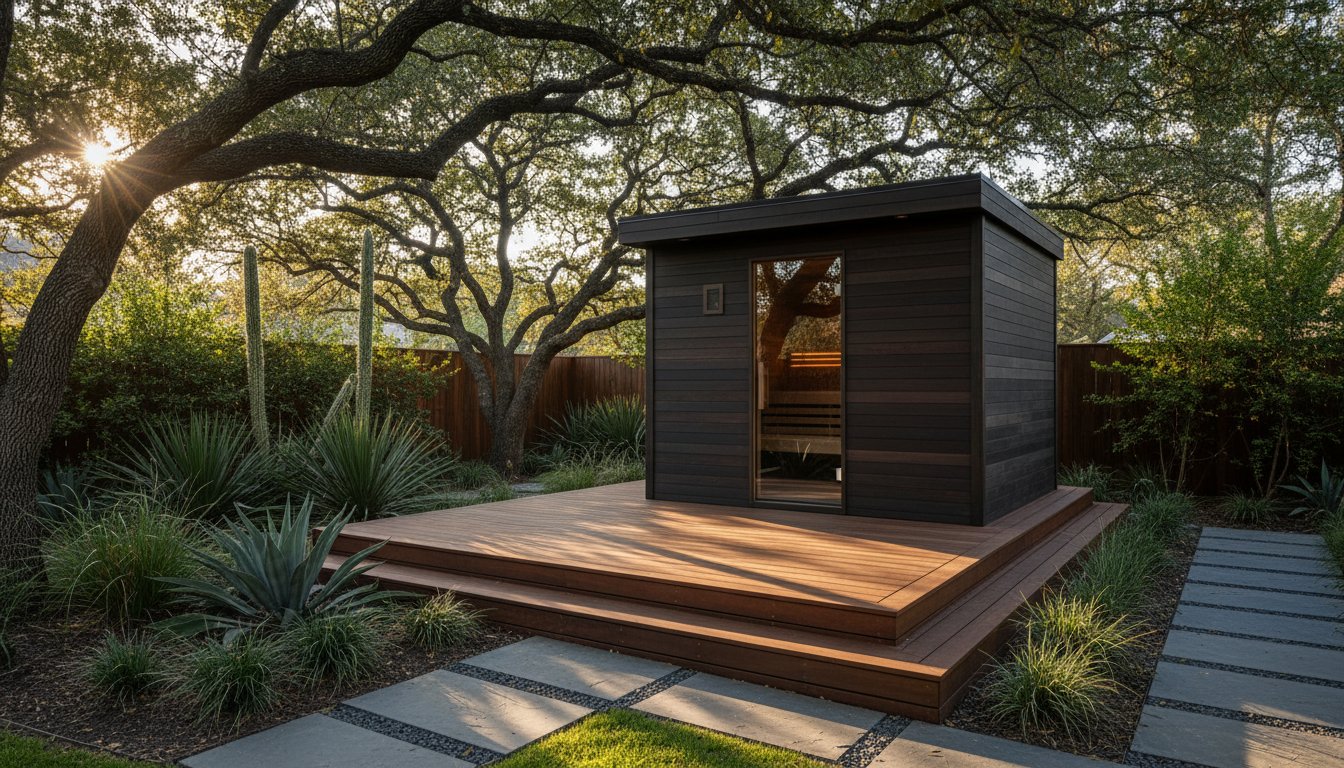
A budget cedar kit is a ticking time bomb in the 90% humidity of a Central Texas summer. Most Austin homeowners realize too late that generic outdoor saunas aren't engineered for this climate, often resulting in structural warping or mold issues within the first 24 months. You want the elite physical recovery benefits and the estimated 15% property value increase that a high-end installation provides, but you can't afford a backyard eyesore that fails after two seasons.
This guide provides the definitive blueprint for selecting and siting a high-performance unit that survives the local heat while integrating seamlessly into your architecture. We'll break down the specific wood grades required for Austin durability, the non-negotiable electrical requirements for 2026 builds, and the strategic placement secrets that maximize your investment. It's time to stop treating your recovery like an afterthought and start building a professional-grade oasis that actually lasts.
Key Takeaways
- Learn why thermally modified wood is the only material capable of surviving Austin’s brutal 100-degree heat cycles without warping or degradation.
- Compare the performance and footprint of different outdoor saunas to select the architecture that fits your specific recovery goals and backyard layout.
- Master the engineering essentials, from dedicated 240V circuits to strategic siting, to ensure your high-performance investment performs under pressure.
- Leverage 3D design renderings to integrate your sauna into a master backyard plan that maximizes both property ROI and aesthetic flow.
Why Outdoor Saunas Are the Ultimate High-Performance Investment in Austin
Austin doesn't do average. We do high-performance. For the local tech and VC crowd, outdoor saunas are the new executive priority. This isn't about a luxury amenity. It's about a strategic recovery asset parked right in your backyard. By 2026, the standard for a high-end residence has shifted. The backyard circuit is the new benchmark, combining heat, cold, and architectural precision to create a private recovery hub.
The science is clear and the results are measurable. Regular heat exposure triggers heat shock proteins. These proteins repair damaged cellular structures and improve longevity. It's a direct counter-attack against high-cortisol environments. If you're looking for a deeper dive into the history and mechanics of what is a sauna?, the fundamental principles remain the same, but the execution has evolved. We're building for biological optimization.
The Austin wellness trend: why now?
Local fitness culture is moving away from crowded public spaces. High-performance professionals want a 24/7 sanctuary. They want total control over their recovery environment. We're seeing a rise in social wellness design in Central Texas. This means the sauna is a focal point for networking and family time, not a hidden box. It's about privacy and convenience. You don't waste time commuting to a spa when the best facility in the city is ten feet from your back door.
Impact on residential property value
Professional outdoor saunas drive serious ROI in the Austin real estate market. Integrated units consistently outperform standalone DIY kits in long-term appraisal value. A 2024 market analysis showed that high-end homes with integrated wellness features sell 12% faster than those without. Future buyers in the luxury bracket aren't looking for projects. They want turnkey recovery suites. A well-executed sauna provides a wow factor that differentiates a property in a competitive market. It’s an investment in your health now and your equity later.
Building these structures requires more than just a heater and some cedar. It takes an understanding of local climate demands and architectural integration. We don't just drop a box on a patio. We build high-performance tools that stand up to the Texas sun and deliver consistent results every single session. Quality construction ensures your investment doesn't just look good on day one, but continues to perform for a decade.
Material Science: Why Thermally Modified Wood Wins in the Texas Heat
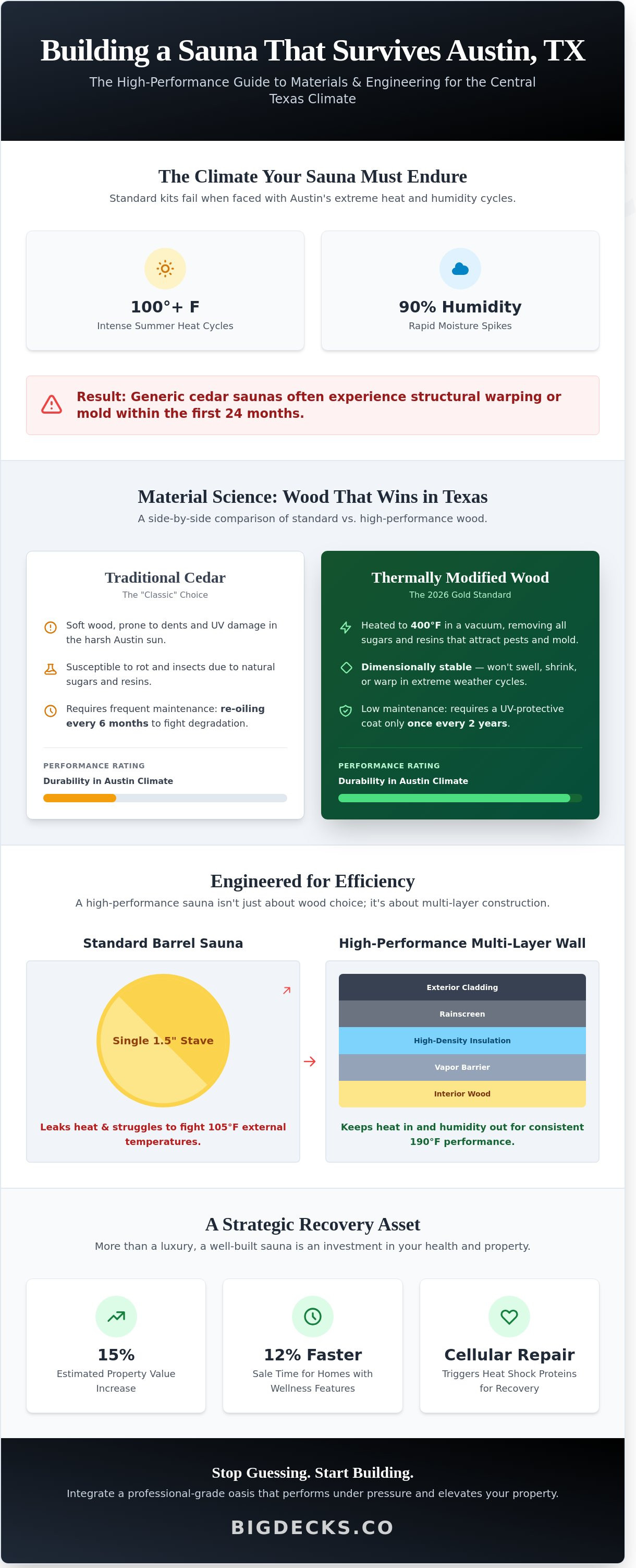
Austin weather is a gear-killer. We face 100-plus degree days for months at a time, followed by rapid humidity spikes that reach 90 percent. This cycle wrecks standard lumber. While traditional cedar is a classic choice, it often fails under the modern high-heat stress of Central Texas. You need a material that won't warp when the sun beats down on your recovery suite.
Thermally modified wood, specifically Thermory, is the gold standard for 2026. The process is intense. Technicians heat the wood to over 400 degrees Fahrenheit in a vacuum. This cooks out the natural sugars and resins that attract rot and insects. It leaves you with a dimensionally stable product. It won't swell in the rain or shrink in the drought.
Cedar vs. Thermory: The No-BS Comparison
Cedar is soft. It smells great, but it requires re-oiling every six months to fight UV damage in Austin. Thermory is a 30-year investment. It offers superior thermal conductivity, meaning it stays cooler to the touch even at high internal temperatures. This is vital for maximizing the cardiovascular health benefits of saunas. You want the heat in the air, not burning your skin on the bench. Thermory requires significantly less maintenance, usually needing a UV-protective coat only once every two years.
Insulation and Vapor Barriers
Many outdoor saunas in Austin are thin-walled barrels. These are built with 1.5-inch staves that struggle to fight 105-degree external temperatures. They are inefficient and leak heat. A high-performance build utilizes multi-layer wall construction. This includes a dedicated vapor barrier to stop internal condensation from rotting the structure from the inside out.
Real performance requires hitting a consistent 190°F. To achieve this in the Texas sun, you need a rainscreen, a vapor barrier, and high-density insulation. This setup keeps the heat in and the humidity out. If you are planning a serious build, look at how professional design-build teams engineer these structural layers for longevity.
High-performance recovery is about precision. You can't get that precision from a kit that warps after one season. Invest in the material science that handles the Austin climate. It's the difference between a functional tool and a backyard eyesore.
Comparing Sauna Architectures: Barrels, Cabins, and Custom Integrations
Selecting the right structure for your outdoor sauna is a performance decision. The geometry of the unit dictates how heat moves, how many people you can fit, and how the wood survives the brutal Central Texas sun. You aren't just buying a box of cedar. You're investing in a thermal environment that needs to deliver consistent results every time you step inside.
Three primary formats dominate the Austin market. Each offers a distinct trade-off between heat-up speed, interior volume, and architectural integration. Whether you want a plug-and-play solution or a permanent structural addition, understanding these mechanics is the first step toward a successful build.
The Barrel Sauna: Pros and Cons for Austin
The barrel is the iconic choice for high-performance recovery. Its circular design eliminates corners where air pockets stagnate, promoting constant heat convection. This allows your unit to hit 175 degrees significantly faster than a square cabin of the same size. It's a strategic win for owners who value efficiency and want a smaller footprint on their property.
Standard barrel designs often face the "cold feet" problem. Because heat rises to the top of the curve, the floor remains cool. High-end models solve this with recessed floors or multi-level benches that get your feet above the heater. In Austin, skip the dirt or grass. Site your barrel on limestone pavers or a reinforced wood platform. This prevents moisture rot and ensures the structural rings stay aligned as the wood expands and contracts.
Cabin and Cube Designs: The Modern Aesthetic
Modern "Cube" designs are currently the standard for high-end builds in Westlake and Tarrytown. These structures prioritize floor-to-ceiling glass walls, making them a strategic choice for properties with Hill Country views. Unlike the tight quarters of a barrel, cabin designs offer superior insulation and vertical space. This allows for multi-level seating where users can choose their heat intensity by shifting levels.
A standard 6x8 foot cabin provides roughly 30% more usable interior volume than a barrel with the same footprint. This extra space is essential for group sessions or "sauna yoga." The flat roof lines also allow for easier integration of high-powered electric heaters that require specific clearances. It's a bold, architectural statement that mimics the clean lines of modern Austin residential design.
Custom Built-ins: Seamless Integration
Custom built-ins represent the ultimate play for homeowners who want their outdoor saunas to feel like a permanent part of the estate. These units are often embedded directly into existing decks or carved into limestone hillsides. This approach maximizes every square inch of your property and creates a seamless transition from the pool to the recovery zone.
Building custom requires precise engineering for ventilation and drainage. You're essentially building a small, high-heat room that must breathe. When executed correctly, a custom-integrated sauna acts as a structural anchor for your outdoor living space. It moves beyond a portable product and becomes a permanent architectural feature that drives long-term property value.
Siting and Engineering Your Austin Sauna for Longevity and Privacy
Don't just drop your unit on the grass and hope for the best. Austin’s soil shifts, and your neighbors have eyes. You need a strategic layout that maximizes heat retention and minimizes social friction. High-performance outdoor saunas require more than a level surface; they require an engineered environment that handles Central Texas weather and neighborhood politics.
Electrical power is your first hurdle. A standard 110V outlet won't cut it for a serious heat cycle. You need a dedicated 240V circuit with a 40 to 60-amp breaker. This ensures your heater reaches 190 degrees in under 40 minutes, even during a February cold snap. Without this dedicated line, you're just sitting in a lukewarm room wasting time.
Foundation engineering is equally critical. Austin sits on a volatile mix of limestone and expansive clay. A reinforced concrete pad or a heavy-duty gravel base with a timber frame prevents the structure from racking as the ground swells. Proper drainage ensures water moves away from the base, preventing rot and keeping the wood stable for decades.
Design for the "Circuit" flow. Position your sauna within 10 to 15 feet of your cold plunge. This proximity allows for the rapid transition required for thermal shock therapy. If you're chasing the sunset, orient the glass toward the west, but use architectural elements to shield your view from the house next door.
Austin Permitting and Code Compliance
Austin city code generally requires accessory structures to stay 5 to 10 feet away from side and rear property lines. If your unit exceeds 200 square feet or includes permanent plumbing, it's a permanent structure in the eyes of the city. Neighborhoods like Barton Creek and Circle C have strict HOA guidelines. They often require exterior finishes that match the primary residence, so plan for cedar or stone accents early in the design phase.
Privacy and Architectural Screening
Privacy is a tactical necessity for a true wellness zone. Use modern horizontal fencing to create a secluded perimeter that doesn't choke off the breeze. Pair the hardscape with native West Texas plantings like Texas Sage or Yucca. These species thrive in 100-degree heat and provide year-round visual density. Finish the space with low-voltage LED lighting for safe, high-end nighttime sessions.
Ready to build a recovery zone that actually performs? Contact Big Decks to start your design.
The BigDecks Advantage: Integrating Wellness into a Master Backyard Plan
Dropping a pre-built cedar box in the corner of your yard doesn't create a recovery zone; it creates an obstacle. Most outdoor saunas fail to reach their potential because they lack architectural context. We treat the sauna as a core structural element rather than a disconnected add-on. When a project is integrated correctly, it stops looking like a backyard shed and starts feeling like a private resort, drawing inspiration from elite European wellness destinations like Beim Wartner that master the balance between architecture and nature.
Before we cut a single beam, we use 3D design renderings to map the entire footprint. This allows you to see how the sauna door swing affects foot traffic or how the evening sun hits the glass at 6:00 PM. We solve the logistics of electrical runs, ventilation, and drainage in virtual reality. This process eliminates expensive mid-build pivots and ensures the final structure aligns perfectly with your home's existing lines.
Our team manages the entire lifecycle of the build. We handle the site leveling, foundation piers, and structural framing required to support heavy equipment. You don't have to coordinate between a carpenter, an electrician, and a landscaper. We provide a single point of accountability from the first shovel in the ground to the final finish coat.
The circuit design: sauna, plunge, and deck
High-performance recovery relies on the transition. We design "The Circuit" to facilitate the shift from 180-degree heat to a 50-degree cold plunge. This involves strategic zoning on the deck to keep wet areas separate from dry lounge spaces. Integrating hot tubs into this layout creates a professional-grade thermal suite; to keep these units efficient and debris-free, many owners rely on Northern Hot Tub Covers for a custom fit. We prioritize textured, non-slip surfaces and thermal-treated woods to ensure the path between zones is safe and durable.
Craftsmanship and precision metalwork
Modern Austin architecture demands a specific aesthetic. We combine traditional heavy-duty carpentry with custom, powder-coated steel accents. This hybrid approach allows outdoor saunas to withstand Texas humidity while matching the clean, industrial lines of contemporary homes. Our commitment to precision engineering means your sanctuary is built to last as long as the house itself. We don't build temporary fixes; we build permanent assets that increase property value.
Building a recovery space is an investment in your daily performance. By focusing on smart design and rugged materials, we ensure your backyard serves as a functional tool for health. If you're ready to move beyond basic upgrades, let's look at how an integrated wellness plan can work for your specific property.
Frequently asked questions
- How long does it take to build an integrated sauna deck? Most custom integrated projects take 4 to 6 weeks from site prep to final inspection, depending on the complexity of the metalwork and utility runs.
- Do I need a special foundation for a sauna? Yes. A standard deck often needs reinforced joists or a dedicated concrete pad to handle the concentrated weight of the sauna heater and stones.
- Can you integrate a sauna into an existing deck? We can often retrofit existing structures, though it usually requires opening the deck to add structural blocking and running new 220v electrical lines.
Own the Austin Heat with High-Performance Recovery
Building a high-performance recovery space in Central Texas isn't about following trends. It's about engineering a structure that survives 105-degree days and 90% humidity. You've seen why thermally modified wood is the only logical choice for outdoor saunas in this climate. It doesn't rot, warp, or surrender to the sun. Successful projects require more than just good lumber; they demand precise siting and custom metalwork that anchors the sauna into your broader landscape plan. This ensures your investment stands up to the specific environmental stressors of the Hill Country.
Our Austin-based design and build team uses precision 3D modeling for every project to ensure your sanctuary fits your backyard's footprint before a single board is cut. We focus on the intersection of material science and architectural intent. Whether you choose a barrel or a custom cabin, the goal is a 20-year asset, not a three-year headache. Your recovery shouldn't be a gamble. It should be a calculated investment in your long-term health and property value. Ready to build your high-performance sanctuary? Get a custom 3D design bid from BigDecks. We're ready to help you build something that lasts.
Frequently Asked Questions
Do I need a permit for an outdoor sauna in Austin?
Austin building code states you don't need a building permit for accessory structures under 200 square feet. You'll still need a specific electrical trade permit for the 240v line. Most high-end outdoor saunas require this dedicated circuit to hit peak temperatures quickly. Don't skip this step, or you'll risk failing a home inspection during a future sale.
How much does it cost to run an electric sauna heater in Texas?
Running a standard 8kW heater costs about $1.12 per hour based on Austin Energy’s 2024 Tier 1 rate of $0.14 per kWh. If you use your sauna for three one-hour sessions every week, your monthly cost stays under $15. It's a low-cost utility compared to the high-performance recovery benefits you get in return.
Can I put an outdoor sauna directly on my existing wood deck?
You can place a sauna on a deck if the framing supports 50 to 70 pounds per square foot. Most barrel-style outdoor saunas weigh between 800 and 1,200 pounds, which creates a concentrated load your joists must handle. We recommend adding blocking or extra posts under the footprint to prevent sagging or structural failure over time.
What is the best wood for an outdoor sauna in Austin humidity?
Thermowood is the top performer for Austin’s 65% average humidity because the thermal modification process prevents rot and warping. Western Red Cedar is a close second, using its natural tannins to fight off Texas pests and decay. Avoid budget woods like hemlock; they'll buckle and split after two seasons in the Central Texas heat.
How often do I need to maintain or re-oil my outdoor sauna?
Plan to apply a UV-inhibiting oil to the exterior every 12 months to prevent the wood from turning gray. The interior should never be stained or oiled; instead, scrub the benches with a mild soap every 10 sessions to remove body oils. This simple routine protects your investment and keeps the wood from cracking under the intense Texas sun.
Is an infrared sauna better than a traditional steam sauna for Austin?
Traditional saunas are the winner for Austin because they hit 185 degrees, providing the intense heat stress needed for athletic recovery. Infrared units max out around 140 degrees, which feels lukewarm when it's already 105 degrees outside in July. If you want a true physiological response, stick with a traditional heater and rocks for that high-performance steam experience.
3D Design Renderings in Austin: Why Your Backyard Project Starts in Virtual Reality
See your Austin backyard before it's built. Our guide to 3d design renderings helps you avoid costly mistakes & visualize every detail in virtual reality.
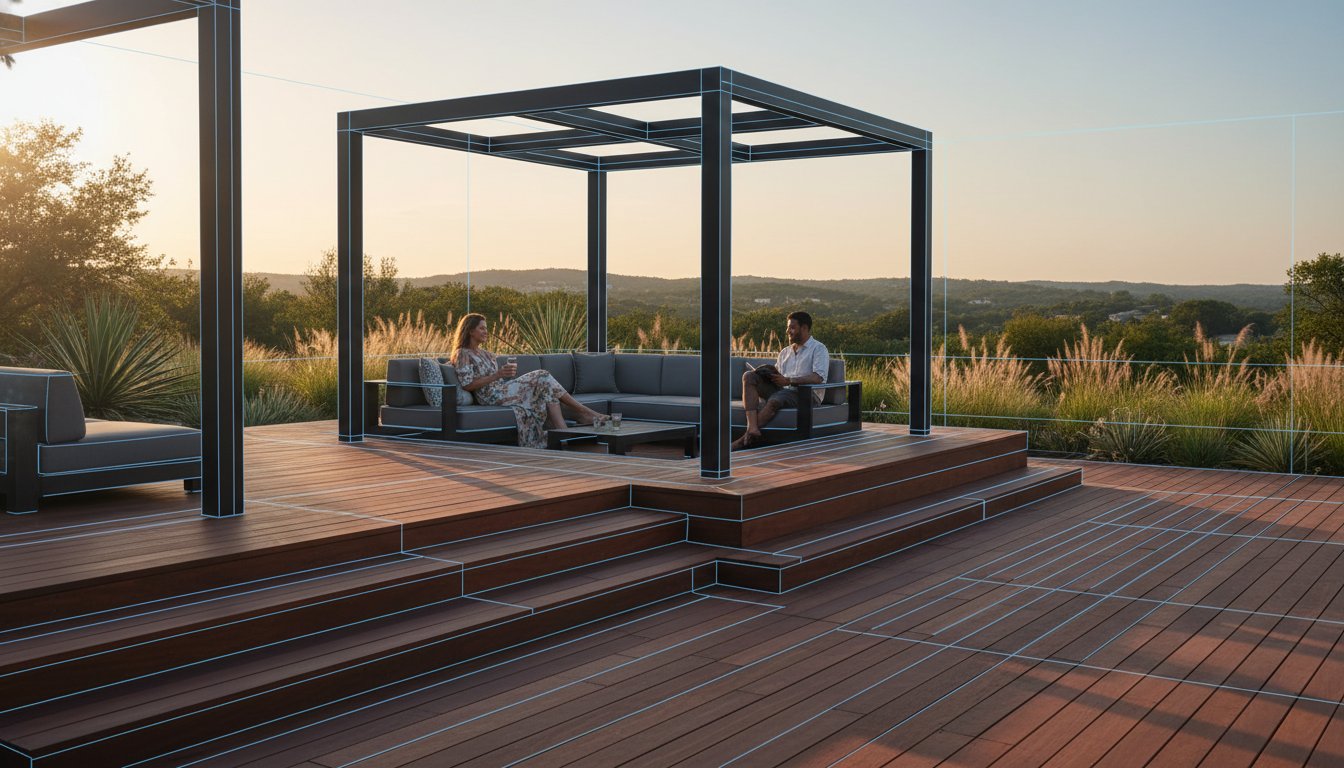
The most expensive mistake you’ll ever make on your Austin backyard project happens before a single hole is dug. You’ve spent weeks dreaming about IPE decking or Cedar pergolas, but the fear of a mid-construction surprise is enough to stall any renovation. High-end 3d design renderings aren't just a flashy sales tool; they're the only way to see exactly how your materials will react to the intense Texas sun before you commit your budget. If you're concerned about the grain of the wood or the way shadows fall across your patio at 4:00 PM, virtual modeling provides the clarity that a flat blueprint simply cannot match.
It’s natural to feel anxious about spatial flow or whether your expensive outdoor furniture will leave enough room for the grill. We agree that guessing is a gamble you shouldn't take when your home's equity and your sanity are on the line. This guide will show you how professional modeling eliminates construction risk and provides a definitive roadmap for your build team. We’re diving into how you can secure total design confidence and create a visual "wow" factor to share with your family long before the first board is cut.
Key Takeaways
- Eliminate the risk of expensive mid-build changes by visualizing every structural detail before a single board is cut.
- Use professional 3d design renderings to bridge the gap between flat 2D blueprints and a photorealistic "digital twin" of your future backyard.
- Protect your project budget by identifying aesthetic and structural conflicts in a virtual environment where adjustments cost nothing.
- Learn why a designer’s grasp of real-world material physics and Austin lighting is more critical to project success than basic software skills.
- Discover how virtual modeling allows for the precision integration of complex elements like custom metalwork and thermally modified wood.
What are 3D design renderings and why does Austin demand them?
Stop trying to project your future backyard onto a flat piece of paper. A 2D blueprint is a relic of a slower era. Today, a 3D design rendering serves as a photorealistic digital twin of your project. It is a high-fidelity simulation that allows you to walk through your space before a single shovel hits the dirt. What are 3D design renderings exactly? They are the process of converting three-dimensional data into a visual image that looks like a finished photograph. In the high-stakes world of Austin real estate, this isn't just a cool visual; it's your primary risk-management tool.
Austin topography is notoriously difficult. If you live in the Hill Country, your backyard likely isn't level. It's a series of slopes, limestone shelves, and drainage challenges. A 2D plan can't show you how a fifteen-foot drop-off affects the structural integrity of your build. You need to see the retaining walls and the steel piers in a virtual environment first. We call this a construction-first mindset. It's about seeing the skeletal structure and the finished aesthetic before you commit to the lumber and the labor.
Visualizing scale and spatial flow
Most homeowners struggle to translate square footage into actual usable space. You might think a twelve-foot deck is plenty of room until you realize your grill and dining table leave no space to walk. 3d design renderings solve this by modeling the actual footprint of your custom decks. We place digital furniture and appliances into the model to test the "path of travel" between your back door and the pool. It ensures you have the necessary clearance for an outdoor kitchen without creating a bottleneck in your entertainment flow. If you are also researching how a pool fits into your master plan, you can learn more about Marlin Exteriors, Inc. and their insights on high-quality installations.
The Austin sunlight factor
The Texas sun is a relentless variable that can ruin a poorly planned deck. At 4 PM in July, a beautiful outdoor space becomes unusable if it's baking in direct heat. We use real-world solar data to simulate exactly how the sun hits your property throughout the year. This allows us to visualize shadow patterns from pergolas, rooflines, or architectural fencing. If the shade isn't hitting your seating area during peak hours, we adjust the design in the software. For homeowners looking for advanced solutions like louvre roofs, seeing how specialists like patioscoast2coast.com.au approach these designs can provide valuable insights into managing light and airflow. It's a data-driven way to ensure your investment doesn't become a 110-degree frying pan during the summer months.
The mechanism of a killer 3D deck design
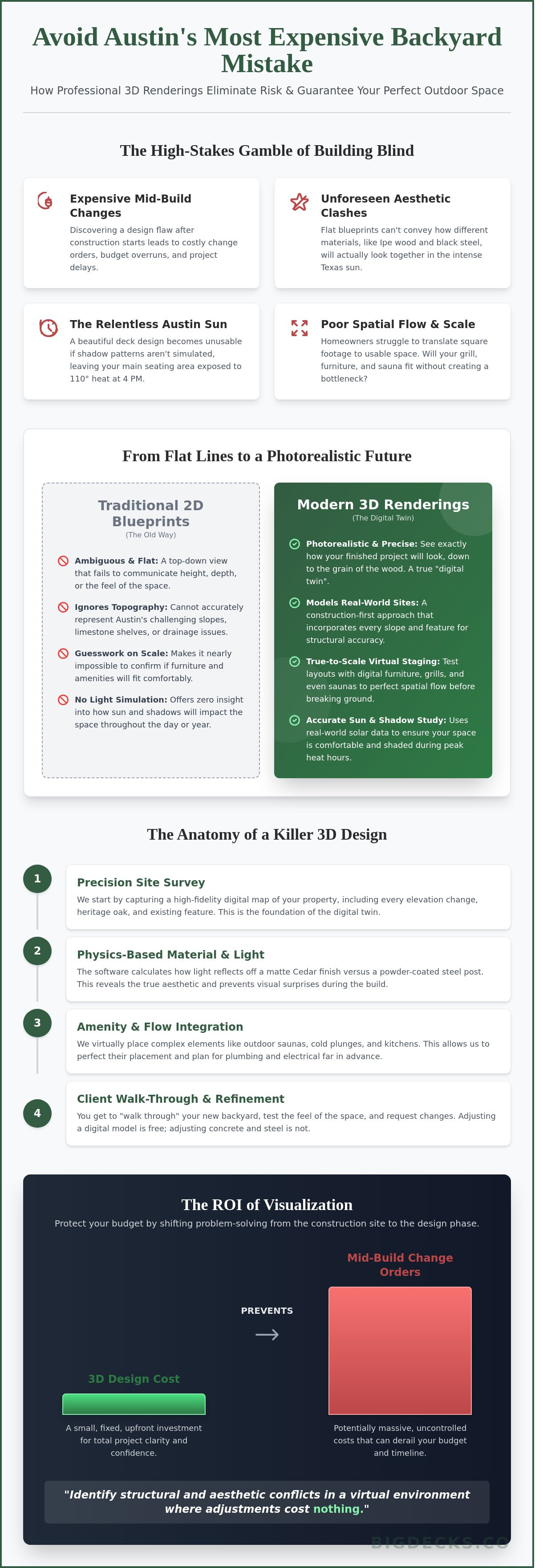
A backyard project isn't a guess. It's a calculated build based on data. We start with a high-precision site survey, capturing every elevation change and existing feature. If your property has a 200-year-old heritage oak or a legacy limestone retaining wall, it goes into the model first. This ensures the 3d design renderings aren't just pretty pictures; they're digital twins of your Austin property. We build the digital version to find the friction points before the first crew arrives on site.
Modern software treats materials like physical objects. It calculates how light bounces off a powder-coated steel post versus a matte wood finish. The mechanism of a killer 3D deck design relies on these physics-based calculations to eliminate surprises during construction. We layer in lighting to simulate "night mode," showing exactly where LED path lights and under-cap deck lighting will land. This prevents dark corners and ensures your oasis is functional after the sun sets over the Hill Country.
Photorealistic texturing for Ipe and Cedar
Generic brown blocks don't cut it. Real Ipe has a deep, oily grain that shifts in the sun. Cedar has a distinct warmth. High-end 3d design renderings allow us to visualize the weathering process. You can see how a clear oil finish looks today versus how the wood might silver over 24 months without maintenance. We also model the high-contrast look of black steel accents against natural wood grains to verify the aesthetic balance. It's about seeing the grain, not just the color.
Integrating amenities: Saunas and cold plunges
Luxury add-ons require technical precision. We place outdoor saunas to maximize privacy while maintaining the best views. The model handles the logistics too. We visualize plumbing lines and drainage requirements for cold plunges to avoid mid-build headaches. Testing the proximity of a hot tub to the main deck area in VR ensures the flow of movement feels natural. If the layout feels tight in the render, we fix it now. It's much cheaper to move a digital sauna than a 1,500-pound cedar barrel. You can explore our design approach further at bigdecks.co to see how these elements fit together.
3D renderings vs. 2D blueprints: The ROI of visualization
Stop guessing and start knowing. A 2D blueprint is a flat map of a 3D problem. While traditional sketches show dimensions, they fail to communicate the feel, flow, and physics of a complex backyard build. For most homeowners, reading a technical drawing is like reading code; it’s easy to miss the critical details that lead to expensive mistakes later. Investing in 3d design renderings upfront acts as a financial insurance policy. It is far cheaper to move a virtual wall with a mouse click than it is to tear down a physical one once the concrete has cured.
In Austin, the terrain is rarely flat. A 2D drawing cannot accurately depict how a multi-level deck interacts with a limestone slope or a 15 percent grade change. This lack of clarity often leads to mid-project change orders that stall momentum and drain budgets. Beyond the build, these visuals are your strongest asset for local approvals. Austin HOAs and permit offices move faster when they don't have to imagine the result. Clear visuals eliminate the "what if" and replace it with a definitive "this is it," making your project the easiest one for the board to approve.
The industry has shifted toward these immersive tools because they bridge the gap between imagination and engineering. For a deeper look at the tech driving this change, check out this comprehensive guide to 3D architectural rendering. It highlights how modern software turns raw data into high-stakes visual narratives.
Spotting structural clashes early
Precision matters before the first hole is dug. 3D models allow us to stress-test the design against the existing house. We can identify exactly where a support beam might overlap a basement window or where a roofline extension might create a water trap. Drainage is another critical factor in Central Texas. We use these models to ensure runoff moves away from the foundation, preventing the $15,000 erosion issues that haunt poorly planned projects. By seeing the clash in virtual reality, we solve the problem in the design phase, not on the job site.
Communicating with the build team
3D visuals serve as the universal language between you, the designer, and the crew on the ground. It removes "interpretation" from the equation. When a carpenter looks at a high-resolution render, they see the exact junction of cedar and steel. This clarity is vital for precision metalwork and custom masonry where there is zero margin for error. The build team works faster and with more confidence because the goal is visible. You get a final product that matches the initial vision exactly, down to the last bolt and board.
How to evaluate 3D design services in Central Texas
A digital model is only as good as the data behind it. Many designers can spin up a basic backyard layout, but there is a massive gap between a generic visual and professional 3d design renderings that function as a buildable blueprint. You aren't just buying a picture; you're buying the assurance that your project won't fail once the first pier is poured. Evaluating a service requires looking past the surface level to find the technical depth required for Austin’s unique terrain.
Material accuracy and depth
Professional design services focus on the details that actually matter during construction. A high-quality render shows the actual 5.5 inch width of an IPE board rather than a generic brown texture. It accurately depicts the grain direction for a horizontal fence, ensuring the gaps provide the exact level of privacy you expect. If the limestone pavers aren't scaled to their real-world 24-inch dimensions, the entire layout will be off by the time the stones arrive on site.
Software vs. Expertise
Software is a tool, not a solution. Effective deck design services require a builder’s eye to spot structural impossibilities before they become expensive field changes. A designer without construction experience might create a stunning "floating" roof that lacks the necessary load-bearing points to pass an Austin city inspection. You need to distinguish between a "concept" that looks good on a screen and a "construction plan" that accounts for 15 percent grades and drainage runoff.
When you review a portfolio, look for these specific markers of quality:
- Realistic Lighting: High-resolution renders should show exactly how the Texas sun hits your patio at 4:00 PM in July.
- 360-Degree Tours: You should be able to virtually walk through the space to check for tight corners or flow issues.
- Fastener Detail: If the model doesn't show how the joints connect, the designer hasn't thought about the structural reality.
- Site Integration: The design must include your home's existing exterior, including windows, doors, and AC units, to ensure a seamless fit.
The goal of using 3d design renderings is to eliminate the "I thought it would look different" conversation that happens at the end of a project. Demand a level of detail that matches the investment you're making in your property. If the designer can't explain the structural logic behind their virtual model, they aren't the right partner for your build.
The BigDecks approach: From virtual render to Austin reality
BigDecks doesn't just build; we strategize. We use 3d design renderings to eliminate the guesswork that plagues standard construction projects. Most builders work from a 2D sketch and hope for the best. We build your project twice: once in a high-fidelity virtual environment and once in your backyard. This ensures that every weld on your custom metalwork and every plank of thermally modified wood fits the exact geometry of your site.
Integrating custom metal and premium wood requires surgical precision. If a steel post is off by half an inch, the whole aesthetic fails. Our 3D models allow us to stress-test these integrations before we ever strike an arc or cut a board. You see the shadow lines and the structural connections in real-time. It's our "No-Surprises" guarantee. What you approve on the screen is exactly what we deliver on the ground. We don't believe in mid-project pivots that drain your bank account.
The Austin design-build workflow
Our process starts with a boots-on-the-ground site consultation. We measure every slope and elevation change of your Austin property. This data feeds the first 3D draft. From there, we enter collaborative revision cycles. We dial in the railing heights, the lighting placement, and the stair runs. Once the model is locked, we calculate the final deck cost based on the exact material quantities generated by the software. This level of accuracy protects your budget from the unexpected costs common in traditional builds. You get a fixed price based on a fixed vision.
Final thoughts on your backyard investment
A high-end deck is a significant asset. It's an investment in your home's equity and your daily quality of life. Don't rush the planning phase. Prioritize clarity over speed. Using 3d design renderings gives you the peace of mind that your capital is being deployed effectively. You'll see the return on investment before the first pier is poured. In a city like Austin, where outdoor living is a year-round reality, getting the details right isn't a luxury; it's a requirement for success.
Ready to see your vision in high definition? Book your 3D design consultation with BigDecks today and let's build something legendary. We'll handle the technical heavy lifting while you focus on the final result.
Stop Guessing and Start Building Your Austin Reality
Traditional blueprints leave too much to the imagination. In Austin's high-stakes real estate market, you can't afford a deck that looks better on paper than it does in your backyard. Our precision 3D modeling eliminates the "what-if" factor by showing you exactly how premium materials like IPE or Western Red Cedar will weather and fit against your home's unique architecture. This isn't just a drawing; it's a structural roadmap for your investment.
Investing in 3d design renderings is a strategic move to lock in your ROI before the first board is cut. Our design-build workflow integrates every technical detail, from specific soil grades to structural spans, ensuring the final build matches the virtual model to the inch. You get a killer result without the typical construction headaches, mid-project pivots, or budget-draining surprises. We prioritize practical authority and construction sense to ensure your backyard performs as well as it looks.
See your dream deck before we build it; book a design consultation
Your dream backyard is ready for its close-up, and we're ready to build it.
Frequently Asked Questions
How much do 3D design renderings for a deck cost in Austin?
Professional design fees in the Austin market are typically calculated as a flat project fee or a percentage of the total construction budget. This cost covers the site survey, digital modeling, and the software licenses required to produce high-resolution visuals. Investing in this phase prevents mid-project changes, which industry data suggests can increase total construction costs by 10 percent or more if structural adjustments are made after the build begins.
Do I really need a 3D design if I already have a 2D sketch?
You need a 3D design to see how the new structure interacts with your home's existing roofline and elevation changes. A 2D sketch shows the footprint, but it can't show you how shadows will fall across your living space at 4:00 PM in July. High-quality 3d design renderings give you a realistic view of scale and material transitions, ensuring the final product matches your expectations before any lumber is delivered.
How long does the 3D rendering process take?
A standard 3D design typically takes between 5 and 10 business days to complete after the initial site measurements are taken. This window allows the designer to model your home's exterior accurately and test different structural configurations. Complex projects involving multi-level decks or integrated outdoor kitchens may require additional time to ensure every detail is technically sound and visually correct.
Can 3D renderings help me get HOA approval in Austin neighborhoods?
3D renderings are an essential tool for securing approval from Architectural Control Committees in Austin neighborhoods like Steiner Ranch or Circle C. Most HOAs require clear visual evidence that a new deck won't negatively impact the community's aesthetic or a neighbor's privacy. Providing a realistic model shows the board exactly what the finished project will look like, which often streamlines the approval process and reduces the need for multiple revisions.
What software do professional deck designers use for 3D renderings?
Professional designers use specialized platforms like Chief Architect, SketchUp, or Lumion to create accurate 3d design renderings. These programs allow us to import real-world material textures from brands like Trex or TimberTech so you can see the exact color and grain pattern of your decking. Using professional-grade software ensures that the digital model is built to actual structural dimensions, which serves as a reliable blueprint for the construction crew.
Is the 3D design included in the total construction cost?
The billing structure varies by firm, but many design-build companies offer the design as a standalone professional service. Some builders will credit a portion of the design fee back to your project if you sign a construction contract with them. This approach ensures you're paying for expert planning and a set of deliverables that you own, regardless of which team handles the eventual build.