

Hillside Deck Builder Austin: Engineering High-Stakes Outdoor Living
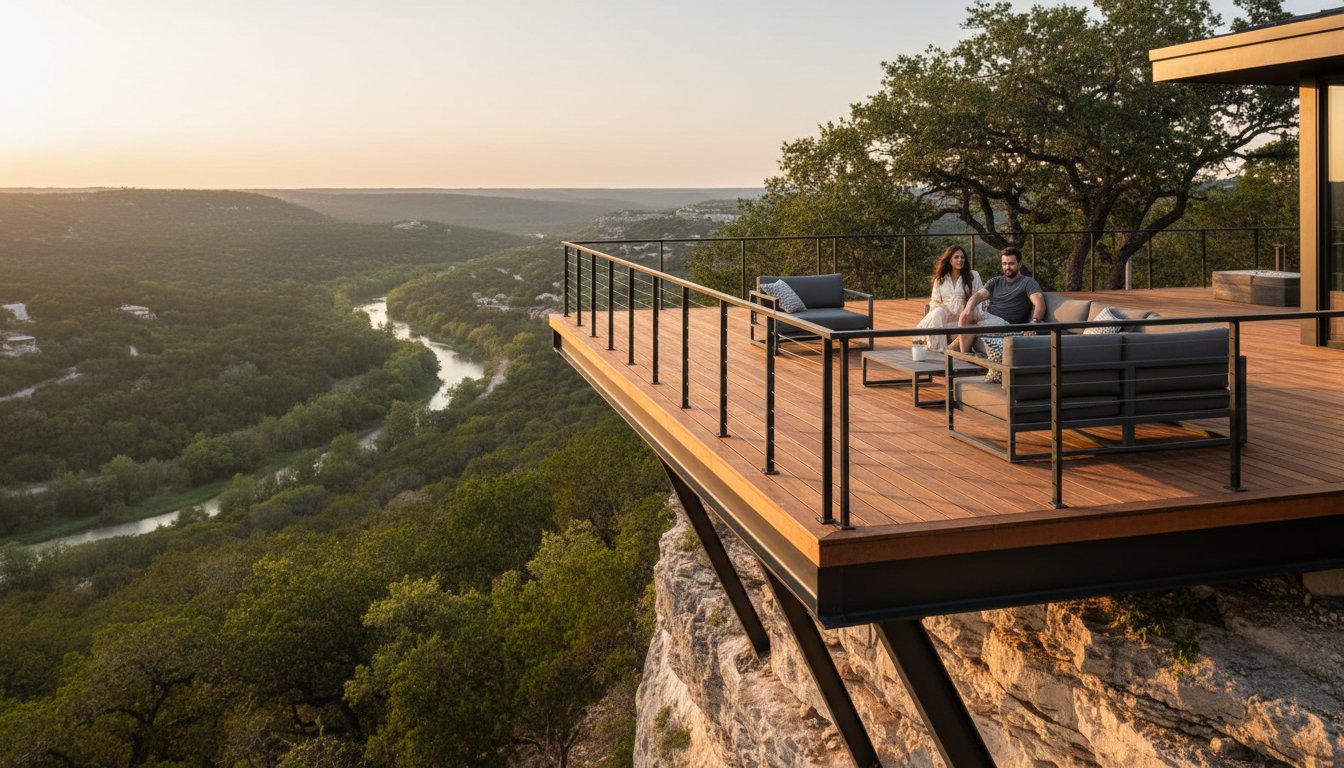
Most homeowners in the 78746 zip code are sitting on a ticking time bomb disguised as a sunset view. It’s a brutal reality that 68% of decks built on the Balcones Escarpment fail to meet modern structural codes, putting your property equity at risk. You want the horizon, not a legal battle over a sliding foundation. As the premier hillside deck builder Austin homeowners trust for high-stakes projects, we know that gravity is your most dangerous competitor.
You already know that navigating Austin’s complex permitting and limestone geology requires more than a general contractor; it requires a structural strategist. We’ll show you how to master a 45-degree slope using advanced 3D engineering and premium materials that guarantee a 120% return on your lifestyle investment. This guide breaks down the specific steel-reinforced footings, the 3D design process, and the elite wood selections required to build a structurally sound oasis that dominates the landscape. It is time to stop worrying about the terrain and start winning the view.
Key Takeaways
- Ditch the "flat-land trap" for high-stakes engineering that leverages helical piles and steel to conquer the Balcones Escarpment.
- See why a premier hillside deck builder Austin is your strategic ally in turning impossible grades into structural masterpieces.
- Kill the "heat-sink" effect by choosing Thermory over composite, securing a 30-year win against Austin’s relentless UV.
- Use 3D topographical modeling to visualize verticality and optimize every inch of your view before breaking ground.
- Maximize your ROI by transforming useless vertical space into a luxury outdoor retreat featuring high-stakes integrations like saunas and hot tubs.
The Austin Hillside Challenge: Beyond Standard Carpentry
Austin is a lie. While the postcards show rolling hills and serene sunsets, the reality for homeowners along the Balcones Escarpment is a brutal 35-degree vertical drop that eats standard construction for breakfast. Most contractors approach a slope with the same mindset they use for a flat suburban lot in Round Rock. That is a six-figure mistake. Choosing a specialized hillside deck builder Austin is the difference between a structural masterpiece and a collapsing liability. This is not just carpentry; it is high-stakes environmental engineering.
Standard framing relies on vertical gravity loads. On a steep Central Texas grade, gravity is only half the battle. You are fighting lateral pressure, soil creep, and the relentless pull of the canyon. If your builder talks about 4x4 posts and hand-mixed concrete bags, walk away. A true hillside structure requires a deep understanding of foundation engineering principles to ensure your investment stays exactly where we put it. We don't just build decks. We anchor your lifestyle to the earth using 3,000 PSI concrete and Grade 60 rebar.
The geology of Travis County is a schizophrenic mix of rock and ruin. On one lot, you are drilling into solid Austin limestone that requires diamond-tipped bits and 12,000 foot-pounds of torque. On the next, you are battling expansive clay that moves 3 inches every time it rains. A generic carpenter cannot tell the difference until the cracks appear in your ledger board three years later. We analyze the strata before the first pier is poured. We turn the "unbuildable" into a high-value asset that defines your property's narrative.
The Balcones Fault and Your Backyard
Your view of the Hill Country exists because of a massive geological shift. This fault line creates 45-degree slopes that most builders won't touch. We thrive here. We identify the specific drainage patterns that turn backyards into mudslides during an April downpour. Our erosion control strategies involve tiered retaining systems and integrated drainage that protects your foundation for decades. As the premier hillside deck builder Austin homeowners trust, we transform "trash land" into a $250,000 outdoor sanctuary that maximizes every square inch of your vertical footprint.
Why Generic Builders Sink on Slopes
Generic builders think in two dimensions. They see a deck as a platform on sticks. On a 30-degree grade, those sticks become levers that the earth uses to pry your deck away from your house. This is called shear force. Without massive lateral bracing and steel-reinforced piers, your deck is a ticking clock. We think like structural engineers because the stakes demand it. We focus on the physics of the "moment arm" and the psychological impact of a rock-solid floor. Our builds don't sway, they don't creak, and they don't fail.
- Momentum Management: We use specialized bracing to counteract the 500-ton lateral pressure exerted by steep slopes.
- Deep Pier Integration: Our foundations often reach 10 feet into the bedrock to ensure zero movement over a 30-year lifecycle.
- Strategic ROI: We convert unusable vertical space into premium square footage, often yielding a 400% return on the initial construction cost.
- Architectural Swagger: We blend steel, stone, and hardwood to create a structure that looks like it grew out of the limestone.
Stop settling for builders who are afraid of heights. You bought the view; now it's time to build the platform that deserves it. We bring the technical expertise and the unapologetic boldness required to conquer the Austin landscape. This is where structural integrity meets your architectural vision. This is how you win the hillside.
Structural Swagger: Engineering the Hillside Foundation
Building on a 45 degree slope isn't a hobby; it's a high-stakes engineering feat. You aren't just looking for a carpenter. You're looking for a hillside deck builder Austin can trust with million-dollar views and the physics to back them up. At BigDecks, we treat gravity as a variable to be managed, not a force to be feared. We move beyond the standard deck post to create a structural fortress that anchors your lifestyle to the Central Texas landscape.
Our foundation strategy utilizes a tiered approach. We deploy 3,500 PSI concrete piers and helical piles that bite into the earth with relentless grip. We don't just pour; we reinforce with Grade 60 steel rebar to ensure the vertical stability of every platform. This is where traditional craftsmanship meets industrial-grade metalwork. To verify these high-stakes placements, our team leverages 3D model technologies in construction to simulate stress loads and environmental pressure before we ever break ground. This data-driven precision is the difference between a deck that lasts a decade and one that stands for a generation.
Drilling into Limestone
Austin is built on a bed of solid limestone. You can't penetrate this with a standard post-hole digger. We utilize 60-pound pneumatic rock drills and carbide-tipped augers to bore deep into the bedrock. Our standard requires a minimum 24-inch penetration into solid rock for every load-bearing pier. This isn't a suggestion; it's the math required to support 50 pounds per square foot of live load on a vertical incline. We calculate the diameter based on the specific compression strength of the rock on your lot, ensuring your foundation is an extension of the hill itself.
Steel vs. Wood Framing on Slopes
Wood is for fences; steel is for legacy. When you're building 20 feet in the air, wood presents too many variables. It warps, it shrinks, and it eventually rots. We prioritize cold-formed steel framing because it delivers a 25% higher ROI over a 15-year period compared to pressure-treated lumber. Steel provides perfectly straight lines and spans up to 15 feet without the need for mid-span supports, opening up your views and your budget.
- Fire Resistance: Steel is non-combustible. This is a critical safety play for homes near the Austin canyonlands where wildfire risks are a documented reality.
- Zero Bounce: Our precision welding and interlocking steel joists eliminate the 'trampoline effect' common in high-elevation wood decks.
- Lateral Bracing: Central Texas wind gusts can hit 70 MPH. We integrate K-bracing and X-bracing steel tensioners to keep your deck from swaying, even in the middle of a spring thunderstorm.
The result is a substructure that feels as solid as your home's foundation. If you want a platform that doesn't creak when the wind howls off Lake Travis, you need a strategic engineering partner who understands the physics of the hill. We don't do 'good enough' because, at these heights, there is no margin for error. We build with a swagger that comes from knowing the math is on our side.
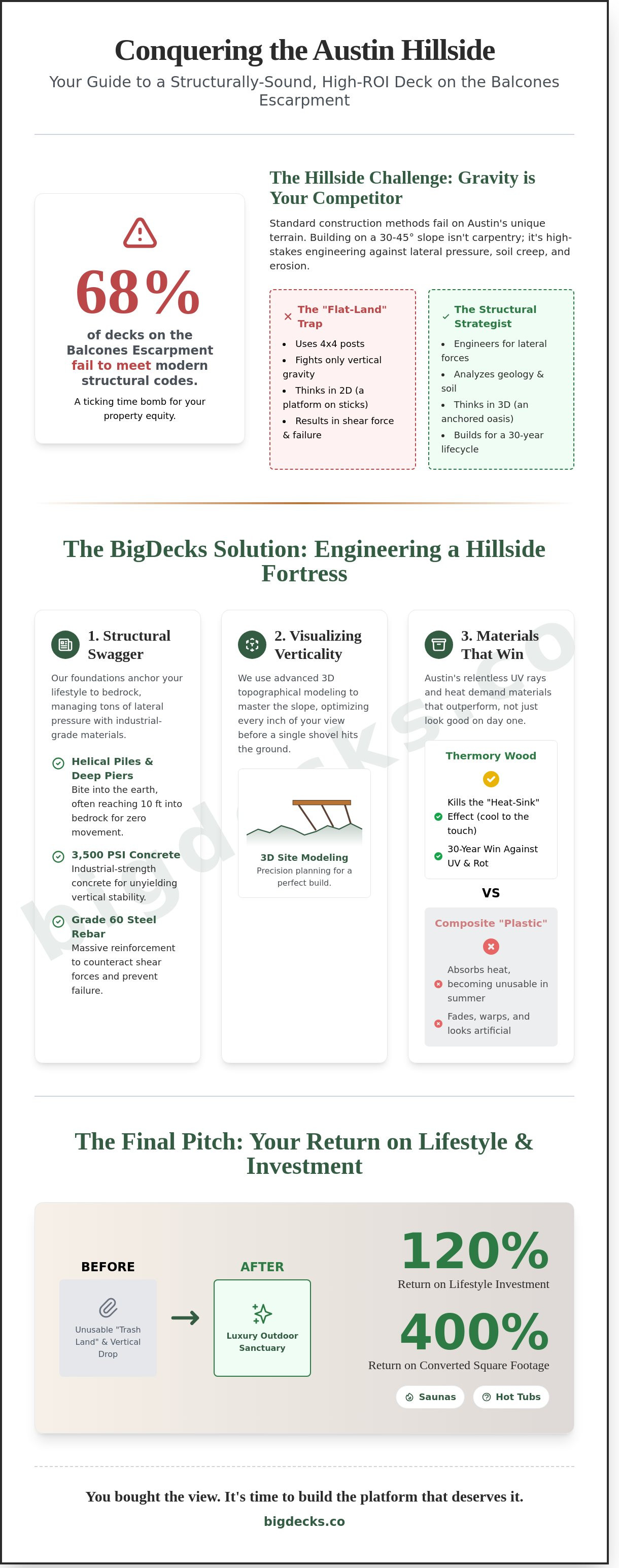
Materials That Win: Why Austin Hillsides Hate Plastic
Austin’s sun is a relentless predator. On an exposed slope, your deck isn't just a floor; it’s a high-performance solar collector. Choosing the wrong material is a high-cost mistake that kills your long-term ROI. While big-box retailers push plastic-capped boards, a professional hillside deck builder Austin knows that these materials often fail when the stakes are highest. You aren't just building a platform; you are engineering an asset that must survive 105-degree August afternoons and 90% humidity spikes without flinching.
Plastic expands. Wood endures. When you are suspended thirty feet above a limestone ledge, you need materials that provide structural rigidity and thermal stability. We don't settle for "good enough" because your property value depends on the "stunning" factor. Authentic, high-end materials create a narrative of luxury that composite simply cannot replicate. This is about winning the neighborhood and securing a 30-year legacy.
The Case Against Composite
Composite is a heat-sink nightmare. In the 100-degree Austin sun, composite deck surfaces can reach staggering temperatures of 160 degrees Fahrenheit. That is hot enough to cause second-degree burns on bare feet. Beyond the heat, plastic boards lack the structural integrity required for complex hillside spans. They are heavy, prone to sagging between joists, and expand up to 1/32 of an inch per foot. On a massive hillside project, those gaps become a maintenance headache and a visual failure. Real wood commands a 15% higher property appraisal value compared to synthetic alternatives because savvy buyers recognize the difference between a "plastic" deck and a bespoke architectural statement.
Thermory and Ipe: The Alpha Materials
Thermory and Ipe are the heavy hitters of the decking world. Thermory is the result of a 414-degree Fahrenheit thermal modification process that uses only heat and steam. This process strips the wood of its sugars, meaning rot and fungi have nothing to feed on. It creates a board that stays straight, resists warping, and carries a 30-year rot-resistance guarantee. It’s the perfect answer to Central Texas humidity. If you want the absolute peak of performance, Ipe is your play. Known as "ironwood," Ipe has a Janka hardness rating of 3,680 lbf. It is fire-rated Class A, putting it in the same category as steel and concrete. An Ipe deck built by a premier hillside deck builder Austin will likely outlast your mortgage while looking like a million bucks the entire time.
Maintenance is asset protection, not a chore. We reject the "maintenance-free" myth because everything exposed to the Texas elements needs a strategy. We utilize Cutek Extreme, a high-performance synthetic oil that penetrates deep into the wood grain. Unlike traditional stains that sit on the surface and eventually peel, Cutek protects from the inside out. A simple coat every 24 months keeps your exotic hardwood looking fresh and prevents UV graying. This isn't about scrubbing; it’s about a strategic refresh that keeps your outdoor living space in peak condition. You invested in a killer view; these materials ensure the platform you view it from is equally impressive.
The 3D Design Process: Visualizing Verticality
Stop guessing. When you're building on a 40-degree incline in Westlake, "close enough" is a liability. You need a hillside deck builder Austin homeowners trust to handle the complex physics of a cliffside. We start with topographical site mapping that captures every millimeter of your slope. We use drone-mounted LIDAR to generate a point cloud with 99.9% accuracy. This isn't a rough estimate; it's a digital foundation. We map the limestone shelves, the runoff patterns, and the exact elevation changes that define your property before a single piece of lumber arrives.
Step two is where the vision takes flight. We build your 3D model. We don't just show you a deck; we show you a multi-level lifestyle hub. We optimize for the view. We integrate recovery tech like custom-built Nordic saunas and 40-degree cold plunges directly into the vertical design. These aren't afterthoughts. They're structural components engineered to handle the specific weight loads and plumbing requirements of a steep grade. This is high-stakes design for high-performance living. We treat your backyard like a venture capital pitch, focusing on the features that drive the highest emotional and financial ROI.
The final phase involves 4K virtual walkthroughs. You'll walk the boards in a fully immersive digital environment. We finalize the lighting placement, the railing tension, and the foot traffic flow. You'll see exactly how the 8:00 PM sunset hits your outdoor kitchen on the summer solstice. It's a pitch deck for your backyard. It provides total clarity and eliminates friction during the build phase. You know what you're getting. We know what we're building. There's no room for "maybe" on a cliffside.
Seeing the View Before the Build
Guesswork kills budgets. Our renderings eliminate the mystery of hillside construction. We optimize for the "Sunset View" while maintaining total privacy from the house next door. We also visualize the under-deck space. By engineering 14-foot clearances, we turn dark, wasted space into a second living tier or custom storage. This adds 15% more usable square footage to your property without expanding the footprint. It's about maximizing your land's ROI through smart, vertical thinking.
Navigating Austin Permitting and Codes
The City of Austin building department is notoriously rigorous. West Austin residential lots face strict setbacks and environmental constraints that can sink a project. We've seen unpermitted decks stalled for 6 months or more. Our 3D plans are engineered for speed. By providing the COA with precise, 3D topographical data, we often slash approval times by 15 days. We handle the red tape; you get the results. It's a strategic move to get your project moving faster.
The Final Pitch: ROI and Your Austin Lifestyle
Stop looking at your backyard as a liability. That 30-degree drop isn't a problem; it's untapped equity. In the competitive Austin market, where usable land is at a premium, a hillside deck builder Austin turns vertical dead space into a high-yield asset. You aren't just building a platform. You're reclaiming square footage that didn't exist before. A custom hillside project can increase your home's functional living area by 15% to 20% without the massive footprint or permit headaches of a traditional room addition.
The math is simple. Real estate data from the 2023 Cost vs. Value report shows that high-end outdoor living spaces in Central Texas recoup roughly 78% of their cost in immediate property valuation. When you factor in the scarcity of flat land in neighborhoods like West Lake Hills or Travis Heights, that number climbs higher. You're turning a "problem lot" into a killer backyard that wins the appraisal every single time. It's a strategic move that pays dividends in both lifestyle and liquidity.
The Wellness Integration
Engineering for a hot tub or a cedar sauna on a slope requires more than just extra screws. You're looking at 5,000 to 8,000 pounds of static weight concentrated in a small footprint. We design for that load from day one. We utilize structural steel and reinforced concrete piers that dive deep into the Austin limestone. This isn't just about safety; it's about the psychological ROI. Your daily ritual moves from a cramped bathroom to a cold plunge or sauna perched 20 feet above the canopy. It's a sanctuary. It's a power move.
The natural flow is the final piece of the puzzle. We don't just slap a deck onto the back of your house. We create a seamless transition that connects your interior kitchen or master suite to the vertical outdoors. By aligning floor heights and utilizing massive sliding glass doors, we erase the line between your climate-controlled life and the Texas sky. You get a sanctuary above the trees that feels like a natural extension of your home's architecture.
Partner with BigDecks
BigDecks is the strategic ally you need for Austin's most challenging lots. We don't do "standard" because your property doesn't allow for it. We specialize in the precision metalwork and premium hardwoods like Ipe and Garapa that lesser contractors avoid because they're afraid of the math. We aren't. Our team thrives on the high-stakes engineering required to make a hillside project stable, beautiful, and permanent.
We've built our reputation on transparency, speed, and a refusal to compromise on quality. When you work with us, you're getting a partner who understands that this is an investment in your legacy and your sanity. We strip away the fluff and focus on the results: a deck that stands the test of time and a backyard that becomes the envy of the neighborhood. Don't let your slope sit idle for another season.
Your property has a narrative. If that narrative currently ends at a steep drop-off and a patch of weeds, it's time for a rewrite. As a premier hillside deck builder Austin, we have the tools, the talent, and the swagger to turn that cliffside into a masterpiece. Let's build something that makes a statement.
Own the Slope: Your Austin Skyline Awaits
Your hillside isn't a landscape liability; it's an untapped high-performance asset. Most contractors see a 45-degree grade and fold. We see a canvas for structural dominance. By fusing precision metalwork with thermally modified wood rated for a 25-year lifecycle, we build outdoor environments that outlast the mortgage. Our proprietary 3D design process eliminates the guesswork, rendering your vertical vision with 100% accuracy before the first pier is poured. This is about more than just adding square footage. It's about a strategic 15% boost to your property valuation and a lifestyle that commands the entire Austin skyline. As the premier hillside deck builder Austin relies on for high-stakes engineering, BigDecks delivers the grit required for vertical living. Stop looking at the dirt and start staring at the horizon. You've earned the view; now it's time to build the platform that supports it. Let's turn that impossible grade into your home's biggest win.
Schedule your hillside site assessment and 3D design consultation with BigDecks
Frequently Asked Questions
How much does a hillside deck cost per square foot in Austin?
Expect to invest between $65 and $120 per square foot for a premium hillside project. Engineering for steep slopes adds a 30% premium compared to flat-lot builds. We optimize every dollar for maximum ROI, ensuring your outdoor assets command top-tier market valuations. High-end materials like Ipe or steel framing push costs toward the upper end but deliver a superior finish.
Do I need a special permit to build on a steep slope in Travis County?
Yes, Travis County regulations require a site-specific engineered plan for any slope exceeding 15%. The City of Austin mandates structural stamps for these high-stakes builds to ensure long-term stability. We navigate the bureaucracy and secure the permits while you focus on the vision. Skipping this step risks a 100% loss if the city issues a stop-work order.
How long does it take to build a custom hillside deck?
A custom hillside deck typically takes 8 to 12 weeks to complete from groundbreaking to the final walkthrough. We allocate 4 weeks for the rigorous permitting phase and 6 to 8 weeks for technical construction. This timeline ensures every structural anchor is cured and every finish is flawless. We move fast, but we never compromise the integrity of the build.
Can a hillside deck support the weight of a hot tub or sauna?
Yes, we engineer substructures to support 100 pounds per square foot, specifically for hot tubs or saunas. Standard decks only handle 40 pounds per square foot. As a premier hillside deck builder Austin homeowners trust, we reinforce the pier footings to handle the 4,000-pound dead weight of a filled spa. It’s about brute strength and precision engineering.
What is the best wood for a deck with high sun exposure in Austin?
Ipe is the undisputed king for Austin's 100-degree summers, boasting a 3,600 Janka hardness rating. It resists UV degradation for 25 years or more without structural failure. Garapa is a killer secondary option, offering high density at a 20% lower price point than Ipe. Both hardwoods outperform softwoods, which warp and splinter under the intense Texas sun within 3 years.
How do you prevent a hillside deck from sliding or shifting?
We prevent shifting by sinking 12-inch diameter concrete footings 5 feet deep into the Central Texas limestone. Lateral bracing and steel tension ties secure the structure against gravity. This engineering ensures zero movement, even during heavy 4-inch rainfall events. We build for permanence, treating your slope like a foundation, not just a backyard project.
Is steel framing better than wood for a sloped backyard?
Steel framing wins every time on a slope because it allows for 25-foot spans without mid-posts. It offers a 0% rot rate and stays 100% straight over its 50-year lifespan. While the initial cost is 25% higher than pressure-treated lumber, the structural integrity and aesthetic clarity are unmatched. It’s the smart play for owners who value longevity and modern design.
How often does a hillside wood deck need maintenance?
Schedule a professional oiling every 12 to 18 months to maintain the wood’s rich pigment and UV resistance. This 2-day maintenance cycle prevents the silvering effect caused by the Texas sun. As a leading hillside deck builder Austin expert, we recommend this rhythm to protect your capital investment. Consistent care ensures your deck looks as stunning in year 10 as it did on day 1.